13 Most Iconic Science Pictures Ever Taken
The truth behind the iconic images that changed the way we think about the world.

Although much of science is tricky, specialised and, well, kinda mathsy , occasionally a picture will show up and capture the imaginations of everyone from your little brother to your science teacher to your grandma. You don't need to go through six years of PhD research to find the beauty in science here. If a picture is usually worth a thousand words, then these iconic images could fill a book.
Sometimes these photographs have something to say about the human condition, sometimes they stir up public controversy and sometimes they just look plain cool.
They are many things, but one thing they all have in common, is that they are all, undoubtedly, iconic.
13. Hubble's eXtreme Deep Field

The Hubble eXtreme Deep Field (XDF) is the deepest optical view of space that we have managed to capture.
The image covers a tiny patch of sky, smaller than the tip of your thumb held out at arm's length, and yet it contains at least 5,500 different galaxies.
Because of the time it takes light to reach the Earth across such enormous distances, the XDF reveals galaxies as old as 13.2 billion years, close to the beginning of the universe itself 13.7 billion years ago. The youngest galaxy found in the XDF existed just 450 million years after the the big bang.
12. Pale Blue Dot
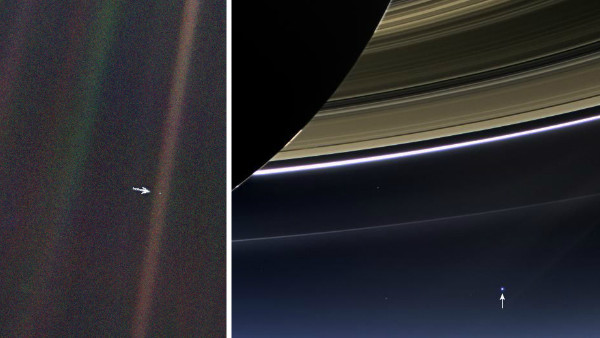
The original Pale Blue Dot image (left) is a picture of Earth taken by the Voyager 1 space probe in 1990 from an incredible distance of 6 billion kilometres as it passed Saturn. The image on the right was taken by the Cassini space probe in 2013.
The Earth appears as a tiny dot, less than a pixel wide, dwarfed by the vast blackness of outer space. The picture was taken at the request of legendary astronomer Carl Sagan, who asked that Voyager 1 turn its cameras around and take one last snap of home before leaving the solar system.
Sagan's reflections on the image in his book Pale Blue Dot are some of the most beautiful and poignant meditations on humanity and our place in the universe. Listen to it below if you're in an existential mood:
11. "View From The Window At Le Gras"
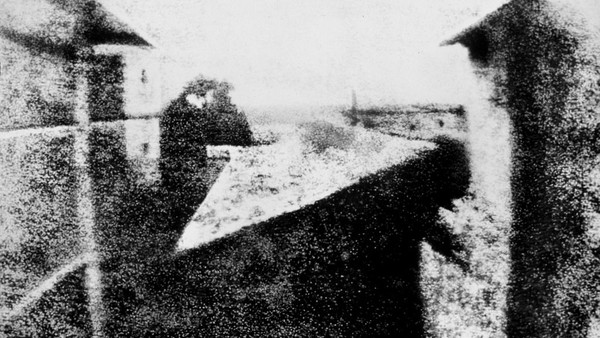
At first glance, this looks like nothing more than a smudgy mess, but this is actually the first photograph ever taken. Look a bit closer and you can make out the sloping roof of a building, a tower, a couple of windows and even a tree in the background.
The image was taken by Joseph Nicéphore Niépce in 1826, from the window of his family home. The exposure lasted a whopping eight hours and the effect was achieved by exposing a bitumen-coated plate in a camera obscura.
Just over a decade later, the first ever photograph of a human was taken, when a man having his shoes shined stayed still long enough to be captured by the lengthy exposure times.

10. Untethered Space Walk

At the time that this photo was taken in 1984, astronaut Bruce McCandless was further out into open space than anyone had ever been - about 100 metres from the cargo bay.
The tiny little human set against the backdrop of black space and the blue of home certainly makes for a striking image.
Although terrifyingly untethered, McCandless was equipped with a Manned Maneuvering Unit (MMU) - a jetpack that works by shooting out jets of nitrogen.
9. Robert Hooke's Flea Drawing
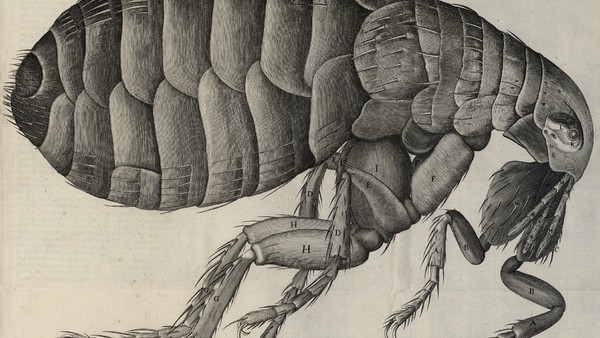
Although seemingly unremarkable now, this drawing of a simple flea definitely blew some minds back in the 1600s.
Before in invention of photography or the widespread use of microscopes, the majority of people simply weren't aware of the levels of detail that occurred on these tiny scales. As far as they were concerned, fleas were little more than black dots that made you itchy.
Robert Hooke's book, Micrographia revealed a hidden, miniature world in exquisite detail. It also casually describes distant planets, a wave theory for light, the organic origin of fossils and coins the term "cell" (as in "plant cell" or "skin cell").
8. Photo 51

We've all heard of Watson and Crick and their great discoveries about the structure of DNA, but none of that would have been possible without this image.
Photograph 51 is an x-ray diffraction image that depicts an actual strand of DNA. It was taken by PhD student, Raymond Gosling in May 1952, working under the supervision of Rosalind Franklin. It gives a good impression of the double helix structure of DNA that is so famous today.
Believe it or not, this grainy image is highly controversial, with many arguing that Watson and Crick essentially stole it from Franklin, used it without her permission and played down her role entirely in their research.
7. Pioneer Plaque

It may not look like much, but the simple illustrations of the Pioneer plaque contain all you need to know about the human race.
The plaque was affixed to the 1972 Pioneer 10 and 1973 Pioneer 11 spacecraft. These probes were the first spacecraft to actually leave the solar system and the plaques are designed to be read and understood by any passing alien that happens to pick it up.
The illustrations of the nude human figures are drawn to scale with a diagram of the probe itself, to indicate our size. The spider-like diagram on the left is a map of our solar system's position, relative to the centre of the galaxy and 14 local pulsars and the diagram of our solar system indicates the origin of the craft.
6. "A Child Is Born"

In 1965, the image of an unborn foetus appeared on the cover of LIFE.
Inside, there was a whole series of breathtaking images to be found, taken by Swedish photographer Lennart Nilsson, chronicling the journey from conception to moments before birth. The images showed the development of bones and blood vessels and even the facial features, but what everybody really wanted to know is how he'd done it.
Although many of the images were taken in utero, some of the foetuses had been surgically removed [...] for a variety of medical reasons.
The twist to this being that the images sparked off plenty of serious debate about the morality of abortion, of a woman's right to choose and the nature of life itself.
5. Sunset On Mars

In 2005, NASA's Mars rover, Spirit, allowed us to glimpse this everyday occurrence on a completely different planet for the first time in human history.
Images such as this allow NASA scientists to determine the composition of the Martian atmosphere. Twilight lasts for many hours on the red planet, due to the abundance of high-altitude dust in the atmosphere scattering the sun's rays long after it has sunk below the horizon, but the thin atmosphere means that the sunsets and sunrises are less colourful that back home.
Perhaps this will be a common sight for future colonists, but for now this is one of the few images of an alien sunset we have.
4. Trinity Site Explosion

Is this a tiny organism? A tumor?
Actually, it's a nuclear explosion.
This image was taken at 5:30am, Monday, July 16, 1945, precisely 0.016 seconds after the nuclear age began. Before the characteristic mushroom cloud forms, this is what a nuclear explosion looks like.
Although it looks as though it was taken through an electron microscope, the top of this bubble is actually already 200 metres high, giving you an idea of the speed and the power of such an explosion.
This image marks the exact moment when the world changed for good.
3. Earthrise

When the first manned mission to the moon, Apollo 8, entered lunar orbit on Christmas Eve, 1968, it beamed a Christmas broadcast back to Earth like no other.
Among the images sent back home was this one, showing the Earth in a way that many had never seen it before. A blue marble suspended in nothingness. Lovell observed "The vast loneliness is awe-inspiring and it makes you realize just what you have back there on Earth."
Seeing Earth from this fragile perspective for the first time is credited with beginning the environmental movements of the following decades and it was features in LIFE's 100 Photographs that Changed the World as "the most influential environmental photograph ever taken."
2. Vacanti Mouse

Although this image dominated debates about genetic engineering in the 1990s, neither the mouse, nor its accompanying ear are actually genetically modified.
The experiment was actually something akin to modern techniques of growing organs in the lab. The "ear" is grown by seeding bovine cartilage into a human ear-shaped mould implanted under the skin.
It was done in an attempt to find a way to grow new body parts for people who have lost theirs, without needing to resort to a prosthesis. Nowadays we can do this in a lab, using the patient's own cells to grow an organ around a scaffold - all without the use of mice.
1. Moon Footprint

This innocuous bootprint has come to represent mankind's ongoing journey off-world.
The boot that created it belonged to the Apollo 11 lunar module pilot, Buzz Aldrin. This wasn't just a casual snap, however, as Aldrin purposefully captured the print to give an idea of the soil compositions on the moon.
Some conspiracy theorists have argued that the print appears to show moisture in the soil, but the sharp, clean edges of the print are actually due to the ultra-fine moondust, which behaves much like talc.
Because the moon has no atmosphere, this boot print will remain there indefinitely as there is no wind to blow it away. It would make a good attraction in the Moon History Museum of the future, don't you think?
Does science make you tingle in your special place? Like us on Facebook or follow us on Twitter for plenty more.