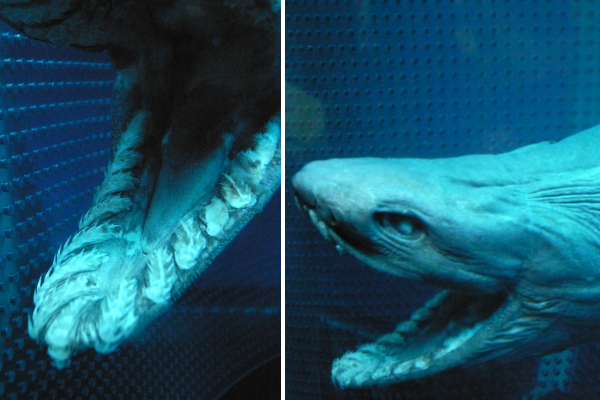
Chlamydoselachus anguineus. Ok, so not strictly found in the deep ocean, more often found above 1000 meters, it does however prefer to live at the bottom of whatever sea or ocean it lives in. They are incredible widespread, having been found off the coasts of Scotland, North West Africa, Brazil, both the East and West coast of the USA and in waters around Japan and New Zealand. They have also been called living fossils as they exhibit a number of features primitive for sharks. Their body more closely resembles an eels' while their heads look like a lizard's, with less of an over bite than the majority of other sharks. This mouth is also huge, capable of swallowing prey half its size whole. Three hundred tiny, needle-like teeth arranged in 25 rows stop the prey from getting out once caught. But the most striking aspect of these fish are their gills. They have six rows of them, the first set of which meet under their chin which is what gives them their name. With this distinct appearance and growing to approximately 2 meters, theyve been suggested as a possible origin for the ancient tales of sea serpents. Based on the stomach contents of caught sharks, theyre known to eat fish, squid and even other sharks. Fish and squid are relatively quick swimmers compared to frilled sharks and unlike devil fish, they dont luminesce. Like most deep sea fish theyre also slow moving. So with no way of attracting or out swimming prey, its unclear how they are able to catch such quick prey. One suggestion has been that their unusual gill structure can be used to create a sort of vacuum to draw unsuspecting prey to them. Whatever their method theyre very successful and so not to be underestimated.