9 Times The Media Tried To Scare Us With Bad Science
5. Phone Masts Are Making People Kill Themselves
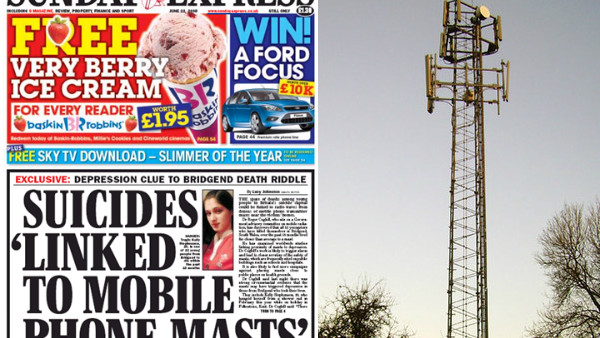
"SUICIDES LINKED TO MOBILE PHONE MASTS" shrieked the front page of the Daily Express, calmly.
The article then goes on to report the link between radio wave exposure from phone masts, and a "spate" of young people committing suicide. The paper says that one Dr Roger Coghill, it would seem, has discovered that all of the 22 people who committed suicide in an 18 month period in Bridgend (sometimes called the suicide capital of the UK) all lived unusually close to mobile phone masts.
Seems pretty solid. Apart from the fact that, after the story broke, Dr Coghill has since said that he would not claim his work as a "study", he has since "lost" his original figures and he isn't actually a doctor. In fact, the claims made by Mr Coghill, MA, don't appear to have been drawn from any kind of recognisable scientific method at all.
At no point were other factors such as socioeconomic conditions or population density taken into account during the "study". It is true that Bridgend has a reputation for an unusually high suicide rate, with the number of incidents reaching their peak between 2007-09.
However, this reputation is made considerably worse by the fact that the suicide statistics take into account the entire surrounding area of 100,000 people, despite the fact that it is often reported as though every instance occurs within the urban population of 39,000. This actually brings the suicide rate much closer in line with the WHO global mortality statistics of 16 annual suicides per 100,000 people worldwide.
Rather ironically, it is sensationalist media, rather than phone masts, that is thought to be to blame for the flurry of deaths by inspiring copycats. Talk about a vicious circle.