This Is What Extraterrestrial Life Would Look Like

Take a look at the daily lives of aliens.
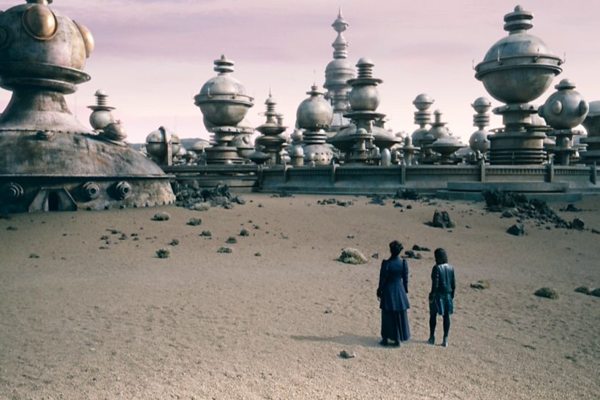
In the year 1600, Giordano Bruno was burnt at the stake for suggesting that there might be other civilisations on other worlds. Nowadays, the first person to prove Bruno right will probably be given a Nobel Prize. The thing is about trying to find alien civilisations is that they're a bit, well, alien. We can't really be sure what we're looking for. Despite this, some of the world's boffiniest of boffins have had a good go at predicting what the daily lives of extraterrestrials might look like and, from the sound of it, those boffins have watched a lot of sci-fi. Unfortunately, as the experts were trying to figure out just what we're looking for in the search for aliens, they have inadvertently come up with a list of reasons as to why we'll never contact them. Many of these visions of alien society would mean that either the aliens are too advanced to give a damn about us, or too concerned with their own business to bother. Oh well, it's still fun to imagine, right?

8. Type I: Planet Masters

Right, to kick everything off, there's this thing call the Kardashev Scale. The Kardashev Scale is a way of sorting different levels of civilisation into rough categories - Type I, Type II and Type III - and it's all to do with where you get your energy from. A Type I civilisation is a planetary civilisation. That is to say, they are able to harness all of the energy available to them on their home world. This would include large scale fusion power, the harnessing of anti-matter and renewable energy such as wind, solar and hydroelectric. Fossil fuels don't count as they're unsustainable. A Type I should also really have taken control of the weather systems on their planet and geological activity (that's volcanoes, earthquakes and so on). Want rain? Just hit a button. Don't fancy that Earthquake? Pull that lever. Of course, non of this can be achieved unless you've got a stable, global government, as opposed to a few individuals sitting on their separate bits of rock and aiming nukes at each other. Now, as a beady-eyed, quick-witter reader, you may have spotted that this means that the human race is not yet a Type I civilisation, and you'd be right, as we're probably more in the region of 0.8. Not to worry, though, as many experts think we'll probably hit the Type I milestone in the next hundred years, so there's that to look forward to.

7. Type II: Star Killers

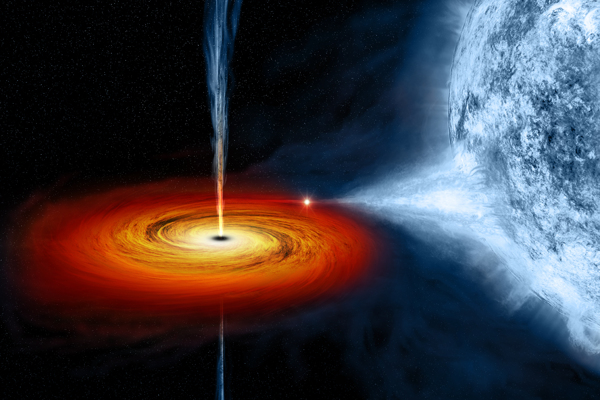
Seeing as a Type I civilisation is most people's idea of an advanced alien race, Type II are on a whole other level. Type II aliens would not just use the energy on their planet, but in the rest of their solar system. They might gather every last drop of energy for their sun using a Dyson Sphere (more on that later). They might have star-lifting tech - a process of removing a chunk of a star's matter and using its energy. This process would also generate a lot of "spare" antimatter that you could essentially recycle. Another, infinitely more badass, way of generating energy is to feed a star into a black hole and harvest the energy that pours back out of it. This would make boiling the kettle either way more exciting, or way more harrowing, knowing that a star died for you to make your morning coffee.

6. Type III: Space Gods

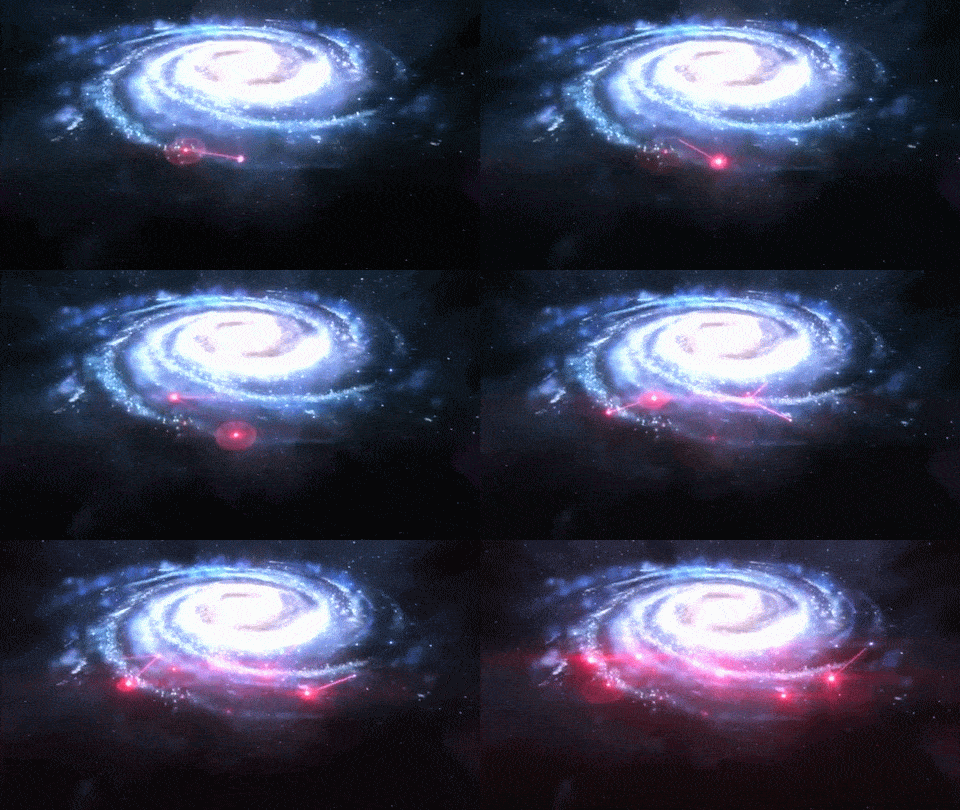
A Type III civilisation is frankly off the charts, they would basically be a master race of their galaxy. Type III designation would use all of the techniques deployed by Types I and II, but would also be able to make use of the energy from the supermassive black hole at the centre of their galaxy (it's thought that most galaxies have one). As well as this, they would be able to harness the power of gamma-ray bursts, which are the brightest things in the known universe (to us puny humans at least) mainly thought to be caused by incredibly massive stars going hypernova (you'll notice, by the way, that the more we get into this, the more sci-fi the language becomes, but it's all real science). They would be able to capture energy from quasars and even White Holes - a theoretical object that is essentially an inside-out black hole that would boot out a hell of a lot of energy. This practically unlimited energy supply, coupled with their technological prowess, would mean that they would probably think nothing of manipulating the very fabric of the universe, perhaps creating wormholes, nipping between dimensions and god knows what else. As you can imagine, the actual members of this civilisation would be so mind-bogglingly advanced compared to human, that neither of us might actually recognise the other as a life form.They might be cybernetically enhanced, perfect, self-replicating AI, they might be composed of sentient gas, who knows. Even talking to them would be tough. For them, it would be like trying to explain the offside rule to a rabbit, for us, it would be like trying to hold a conversation with thunder. The Kardashev Scale originally stopped here, but there are some who reckon there could be a Type IV civilisation living inside a supermassive black hole somewhere.

5. In A Dyson Sphere

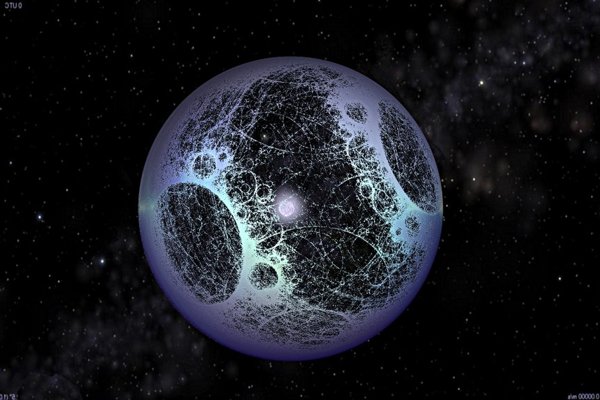
Right, so lets dial it back a bit from black hole-dwelling master races and get back some more familiar ground. In October of 2015, scientists thought they might have spotted some kind of "alien megastructure" around an alien star and suddenly everyone was talking about Dyson Spheres - but what actually are they? A Dyson Sphere is basically a huge structure around a star used to collect as much energy as possible. Our alien chums could even be living on it if their home planet became to inhospitable, in an interconnected network of power stations and habitation zones. Despite the sci-fi depiction of a Dyson Sphere as a big old shell encompassing a star, there's no reason why it should be a solid structure. It could be made up of a swarm of artificial satellites forming a kind of biosphere around it. Incidentally, this is closer to what Freeman Dyson, the guy who kicked off the whole sphere hype in the first place, meant. Whether or not this is what we spotted around a distant star, it could well be something that is on the cards for the human race at some point in the future, if we can get it together for long enough to build one.

4. In A Virtual Reality - The Matrioshka Brain

Another idea for how aliens could be living, is in something called a Matrioshka Brain (although it's highly unlikely that that's what the aliens call it). This theory is particularly interesting because it goes some way to explaining why we haven't been contacted by any little green men yet. A Matrioshka Brain is essentially an enormous computer with immense processing capacity. It is similar to the Dyson Sphere in the sense that it would require the energy of an entire star to power it, but it would also have the consciousnesses of an entire alien race uploaded to it. This would enable them to live in a perfect virtual reality as part of the computer programme. There are even some, in the slightly nuttier parts of the internet, who think that this could already be the case for us. Although, don't know about you, but if this was a giant computer simulation, whoever programmed it had a pretty dark sense of humour.

3. On Interstellar Generation Ships

Stepping outside that pesky box for a second, there's no reason why aliens should be living around a star at all. A Generation Ship, or Interstellar Ark or whatever you want to call it, is basically a starship that travels in open space, either on its way to a specific location such as another habitable planet, or just drifting through space. In the absence of faster-than-light travel, these kinds of arks are pretty much the only conceivable way anyone could explore the galaxy - the Milky Way is 100,000 light years across and so would take millennia to explore just a small part of it, even at light speed. The generation ship would be crewed by successive generations of a civilisation and would essentially become a huge, roving planet. For a civilisation to thrive on a generation ship, it would have to be a self-sustaining habitat with no need for external input. The society itself would have to be extraordinarily stable as mutiny in deep space is probably not a pretty sight. It's also entirely possible that a ship like this could kick-start a whole new branch of evolution, meaning that if humans ever embarked on a round-the-galaxy mission in one, they might not be humans by the time they got back.

2. All Around Us (In A Different Dimension)

https://www.youtube.com/watch?v=iiWKq57uAlk We spend most of our time pointing our telescopes at dim, distant objects in the sky, in the hope that one day we'll see a little alien waving back (that's how astronomy works, right?) However, there is a theory floating around that the aliens could be all around us, just in a different dimension. This is also another contender for the "reasons why we haven't been contacted" category, as it's pretty difficult to communicate across dimensions. The interdimensional hypothesis is commonly used by Ufologists as a way of explaining how alien spacecraft can appear to wink in and out of existence (don't let that put you off though). To consider another dimension, you have to think about moving in another direction in addition to up, down, left and right. It's quite difficult to get your head around what a four-dimensional projection into three-dimensional space would look like, you would essentially see a three-dimensional cross section of it moving and shifting through space. The best way to think about it is to scale it back to the second and third dimensions and imagine what it would look like to a two-dimensional being if you put your hand through the 2D plane that they live on. The venerable Carl Sagan explains it in the video above. The interdimensional hypothesis gets a bit muddied by everybody from ghost hunters to theoretical physicists using it to try to understand the universe. Could it be that the aliens are all throwing big, four-dimensional parties without us?

1. Primordial Soup

Let's be honest with ourselves here, as much as we'd love to find a whizzy alien race with star-mining technology and awesome spaceships, but if we do ever find them, the chances are that they'll be in the form of microbial sludge. Soz. Hey, we've all got to start somewhere. We were all microbial sludge at one point (go into any city centre on a Friday night and you might conclude that we haven't moved on much) and now we have arms and legs and faces and spaceships. Just give it a few billion years and we could finally get our civilised alien race, even if we did have to wait a bit for them to grow up. It could be that one day in the far distant future, those little microbes will have grown up into walking, talking life forms and will look out to the stars and see one of our super-advanced generation ships fly past. Want to write for What Culture Science? Click here to find out how you could get paid to write about what you love.Love all things science? Like us on Facebook or follow us on Twitter for your next fix.

 
First Posted On: 
Contributor
Contributor

Writer. Raconteur. Gardeners' World Enthusiast.