10 Hidden Easter Eggs In Batman The Animated Series
DC's classic cartoon featured nods to the wider DC Universe, but also to... Stephen King's IT?!

Batman The Animated Series redefined the quality of animation in the nineties. It raised the bar for animated television from that point on, with the X-Men animated series taking both inspiration and building on it as well. It was an incredibly well designed and well plotted show - but one with plenty of room for the animators to play with the form.
(Oh, and could they bring this show back now? Please? Asking for millions of friends.)
There were many little (and not so little) Easter Eggs dotted throughout the run of the show, with many going on to lay the groundwork for the wider DC Animated Universe that would follow.
Some of these are obvious nods to the history of Batman and the lore that surrounds the character, while others were simply added at the seeming whim of the producers. There are clever and fun nods to many other properties - and Hollywood history - that allow the viewer to have a bit of fun searching for them.
Here are 10 Hidden Easter Eggs in Batman The Animated Series...
10. Joel Schumacher

In an episode of The New Batman Adventures (the redesigned final season of BTAS), Joel is a young boy who lives in Gotham City. In the episode Legends of the Dark Knight, three young children are telling different stories about the Batman, with each of them depicting him in a different manner.
The late Joel Schumacher re-imagined Batman for the nineties with Batman Forever and Batman & Robin. Like them or loathe them, they have an instantly recognizable style. Young Joel in this episode, who is standing outside the shoemakers store, talks about hearing rumours that the Batman wears rubber suits and has a car that can drive up walls - both of which come straight from Schumacher's movies.
While the other children laugh at his suggestion, it is done with a good humour rather than a pointed insult. Joel had his style and it is certainly honoured here!
9. Tim Burton

Poor Twitch!
In the episode Off Balance (which will feature again on this list), the story opens with Batman meeting one of his underworld informants, Twitch, at the top of the statue in Gotham's harbour (one that bears a striking resemblance to a certain Lady Liberty). Poor Twitch doesn't last very long, as he is unable to tell Batman all that he knows before two assassins arrive and toss the man into the murky waters below.
Twitch's appearance was based on director Tim Burton, who had just completed and released Batman Returns. This film, along with his first film in 1989, had an enormous inspiration on the look and feel of the animated series overall. Though he was not named as Burton, Twitch's appearance and mannerisms are somewhat difficult to ignore once you see them.
This would not be the only time a Batman director was gently parodied in the animated series. In fact, it seemed that the show had a fairly good humour about how they depicted people overall, not least with Burton and Schumacher, who has already appeared on this list. The show's own producers appear in quiet cameos throughout the run of the show as well, with Bruce Timm being unlucky enough to have an address in Crime Alley, as seen on a mailbox next to Dr. Leslie Thompkins.
8. The Shadow

In the episode Beware The Gray Ghost, Bruce Wayne remembers watching an old serial that he used to enjoy, starring the eponymous Gray Ghost - a noir style, crime-fighting costumed vigilante. More than a small amount of inspiration for what Bruce would grow up to become originated here.
Bob Kane, co-creator of Batman along with Bill Finger, took inspiration from old serials about The Shadow. According to The Steranko History of Comics, Vol. 2, he said in the early seventies that the very first Batman story was inspired heavily by a Shadow. The Joker's laughing gas was also inspired by a Shadow radio serial, The Laughing Corpse.
The Gray Ghost is the animated series homage to The Shadow, with the design heavily based on the appearance of the Shadow, while almost emulating those early serials. However, this easter egg is mashed together with a nod to Batman lore itself.
The Gray Ghost is voiced by none other than Adam West, the Batman of the sixties. He plays both an actor who is down on his luck and hoping for another shot, with a hope for a simpler time mixed in as well. The entire episode is a loving nod back to the early days of comic and comic related storytelling.
7. Batman Finds A Psycho

Batman suspects that Detective Bullock has something to do with the disappearance of an informant. Spider Conway was due to receive early release in exchange for testifying against Rupert Thorne (I give him a week, tops) and is taken away by a mysterious assailant as his ships approaches the Gotham City docks.
Batman overhears Bullock and Commissioner Gordon speaking, both of whom are conscious that Conway's testimony could bring up a lot of ugliness from the past. Intrigued and suspicious, Batman breaks into police headquarters and rifles through the files on Bullock, thumbing through the B's to get there.
One name stands out for anyone who has seen Alfred's Hitchcock's Psycho, as BATES, N. is clearly legible on one of the files.
Major spoilers for that film ahead, so if you somehow haven't yet seen it, best look away now.
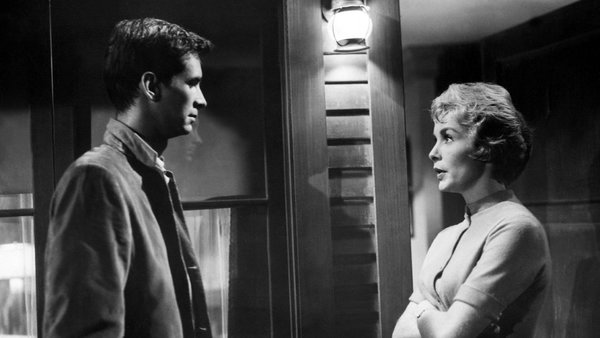
Norman Bates is of course the Psycho in question, one who was clearly deemed so dangerous that all police precincts received his file.
This is worrying - perhaps there were also a rash of shower murders in Gotham City? Who is to say? All that can be clearly determined by the episode's end is that, unless Norman Bates developed a very bad skin condition, and was suddenly able to bite with the ferocity of a Crocodile, he probably wasn't involved in this particular case.
Next time, Batman!
6. Citizen Kane

In the episode Harley and Ivy, the two villainesses team up, although it is quite accidental to begin with. Harley is attempting to break away from Joker, which leads her to attempt to plan a heist on her own. She runs into Poison Ivy, before both are quickly surrounded by the Gotham City Police Department. In an uncharacteristic show of solidarity, Ivy offers to help Harley escape.
Together, they jump into her custom pink car - with the registration Rose Bud.
Citizen Kane is widely regarded as one of the greatest movies ever made. It is the rags to riches tale of Charles Foster Kane who, on his deathbed, calls out for only one thing - Rosebud.
I won't spoil who or what Rosebud is, just in case, but suffice to say it is a key element of Kane's life. Poison Ivy, of course, lives a life that revolves around greenery and botany in general. For her, Rose Bud is not just a catalyst for her actions. It could almost be the name of her very soul, so to have this licence plate is more than just a visual gag to enjoy. It speaks to her character's beginnings and life overall, with Rose Bud then becoming her very means of escape.
She and Kane may be different in many ways, but they both have a ruthless streak shared by few.
5. Rossum's Universal Robots

Here we have another licence plate serving as an Easter egg, though this is both more subtle and even more brilliant than the Rose Bud gag on Poison Ivy's car. In the episode Heart of Steel part one, Randa Duane is the name of the lady driving the car, with this plate serving as an extremely subtle spoiler for what is to come.
The episode revolves around the creation of H.A.R.D.A.C., a sentient AI. Karl Rossum is a retired Wayne Tech employee, who specialised in the field of robotics. After a theft at Wayne Enterprises of computer chips that would allow a computer to become self-aware, Lucius Fox advises Bruce that speaking to Rossum would make sense. What Wayne ends up discovering is much more than he anticipated.
The licence plate RUR is a reference to Rossum's Universal Robots, a play that was written by Karel Čapek in 1920, premiering in 1921. It has gained notoriety for introducing the word 'robot' to the English language.
The robots in the play are not the robots in modern understanding, but rather artificial biological constructs that may be mistaken for humans. Along with the RUR licence plate, both the play and Heart of Steel bear many resemblances to Blade Runner. William Sanderson, who provides the voice of Karl Rossum in the episode, also portrayed J.F. Sebastian in this film as well - which of course featured the Nexus 6 Replicants, a design of android that were almost identical to humans.
4. Axis Chemicals And Star Labs

In the episode Nothing To Fear, the audience is introduced to Jonathan Crane, aka The Scarecrow, for the first time. He is the villain that experiments on his victims with his nightmarish fear toxin - a gas that forces people to see their worst fears made real. While on the trail of the madman, Batman conducts a background search in the Batmobile.
On the screen, several previous connections to Crane come up, including two that are very recognisable to comics fans. AXIS Engineering is the first name on the list. This is a direct reference to Tim Burton's Batman 1989, wherein Jack Napier had his fateful encounter with Batman. After being accidentally shot in the face, Napier falls into a vat of chemicals in Axis Chemicals, emerging as the Joker.
Further down the list, Star Labs appears. Star Labs is a famous lab from Superman's stories, based in Metropolis. This is its only mention in Batman's animated series, but it has appeared in several episodes of Superman, Justice League and Justice League Unlimited, which share the same continuity in the DCAU.
3. Pennywise Lives In Gotham

In the episode Be A Clown, Jordan, Mayor Hill's son, decides that he's had enough with his overbearing father, as he simply wants to be a magician. The clown that is hired for his birthday party (honestly, sidebar for a moment: why would ANYONE in Gotham ever hire a clown? When has it ever ended well?) is also a bit of a magician, who then fascinates Jordan with his tricks. Alas, as this clown is leaving, a bomb detonates out of the birthday cake.
The clown, of course, is the Joker, who has entertained himself once more by bringing havoc to the people of Gotham. However, there is a small problem in his plan - Jordan has stowed away in the boot of his car, wanting desperately to join him and learn his tricks. The Joker sees the possibility for both an apprentice and an easy victim.
Batman tracks them down and a chase through Gotham's abandoned amusement park (again, why is there one of these? Bulldoze it!) which brings Jordan face to face with a laughing robot clown - voiced by none other than Tim Curry.
Curry had originally been cast as the Joker in the animated series, but was later replaced by Mark Hamill. While there is no denying that Hamill is iconic as the Joker, there is an intriguing 'what if?' quality attached to Curry. The laugh that comes from this clown is a taste of what could have been if the voice of Pennywise had stayed in the role.
2. The Invisible Link

This one is something of a back and forth through time, which has only gotten better as the years have passed. In the episode See No Evil, the episode features a villain who can make themselves invisible. There are many references to classic universal horror movies featuring the Invisible Man, with more than one allusion to his growing insanity, due to the chemicals that have been absorbed into his system.
However, that is not the Easter egg I'm mentioning here. In fact, the Easter was entirely unintentional, and only became an egg with the release of Blumhouse's rebooted Invisible Man film last year.
The connection between both stories is Elisabeth Moss, star of The Handmaid's Tale and Mad Men. She is the lead in The Invisible Man, and also voiced Kimmy Ventrix in the animated series.
Ventrix is the daughter of Jimmy Ventrix, the man who has stolen this invisible technology. The entire episode now feels as though it had been predestined, adding to the overall enjoyment of the episode, along with the Blumhouse film as well.
Seriously - what a wonderful way for things to play out!
1. Vertigo

Alfred Hitchcock returns to this list with one of his most famous films, Vertigo. In the episode Off Balance, which featured earlier on this list of Easter Eggs, another homage appears in the close of the episode, one that seems to be directly referencing the great Hitchcock film. In the climactic battle with Batman, Count Vertigo plunges from the top of the tower to his death.
There is a shot from inside the tower which sees him passing a hole in the wall on his way down. This is an almost exact recreation of a similar scene from Vertigo, wherein Madeline, played by Kim Novak, seemingly falls to her death. Scottie, played by Jimmy Stewart, is paralysed by his acrophobia and is unable to help her - simply watching her fall through a gap in the wall.
The name of the character of Count Vertigo aside, this is a clear and loving recreation of the scene in animation, proving once again that it is possible to have an Easter egg in the show that may not be immediately obvious on the first glance, but when dug into a little deeper, shows the lengths and extent that the animators went to when lovingly constructing DC's most iconic comic book cartoon.
Watch Next
You'll Never Be Able To Name All Of These Batman Villains!
