10 Reasons To Greenlight Star Trek: United NOW
It is a time of uncertainty for the Star Trek franchise - we need something to be United around.
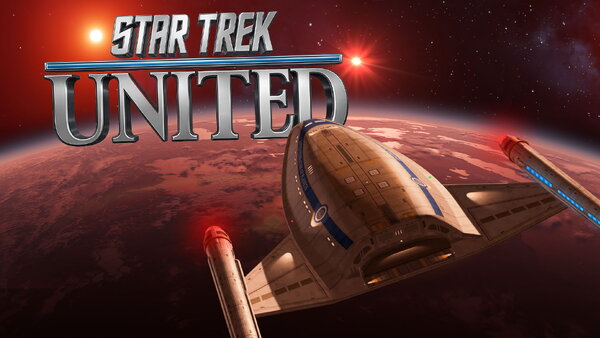
Every so often, a news item cuts through the subspace noise and sends a shockwave through all of Trek fandom. Last August at Creation’s STLV convention, Scott Bakula casually stepped onto the Las Vegas stage... and broke the internet. In response to a fan’s question, Bakula revealed that he, along with veteran Star Trek writer-producer Mike Sussman, had developed a pitch for a potential new series called Star Trek: United.
Set during the early days of the Federation, this Enterprise spinoff would see Bakula reprising his role as Jonathan Archer, now as President of the United Federation of Planets, the alliance he helped forge.
The reaction, to put it mildly, quickly grew legs. The existence of this fully-developed series concept starring one of the franchise’s most beloved and bankable actors launched fans into high orbit, and many of them still haven’t come down. The question now: has the studio, which has been consumed by billion-dollar merger talks, been paying attention?
In this “Memo to Paramount,” we’re making the case that the answer to Trek’s TV future may be right in front of them. With no new Trek series currently in production in this, the 60th anniversary year of the franchise, there is a gap in the market that needs to be filled.
Uniting behind this idea seems the perfect next step for Paramount.
10. 25th Anniversary Celebrations

Star Trek: Enterprise debuted in 2001, originally airing without any competing Trek series alongside. While Deep Space Nine had arrived during The Next Generation's penultimate season, and Voyager spent several years overlapping with the former, Enterprise was out there on its own. Sadly, while it had a strong start in terms of numbers, those viewing figures dwindled over its four-year run.
However, while there were several contemporary reasons for this, the show found a new life when it arrived on streaming. This, when combined with much of the cast's ongoing visibility and popularity, has led to a reassessment of sorts for this prequel series. As it turns out, Enterprise was never bad; it simply arrived at the wrong time.
2026 sees the 25th anniversary of Broken Bow, with celebrations planned for the Trek to Vegas convention in Las Vegas. While Star Trek: United would not necessarily be a revival of Enterprise in the strictest sense, it has quickly found itself tied to the overall Enterprise discussions.
In terms of timing, now seems the best time to strike forward with United. Starting any show comes with myriad difficulties, not least of which is securing an audience from the beginning. This struggle is all too common, as the recent Starfleet Academy experienced during its debut season. With so many eyes focused on Enterprise this year, there may never be a better time to begin production on a show that features at least one (if not more) of the original cast.
This is, effectively, a case of strike while the iron is hot. Paramount and CBS are, to put it bluntly, floundering when it comes to Star Trek right now. This could also go a long way to mending some very burnt bridges.
9. Let's Talk About Ships, Baby
Flagships, Romulans, and Aenars, oh my!
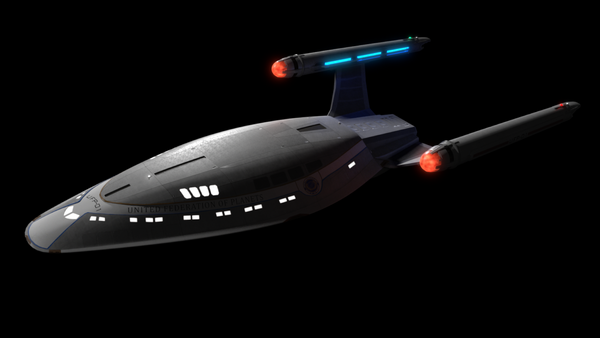
Star Trek: United already has one of the crucial requirements for any Star Trek show: its own flagship.
Federation One: an Envoy-Class consular vessel. This civilian ship has the registry: U-F-P-Zero-One. It was designed by Star Trek concept artist Andrew Probert (he of Picard’s Enterprise-D and Kirk’s Motion Picture refit), who reached out to Mike Sussman after hearing the buzz around United. The brief resembled Air Force One with a pair of ample nacelles. This design was further brought to life in three dimensions by Emmy award-winning visual effects artist Robert Bonchune.
Federation One has another trick in its arsenal. She's two ships in one, with the upper section detaching from its warp sled, inspired by Spock's shuttle in The Motion Picture, suited for planetary landings.
With President Archer now mobile, the show could help to shed light on some of the greatest missing chapters in Star Trek's history. First of which is, of course, the Earth-Romulan War. This is a conflict never depicted in a film or series, yet it is so significant that it shaped galactic politics for centuries to come. As Sussman says:
The way I see it, the series would open with a flashback to a battle set during Enterprise’s sixth year out of spacedock — a season we never got to make. We’re aboard the NX-01 in the thick of the Romulan War. That immediately tells the audience: we’re finally giving you what we promised.
Sussman also promised his series would finally answer one of the franchise’s most enduring mysteries: why did no one in Captain Kirk’s time, a century later, know what a Romulan looked like? According to Sussman, it’s not a plot hole — it’s a story waiting to be told.
8. Bakula Where He Belongs
William Shatner returned in Starfleet Academy (the game!), Patrick Stewart returned in Picard, and Kate Mulgrew returned in Star Trek: Prodigy. We may never truly see the return of Avery Brooks to Trek in live-action, yet if there is something that Star Trek fans enjoy, it's a good old returning commander.
Scott Bakula hasn’t stopped working since Enterprise left the airwaves. For seven seasons, he anchored his own NCIS spinoff on CBS. He recently played Abraham Lincoln on stage — a wartime leader trying to hold his fragile union together, not unlike a former Starfleet captain.
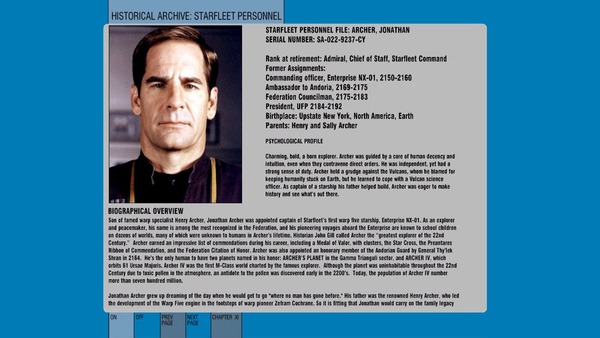
And by total coincidence, Bakula is right now the same age Jonathan Archer would be at the start of his presidency — as established in a biographical display seen in Enterprise’s In a Mirror, Darkly, Part Two.
When asked in interviews about a potential return to live action, Kate Mulgrew expressed her opinion that she would be open to it if there was a reason for it to happen. No vanity projects, in other words. Whether this was a gentle jab at Star Trek: Picard specifically, or a simple reading of the numerous legacy sequels and spin-offs that have popped up over the last two decades, is unknown. However, she raises an excellent point.
The world could simply be delivered Enterprise season five, and the audience may even enjoy it. However, United seems designed to take a version of Archer who has grown, not just in years, but in wisdom and experience. The third season of Enterprise saw a man pushed to his limits, breaking rules he had never believed possible. Scott Bakula more than delivered on this in the early 00s.
Now, in 2026 and beyond, United promises a character with twenty years of growth and pensieve rumination, played by an actor who has only continued to work and develop in the intervening years. While Picard was not without many positives, it ultimately settled back into fan service. United must both offer and deliver, evoking the past without simply rehashing it.
7. Salvation For Characters From A Cancelled Network
Why greenlight a spinoff of the first Trek series to be cancelled since The Original Series was pulled off the air, twice? This is both a very fair question and one that also deserves a deeper examination. Context, as they say, is king. True, Enterprise suffered ratings erosion over its four-year run, as did Voyager and Deep Space Nine, though both of them were granted seven seasons.
Ah, seven seasons. Remember them?
Enterprise went through several prescribed changes during its run, including a push to become more action-oriented (hello, Xindi arc), and the inclusion of Star Trek in its name. That did not, however, prevent UPN from pushing it into the Friday night 'death slot', i.e. 10 pm. During the production of In A Mirror, Darkly, the cast and crew were informed that Star Trek: Enterprise was being cancelled.
Enterprise debuted on UPN, much like Voyager had been. However, the UPN that Enterprise arrived on was quite different seven years later. While Deep Space Nine was sold into first-run syndication on its debut, as The Next Generation had also been, and Voyager was instrumental in launching UPN as its flagship show, the landscape had changed.
Not long after pulling the plug on Enterprise, UPN merged with The WB network to form The CW. The network may be gone, but Enterprise lives on, finding new audiences every year on streaming.
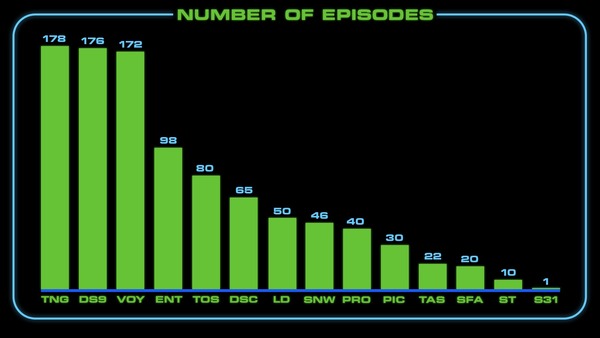
Enterprise produced 98 hours of television, spread over its four seasons. When compared to the Trek series that have come and gone since 2017, it has delivered more individual episodes than any of the shows that followed, including Discovery, Lower Decks, and Strange New Worlds, all of which have had, or will have had, five seasons to tell their stories.
While the fourth live-action Star Trek spin-off may have been cut short, it was far from a failure.
6. And The Children Shall Lead
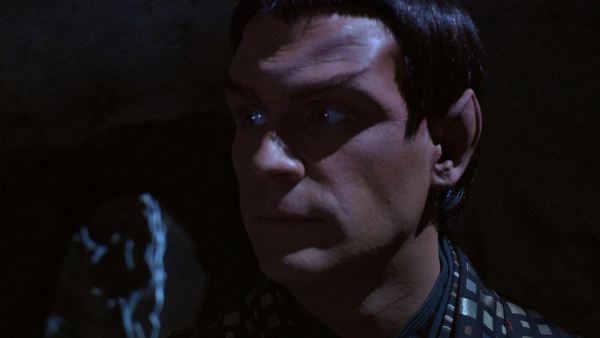
Mike Sussman has been liberal with the details that would help build Star Trek: United, with the focus on Archer's children being among them. Starfleet Academy received unfair criticism for focusing on its younger cast in marketing, which, while frustrating, should still be a lesson if United receives the greenlight.
Camilla, Gus, and T'Var are described as extensions of, as well as variations of, Archer himself.
When The Next Generation was announced in the late 80s (how's that lower back treating you? Mine's acting up again), it was met with waves of derision from some long-time Star Trek fans. Think of all the critiques recently aired about Academy, swap the show title, and you're nearly there.
So, why greenlight a show that would quite deliberately focus on Archer's next generation?
The first word that comes to mind is ensemble. Star Trek has always been at its strongest when it has successfully utilised the extended cast. Deep Space Nine may be the greatest example of this, yet the entire bridge crew of The Next Generation remains one of the most popular collectives in the franchise.
Archer may be the centre of gravity in United, but Sussman promises that much of the drama would come from the ensemble around him, primarily his three adult children. Archer's daughter Camilla experiences a calling to public service, while her twin Gus would take a different path, electing to serve in Starfleet.
Their brother is T'Var, rescued as an infant during the Romulan War, now working in Federation intelligence. A Vulcan raised by humans, he ends up in the crosshairs of Talok, that deep-cover Romulan operative first introduced in Enterprise, played again by Todd Stashwick. Stashwick, these days, is perhaps better known to Picard fans as the irascible Captain Shaw of the USS Titan-A, and has made no secret of his interest in returning to the role.
With a cast of characters who are as compelling as the returning Archer himself, there lies the groundwork for a show that deserves to stand on its own, rather than falling into any fan service pitfalls.
5. As The Lights Come Down On Starfleet Academy, United Holds A Candle Of Hope
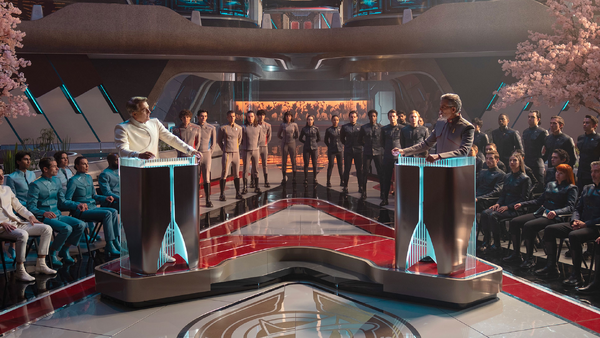
When studio executives initially passed on United, the stated reason was overlap with the then-in-development Starfleet Academy. The latter, we know now, was a combination of planet-based and space-based, with the USS Athena serving as the new campus for the eponymous institution. United promised to differ from the standard Star Trek formula (i.e. it wasn't going to be set entirely in space).
One could be forgiven for assuming at the time that both projects were similar in how they would differ from the Star Trek iterations that had gone before. While they would be correct to think they'd both be different, the assumption that both shows were the same was wrong.
While Academy was set partially in San Francisco, the plan for United would not unfold in Paris (the future home of Federation Headquarters) but on the planet Babel, the centre of interplanetary diplomacy, introduced in The Original Series episode Journey To Babel.
That episode famously introduced Mark Lenard's Sarek, with the character later returning in Star Trek: Discovery, now played by James Frain. A younger version of the character would appear in United, adding another bridge between this show and the Trek that has come before.
However, as previously discussed in this article, the inclusion of legacy characters would not and should not be the focus behind greenlighting this show. There is a logistical and financial consideration to this: new audiences. A show that is a spin-off or continuation from a previous series runs the automatic risk of alienating new viewers who have not seen Enterprise (or any Star Trek).
Sarek, T'Pol, and even Shran may be excellent draws for returning fans, though they may not be a draw for newer sets of eyes.
4. Memberberries Are Dessert, Not the Meal

So, will it be Star Trek: Enterprise 2? Of course, United should and would honour what came before. Sussman has said he’d like to open the series with a flashback featuring the entire crew of the NX-01, digitally de-aged and together 'one last time'. This immediately makes us wonder if the show would address that last-minute death in These Are The Voyages?
Would Trip Tucker be alive and well aboard the ship still? If so, how would this reconcile with the events of one of the most reviled finales in Star Trek's history? To temper expectations, Sussman says it’s unlikely anyone from the old show would be a series regular, though he’s open to a legacy character becoming part of the ensemble if there’s a story-driven reason for it.
The fate of at least one Enterprise character is already well-documented: the NX-01 herself. Decommissioned around the founding of the Federation, she’s likely already a museum piece by this era — as later glimpsed in Star Trek: Picard. Would the version we see in United sport the secondary hull, envisioned by designer Doug Drexler for the long-lamented fifth season? Quite frankly, this seems to be at least one solid requirement of the show. Federation One may be the hero ship on which President Archer travels the stars, yet there is nothing to suggest the NX class has been retired.
The NX class also has the distinction of featuring in almost every iteration of Trek since its first appearance. A model of the ship sits on Admiral Marcus's desk in Star Trek Into Darkness, with another model on display in Chancellor Ahke's office in Starfleet Academy. The original ship appears in Star Trek: Picard. It receives several mentions in both Discovery and Strange New Worlds, as well as appearing on a display in Star Trek: Prodigy.
3. Politics Versus Preaching
Here’s the thing about Star Trek that sometimes gets lost in conversations: Gene Roddenberry didn’t create it for the cool starship battles. He created it because he had things to say, about race, war, nationalism, and power. Network television in 1966 wouldn’t let him say those things openly on TV, which led to his first series, The Lieutenant, being airlocked after just one season.
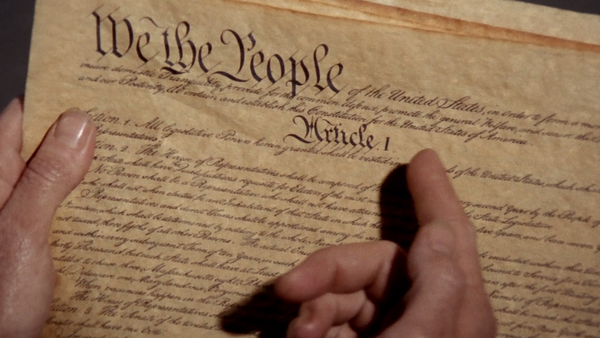
Roddenberry set his next show in outer space. Vietnam became the planet Neural. The Russians became Klingons. The Yangs and Kohms had their own copy of the U.S. Constitution. We never said that Roddenberry was always subtle.
That’s always been Trek’s superpower: telling political stories in its own unique language. And it’s a tradition United would strive to embrace. Perhaps one may be familiar with the quote 'If you have a message, call Western Union' (which has been attributed to Samuel Goldwyn, Moss Hart, and Humphrey Bogart, depending on the source). Roddenberry’s genius was finding a way to send the message anyway, wrapped in gold velour and aluminium foil so nobody noticed until the credits rolled.
United needs to do the same. The proof of concept already exists, though it was told a long time ago, in a galaxy far, far away. Andor showed that science-fiction audiences are hungry for dramatic depth and moral complexity. If that worked for Star Wars fans, imagine what it could do for Trekkers who’ve been asking for exactly this kind of nuanced storytelling for decades.
2. Let's Talk About The T'Pol In The Room

We have made no secret on the channel of our enduring love for T'Pol. The Ups & Downs for Star Trek: Lower Decks' episode Fissure Quest were a love-letter to Jolene Blalock, delighted as we were for her very unexpected return to Trek.
While yes, any extension of Star Trek: Enterprise would offer an opportunity to see T'Pol in live action again, expectations should and must be tempered. We want her back, yet the likelihood dwindled some time ago.
In an interview with TrekMovie, John Billingsley spoke about the lack of contact between the cast and Blalock in the years that followed Enterprise's cancellation. Though she did make an appearance at the Star Trek Day celebrations in 2021, which in itself spurred a whirlwind of rumours about a return, it was simply that: an appearance. Mike McMahan reached out to her after this to invite her back for that cameo, yet as TrekMovie points out in their article, she didn't take part in any of the press surrounding the episode.
TrekCulture has for years hoped for a T'Pol cameo in Strange New Worlds. While one hundred years later in the universe, what is a century to a Vulcan? To date, there has been no appearance, nor a flashback to Enterprise's era, despite several references to the earlier show dotted throughout.
So, greenlighting United must not be predicated on the hope that Jolene Blalock will return to the role. Having said that, greenlighting United now would at the very least provide a platform for the entire cast to return, should the correct story arise.
Eighteen years passed between Star Trek: Nemesis and Star Trek: Picard, twenty between Star Trek: Voyager and Star Trek: Prodigy, and now twenty-one years between These Are The Voyages and today. Actors like Connor Trinneer, Dominic Keating, John Billingsley, and Anthony Montgomery remain active on the Trek social and convention circuits, while Linda Park and Jeffrey Combs are frequent guests at conventions and cruises.
The cast may not be getting any younger. While United may never be a sequel to Enterprise in the strictest sense, the time is very much now to get this cast into a scene together, albeit perhaps for the last time.
1. A Star Trek To Unite Us

At a time when the fandom has rarely felt more divided, United offers something we sorely need: a reason to rally around the Federation flag again. The hope is that this is a show with something for every kind of Star Trek fan. The Next Generation lovers get a focus on principle, diplomacy, and the responsibility of command. Deep Space Nine fans get political intrigue, uneasy alliances, and a deep-space setting where anything can happen. And The Original Series diehards get the mythic Federation taking shape — the world Kirk will one day inherit.
For older fans who love legacy characters, United gives you Jonathan Archer and Shran, old warhorses with history, scars, and unfinished business. For younger fans looking for a generation to call their own, the show offers fresh-faced Starfleet officers, untested diplomats, as well as Archer’s youngest daughter, described as half-human. As a child of two worlds, she’s one of the first born into a time when the lines between species are starting to blur.
Gene Roddenberry gave us a Federation that was built by aliens who often didn’t like each other and, sometimes, even tried to kill each other. But those species put aside their differences and chose cooperation, because the alternative was unthinkable. That’s the future Star Trek has always pointed toward. United would ask us to believe in that future again.