5 Modern Sci-Fi Shows As Understood By Someone Who Reads WAY Too Much Into Them

Philosophy Of Science Fiction E1344750869555

I love science fiction television. Seriously, I just plain love it. I've watched pretty much every major science fiction series released in the past 20 years. Sure, there are some gaps in that, but if it's got the words "star", "space", "alien" or "X" in it, it's a safe bet I've seen it. A lot of those shows are just plain old fun. Some of them, however, get a lot deeper. Science fiction at its core was created to measure mankind's progress, and the genre has never been far from its philosophical roots. There are a few shows, though that are really quite clever about hiding their true meanings. Maybe you've already noticed, because you're smart. Maybe you haven't noticed. Maybe you just haven't watched every single episode of these shows, because you don't have the time to do that. You're probably better off like that, honestly. For better or worse, here's how I read into those TV shows....

5. Stargate SG-1 - An Exploration Of Growing Military Nations Caught Between Two Superpowers

Stargate Sg1 Logo 24108

At face value SG-1 is pretty much just a rip off of Star Trek: The Next Generation; only with better fight choreography. It really would be hard to be worse. Sometimes it's as if they are trying to make the shootouts look crappy. SG-1 has many of the same elements of exploration, militarization of science, and the weekly triumph of reason and progress over evil. But, bubbling just beneath SG-1's easy to digest premise is a pretty obvious analogy for the geopolitical conditions of several post WWII nations such as Israel or Vietnam. The basic story is that humanity discovers the stargate, goes out into the galaxy, discovers aliens, realizes aliens are total dicks, gets told to prepare for being occupied by dick aliens, discovers new aliens, realizes the other aliens are sweethearts, realizes the two aliens are at war, and winds up in the middle of a conflict way beyond their own capacity. How does that sound like if not post-French occupation Vietnam? Much like the Afghan conflict or even Israel to an extent, Earth finds itself between two much more powerful nations in Cold War. Earth has some strategic value, which makes both parties interested in maintaining control of it. However, in the end, both sides just want it out of principle. And so, poor little Earth is forced to participate in a war they are way outgunned in by fighting a guerrilla campaign. So far this story is close to Vietnam, but could easily be seen as a coincidence. Until.......things start getting too close to history when you look at the development of militarization of Earth in the show. The underfunded, outgunned, backwards Earthlings are all set to get their butts kicked up and down the galaxy until they start stealing technology from the enemy. Once they prove they are capable of using that technology to fight the jerk-faced aliens, the nice guy aliens start supplying technology to keep up the fight, making Earth a battleground state for an increasingly violent Cold War between two powers. The show doesn't follow any one nation down to the T. But, you can be certain that this is a pretty accurate look at the militarization of certain nations during the cold war era.

4. X- Files - Governments Lie To The People When The Truth Would Be Easier

X Files Wallpaper 3 By Solidalexei

X-Files is probably my favorite show on this list, despite it being one of the cheesiest and most poorly executed shows to ever gain such popularity. Watching some of the early episodes is almost painful when compared to the polished product we get in the last season, season 7. And, before you try to tell me there were 9 seasons, I want to make it clear that this entry is only about the first 7 seasons, which were the original story. Everything after season 7 is c**p and I hate it. Unlike the other series in this list, X-Files might not have intentionally created this underlying meaning. It's altogether likely that the meaning just came from the story as it was being fleshed out, and that the more the style grew, the more entrenched in the meaning the series became. If you haven't ever taken the entire month it would consume to watch every episode of the X-Files, it isn't actually about chasing monsters, like most people think. Instead, the show is the story of the relentless pursuit of the truth about aliens visiting Earth. However, if the show was about a guy walking in the woods with a "please abduct me shirt" on it wouldn't be all that entertaining. So, to keep the pace suspenseful, and action packed when needed, the producer Chris Carter placed the U.S. government in between the truth and the main characters. The result was a world in which even the most life threatening situations were not divulged to the general populace, because governments are jerks. It didn't matter if the world was threatened by a plague, if a trash monster was killing people for not mowing their lawn, or if an alien invasion had already begun in secret. Nope. The government was going to fold their arms, put on their oversized sunglasses, and shake their heads. It's kind of sadly true in the modern United States.

3. Start Trek: TNG - God Is Watching You, And Waiting For You To Screw Up

The Next Generation Main Cast Season 1

He's out there, and his name is Q. Well, its name is Q; or Q Continuum. I was never totally sure about that part. The point is that an all knowing, all seeing, outside-of-time deity exists. That deity is watching your every move, waiting to sit in judgement on the day that you drop the ball and accidentally melt the universe with your stupid human brain. While the majority of Star Trek: TNG episodes were mostly about the Borg chasing us or how many breasts you can fit on a hooker on the holodeck, the main story episodes were some of the most intensely meaningful "tele-literature" ever aired. The series follows Jean-Luc Picard, the absolute apex of human evolution. He is intelligent, well read, kind hearted, stern when necessary, strong, creative, respected, funny, etc. He represents all of the qualities that make a man "good". That's not me just fawning over Patrick Stewart either, it's actually necessary for the story as Picard is chosen by a deity to represent humanity in an ongoing test. The test? Does humanity have what it takes to last in the galaxy, or should the all powerful deities erase humanity from existence. So, you know, no pressure. At its core, TNG is about exploring new worlds and seeing new things. It's the ultimate scientific society, in which discovery and diplomacy are valued above all else. The story episodes, however, focus on the problems associated with that kind of society, and through them, the problems with scientific progress in the real world. You see, the further we explore, the thinner our knowledge gets of what we're exploring. Right now, researchers are experimenting with ways to negate gravity. There are research projects with the goal of building self replicating robots. Last year, a team created a microscopic black hole that lasted for almost a second. Building black holes? How could that turn out bad? The point being, Star Trek: TNG is both an advocacy of technology and a warning about it. The great and powerful Q watches over the humans as they stumble about the universe, happy to see a new species that is so interested in self betterment. But, he's clearly nervous that, like a child in a nuclear reactor control room, we're going to flip the wrong switch and unexist existence. I really enjoy the final episodes, so I'm not going to spoil this one with details. Watch them yourself.

2. Babylon 5 - We've Got To Make Our Own Decisions And Grow Free Of Influence

Cob5logo

It's been said that Babylon 5 made a habit of falling on its own face by just making some of the most utterly bad decisions in the production department possible. I can't possibly argue against that, because it's simple true. But, it can't be said that B5 isn't one of the most well thought out and well planned TV series of all time. Creator J. Michael Straczynski didn't pitch an idea and write it as he went, he brought the entirety of the story with pages and pages of back stories for each character to the first meeting with the network. This is one story that new exactly where it was going from day one. And, what starts as a pretty clear cut "alien bad guys must be blown to pieces" sci-fi piece of junk quickly becomes one of the most well thought out and well organized stories of modern television. Quick version: Babylon5 is a space station/ peace talks outpost full of alien species of relatively equal power in the galaxy, with the exception of one uber-powerful race. There are also sneaky, invisible bad aliens. The bad aliens want to start wars by helping certain races. Wars break out. Things get ugly. The bad aliens start going conquer crazy. The uber-powerful aliens also start going crazy, killing pretty much everyone to get to the bad aliens. Soon, the entire galaxy is stuck between a war of two very powerful races, representing dichotomous philosophical views. Yeah, that's a lot to swallow in one paragraph, so I know it doesn't make too much sense. The main idea being this: the two most powerful races represent opposing philosophies on the role of government/child care/gods. On one side you have the ancient race that believes creating order and stability will allow younger species to grow and learn. The other side believes that growth comes from conflict; the strong survive. In effect, the galaxy becomes their debating zone. Again, the ending to this one is too great to spoil, so lets just say that the writers clearly believed that it's our own responsibility to learn and grow on our own, and everyone reaches an age in which they must question what they're being told and make their own decisions.

1. Farscape - WMDs And Tragedy Are The Only Way To End Conflicts
Farscapeposter

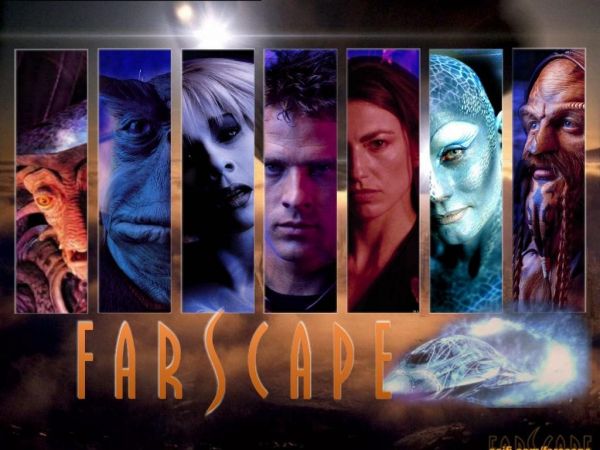
= The inevitable result of conflict is mass annihilation. Mass annihilation ends conflict. Only mass tragedy and shared experience can create empathy on a social level. That's a depressing tag line, which is probably why they didn't make that entire thing the name of the show. "Farscape" is much more appealing. For the uninitiated, Farscape is about John Crichton, all American astronaut who gets his ass rocketed across the galaxy in a wormhole. Once there he finds himself stuck on an escaping prison barge in the middle of a war in which everyone wants to saw open his brain to get his knowledge of wormholes out. In other words, kind of a bad hand to have been dealt. On the upside, Claudia Black is all over him, so it rather evens out. For anyone versed in WWII and post WWII history, the hidden meaning isn't all that hidden. Crichton is pretty much an allegory for Albert Einstein, who is responsible for the development of the Atomic Bomb. Not that he was all that excited about it, though. Much like Einstein, Crichton's knowledge is used to start a war using weapons of mass destruction, in this case a wormhole weapon. Where this one gets interesting is that the use of wormhole weapons isn't just something Crichton is afraid of, it's something that every other character in the universe is excited to see EXCEPT Crichton, making it an eventuality. Someone was going to make one. We just didn't know who. And, once deployed, Crichton knew that the weapon would completely end the conflict by destroying one or both sides of the war. It's a pretty bleak picture that gets painted throughout the series, especially through the finale movies. WMDs will be made simply because that's how politics works. When they get used, they will do exactly what they were intended for on a scale we couldn't have imagined. But, there's a light at the end of the tunnel. Crichton's use of the weapons finally does bring the universe so close to its own destruction that warring faction can make peace. The meaning? As messed up as it was, the world needed to see the horror of atomic warfare in Japan. Without that we would never have reached the "relative peace" that exists now.

Contributor
Contributor

Clayton Ofbricks hasn't written a bio just yet, but if they had... it would appear here.