8 Times Star Trek Actually Did Change The Laws Of Physics

"I cannae change the laws of physics, Cap'n!" Except when I can. Which is often...

"I cannae change the laws of physics, Cap'n!" If you know your Star Trek, you'll know this line spoken by the imitable Montgomery Scott, Chief Engineer of the original Starship Enterprise. Hailed by many as a miracle worker getting the Enterprise (and even the Enterprise-D in The Next Generation) out of trouble spots, especially after being fired upon by Klingons and Romulans. But other than well known theoretical physics possibilities, have you ever wondered how much else is possible and what was made up? What was true to all the sci-babble of Quantum Mechanics and String Theory and what was completely impossible? Would you believe that there are multiple instances of the Trek writers basically writing themselves into a hole only to resort to a MacGuffin device or trick to get the characters we know and love to safety (or to put them in danger to begin with)? Let's look at some of these instances...

8. Transporter Twins

Ok, even though teleportation is not at the stage we would need it to be to teleport even simple items like a book... or a dog... the basic premise and principle is actually sound. It has even been done with simple particles. Now what does this have to do with changing the laws of physics? Two words: Thomas Riker. Don't recognize the name? You'd be forgiven for not remembering for the simple fact he has shown up in only two episodes of Star Trek spanning 2 series (the TNG episode Second Chances and the DS9 episode Defiant). He is the result of a fractured transporter accident when beaming then Lt. Cmdr. Will Riker from a desolate planet. In essence, he was split into two identical beings; right down to memories of being neglected by his father. Let's first assume that the Enterprise uses a quantum computer capable of calculating an untold number of bits of information at once, or at least able to calculate Pi multiplied by the Cosmological Constant at a fraction of a second. Now this quantum computer should be able to know where all your atoms, electrons and positrons are at any given time, calculate the distance it would need to transport them from point A to point B, the energy needed to do so, take them apart and then reassemble them at the destination point. Now let's take a look at Will and his transporter clone. Basically you have a man in mid-transport hit by some type of energy that then replicates his exact number of molecules in the exact order at once without scattering Will's entire being into the aether. So... where did the duplicate atoms come from? How did this energy order the atoms into an exact duplicate of Will Riker? Thomas, you have some 'splainin to do!!

7. Fixing The Timeline

Believe it or not, the Star Trek reboot actually got it right: when you go back in time and change something, you are either in or create an alternate timeline. Say I were to go back in time to kill my grandpa, I will still be here because in essence I killed my parallel universe twin's grandpa. How many times have we seen someone go into the past in any incarnation of Star Trek, change something, and everything is different in their 'present time', but if they go back to that exact moment they changed things and change it back to how it was, everything is corrected. This is the accepted way of how time travel into the past works in Star Trek, but it isn't accepted by Theoretical or Quantum Physics. This is changing the laws of physics, even if only theoretically, because of the "killing my grandpa" conundrum. Therefore, no Yesterday's Enterprise, no First Contact and no meeting Guinan on 1800s Earth in Time's Arrow. Shoot, there would be no All Good Things, either!

6. Inertial Dampers

Yes, this is a staple of Star Trek and something that countless other Sci-Fi series and movies possess but rarely mention. It's also something that is impossible, at least with our understanding of physics. What inertial dampers do is actually inertial negation: negating inertia and its effects. You cannot negate inertia anymore than you can drive your Maserati at light speed. As you'll read later on in this article, the Enterprise, and by extension science, already have an answer to the effects of inertia. Actually it has two answers. The first answer is their artificial gravity. Let's take a look at the hunk of rock we call home and apply it to this scenario. A single rotation of the Earth travels at 1000 miles per hour, taking into account the size of the planet is 24,000 miles in circumference and there are 24 hours in a day. Gravity keeps us from flying off the planet and becoming street pizza. The second answer is Warp speed. Warp is not actually acceleration, vis a vis going from 0 to Mach 2 with a combustion engine. Since you're basically in subspace and not accelerating, you won't be hit with G-forces turning you into chunky salsa.

5. Slingshot Time Travel

You know the deal. Earth once again needs saving and Capt. Kirk and crew must go back in time and retrieve humpback whales to quell the onslaught of an alien probe that can't find their beautiful song. Of course, your only shot at time travel is slingshotting around the sun to gain enough speed to travel faster than light and head into the past. There are two things wrong with this and is one of the niggling points I've had with Star Trek on and off. First, traveling at Warp is achieved by warping space behind and ahead of the ship. This is why you see the Enterprise (or any ship) stretch ahead when it's warping into sub-space. The actual combustion engines just push it along enough to propel it forward. In effect, it is being pushed along similar to a toy boat on the surface of soapy bath water. The other thing is that Warp Drive is not achieved by some incredible combustion engine. This is based on Einstein's Theory of Relativity. An object, no matter how fast, cannot approach the speed of light without coming apart or expending the entire sum total of the Milky Way galaxy's energy. That's not even counting all the other things wrong with this such as outpacing the speed of light to travel backwards in time!

4. Red Matter

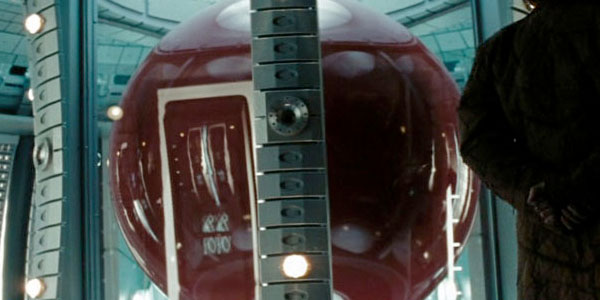
Need a black hole? Need to go back in time and create an alternate timeline? Need something big and red to give some color to your spaceship? Look no further than this giant glob of Red Matter! Send 300 payments of $19.99 to Quark's Emporium TODAY! Ok, I don't think any of us are going to send Quark any of our hard earned Gold Pressed Latinum, but if there is a bigger MacGuffin device in Trek lore, then I'd like to see it and sell it for a cool billion dollars! But first, let's see what Red Matter is. It's red... wet looking... and makes black holes when placed in contact with the vacuum of space or a planet's core. Now let's see what's wrong with this and how it changes the laws of physics. First off, a black hole is created when a massive dead star collapses in on itself, warping space in such a way that it becomes a perfect black mass whose gravity is so great that not even light can escape it. That said, how is a small part of a giant red gelatinous blob going to create a black hole large enough to swallow an entire planet? MacGuffin, indeed.

3. Warp 10

Ok, don't let this picture bother you too much as it pertains to the whole Warp 10 thing. Warp speed is a veritable mire of confusion for many as the speeds and their meanings change between decades or even between episodes. We mostly know that the Enterprise, Defiant, Voyager and most Federation and non-Federation ships can generally only get to Warp 9.7. But what about Warp 10? In relatively recent Trek lore, Warp 10 is defined as infinite velocity, the point where you're occupying all points of space simultaneously and the current possible Warp Factor speed is a re-calibration from the original series speeds. OK, so let's say Warp 10 is possible and traveling at that speed negates any wait times for StarFleet, or any space-faring fleet, to travel from their home planet to, say, the Devron System. But since we know what Warp Drive is, you're essentially not traveling at speed, but relative speed. In other words, unless you're a tachyon, you're actually going at sub-light speed but you're being propelled at Warp with space itself being warped around your ship. So then, knowing this, and going back to the picture above from the Voyager episode, Threshold, how are you accelerating so fast that you speed up your own evolution? Especially knowing you didn't actually accelerate that fast! Key word: accelerate. Even if Paris and Janeway were accelerating at that speed and had sufficient inertial dampers, they would have slowed down in aging and not accelerated their evolution. And don't get me started on the whole "Warp 13" thing from the TNG finale, All Good Things.

2. Barely Escaping A Black Hole At Warp Speed

No matter how you felt about the Star Trek reboot in 2009, it has reinvigorated the franchise with some much needed new blood without forgetting what came before. Increased action, TOS characters and new situations are the order of the day with JJ Abrams' new take on some much beloved characters. But there were some... parts of the movie that stuck with me, even upon first viewing. And, yes, it has to do with Warp. Since by now we know what Warp Speed is and how it's achieved, this really has me questioning whether or not the writers were smoking some wacky tobaccy. A black hole's gravity is so great that light cannot escape it, right? And we know that speed is relative in regard to Warp Drive and StarFleet vessels. We know that they neither accelerate to Warp speed or light speed, right? So then, how is the Enterprise caught in the gravity well of a black hole, threatened to be consumed by its Event Horizon? This would make so much more sense if it was only being accelerated by thrusters and the Warp engines weren't able to be used, but the engines were fine. Since Warp is not dependent on any kind of combustion engine, they should have been able to escape the black hole's gravity easily! I tell you, I almost threw my soft drink at the screen!

1. Phasing While Cloaked

The Pegasus was our introduction, in TNG, to StarFleet cloaking technology. What made this tech unique was that it allowed a ship and its inhabitants to phase through solid matter while cloaked, adding another layer of spycraft. At this point in time, cloaking is still illegal in the Federation and the existence of the ship had been both denied and thought to be lost. My problem with this is two-fold. When a ship is at Warp, it's already cloaked and can cloak itself by warping space around it without travelling anywhere. So why is there is a need for a separate cloaking device? As well, the phasing through solid matter makes no sense in this case as the device would have to disrupt an immense number of atoms, stabilize and track their positions and then reassemble them or cease disruption of them once they're at their destination. This is not even going into the electromagnetic force and the destruction of said objects, most notably the crew of the ship! So there you have it! 8 instances of Star Trek writers totally disobeying the laws of physics in order to advance the story. Did I miss anything? Have anything to add? Sound off in the comments below!! I can't wait to read what you all have to say!!

Contributor
Contributor

Shawn “Loc Da’Borg” Jackson is a native of Mississippi, born in Vicksburg and raised in Philadelphia in Neshoba County. At the age of 15 he was diagnosed with Tourette Syndrome and, later into his early 20s, he became Profoundly Deaf. Writing has been one of the main staples of his life and he has dedicated a good portion of it to educate, entertain and enthrall with the written word.