As much as some Doctor Who writers would like to, you can't always wheel the Daleks out; which is surprising really, given how often the old pepper-pots appea. It's no surprise: they're the go-to option if you want to pit the Doctor against a despicable foe, but sometimes it's better to have a bit of imagination. There are monsters in the Doctor Who pantheon, like the Daleks, the Weeping Angels and even the Family, who can strike the fear of God into adults and children a-like; it's a testament to the ingenuity of Who writers for creating such iconic villains. But whilst the standard of the Doctor's enemies is usually very consistent, sometimes monsters feel wasted in a story. We long to see more of them, for them "not to be written like that", and when they evaporate from a story in the blink of an eye - quite literally in some cases; we were warned not to blink - it doesn't so much send us behind the sofa, but wonder "Was that it?" We're still waiting for a sequel for more of these monsters; it seems like teasing to introduce such a fantastic concept, only to never use it again. Let's take a look at ten Doctor Who villains who looked fantastic, sounded fantastic, and were well set-up, only to leave us wanting more than what we got.
10. The Whisper Men
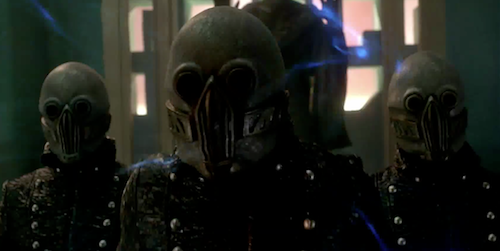
Around this time last year, Matt Smith and Jenna Coleman hinted that a particularly scary monster with a great name would appear in the latter half of Series 7. Excitement began, as a trailer depicting a bow tie-less Doctor in a forest, declaring "I am the Doctor... and I am afraid," surfaced; we caught a glimpse of what looked like a twisted Silent, and guessed that this might be the monster in question. It was in fact the Broken Man, and the forest wasn't actually the fields of Trenzalore. The scary monsters that the cast were referring to were the Whisper Men, a group of faceless but well-dressed henchmen for Richard E Grant's Great Intelligence. Whilst the Whisper Men looked fantastic and their sinister hissing gave audiences the chills, they didn't actually do a lot in 'The Name of the Doctor'. We were all expecting them to pray on another primal fear, just like Moffat's finest creations, but they were only there for tension: surely they should've had some kind of ability to make people spill their darkest secrets? The audience fear that Moffat actually exploited though, was the threat to reveal the Doctor's name. It's a good job he didn't.
9. Davros
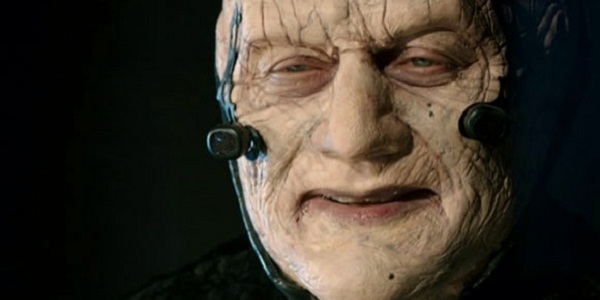
The first series finale brought just the Daleks back, then the second one used Cybermen and the Daleks, the third the Master, then the fourth gave us the Daleks, the last remaining member of the Cult of Skaro, a nice shiny red Dalek I forget the purpose of, and the big man himself, Davros. It was to be just like the good old days: the Doctor jostling with a fellow genius. The potential for 'The Stolen Earth'/'Journey's End' was limitless. Unfortunately, the great Davros was now reduced to being, in the Doctor's words, "The Daleks' pet." He wheeled around the room quoting a prophecy - that never came true by the way - and claimed that his greatest victory was seeing the Doctor realise he turned his companions into weapons; gone were the tense, incredibly-acted stalemates that he might have enjoyed with the Fourth Doctor, replaced by Davros imprisoning Ten, and telling him how his final plan was to destroy the whole universe. All it took to destroy him in the end was a superpowered Donna Noble flicking a few buttons; a deus-ex-machina was always going to happen, we knew that, but Davros never really felt like the Daleks' creator, just an elderly man on the door, shouting harmless platitudes at the heroes whilst the real danger was further inside the ship. It was an all-right performance from Tennant, but not a return to the glory days of Who.
8. The Silence
A lot of people make a simple mistake about the Silence; those big creatures with the huge hands that look like Edvard Munch's The Scream, aren't actually the Silence. The Silence are a religion, these just happen to be creatures within that religion. We now know, after 'The Time of the Doctor', that these creatures are genetically-modified priests. All of this business with the organ grinders takes away from how brilliant the monkeys are; these creatures are terrifying, and yet most of Series 6 is dedicated to Madame Kovarian and her bonkers plan to kidnap children. We only saw what these things can really do in 'The Impossible Astronaut'/'The Day of the Moon', and even then, they were entirely overshadowed by all the other mysteries flying about the episode. Not that the episode wasn't great; it would just have been nice to see more of the Silent creatures. The Weeping Angels have had a fair crack of the whip, what about a story where some of these GM priests break away from the Silence to wreak havoc of their own?
7. Victor Kennedy
Peter Kay as a sinister villain: who'd have thought it? It's arguably one of the most bone-chilling moments of the second series though when Victor Kennedy descends on LINDA, declaring quietly, "I am your salvation." 'Love and Monsters' spiralled into a Benny Hill chase scene between Elton and Kennedy, now in his natural, green form. The Absorbaloff may have looked awful - it was designed by a child, remember - but the concept behind it was fantastic, and Kay really was threatening: could we not have seen more of Victor Kennedy and less of his alter-ego from Klom? What if Kennedy absorbed his victims and not the Absorbaloff? It would have been a bigger twist too: all the time Elton was concerned with alien attacks, he'd missed one that looked human, right under his nose. Perhaps none of that would have worked; maybe there's no saving the episode. Or maybe you don't have 'Love and Monsters' quite as much as the abysmal 'The Curse of the Black Spot'. Surely we can all agree that Victor Kennedy was the scariest character in the episode though?
6. The Smilers
Steven Moffat himself claims that 'The Beast Below' is his worst episode. Unfair, you might think - should you be one of the many who have despised the last two years of Doctor Who - but it is symptomatic of something Moffat would be widely criticised for later in his tenure. 'The Beast Below' doesn't answer all of the questions it raises, but more than that, it throws away a perfectly good villain with little explanation. The Smilers are those doll things in the booths; when their head turns around with an angry expression painted upon it, it's one of the creepiest moments in an otherwise fantastical series. It's even scarier when human heads pivot to reveal Smiler faces on the back; it's a truly dystopian nightmare ripe for scaring children with. Can anyone remember how the Doctor defeated the Smilers? Can anyone remember anything about them at all, other than the iconic shot of the head turning around? No? 'The Beast Below' had a lot on its plate, most of us agree on that; maybe it would've been a better episode if it focussed on this one villain, that had the potential to be terrifying.
5. The Vashta Nerada
Another Moffat story, 'Silence in the Library'/'Forest of the Dead' is easily two of the finest Doctor Who episodes of the revival. The chemistry between Alex Kingston and David Tennant is great, the layered storytelling is excellent, and the conclusion pays off all those ingenious little mysteries we wondered about. But what about the Vashta Nerada? They were fantastic for many reasons, but partly because they were real; they exist on Earth, the Doctor said. While the Doctor was getting to know his wife however, these creatures were lurking in the dark, waiting to attack when they'd stopped arguing; it was all great, but the flesh-eating shadows were only a footnote in the story. This is a creature that had potential to be as iconic as the Weeping Angels: why hasn't Moffat brought them back? It would certainly work if a whole episode focussed on their threat; are we really never going to see them again? It just seems like Moffat wasted one of his greatest villains on being a sub-plot in a romance.
4. The Sontarans
For many, Strax is the worst thing to happen to Doctor Who; for others, he's the unexpected consolation of the Sontaran revival. The Series 4 two-parter that re-introduced the psychotic potato dwarves was a huge disappointment, with this classic monster only being used for the Doctor to throw heightist punchlines at; since then, they've only appeared in cameos, usually for comedy value. The Sontarans are no longer the fearsome threat that they were in the '80s; whilst the Daleks, the Cybermen and even the Ice Warriors have both been given makeovers and specific episodes to "make them scary again", no one's really bothered with the Sontarans. They might not be all that different from other war-obsessed, all-conquering aliens, but for anyone who grew up with them, it's sad that they've been reduced to being the butt of any sci-fi joke a writer wants to make. Fans have been talking about an episode where Strax chooses between his people and Vastra; now that could redeem the Sontarans.
3. The Broken Man
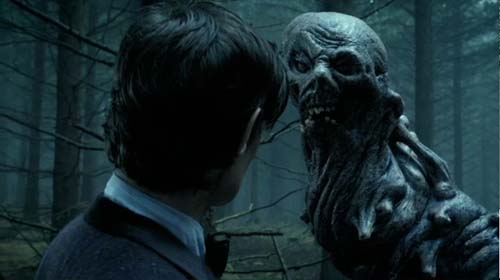
As mentioned, it's a shame when a great monster becomes a tiny detail in a romance, even if it is for the best of the story. 'Hide' however, took the bold move of injecting romance as a tiny detail in a story about a great monster. The Broken Man is genuinely scary; it moves in an unnatural way, it looks terrifying and it always seems to occupy the corner of the Doctor's eye. Another case of an incredibly frightening monster only being a sub-plot in a thrilling episode, the Broken Man was largely regarded as a ghost, and then swept under the carpet as soon as the Doctor knew what he was. There was so much promise for this creature, and whether you liked the ending or not, there's surely more story to tell than a quick, panicky sequence of the Doctor being stalked by the Broken Man. We probably won't see him again: his story's been tied up. But the possibilities surrounding this character are fantastic, and it's a shame he was only briefly seen, even if the episode was brilliant, after all.
2. The Vigil
Another Neil Cross creation, the Vigil are absolutely ingenious. They're one villain that actually turns the sonic screwdriver into a proper weapon, given that they expel sound waves, and the design of them is brilliant. What's more is that the name, Vigil, is a literal translation of what they are; a vigil is either a period of observation or the eve of a religious festival, and they're the creatures that go looking for Merry when she disappears before the festival. But what exactly happened to the Vigil? They disappeared. Why? Because a bigger monster took their place. And then a bigger monster took that place. The Vigil were brilliant enough though to hold the episode all on their own. They were clearly just henchmen for someone more powerful, but 'The Rings of Akhaten' would have been all the more fascinating with them leading the attack against the Doctor. It's one of the most hated episodes of the series, but with a bit more cohesion, and maybe some focus on these brilliant monsters, 'The Rings of Akhaten' would have been more well-received.
1. The Shakri
Traditionally, we fear the monsters that the Doctor does. That's why when Ten made digs at the Sontarans, we saw them as comedy characters, and not villains. It's also why the Daleks constantly return; every fairytale needs a good old fashioned villain. The Shakri were built up as being a race that the Doctor had heard about from stories when he was a child. He'd heard how ruthless they were, the pest controllers of the universe. And forty minutes of 'The Power of Three' had been dedicated to setting up the Shakri's evil plans. Imagine the surprise of just about everyone though when the Shakri disappeared into thin air. Not only were the Shakri massively disappointing, their plan was foiled by the Doctor with a few waves of his magic screwdriver. This was built up as one of the most complicated and intelligent threats since the revival, and yet, the alien were wasted in what was essentially a cameo in an episode all about Amy and Rory. A lesson to any Doctor Who writer; if you're going to introduce a brilliant villain, at least give them a satisfying arc.