Doctor Who: 10 Timey-Wimey Episodes (Written By Steven Moffat)
In my last article I looked at the best timey-wimey episodes of Doctor Who NOT written by Steven Moffat. Now, I think it's time we take a stroll through the work of the Moff himself. Steven Moffat is a controversial figure nowadays but back a few years ago when Doctor Who returned to our screens triumphant, Moffat's scripts were rightly praised. Applauded for their humour and scary monsters, but most of all, for their intricate plotting that more often than not played with the nature of time travel. When Moffat took over as head writer of Doctor Who from Russell T Davies in 2010, he continued to produce the timey-wimeyiest Doctor Who there's ever been €“ there were deaths undone, lives rewritten and more parallel worlds and alternate timelines than you shake a TARDIS at. And that's without mentioning the Doctor's time-travelling wife who kept meeting him in the wrong order, So before you go all wibbly-wobbly at the thought of more introey-winrtroey (that's not going to catch on, is it?), let's have a look at the best timey-wimey episodes written by the man who coined the phrase.

10. Time Crash

This 2007 Children in Need special may only be seven minutes long but it certainly packs a paradoxical punch in its short running time. Not long after saving the Earth, stopping the Master and saying goodbye to his best friend (the Doctor never has a dull day), the Tenth Doctor finds his younger self, the Fifth Doctor, in the TARDIS! Though Number Five doesn't at first believe 'the skinny idiot' in front of him is himself, the Doctors deduce that their two TARDISes have crashed together, causing a terrifying paradox that could blow a hole in spacetime the size of ... Belgium, apparently. That's a bit undramatic, isn't it? However, before this can happen the Tenth Doctor steps in and creates a black hole and supernova at the exact same instant, the resulting explosion and implosion cancel each other out and the TARDISes go free. The Fifth Doctor is amazed that his future self worked it out so quickly. And then realises. The Tenth Doctor remembered being the Fifth Doctor watching himself doing that. Just to alleviate some of the stress this might cause viewers, the two Doctors then give a cheery rendition of 'wibbly-wobbly timey-wimey.' Only a few months after Blink, the idea of the timey-wimey had now properly crashed into the Whoniverse.

9. The Angels Take Manhattan

The poor Ponds most probably had the timey-wimeyiest time in the TARDIS of all of the Doctor's companions so its fitting that their final adventure materialises onto this list. In modern-day New York, the TARDIS trio are broken up when Rory goes missing €“ only to reappear in the pages of the Doctor's book, a pulp detective novel from the 1930s. Realising that the book is a document of the adventure they are about to have, the Doctor and Amy travel to 30s New York and discover Rory, River Song and a fiendish plot from the Weeping Angels to enslave the city. Having peeked at the end €“ spoilers! €“ it seems Amy and Rory are about to die. Because time can't be changed once its been written in stone... Angels is a cracking mix of the film noir and the series finale-type feel plus an ingenious use of time travel €“ what if the Doctor had a book about one of his adventures? How much could he read? How much would he want to read...? If Angels itself was a book it'd be a sure page-turner!

8. The Girl In The Fireplace

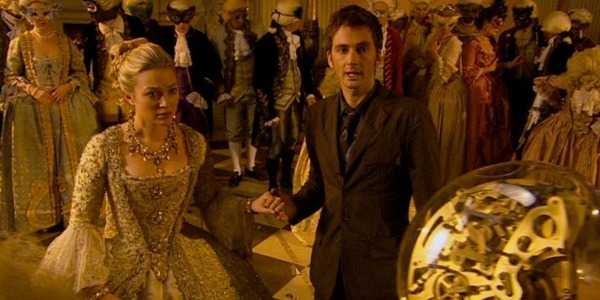
Years before that temporal temptress River Song arrived on Doctor Who, Steven Moffat created another timey-wimey Doctor Who love story in the Girl in the Fireplace. Discovering time windows on a 51st century spaceship, the Doctor wanders into 1700s France and encounters a young Reinette Poisson, the famous Madame De Pompadour. He returns €“ minutes apart for him €“ several times over her life and each time the pair grow closer. The reason for these time windows is that the spaceship's clockwork repair droids want to get their hands on Reinette's brain when she is 37 (due to their ship, SS Madame De Pompadour, being 37 years old). The Doctor defeats the droids and promises to come back for Reinette and show her the stars. Sadly, the uneven windows mean that when he returns, Reinette has passed away. The Doctor is heartbroken. While it seems natural for the Moff to write puzzlebox plots, they are rarely as heartfelt and sincere as the one on show here which perfectly utilises the timey-wimey to tell a unique story about love and loss. I'm not winding you up.

7. Silence In The Library/Forest Of The Dead

While not being overwhelmingly timey-wimey in itself €“ this story is much more fussed with dream worlds and computer memory banks €“ Silence earns its place on this list for introducing the enigmatic Professor River Song, archaeologist, spoilerphobe and, apparently, someone rather special to the Doctor. In The Library, the planet-wide largest library in the universe, the Doctor encounters River Song, a woman who claims to know him in the future. Very well, in fact. She even knows his name... After sharing an adventure fighting the shadowy Vashta Nerada, River Song sacrifices herself to save the souls trapped in the Library's data core. She realises that throughout all their time together, the Doctor always knew how she would die. Tragicy-wagicy. Before the intense playing with River's timeline and her role in the Doctor's life that developed in Series Six, the idea of the character is played rather straight here - someone uniquely close to the Doctor, hurt because he does not recognise her €“ and its done so very effectively. At that point, we didn't know exactly what she was to the Doctor. But we would... Is that wedding bells I hear? Or is it an army of outraged fans?

6. The Wedding Of River Song

After the Doctor's apparent demise, various Amys, several Rory deaths and the revelation of River, not just as a Time Lord, but also as Amy and Rory's daughter (blimey, I'm glad I don't have to explain all that), Series Six ended on a fittingly complex note with the wildly wibbly-wobbly The Wedding of River Song. River Song kills the Doctor on the shores of Lake Silencio in Utah, 2012. This is a fixed point in time and cannot be changed. However, unable to murder her beloved, River refuses and so time itself goes to pot. Every moment in history takes place at once €“ Holy Roman Emperor Winston Churchill rules with Silurians at his side, Charles Dickens is advertising his new Christmas ghost story on breakfast telly etc. Eventually time will disintegrate. Unless the Doctor dies. The Doctor convinces River that she has to kill him to save the universe, But first, they decide to tie the knot. Nothing says romance like the threat of the impending destruction of all of reality. In contrast to River Song's first appearance, this is timey-wimey turned up to ten. Tying up a series with so many twists and plot threads as Series Six was always going to be tough to crack (oh no, wait, they were in Series Five) but Moffat creates a perfect marriage of hype and heady timey-wimeyness. Heh, see what I did there?

5. The Name Of The Doctor

The finale of Series Seven was as equally timey-wimey as the last two. We'd had two weddings. Now, it was time for a funeral. With the Great Intelligence kidnapping Vashtra, Jenny and Strax, the Doctor is forced to journey to Trenzalore, the one place he must never go. The place where he is buried. Discovering a decaying TARDIS €“ his tomb €“ the Doctor witnesses the Great Intelligence launch himself into his timestream (the only thing left behind when the Doctor dies). As the Doctor is being removed from history, Clara has no choice but to jump into the timestream after the Intelligence and fix things. Saving the Doctor's life, she scatters herself across his personal history - the reason he has met her several times. Like many of Moffat's best episodes, The Name of The Doctor has at its core a fantastic idea: What is the one place the Doctor could never go? To his own grave, of course! Although a lot of it doesn't quite add up €“ exactly how does Clara save the Doctor? Where does the Great Intelligence go? €“ it's still a fabulous adventure that literally intervenes in the history of the show. But there was another Day coming that would do that far more...

4. The Day Of The Doctor

The highly-anticipated 50th anniversary special was always going to be a somewhat timey-wimey affair. Before transmission, we already knew that something was going to be bring Doctors Eleven and Ten together - as well as a never before seen incarnation played by John Hurt. Doctor who? On the night (or should that be day?) we found out the truth. The Day of the Doctor sees the War Doctor on the brink of destroying Gallifrey with the aid of the Moment. However to make him see the error of his ways, the sentient Moment lets him meet two future versions of himself to see the affect his actions will have. Still, he seems sure it is the only way out. That is until the Doctors combine their efforts and realise that they can save Gallifrey by shunting it sidewards into another dimension - with a little help from all of their incarnations. Gallifrey falls no more! What constitutes timey-wimey more so than rewriting the categorically-stated history of the show (I'd have loved to be a fly on the wall when Russell T Davies, the creator of the Time War, saw the special for the first time)? Thanks to Day, Doctor Who is set on a brand new course. Steven Moffat himself certainly wasn't having a bad day when he wrote this episode.

3. A Christmas Carol

As a Christmas special - a spot traditionally saved for light, fluffy episodes of Doctor Who- A Christmas Carol is often forgotten as one of the great timey-wimey stories. Much like the Doctor did with Kazran's life, let's fix that now. For one, it's a supremely clever take on Dickens' immortal tale of a person being rewritten by visions of his past, present and future €“ a story begging for a Doctor Who adaptation if ever there was one. Sardick is the cruel, miserly ruler of Sardicktown who is refusing to allow a crashing cruise liner €“ with Amy and Rory onboard €“ safe passage to land. Determined to save his friends, the Doctor travels back in time to make Kazran a better person so he will save the cruise ship in the future. But the Doctor learns that rewriting people is a lot harder than rewriting time. As well as being incredibly timey-wimey, Carol also manages to be delightfully Christmassy and heartfelt as well. Not only one of Moffat's most timey-wimey episodes, it's also one of his most accomplished stories for Doctor Who. And nothing can go back in time and change that.

2. The Pandorica Opens/ The Big Bang

When you think of complex episodes of Doctor Who, the Series Five finale The Pandorica Opens/ The Big Bang is one of the first to come to mind. Definitely the show's most glorious and gleeful use of time travel, it actively breaks all of the rules in the Doctor Who world but, for one time only, it really works. The Doctor, we have been told countless times, cannot intervene in past events that he himself is already part of €“ except, it seems, when he really has to. As the universe is disintegrating due to the explosion of the TARDIS, the last place left in the universe is Earth but that is rapidly vanishing. To save reality, the Doctor has to use River's vortex manipulator to go back in time and release himself from the Pandorica €“ a prison built by his enemies €“ save Amy's life and finally steer the Pandorica into the exploding TARDIS to restart the universe. Got that? No, I understand. And, trust me, this is a streamlined version. Unashamedly timey-wimey, this two-parter finale is impossible not to love, just as it is impossible to fully understand until you've seen it a few times (for me it was that perennial question: 'so why is Rory a Roman?') It reminds us that when Steven Moffat took over as head writer for Doctor Who he left an indelible big bang on the Whoniverse. It had been totally rebooted and it would never be the same again. You have to wish good luck to who ever replaces him as, while Moffat's take on the show is clearly not for everyone, he is one hell of an act to follow.

1. Blink

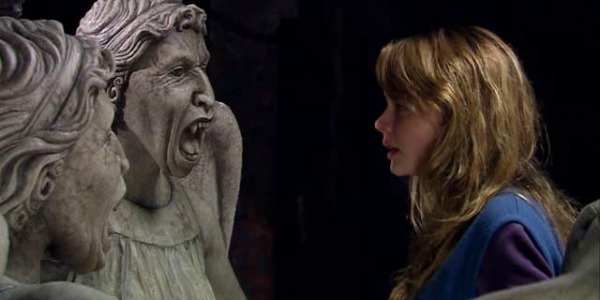
What could be top of a list of timey-wimey Steven Moffat story than the adventure that the phrase first appeared in? Blink - the ultimate Doctor Who timey-wimey episode! Every element is doused in timey-wimey juice (yeah, OK, I just made that up) but it all works. The timey-wimey horror is the scariest Doctor Who's ever been. The touching timey-wimey €“ such as old Billy Shipton in the hospital €“ tugs at the throat with the grip of a Macra. And, of course, the complex plot involving DVD easter eggs, messages on walls and a spooky house is engaging and completely followable. Blink cannot be beaten and deserves to be forever watched and set in stone as not only Steven Moffat's and the show's greatest use of time travel but arguably as Doctor Who's greatest ever episode. However, that's not quantum locked as who knows what else the Moffster still has up his sleeve as he creates a brand new set of stories for a brand new Doctor. I don't know about you but I'm glad we're travelling in time in the right direction to see it. Do you think time should be rewritten to make me pick better choices? Have your say in the comments below!

Contributor
Contributor

Spewing words on the internet daily. You can also read my stuff at StarburstMagazine.Com, WeGotThisCovered and TheQuiz.Com.