Doctor Who: 20 Most Satisfying Moments

11. The Celestial Toymaker Defeated

From The Final Test: 23 April 1966 The Celestial Toymaker was a series of pure imagination that I would put up there with Alice In Wonderland from literature. You can still see this final episode of the series, but the other three are now lost. It is the pay-off that offered such a sense of relief at the story's outcome, but without being able to see all of it you might not realise it these days. Still, that's no reason on its own to ignore it. I suppose The Toymaker had about him similar attributes to House in The Doctor's Wife, or The Dreamlord from Amy's Choice: he was all-powerful in his own domain. Now a familiar theme, this was the first time that Doctor Who had explored that notion. In this series The Toymaker is like the queen from Alice In Wonderland. We were genuinely fearful for The Doctor and his companions. It was unsettling in a new way. The Toymaker inhabited a world that was acutely real to children, if not so relevant to adults. It had children's games played on electric floors that might kill you. It had nursery rhymes that acted like witches' spells being cast upon you and it had inescapable rituals in which you were always going to turn out as the victim. Most of all it looked like our dear old 'grandfather Doctor' was going to lose. If The Doctor were to lose the murderous Tri-Logic game then he surrendered everything to the Toymaker: his knowledge, his power and even his memories. If he should win then the world itself was destroyed along with he and his companions. Self-destruct was no solution either, since The Celestial Toymaker was akin to some sort of demi-god who could rebuild his world at will, simply and easily. The Doctor's solution was clever. He instructs the final winning move of the game from within the TARDIS, thus allowing him to escape the domain at the very moment it collapsed. So many of the best pay-offs in many genres involve the impossible escape. Alice takes control of her dream instead of letting it victimise her and the Dreamlord is faced down by standing up to him. The story of The Celestial Toymaker offers us the hope that the tyrant can also be defeated, no matter how powerful he at first appears.

10. Daleks Vs Cybermen

From Doomsday: 8 July 2006 The Daleks square up to The Cybermen. It is something we always wanted to see and Russell T. Davies nailed it when he said just that at the time he dreamed up this classic confrontation. This moment's satisfaction does not lie in the episode as a story. Incidentally I found that satisfying enough, but it was the pure comedy gold as two of the show's most pragmatic killing machines exposed their basic weakness. It became clear that neither would ever be capable of understanding the other. The foremost strength of Russell T. Davies' writing is his ability to take two massive themes, condense them into a few lines of script then smash them together so that sparks fly. That is the basic premise of the Rose Tyler / Tenth Doctor story arc; impossible love meets unfailing duty. In 'Midnight' the goblin-like, almost mythological entity inhabiting Sky Silvestry could be seen as a direct challenge to the ultimate scientist as represented by The Doctor. In Daleks and Cybermen two very different ideologies come up against each other. It reassures us that despite their best efforts later when The Pandorica opened, the baddies will never ever be capable of getting it together. What we see precious little of in the show is when baddie meets baddie. Davies shows us that The Daleks could never ally with the Cybermen, because the Cybermen would always be seen as racially inferior. The Cybermen are always going to be confused by this, because there could never be a case in their universe where two powerful beings joining forces cannot represent an "upgrade". Just prior to the 'negotiation' itself there is also the classic 'identify yourself' routine in which Cybermen and Daleks fight not to be the race that identifies itself first to the other. The stakes are so very small at this point that it almost reminds you of two academics arguing passionately about nothing that anyone could ever care for! How do these two alien psyches react in that situation? The best script-writing usually holds up a mirror to our own lives while we watch and this exchange tells us more about ourselves than it does two fictional races in a TV show.

9. The Dalek Invasion Of Earth

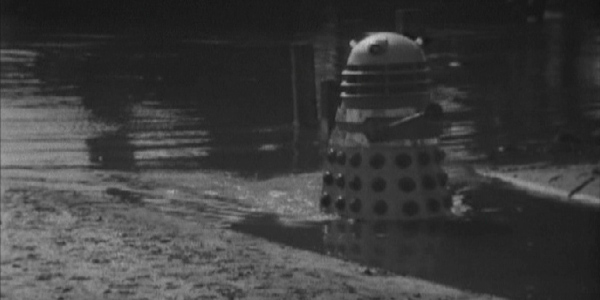
From World's End: 26 December 1964. They all refer to this iconic moment. Why do 'they' keep on doing that? Have they never seen anything else in Doctor Who? For me, the reason is that it ticks every box that Sci-Fantasy needs to make it work. Oddly, it became a quiet moment for ruminating upon the meaning of everything in the world of The Doctor. It is the moment when 'that Dalek' emerged from the River Thames. We had seen the Dalekanium-encased mischief-makers for only the first time about a year earlier and they had created uproar in every household and school playground ever since. Depending upon how you count it, we had waited for around a year before they made their second, stunning entry. That's a lifetime for a child, or at least a tenth of one for a ten year old. The moody shots of a battle-scarred London built brilliantly towards the episode's climax. The Doctor was puzzled and clearly something evil was afoot. We jumped for joy €“ they were back! Then, as the credits came up and real life threatened to engulf us, we realised that we had been idiots. The nagging feeling that something terrible was about to occur grew and grew so that we were compelled to see next week's episode. When we drifted off to sleep later that night the stark image of something truly alien intruding into our familiar world burned itself into our brains. It was the pay-off to a great episode and it became the fulcrum upon which that series turned. Many talk about the first time that that Dalek sucker was seen on our screens during the previous series as the moment that made the Daleks. It was not. It was this scene and what followed that truly sealed the Daleks' fate in British culture. 'The Dalek Invasion of Earth' had so much more going for it than 'The Daleks' ever did. It had a stultifying aura of terror about it and the pathetic sight of people at war collaborating with the enemy who were ready to betray their fellow humans merely for a basket of vegetables was very disturbing indeed. The invader was ruthless as it destroyed everything people knew and there were some memorable battle scenes thrown in for good measure. This was the pay-off that promised so much and never failed to deliver.

8. Playing To The Grandstand

From The Pandorica Opens: 19 June 2010. This and the speech of the newly regenerated eleventh incarnation at the end of The Eleventh Hour are examples of Doctor Who at its best in the modern era €“ magnificent grandstanding. Sometimes these things just amount to an empty gesture and sometimes they are filled with dark meaning. Either way, these are great moments. I think I'll just let the moment speak for itself:
The Doctor: Hello, Stonehenge! Who takes the Pandorica, takes the universe! But bad news, everyone, 'cause guess who! Ha! Listen, you lot! You're all whizzing about; it's really very distracting. Could you all just stay still a minute, because I! Am! Talking! Now, the question of the hour is, "Who's got the Pandorica?" Answer: I do. Next question: Who's coming to take it from me? Come on! Look at me! No plan, no back-up, no weapons worth a damn! Oh, and something else, I don't have anything to lose! So, if you're sitting up there in your silly, little spaceship with all your silly, little guns, and you've got any plans on taking the Pandorica tonight, just remember who's standing in your way! Remember every black day I ever stopped you, and then, and then, do the smart thing: Let somebody else try first. That should keep them squabbling for half an hour.
Great, isn't it?

7. Sarah Jane Discovers The TARDIS
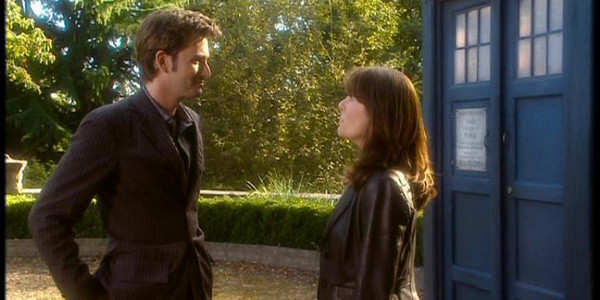
From School Reunion: 29 April 2006 This is a moment where just a single scene said it all. It is the scene where Sarah Jane Smith stumbles across the TARDIS as she creeps around Deffry Vale High School at the dead of night in search of evidence to support her suspicions that things were not quite right at the institution. The moment itself had been expertly set up in the scenes preceding it. Taking the role of investigative journalist, Sarah Jane had infiltrated the school on the pretence of writing a profile of its Head Teacher, Mr Finch. Unknown to her, The Doctor in his tenth incarnation and Rose Tyler are already undercover in the school as a teacher and 'dinner lady'. Drawn there by similar suspicions to Sarah Jane she is presented to The Doctor in his usual guise as plain John Smith. It is the classic we-know-that-he-knows-who-she-is, but we-also-know-that-she-doesn't-know-who-he-is. From then on we just want her to find out. The dialogue employed when they meet expresses untold longing in Sarah Jane for her own John Smith who left her life countless moons earlier. Toby Whithouse is responsible for the script here and it is a brilliant example of how to line the viewer up for maximum pay-off. We know it's coming, but are fearful too that it might not, all the same. When it does come, the look of shock and hope on Sarah Jane Smith's face is a fitting testament to the quality of an actor who has in previous decades gone unnoticed to some extent. It used to be fashionable to say that the point of any companion was simply to scream a lot, freeze in terror and get rescued. The performance of Elisabeth Sladen in this episode gives a lie to all that, so not only is the moment itself a satisfying pay-off, but so also is the character of Sarah Jane Smith allowed to come of age.

6. Tell Me Why I Mattered

From Vincent and The Doctor: 5 June 2010.

Richard Curtis, the writer of this little speech has a fine track record of writing scripts calculated to involve you emotionally. In this one he brings in one of his favourite actors to deliver a devastating piece of rhetoric:
Dr Black: Well... big question, but to me, van Gogh is the finest painter of them all; certainly the most popular great painter of all time: The most beloved; his command of colour; the most magnificent. He transformed the pain of his tormented life into ecstatic beauty. Pain is easy to portray, but to use your passion and pain to portray the ecstasy and joy and magnificence of our world... no one had ever done it before. Perhaps no one ever will again. To my mind that strange wild man who roamed the fields of Provence was not only the world's greatest artist, but also one of the greatest men who ever lived. Doctor: Oh, Vincent, I'm sorry. I'm sorry, is it too much? Vincent: No, they are tears of joy! Thank you sir, thank you! Sorry about the beard.
Naturally this all needed setting up first, coming as it does at the end of an episode that some found lacked punch. I did not see it that way. It is quite a deep piece overall in which the writer sets out to objectify the demon in Vincent Van Gogh's life through a monster invisible to all but him. Vincent was a haunted genius, but the fact is none of us really knows how that is so. We are not Vincent Van Gogh and we have absolutely no power to live his life in his shoes. That's what is clever about what Curtis does here. He enables us to get a flavour of what it is like to be underestimated and ignored when you are even more in touch with your surroundings than those in your orbit. And then in the final act he summarises perfectly everything that Van Gogh represents. We're no closer to understanding the genius himself, but we know after this speech that what Dr Black said is somehow absolutely correct at a very personal level and we want to jump for joy that someone, finally, has fought Vincent's corner.

5. The TARDIS Is In The House

From The Doctor's Wife: 14 May 2011 The character 'House' turned out to be a thoroughly nasty piece of work and by the end of The Doctor's Wife I for one wanted only bad things to happen to him. And that's just what happened! This moment comes right at the end of the episode and is satisfying, because it is a simple case of the archetypal bully getting his just desserts. There is, naturally, not one redeeming feature in the character. He has made a systematic career of luring Time Lords such as The Corsair to his bubble universe and stripping them of their TARDISes, their body parts, and ultimately their lives. In this episode he manages to eject The Doctor's very own TARDIS from the machinery in which she lives and we are drawn a picture by writer Neil Gaiman of a good and pure character. It's great counterpoint, setting us up even more effectively for the ending. When we do catch up with House, now in the fabled blue box and on his way to conquest of our own universe, he believes himself to be untouchable. He is arrogant and a mirror of all those bad people in film we love to hate. When The TARDIS finally enters her natural domain The Doctor is almost dismissive of House. His fate, almost by definition is inevitable and we are reminded just why The TARDIS is a weapon. Brilliant!

4. Give The Boy A Gold Star

From Earthshock: 16 March 1982. One movie that understood the satisfying pay-off better than most was the original Death Wish (1974) film. Demonised by many in its day for exposing and celebrating all that was shameful in people, nevertheless it told an honest truth. We want to see justice done and if the law will not act on our behalf then we will take the law into our own hands. This is probably the nearest that Doctor Who comes to having a proper 'Death Wish moment'. The pure moment of revenge comes before Adric's death, but his fate had already been sealed. Adric is on a freighter plummeting to Earth that is destined to wipe out the dinosaurs some millions of years before our time. It's all been caused by the nasty Cybermen and while Adric continues trying to avert disaster the Cyber-Leader decides to kill the TARDIS crew. In the ensuing struggle The Doctor breaks up Adric's gold-plated Mathematics Achievement badge into the Leader's chest unit. It poignantly reminds us that all that was Adric had in fact killed the Cyber-Leader. As he dies, the Cyber-Leader fires his gun, damaging the TARDIS console in the process. The Doctor grabs the gun and shoots the Leader, finally destroying it. There is something visceral, close up and personal in The Doctor's actions as he plunges the gold star into the Cyber-Leader's chest. He means it. It's one of the very few times in the show when The Doctor uses a gun, but again you feel like this time he means it. The show ended without the familiar theme tune to carry us off. Instead the credits rolled in silence and we watched forlornly as the camera held shot on the crumpled gold star. It was not a moment of elation, but as a plot pay-off it was both memorable and haunting. At that time Adric was not many people's favourite companion. Cleverly though, the plot required that Adric die after the act of vengeance for his death. That way we were left with coldness at our loss of a companion rather than the heat of justice recently enacted. Sometimes the elation we feel is not especially wholesome, but sometimes we have to just face that fact.

3. The Demon's Run Campaign

From A Good Man Goes To War: 4 June 2011.
Demons run when a good man goes to war. Night will fall and drown the sun, When a good man goes to war. Friendship dies and true love lies, Night will fall and the dark will rise, When a good man goes to war. Demons run, but count the cost. The battle's won but the child is lost.
The moment itself stretches on for about twenty minutes. It's glorious. It may have ultimately been a futile gesture, but it gives us a glimpse of why The Doctor is known as The Oncoming Storm. We are carried along on a victorious tide as The Doctor's plan escalates. First he destroys an entire Cyber legion to extract a tiny piece of information, and then he pops up at the heart of the enemy's camp to spread confusion and dismay among Madame Kovarian's legions. It's Like some Errol Flynn-style swashbuckling hero, not only does he win, but he wins with aplomb. The girl is rescued by the dashing knight and the 'dragon' has been destroyed. Even the chief soldier of the opposing army has been made to eat humble pie. We know now that the entire episode was foreseen by Kovarian and that the baby was never rescued at all, but it was for a few minutes at least, an example of when The Doctor is the one calling the shots. He's the Time Lord Victorious again, but this time without the pride that nearly destroyed him. He's the invincible super-hero and it's only when the plan has come to fruition that he begins to realise he is not the healer he thought he was, but the warrior he never saw coming. It's a bitter-sweet moment, nevertheless that twenty minutes or so was a truly great pay-off as a passage of pure cinema.

2. You Can Seek But Just Make Sure You Never Find

From The Family of Blood: 2 June 2007. This moment gets 'Time Lordiness' all into perspective really. We are constantly being told that the Time Lords are just about the most ancient race in the galaxy and that they have unimaginable power. Why then is The Doctor's favourite escape plan to run? This episode, a two-parter preceded by 'Human Nature' takes that premise to stupid levels €“ or so it seems initially. The Doctor is pursued by a family of an alien race that aims to feed off the Time Lord's essence, or power if they can capture him. The Doctor lays down and hides his Time Lord nature using a piece of equipment known as the Chameleon Arch, becoming to all intents and purposes human. Companion Martha Jones watches over him while he blends into pre First World War rural Britain, safe in the knowledge that every last trace of incriminating Time Lord memory has been erased for the duration. There is a love story in here and observations about duty and honour on the battlefields to come. There are themes of cowardice and bravery beyond the call of duty and above all, the responsibility attached to being a Time Lord. No wonder it got nominated for a Hugo Award for Best Dramatic Presentation in 2008. In the end we learn that The Doctor is not running to save himself, but to protect his pursuers from the consequences of their own stupidity. These lines were among the most satisfying moments in all of Doctor Who's history as a dramatic conclusion to a great story:
Son of Mine: He never raised his voice. That was the worst thing€”the fury of the Time Lord. And then we discovered why €” why this Doctor, who had fought with gods and demons, why he had run away from us and hidden: he was being kind. He wrapped my father in unbreakable chains forged in the heart of a dwarf star. He tricked my mother into the event horizon of a collapsing galaxy to be imprisoned there, forever. He still visits my sister once a year, every year. I wonder if one day he might forgive her, but there she is. Can you see? He trapped her inside a mirror. Every mirror. If ever you look at your reflection and see something move behind you just for a second, that's her. That's always her. As for me, I was suspended in time and the Doctor put me to work standing over the fields of England, as their protector. We wanted to live forever. So the Doctor made sure we did.

In this post: 
Doctor Who
 
Posted On: 
Contributor

Hello, I'm Paul Hammans, terminal 'Who' obsessive, F1 fan, reader of arcane literature about ideas and generalist scribbler. To paraphrase someone much better at aphorisms than I: I strive to write something worth reading and when I cannot do that I try to do something worth writing. I have my own Dr Who oriented blog at http://www.exanima.co.uk