Doctor Who: 10 Answers For Steven Moffat Plotholes
 Steven Moffat is the most celebrated television writer in the UK, if not the world. His work on the first four series of Doctor Who propelled him to the lofty heights of head writer in 2010, and he's the brains behind that show with Benedict Cumberbatch and Martin Freeman. You know, that other one that a few people here and there watched. But with great power comes great plotholes; Moffat's not only one of the most loved men to write the Doctor, he also has his fair share of critics who claim his storylines don't make sense. Well, if Steven won't give us the answers, I will. Here are the top ten Moffat plotholes that Who fans talk about, and a little explanation on each of them. (Note: I can't say I've got all of them right, but hopefully I can shed a little light on them.)
10. Why Doesn't The Dalek Parliament Reflect What We Already Know About Daleks?
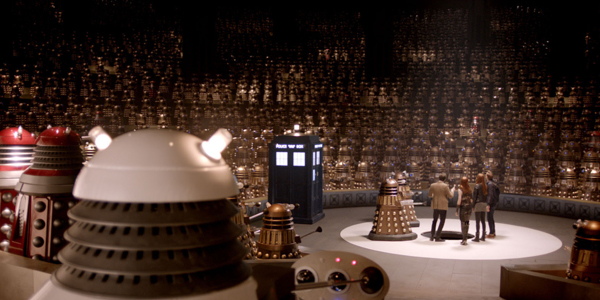 'Asylum of the Daleks' was a divisive episode for Moffat and Who alike; on the one hand, the heartbreaking Oswin story introduced Jenna-Louise Coleman brilliantly, but on the other, there was so much discontinuity with everyone's favourite foes. Why is it offensive to destroy beautiful hatred now, when in 'Victory of the Daleks', the new Daleks destroyed the old ones? Didn't Dalek Sec say that Daleks had no concept of beauty? And wasn't Skaro destroyed in the Time War? Whilst there are some gaps in Dalek folklore here, 'Asylum of the Daleks' acts as a reset for the old pepper-pots; for the first time since the revival of Who, an empire of Daleks has had time to rebuild their parliament and appoint a prime minister. And if Skaro was destroyed in the Time War - Russell T Davies didn't actually specify that it was - than they certainly have the power now to rebuild it. Clearly though, the Dalek Prime Minister was lying. It's not offensive at all for them to extinguish the mad asylum Daleks; he was just too scared to do it. That's why they sent the Predator, after all.
9. How Could Amy Interact With Amelia In 'The Big Bang'?
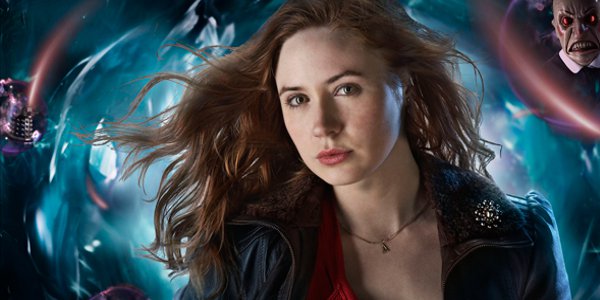 Oh, Moff. We know you don't want to reuse Russell T Davies's themes and ideas, but we had a whole episode about Rose touching herself (not like that) and those Jurassic Park-looking things that stole the inside of the TARDIS. Can you really disregard that? Actually, yes. The Ninth Doctor told us that any paradoxes damage time and the Reapers are there to clean the wound as best they can, even if that means eating wedding guests. But in 'The Big Bang', time was already damaged. The universe was now tiny. Everything in creation had died, minus five creatures, and the Doctor was travelling by vortex manipulator, something he really doesn't approve of. Amy probably shouldn't have touched Amelia's hair, but if it was going to cause that much carnage, the Doctor would've told her not to interfere with her past self when he left the message in her head. Of course though, I have no explanation for why Kazran Sardick could cry into his younger self. Perhaps the planet Ember doesn't abide by the same time constraints? Or perhaps time can be rewritten after all...
8. Why Did It Have To Be River That Killed The Doctor?
 If the spacesuit could function by itself, why put River inside it? Surely it's less hassle to kill the Doctor without the emotional baggage of his wife being the one to do it. Maybe the Silence needed a scapegoat. Maybe it was cleverer to lead the Teselecta to River than it was to take the blame for killing the last of the Time Lords. Maybe the Silence knew it was a fixed point in time and just went along with it, being too scared to tamper with it. If the Silence seem somewhat illogical at times though, remember that they're a religion, not a race; they only have prophecies, not direct instructions. If the prophesy said that River kills the Doctor, who are they to go against it? Ultimately though, River would've killed the Doctor if it wasn't for the Doctor faking his own death: the Silence's part of the plan worked, and River served her time. It wasn't that ridiculous an idea.
7. Why Doesn't The Eleventh Doctor's Screwdriver Look Like The One He Gave To River?
 In 'Silence in the Library', Moffat established a set of parallels between River and the Doctor that would run throughout Eleven's tenure: River was a time traveller too, with a blue diary rather than a blue box, but with a sonic screwdriver to (nearly) match the Tenth Doctor's. But it was the Doctor claimed that it was his future screwdriver. Yes, the Doctor lies, but not about things that he doesn't actually know. He didn't know for certain it was his screwdriver, and it's more than possible that this was one that Eleven designed specifically for River. Maybe the Tenth Doctor created the screwdriver as soon as he got back in the TARDIS and the encounter with River was fresh in his mind. Maybe we've seen the design of the Twelfth Doctor's screwdriver already. Or maybe the design team felt like creating one more in the vein of Matt Smith and not just giving him Tennant's cast-offs.
6. Why Didn't River Recognise That Ten Was Younger Than Eleven?
 On the subject of 'Silence in the Library', River's supposed to have pictures of all the Doctor's faces, but when he first met her, she didn't realise that this was a younger incarnation of the Doctor. What's more, she asks if they've done "The Crash of the Byzantium" yet; how could they have? He hadn't regenerated yet. It's possible that River thought that she was talking to Twelve, and of course, they always meet in the wrong order. But going by facts already established in the show, a Time Lord can recognise another Time Lord regardless of their face; the Doctor did so when he knew that Professor Yana was really the Master in disguise. Yes, River's only half Time Lord, but when she looks into Ten's eyes, she realises how young he is. Not only is this lovely that River can see the 900-year-old beyond the 40-year-old Scottish actor, but it's an insight into how Time Lord driving licenses are checked. Alternately, Moffat could have intended to write another adventure with River and Ten: we'll never know. Well, until November 23rd of course.
5. How Did Mels Find Out Everything About The Doctor From Amy?

4. Are The Weeping Angels At The End Of Blink Really Quantum-Locked?
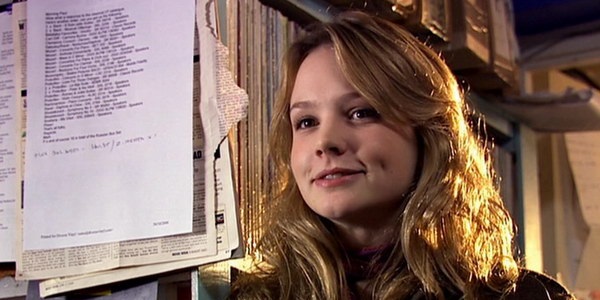 'Blink' is legendary in the Who community. It's an episode of near universal acclaim and terrifying villains, and in the end, the Doctor tricks the Weeping Angels to look at each other, so they can never move again: but can psychopaths as old as the universe really be defeated by an Ikea lightbulb? It's established in the Angels' return that they can turn lights off, but even if they couldn't, how long would that light last? Can't they just chase poor old Carey Mulligan once it dies? The short answer is "yes", the long answer is "yes, and?" These are perhaps the scariest aliens in Who, it just makes it all the more unnerving that the Doctor can never kill them, he can only put them off. If Moffat had wanted us to think they were gone, he'd have had the Doctor sonic the lighbulb; instead he just showed us statues across London and suggested that any of them could be an Angel. It worked: Who fans still stare at statues. But not in the eyes of course.
3. How Can The Statue Of Liberty Be A Weeping Angel?
 And whilst we're on the subject of the Weeping Angels, how can the Statue of Liberty get from one side of New York to the other without anyone seeing it? Well for a start, no one would've been visiting the statue when it started gallivanting around New York, because it was actually closed in 1938 for rennovation (so don't say that Moffat never does his research). Secondly, these are beings of infinite power who have lived possibly as long as Time Lords themselves, and who have built a battery farm for human beings in one of the biggest cities on the planet. Is it that unbelievable that their leader could move without us noticing? After all, they've lived on our planet for centuries and we never even noticed. Maybe it's simply a hallucination of the battery farm. Maybe the Statue is merely the image of an Angel that became an Angel. Or maybe, as Moffat himself put it, "it tip-toed".
2. Why Can't The Doctor Go Back And Visit Amy And Rory?
 Last Weeping Angel one, honestly, but he has a time machine. Is life not simple with a time machine? If you just asked that question, ask yourself another one: have you ever watched Doctor Who? If you're still wondering, watch 'The Waters of Mars'. Watch 'Father's Day'. Watch the rest of 'The Angels of Manhattan', have your heart broken all over again, and then tell me that the Doctor hasn't thought of parking the TARDIS 50 miles away and asking to meet at a service station. Moffat himself explained that he thought the gravestone would be enough to show the audience that this was the end, but clearly it wasn't enough explanation. "Normally he could perform some surgery," Moff said, "This time too much surgery has already been performed. But imagine saying that on BBC One!" Time damages like tissue, and that's why he can't go back; he might put another dent in the 80s.
1. Why Would The Silence Explode The TARDIS If It Meant Blowing Up The Whole Universe?
 Okay, Moffat's never told us on-screen that the Silence exploded the TARDIS, but it's implied a lot. Or maybe he has told us, and information about the creatures has erased itself over time. But knowing what we know now from 'The Name of the Doctor', the Silence's plan makes a bit more sense. If silence had fallen when the question "Doctor Who?" had been asked, the Great Intelligence wouldn't have changed the entire course of the Doctor's life. A world without the Doctor didn't just see the end of creation, it saw every victory turned to a defeat. And maybe no universe at all is better than a universe in which the Daleks, the Cybermen, the Weeping Angels, the Sontarans, the Ice Warriors and the Great Intelligence all rule supreme amongst others. All the Silence were trying to do was to prevent another 'Turn Left'-type scenario; it's like when Moriarty killed himself to make sure Sherlock wouldn't find the answer to save his friends. They had to kill the Doctor, because no creature could fail to answer or answer the question falsely. So actually, the Silence are sort of admirable, despite being evil and weird-looking.