Doctor Who: 6 Polarizing Episodes Of Mark Gatiss
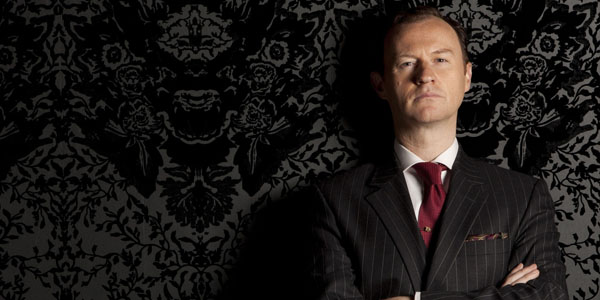 When you look at Mark Gatiss as a person in many interviews to do with Doctor Who, you see a man with a clear care and passion for the show. He clearly knows what he's talking about and is capable of capturing the classic series sensibility when he's at his best. The fact that he's the mastermind behind the upcoming docudrama about the creation of the show fills me glee. The more press pictures and behind the scenes content of the drama I see the more excited I get. Which is why it's so baffling to me as to why his episodes quality wise are so polarizing. For every good episode he writes, a mediocre- bad one is not so far around the corner. So here are my thoughts on his six episodes so far and what we can really learn from these and likewise himself as a writer. 6. The Unquiet Dead - A Pretty Good Start
 This is universally seen as a great story, and why shouldn't it be? It has all of the classic traits of what makes what we see today as classic Gatiss, the historical setting, creepy villain, atmosphere and strong characters. Not to mention meeting a famous historical figure but taking him into territory you could never imagine him in a premise that wasn't Doctor Who. Where else are you going to find an author's entire sense of reality going kaput after finding out that the fiction he writes about is to some extent real? With this story you have everything that makes a good one, a well rounded and creepy alien that actually makes you think and discusses the morality of whether it's better to help a dying race of aliens or preserve the human condition after death out of respect. Even Rose to some extent comes across as a nicer person for once thanks to her interactions with Gweneth. Even though her argument against the Doctor is nonsense and they did have to make the Gelth evil to try and poorly attempt to make Rose right, in spite of that never really being her argument to begin with. But I can't really fault the episode for that, after all this script probably had RTD's influence in it after all to make his Mary Sue right. And you should judge the episode based on how well they convey their message, not whether you agree with said message. Overall this is a fantastically well written story with some great characters, villains and is simply a great example of a classic.
5. The Idiots Lantern - Meh
 This one is often seen as either really bad or really good, I just find it a little weak. The premise is interesting and the Wire could have been chilling, the problem with this episode is in the execution. Mark Gatiss is known for his dark comedy the League of Gentleman and some of his greatest work as a writer is displayed in that series. I feel like the Wire would feel right at home in an episode of that show. It's almost as if he's trying to achieve an unnerving and creepily funny premise but due to it's execution, you just don't know what to feel. The Father/ Son subplot feels really underdeveloped and just seems to paint the Father as a babbling one dimensional bad guy. The Tenth Doctor and Rose's interactions in this one feel incredibly obnoxious especially at the beginning. The whole thing just reeks of emptiness, it's not bad, it just feels awkward and out of place. There were some great ideas but they got lost in the execution where the tone of the episode feels really disjointing. Again, not bad, or good, just meh.
4. Victory Of The Daleks - It's Not As Bad As Some People Seem To Think
 Let me first start off by correcting a few misconceptions about this story that some people seem to have. This is not in anyway an objectively bad story. It's not perfect of course, and there are problems with it. But as a whole for what it is there really isn't anything to hate about it beyond the cosmetic. And for the sake of my sanity I'm going to discount the Dalek redesign because in reality, that's all anyone who hates this episode talks about. They seem to ignore that there is a 45 minute episode in here full of other (and really great) stuff. There is one problem with this story, and it's a problem that you can't really pin on Gatiss when you think about it. To prove my point here's a list of everything he had to do in the space of just one 45 minute episode. -Introduce the war time setting - Winston Churchill's relationship with the Doctor, as well as give characters in the bunker screen time to establish themselves in order to show the personal stakes of the war. - Introduce the Daleks - analyse and discuss from both sides whether regardless to where their loyalties lie if they should be used in the war effort. - Have the Daleks reinstate themselves as a credible threat and have the Doctor confront them. Have them create a threat on a global scale that could cause mass destruction on top of the war itself and for this plan to be thwarted. -Ensure the Daleks restore themselves to a position of power and escape to open up their possibility to return future episodes. -Have the Doctor reestablish his relationship with churchill and provide a satisfactory conclusion to the characters in the bunker. He had to do all of this in the space of one 45 minute episode, something in the writing has to give way in order to cram all of that in. You have premises there in one bullet point that could potentially carry one episode on their own, let alone be one tiny element in one story. My argument with this is that Gatiss did the best job he could with the poor hand he was dealt with. If this episode had been longer or even a two part story, I'm confident that it would have probably been a much stronger episode. However for what the episode is, it is still pretty good, but all of the problems with the episode, the rushed ending, reliance on quick fix plot solutions (spit fires in space and convincing the Bracewell robot he is human) and general lack of development (all of the war officers should have had more screen time for their characters) all boil down to a lack of time to tell the story in any other way. But what is there is good, the war time setting and the Daleks matches both the icons the Daleks are in this setting as it draws from their initial inspiration and makes for an interesting premise. You've got some great Doctor/Dalek interaction here that we haven't really seen since series 1 seeing as the last time we saw them the Doctor had pacifism thrown into his character for no real reason. Not to mention Churchill as a character was excellent, the war time atmosphere and execution of the time period was well handled. And the Daleks for the first time in the new series were portrayed more as intelligent and cunning as oppose to this big overly bombastic threat they had been in the past years. They took a back seat and allowed to use the Doctor's hatred of them to their advantage rather than the other way around which gives them a new layer of depth that hadn't been seen since Power of the Daleks in 1966. I can't say I didn't enjoy this episode despite its flaws, what is there is great, the problems only really lie in the time it was given to tell the story it needed to. At it's best it's a decent story, at its worst it's a story that didn't quite live up to it's full potential because of circumstances that were out of Gatiss's control.
3. Night Terrors - Weak
 Not really much to say about this one, other than it just feels really weak. The story is uninspired and has been done to death, the young child suffering from nightmares with an alien intervention twist is almost cliche at this point. Although it's much less intelligence insulting than Fear Her. It would probably have been a really well made piece of drama had it been made years earlier, but for what it is it just comes across as uninspired and lackluster. The resolution is bland, the Peg dolls are a little bit creepy but don't get enough screen time or come across as a big enough threat to warrant the hype they got. There were some scenes that were classic Gatiss such as the floor sinking sequence but like Lantern, it's an exercise of great ideas executed poorly. The strongest elements of this episode are Matt Smith's and Daniel Mays' interaction with one another, it's not bad per-say, just uninspired and weak.
2. Cold War - Classic Base Under Siege  This episode is probably my overall favorite episode of series 7, this is a textbook definition of a classic style base under siege story that actually both works as an episode and makes the Ice Warrior's better creatures. When your story actually adds layers and dimension to an already popular and strong enemy, then you know it has the makings of greatness. What I like about this episode is simply the atmosphere and tension it creates. The claustrophobia of the submarine is well captured and serves as a worthy back drop for the almost alien-esque sequences involving the Ice Warrior out of it's suit. I also love the lack of over emotion and arc heavy pandering that tends to plague the new series in every story, this episode feels like it could very easily fit into the classic series. It reintroduces the Ice Warrrior's in a familiar but brand new light at the same time, the redesigned Ice Warrior is a thing of beauty. I'd go as far to say that this is the best episode of Who Gatiss has ever written. And if anyone has ever any had any doubts about Gatiss's ability to write for the show really need to give this one another watch. The only negatives I can find are the Ice Warrior head reveal- not just because they should have left it unseen, but because of the use of CG. And a lack of stand out moments for Clara, but that is true of pretty much all episodes in series 7 after St John. However these small things are no where near a big enough problem that it renders the episode bad, it's more of a small niggle in an otherwise brilliant story.
1. The Crimson Horror - Eugh!
 I was kind of expecting this one to not be as good as the last, mainly due to the obvious pattern I could see in the Gatiss episodes, but I wasn't expecting a bad episode like this. It felt like it was an arc episode written by Russell T Davies rather than a usually dark, sinister and vaguely amusing entry that you'd expected from Gatiss. Everyone was incredibly hammy and over the top including Diana Rigg and the problem of the dark humor being executed poorly is amped up to about 10. This honestly felt like a parody episode, there is credence and credibility in here. I do like Vastra and Jenny and even Strax and Gatiss does do their character's justice to an extent (minus the Thomas Thomas nonsense). But Clara barely does anything and Smith's Doctor appears to be his most out of character in this episode when he tried to kiss Jenny and gets a slap in the face, (that's something Ten would do, not Eleven). If this was intended to be a backdoor pilot for a spin off, I don't think Gatiss is the right person for that job. Where this episode fails in the plot, it's incredibly generic and weakly executed and it suffers from a rushed ending like all series 7 episodes did (if you want a movie of the week series, make the episodes long enough to tell the story they need to). Overall this one is probably Gatiss's worst, it is bad but there is still greatness in here, it's mainly the plot and the way it's executed that doesn't work. Overall conclusion: As a whole although Gatiss is polarizing, for every bad episode he writes a good one to counter it. It is very hard to tell why these problems in his bad episodes occur, for all we know it could be the direction or the show runners edits. However with all that is said and done, even in his worst episodes have something to like in them. I actually think that once Steven Moffat steps down then Gatiss should at least be given a shot at running the show. We've had writers that can write cracking episodes turn out to be not so good show runners. Who's to say that the only problem with Gatiss might be the very opposite? He clearly does some amazing work on Sherlock and he's the co-writer on that show. He clearly understands the show and has a passion for it. If I was working for the BBC I'd at least consider Gatiss as the next show runner, for all we know we could be pleasantly surprised.