Game Of Thrones Season 7: 10 Ups And 3 Downs From 'Beyond The Wall'
“Walking’s good. Fighting is better. F**king is best.”
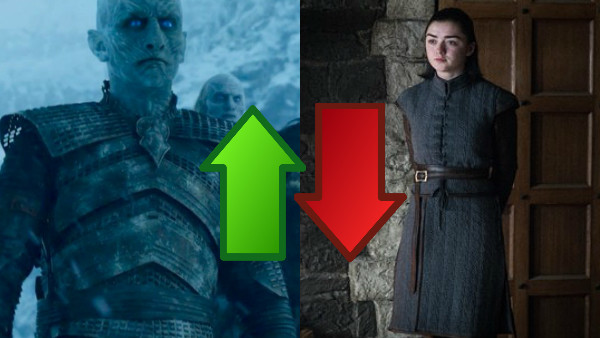
Even in a shortened season, the penultimate episode of Game of Thrones lives up to its billing.
The 'ninth' episode (even when it comes as the eighth (as with Hardhome) or, as here, sixth in a season) is the biggie, and the show doesn't deviate from that formula here, even bringing back Alan Taylor - the man who directed the first ever ninth episode, Baelor - to helm it.
As the title indicated, the focus of this instalment was on the Magnificent Eastwatch Seven striding beyond the Wall to capture a wight, in what was the worst idea in a season of terrible plans - and, of course, it all goes accordingly to that.
It wasn't a one-location episode though, as some penultimate instalments have been. There were also further rising tensions between Arya and Sansa at Winterfell, and some terse moments with Daenerys and Tyrion, but King's Landing was left off the board this week.
Befitting its placement in the season, and the clash between the living and the dead, Beyond The Wall offered up some exhilarating thrills and icy chills, but also a fair bit of frustration as well.
10. Shared History And One-Liners

One of the reasons these seven warriors coming together was so great is the shared history between them all: whether it's something we've seen in the show, like Gendry and the Brotherhood, or happened way in the past, like Thoros and Jorah.
Like Eastwatch, this episode uses that to its great advantage, leading to a stellar opening as the various members of the group catch-up a little more and talk through their issues, such as some further explanation of the Siege of Pyke.
It helped deepen the unity between these seven characters, which then made the disaster they faced together all the more meaningful, as well as showcasing the density of this world created by George R.R. Martin (and brought to screen by David Benioff and Dan Weiss).
It also allowed for some epic one-liners and conversations, most of which came from either Tormund or the Hound, who came to their own startling connection: Brienne of Tarth. In a heavy episode, they provided moments of levity and reminded us why we love them so much (I really thought Tormund was a goner this week, and while you can argue about the show's reluctance to kill off characters, it's a delightful relief that he lives on).
"Gingers are beautiful. We were kissed by fire. Just like you."
9. Jorah And Jon
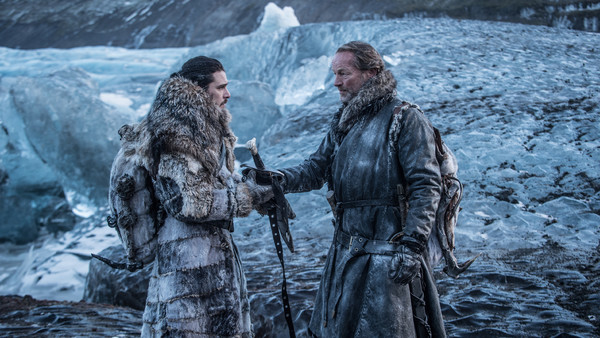
Of all the character interactions between the seven heroes, the one that really stood out (beyond humorous purposes) was the one with Jorah and Jon.
Jon did what he probably should've done last week (or during the boat ride up, maybe) and discussed how he has Longclaw, which by right belongs to House Mormont, and offers it back to Jorah.
It makes for a scene full of pathos, with Iain Glen particularly excelling - he's one of the real MVPs of the episode - and leads to Jon confronting his future, something he's never done much beyond the fight with the Night King. We also saw them touchingly reminisce about Jeor Mormont, and all of this paid off when Jorah stepped in to help save Jon during the battle.
8. The Wight Bear
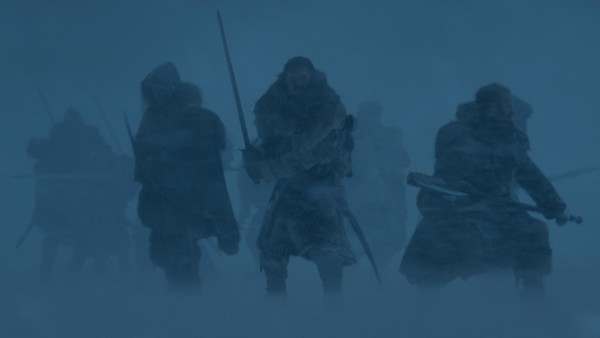
The first serious action in Beyond The Wall came as a bit of a surprise, but certainly a welcome one. Spotting what appears to be a bear in the distance, it turns out that, of course, this animal is no longer living, and we get our first thrill.
The wight bear attack is an excellent first challenge - D&D did go a bit D&D with this mission - and sets the stakes for what's to come later, while giving us an exciting moment in its own right.
There's a little bit of fun in seeing Tormund take on a bear, given his history with the species (let's assume this wasn't Sheila), but mostly it's a solid action sequence that shows what the heroes are up against, and further establishes that it's not just undead men they have to face (and we (or at least I) can be VERY thankful it wasn't an ice spider).
7. Thoros' Death

It seemed nailed-on that at least one of the Eastwatch Seven was going to die in this episode - they had to really, given the stakes. And with that being the case, Thoros was always the most likely to perish.
He was the least recognisable and beloved of the group, which made his death easier to do than offing one of the others (either Tormund or Beric could've died if they really wanted to crush us, and I'd say should've done had a dragon not been killed).
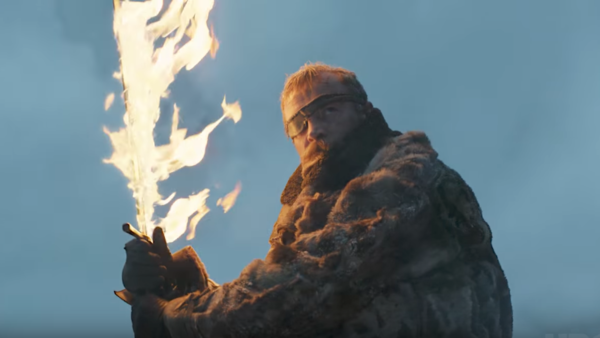
Thoros' death was very well handled though, even if it was heavily signposted when he picked up an injury. We got some references to his past, got to see the impact on Beric, and enjoyed some moments of fiery-sword greatness before his flame was extinguished for good.
6. The Wights Attack

The whole purpose of the mission was to capture a wight, and they actually got one fairly quickly, managing to tie it down but not keep it quiet.
It was never going to be easy, and a handful of wights turns into uncountable numbers as death comes for our heroes. It allows for a thrilling sequence with a few heart-in-mouth moments as the Westeros Avengers are backed onto a lake and desperately fight for survival.
It once again sees the show proving how well it can do zombie action (though it's not quite as well shot as Hardhome), and provides a lot of the episode's excitement.
What's really important here, though, is that the rules have seemingly changed. It's not just fire that kills wights, but Valyrian steel and dragonglass - and a war-hammer seems to at least do some serious damage too - and, even more crucially, that killing the White Walker who made them kills all the wights (presumably the one they captured just happened to be different from those around it).
It's similar to another epic work of fiction (which will be coming to screens one day), The Passage, with the White Walkers becoming The Twelve. And the one that really matters is the Night King (Zero, in this comparison), and this (and a later moment) really establishes why he's so important. This was a big episode in terms of the series' endgame, and we got some vital new information for that.
5. The Heart-Attack Inducing Tension
Alan Taylor made his big return to Game of Thrones this week, with Beyond The Wall his first episode since he made the transition to the big screen and directed two pretty terrible films.
Thankfully there are no Thor: The Dark World or Terminator Genisys level issues here, and Taylor does a good job that harks back to his previous episode 9, Baelor, albeit in a very different setting.
He does a great job of building and layering tension throughout the whole episode, with a number of moments bringing you up to heart-attack levels of anxiety, and then relieving it just enough that you can relax for a moment before it starts to rise again.
It makes for complete edge-of-your-seat viewing, and is combined with some absolutely stunning snowy vistas and aerial shots of the land beyond the Wall.
4. It Sets Up A Great Finale - And Season 8
The episode, for all the dragon-killing drama, had one specific purpose: have these characters get together, capture a wight, and take it to King's Landing to convince Cersei of the real threat.
Next week, which the promo has showed only the tiniest, tantalising hint of, promises to be epic in a completely different way to this episode or The Spoils of War. Thanks to this setup, we're now going to see, to name a few, the following characters all sharing the screen:
Daenerys, Jon, Tyrion, Cersei, Jaime, the Hound, the Mountain, Bronn, Davos, and probably a number of others.
There should be enough drama in the Dragonpit alone to fill a lot of the finale's extended runtime, and while there have been some questionable decisions in order to get there, we should be receiving a lot of payoff to this week (and that goes for the threat that remains beyond the Wall too) and those that have preceded it.
It also does the most of any episode to setup the final season since Hardhome. Eventually, and for better or worse, the squabbles and differences need to be put aside to take on the White Walkers in a battle of ice and fire, and we got out biggest taste of that yet.
3. Ice And Fire
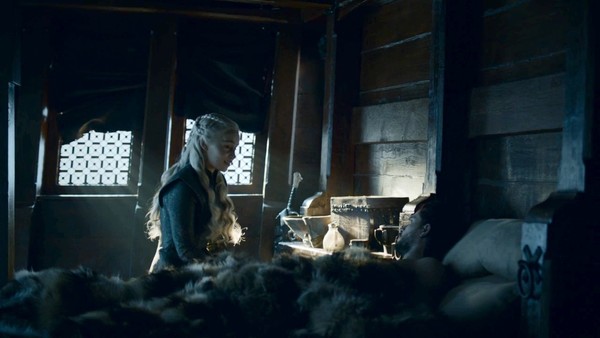
Is the show really going to commit to a Jon and Dany - sorry, Daenerys - relationship? Should they?
Based on the ending to this episode, the answer to the first question is yes. The answer to the second is more complicated. Judged on the fact that they're related, then no, they probably shouldn't, and it's also a bit of a cliche to have the main two heroes get together.
But then, the scene between them at the end was so strong you almost forgot about how incestuous it is. The show's gradually been seeding more and more chemistry between the pair, and those sparks are really allowed to fly in this bedside moment.
It was affecting, romantically and emotionally charged, and rather important for the story going forward, as well as the strongest scene yet between Emilia Clarke and Kit Harington - people might complain about a lack of major death, but it sells the idea of how much this has hurt Daenerys brilliantly. I could still see a scenario where they are forced apart because they're related - it's hard to see Jon especially get on-board with that, and Alfie Allen previously mentioned a Star Wars-like reveal, so perhaps this is the Luke and Leia romance - but it's actually going to be fun watching it teased out.
2. Ice Versus Fire

We got an early look at Season 8 with this episode, which for the first time ever brought together the two most literal representations of ice and fire: the White Walkers and the dragons.
That is a huge deal, and thankfully the show handles it well. Once again the effects work on the dragons as they blast through the dead army is great, with visual splendour (and let's not overlook Dany's new outfit, because Michelle Clapton is killing it this year) up there with what we witnessed in The Spoils of War (and the fire cutting through the ice is a particularly great touch), and just as brilliant is how much chill (pun...unavoidable, really) the Night King has when faced with these beasts.
There were rumours even last year that a dragon would die beyond the Wall, but when so much gets 'leaked' it's often hard to know what's real and what isn't. This was very much real, but it didn't spoil the shocking impact of seeing a dragon hit by a, er, magical ice spear thing, and die.
The White Walkers have long been this far off threat, with only Jon and a handful of others knowing they're real. This step brings them much more into the fold, gives Daenerys a real reason to fight them, and shows us just how ridiculously powerful the Night King is. And it had to be Viserion who died, since he was named after such a horrible character.
1. The Ice Dragon

While a dragon dies, it doesn't stay that way. Ignoring, for now, just where the wights got those massive chains from to pull the beast out of the water, we get the biggest moment of the season.
We've had characters colliding and an epic battle, but so far nothing beats a dragon being reanimated by the Night King. The sight of that one eye turning blue was both awesome and spine-tingling.
It opens up a multitude of questions - is the Night King now the third head of the dragon? Could Bran warg into it? Wouldn't an alive dragon just be able to quite easily kill a wight dragon with fire? Does a wight dragon breathe fire, ice, or nothing at all (being dead and all)? - and is obviously the biggest blow ever dealt to Daenerys, radically shifting the stakes of the Great War.
Downs...
3. Arya's Turn On Sansa
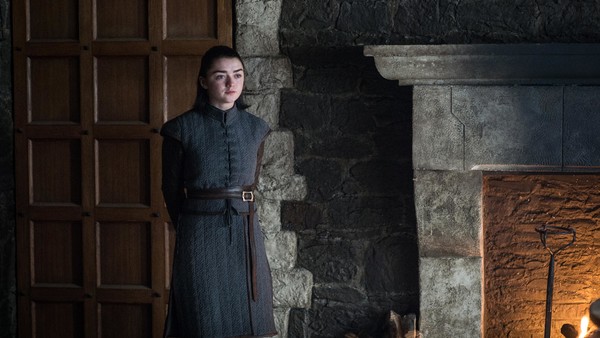
Arya confronting Sansa about the letter made sense, as understandably there'd be some conflict there. Arguably even then Arya should be a little more forgiving, since Robb, Catelyn et al all waved the latter away as Cersei's work, but it does fit with the difficult relationship they always had. Again, there's an argument to be had about how quickly that's happened, and a lack of meaningful conversations about what each of them has been through since they were parted.
What really didn't fit, however, was their final scene of this episode, when Sansa discovers the faces in Arya's bag (and she thought Bran was the creepy sibling), and her little sister starts to threaten her life.
It's a huge leap from a confrontation about a letter to 'I'm gonna wear your face', and also paints Arya - one of the most interesting characters in all of A Song of Ice and Fire - as a somewhat cartoonish villain, like a caricature of a Faceless Man playing Arya. Maybe this is all some sort of plan to trick Littlefinger, but even if that is the case, it's not really worth the damage to these characters in the meantime.
2. Benjen Ex Machina
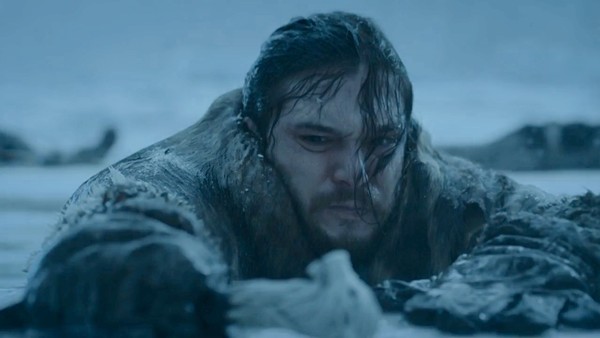
"We'll speak when I return."
Those were the words Benjen said to Jon at the Wall, before he went off on the ranging mission that would ultimately cost him his life.
Benjen finally returns to Jon here, to save the day in almost the exact same way he did last year with Bran. And then, before more than a shocked "Uncle Benjen?!" can be uttered, they're parted again, and Benjen goes to what could be his final, proper death.
The dragons flying in to save the day could be seen as something of a deus ex machina, but at least they serve a real narrative purpose (one dies, Dany understands the real threat, we get the fight battle of ice and fire).
Benjen, however, appears out of absolutely nowhere and is gone almost just as quickly. There's no real meaning to it, except to save Jon (because obviously he was never going to die or get left there), but if you're going to do that, just have Rhaegal come down and save him - thus establishing a connection between Jon and the dragon named after his father, which could be very important later on - rather than this (barely-even-counts-as-a-) reunion.
1. The Leaps Of Logic
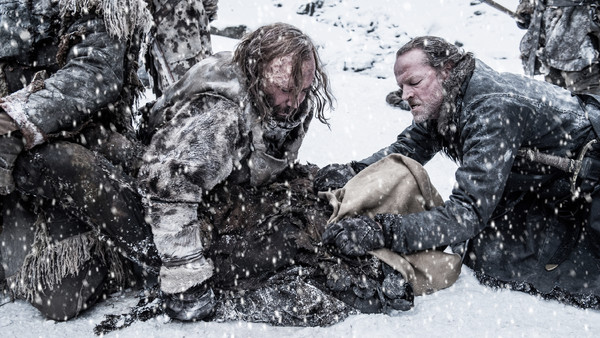
Game of Thrones has been making some frustrating moves this season, with bad decisions and, more noticably, characters zipping around all over the map. For the most part it's been easy enough to ignore (speaking personally anyway, though plenty have been very annoyed by it).
Beyond The Wall feels particularly egregious in that regard, to the extent it's a lot harder to ignore. Jon sends Gendry running back to Eastwatch (four years of cardio paid off, but how does Jon know he's the fastest? I guess it's a fair assumption, but still), he sends a raven to Dragonstone (who the hell is Eastwatch's Maester?), and Daenerys flies in with her dragons to save the day. Just how fast are ravens these days?!
Then there are the issues that come down to the whole idea in the first place. It's a terrible plan, and not at any point does someone question whether Cersei - y'know, the *Mad* Queen - will listen to any of this. They also apparently didn't expect to encounter such a large army of the dead, despite Jon going on about it for so long, and made no contingency plans. Why didn't they ask Daenerys for her dragons before the sh*t hit the fan? Why can't anyone try and ask Bran for some information about any of this?
This all serves to push us into the season finale, which to be fair looks epic, but there are some very frustrating leaps of logic here. The payoff should be worth it, but also Thrones should be better than this. Discussing the Benjen moment, David Benioff said:
"The thing with Coldhands is it allows us to work in a pretty compressed time frame because there just isn't time."
Therein lies the real crux of the issue with this episode, and Season 7 as a whole. When Benioff and Weiss announced they were doing just seven episodes, it seemed like a fair move. They knew how much story was left, after all, and HBO weren't going to drag it out for the sake of money.
The longer the season has gone on, though, the harder that decision becomes to understand. Some narrative elements work in the context of 'well, there are only seven episodes', but it's a qualifier that doesn't really need to exist. Doing 10 episodes would solve a number of this season's issues, make the storytelling more satisfying, and there's easily enough material for it, and this being the penultimate episode highlights that more than in previous weeks.
What did you think of Beyond The Wall? Let us know down in the comments.