Red Dwarf: Ranking The Time Travel Episodes From Worst To Best

Laws of time and space? Let's give a smeg!
In the long and celebrated history of British sit-coms, Red Dwarf has to be the most unique. On the one hand it follows the tried and tested formula of laddish antics, which made shows like Porridge and Men Behaving Badly so popular, but it stood out from the crowd thanks to its particular situation of lads in space. This far out setting enabled the show to go where no other sitcom had gone before, and throughout its ten series the show has produced some of the most original science fiction ideas ever broadcast. New concepts such as the justice zone, psi-moons and white holes are an integral part of its charm, but they also featured alongside classic sci-fi staples; everything from parallel universes to shape shifting monsters were lampooned, and given a fresh spin through the comedy lens. Temporal phenomena were undoubtedly the most prolific of these standards though, with a large percentage dealing with wormholes or time wands of some description. From witnessing historical events, unravelling paradoxes, and meeting their own past/future selves, some of the shows biggest laughs come from theoretical physics' biggest head spinners. With a rich history in the past and an eleventh series due in the near future, what better time than the present to look back at those timeline tangles...?

Honourable Mention: Future Echoes

With the amount of episodes that dealt with the notion of time, not all could see the crew jaunting through the fourth dimension. Future Echoes is the most prominent of these, but it still had to be included here somewhere due to time being so central to its premise. Another reason it can't be omitted is because of just how brilliantly it treats the concept; when Red Dwarf passes the speed of light it causes the crew to catch up with things they're about to do before they've actually done them. Offering glimpses of what shall be going to happen, this particular episode embraces the theories of time dilation and predestination paradoxes not just in a funny way, but also one which proves the show has smarts way above the levels of other sit-coms. These culminate in Lister preparing for his own death, only to survive and be told by his 171 year old self that Rimmer instead witnessed the death of Bexley, Lister's son. At the extreme end of theoretical physics, temporal paradoxes have the potential to confuse and deter audiences, and it was a brave move to base the second ever episode around them so implicitly. Without lingering too heavily on the science however, Future Echoes proves that the show knows how to utilise these ideas for great comedy, great tension, and prove to casual viewers that science fiction doesn't have to be alienating.

9. Rimmerworld

Complications aside, there are several episodes that just use the idea of time travel as a tool to set up a premise which would then be left to its own devices, one of which was Rimmerworld. After travelling through a wormhole and arriving on a desert planet 600 years before he can be rescued, Rimmer populates his new home with countless clones of himself. A series six episode which is often overlooked for the simple reason that it isn't really worth remembering. The episode essentially reused ideas that made up Me2 and Terrorform, which when combined here are less than the sum of their parts. Not only is the initial scene in which Kryten diagnoses Rimmer's dangerous levels of stress far too long, but so is the entire build up to the central premise: Arnold J. doesn't land on the titular planet until 18 minutes into a half hour episode. In addition to this, from a show which generally tries to address to them, here we are given an episode which butchers the laws of physics for the sake of jokes that aren't funny. Despite going through exactly the same wormhole in exactly the same manner, Starbug doesn't encounter any of the same effects, and the Simulant's teleporter also jumps randomly through time for no reason. Combined with an over reliance on jokes about handling balls, an episode selling itself on the idea of a planet full of Rimmers is just as uninviting as it sounds.

8. Backwards

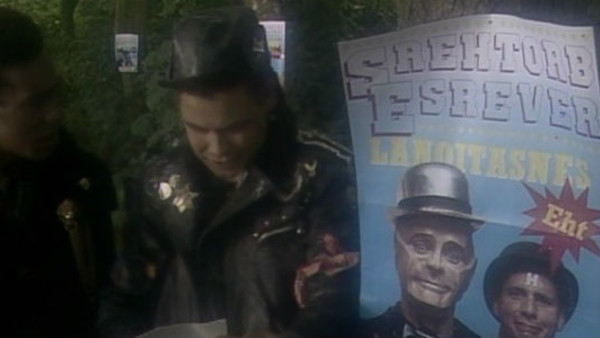
The beginning of series three saw the show develop in a new direction; the opening title was radically altered, Kryten joined the cast as a regular, and Holly came out about his/her genderfluidity. In addition to the lack of a proper explanation for all this (the Star Wars style scroll that goes too fast to read was hardly worth it), an episode which is just a one trick pony wasn't the best of new starts. Putting a unique spin on the idea of a futuristic sci-fi show visiting contemporary Earth, Red Dwarf formulated its own plausible development of a well documented scientific theory; if the universe will one day contract, wouldn't this apply to time as well as space? Thus the crew land when everything happens in reverse, making Lister think they're in Bulgaria. Despite the great theory there's hardly any variation in the jokes, with some set pieces even struggling to qualify for that description. There are some clever moments though, the climactic bar room tidy in particular is well thought out and superbly executed. The highlight however has to be Lister and Cat's discussion about Wilma Flintstone: a simple but hilarious bunk-room conversation that reassured audiences that despite all the changes, Red Dwarf was still the same show at heart.

7. Tikka To Ride

Picking up where the previous series' cliffhanger ended (more on that later), Lister replaces Kryten with a spare head and removes his guilt chip so that he can reacquire a time machine in order replenish the now missing curry supplies. Unwittingly landing in Dallas, 1963, the crew accidentally push Lee Harvey Oswald out of the window and create an alternate future in which the Cuban Missile Crisis was decided in the Soviet Union's (and the mafia's) favour. An episode which featured some great ideas, it doesn't quite pull them off thoroughly enough, leading to too many unanswered questions. Although guilt free Kryten gives the episode some of its biggest laughs, and several memorable moments of disgust, the exact relationship between spare heads and the 'actual' Kryten is never properly explained. More than this though, the fact that JFK himself becomes the mysterious second gunman is a very novel idea, but one which goes against the episode's internal logic; Lister's introductory monologue is based entirely on the fact that you can't kill yourself in the past. The X-tended version also revealed the paradoxical nature of Lister's missing curries, but likewise came at the expense of not ending the episode on a natural resolution.

6. Timeslides

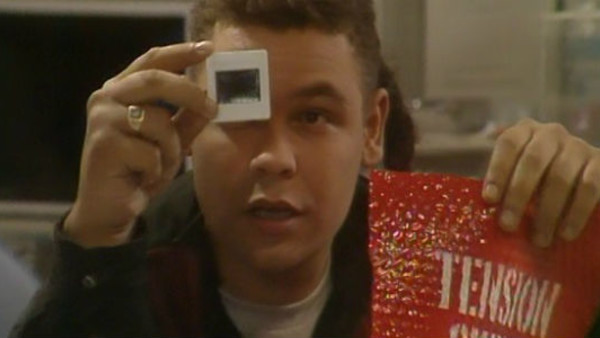
There have been countless ways in which Lister and co. have manipulated the space time continuum, and Timeslides features the most Red Dwarf explanation of all: mutated developing fluid. Able to visit any period of time they have a photograph of, Lister then gives his 17 year old self an invention that makes him rich beyond his wildest dreams. This creates a timeline in which he marries supermodel Sabrina Mulholland-Jjones, and lives in a mansion complete with larger than life statue of himself that urinates champagne. As the first episode to feature the idea of actually changing time, it doesn't hold up as well as those which came after it. Suspending enough disbelief to accept that Rimmer can climb through a photograph into an alternate reality where Lister is filthy rich isn't a problem, but his appearing in a room with no camera is. The inclusion of Hitler in a time travel scenario is also rather cliché, although his special guest star credit as himself does raise a few laughs. These points aside it does finish on a high; bringing yourself back from the dead only to kill yourself mere moments later is something that could only happen to the serially unlucky Arnold J. Rimmer. But then perhaps that's exactly what he deserved.

5. Lemons

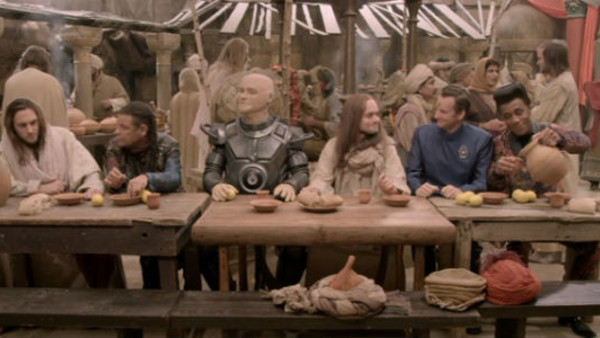
After the disappointment of Back To Earth, it was understandable that many thought series 10 would be just as bad. Thankfully, that was not the case however, and Lemons was just one episode which showed that lessons from the mini-series had been learnt. Combining the Red Dwarf everyone knows and loves with The Life Of Brian, this particular episode saw the dwarfers entangled in a case of mistaken historical identity. By focusing on Jesus of Caesarea, Son of Rachel the Fornicator and Samuel the Chicken Stealer, touching on the idea of religion was inevitable. This allowed Rimmer to expand upon his parents' previously mentioned "faith hop and charity" beliefs, with their adhering to the Church of Judas also explaining his rather unfortunate middle name. Not one to take the subject lightly, Jesus pointing out apparent inconsistencies in the ten commandments in an attempt to discredit them was a brave move. The drastic ending which sides with the Church of Judas' beliefs is cushioned in the credits however, listing actor Tom Paper merely as "Man who may be Jesus & Judas". A fairly unique episode in terms of setting and subject matter, but one which the humour comes from the still there camaraderie between the characters, which is present throughout.

4. Ouroboros

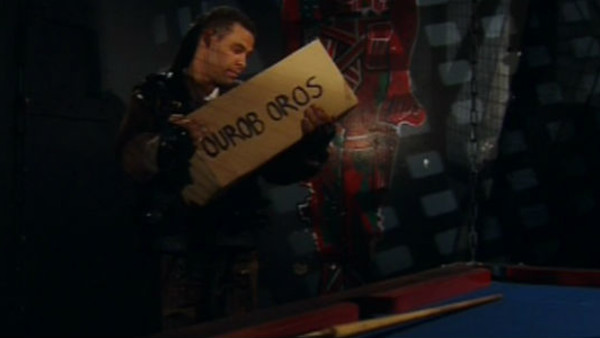
Despite being a comedy, Red Dwarf still proved it took itself as seriously as other science-fiction shows by adhering to its own sense of continuity, something best seen in Ouroboros. Not only does it feature the revenge of Lister's Gelf bride from Emohawk (itself a semi-sequel to Polymorph), but it also establishes the origins of Lister's unique history. It had been a long running fact throughout the show that he was an orphan who had been abandoned under a pool table, and here we see that baby Lister was left by none other than adult Lister himself. He is in fact his own father, his ex-girlfriend is his mum, and as the last human being alive it created a paradox in which the human race could never become extinct. It also lead to the hilarious Fathers and Suns, a series 10 episode which capitalised on the idea so magnificently. This was just one way in which the reintroduction of Kochanski injected the show, which was now up to its seventh series, with a new lease of life. Whilst still filling the same role as recently departed Rimmer (pretentious boarding school graduate who goes by the book), the inclusion of a female presence in an all male environment opened the door to a whole new level of humour.

3. Out Of Time

Based around a simple premise in which the crew scavenge a time machine from a derelict science vessel and meet their pompous future selves, Out Of Time is an episode with several stand out moments. The unreality bubbles used to deter looters is one of the most original ideas Red Dwarf came up with, the 'disappearance' of Cat even sending up the idea which had only just been introduced. Likewise travelling to the 15th century but still remaining in deep space is a simple moment that parodies decades of science fiction staples, yet also works on its own merits. What the episode is really remembered for however, is the crew's confrontation against their future counterparts. They have all become materialistic and self-centred, Cat is balding rather rapidly, and the only one who hasn't put on any weight is Lister, who is now just a brain in a jar. At the end of the sixth series, Out Of Time also features the show's most memorable cliffhanger when their newly acquired arrogance see the future Dwarfers destroy their past selves. A To Be Continued which would wait over three years for its conclusion, it also shocked viewers thanks to the fact it was none other than Rimmer who first chooses to fight and takes bazookoid in hand in an attempt to save the day. Better dead than smeg indeed!

2. Stasis Leak

The first example of the crew being able to travel back in time and interact with their past selves occurred thanks to series two's Stasis Leak. After trying to adequately explain deck 16's anomaly in the space time continuum to Cat (and the audience), Rimmer and Lister settle on simply "a hole back into the past", and each tries to influence and improve their lives. Arriving three weeks before the nuclear meltdown which killed the crew, Rimmer attempts to convince his past self to enter stasis and thereby survive alongside Lister. His efforts are applaudable but his rather long winded description of cause and effect merely convince him that he is just having another hallucinatory trip from Lister's Titan Mushrooms. Lister meanwhile, having previously found a wedding photo of him and Kochanski, sets about marrying the love of his life only to discover she in fact marries yet another Lister from the future. Causality is also interwoven with classic Dwarf humour, the other side of the magic doorway being located in the men's shower room for example, and Rimmer's barrage of Captain Hollister dressed as a chicken has to be the funniest scene ever between the two. Often overlooked by the Lister/Rimmer double act, the Cat here also has some great moments to shine; his understandable confusion at time travel is hilarious, and his first encounters with particular aspects of human civilisation (women included) are spot on.

1. The Inquisitor

With such a huge scope, it is no surpirse that Red Dwarf evolved over time. Series five and six in particular often went with the "monster of the week" format popular with episodic science fiction. While this was a far cry from the bunk room double act scenes of its origins, it did see the introduction of several unique antagonists, the best of which was undoubtedly the Inquisitor. Seen on-screen right from the start, there is no waiting around to be introduced to the titular simulant's raison d'etre of replacing those unworthy of existence. Bringing the idea of an unstoppable time travelling killer robot to a whole new level, details like each person being judged by themselves takes the episode from flawlessly executed, to firmly establishing Red Dwarf's place amongst the sci-fi elite. Going beyond just the idea, you will not find a more perfect exploration of exactly who a show's main characters are, than when the four crew members attempt (or don't) to justify themselves. Another highlight includes Rimmer signing his name with a BSc which stands for Bronze Swimming certificate, Kryten's "don't tell me, I've got it" was inspired by actor Robert Llewellyn's real life trouble with his lines, and the drastic reordering of the timeline was a blessing to any fan who tries to make sense of the show's inconsistencies. Five star rating? It does better than that, it gets fifteen! Which of these episodes is your favourite time travelling episode? Share your picks in the comments thread below.

In this post: 
Red Dwarf
 
Posted On: 
Contributor
Contributor

One man fate has made indescribable