Sherlock: 10 Ingenious Pieces Of Foreshadowing You Never Noticed

Not even the great detective himself would have spotted these.

Sherlock is an intricate show, to say the least. But among all the cases, the clues, the crime scenes and the curious motives, lies the biggest mystery of all: the man himself. In three short series, we've unravelled new layers of the character gradually; the man who nearly died gambling with his life in the first episode, developed into a man who risked everything to bring down Charles Augustus Magnussen, and give his best friends a normal life. There were hints at the plot twists that were to come, but did we actually notice them? Steven Moffat's known for his timey-wimey, twisting arcs that span across multiple series; he ended a Doctor's reign by answering the questions raised in his first episode. But Sherlock is a different kettle of fish; the questions much more subtle, much more character-centric and actually, a lot of them don't matter all that much. They're just nuggets that reveal wonderful details about these characters that we love. Here are ten beautifully elegant uses of foreshadowing in Sherlock, that you might not have noticed before.

10. "What Might We Deduce About His Heart?"
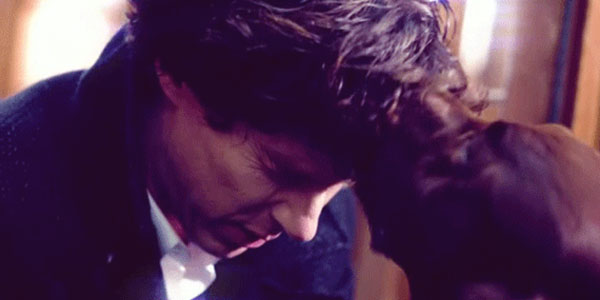
So often, Sherlock revolves around one of the greatest fictional minds ever conceived, but more and more in this show, we're being given just glimmers and glimpses of what the man's heart is like. It's a question openly discussed by Mycroft Holmes in 'A Scandal In Belgravia' in Series 2, shortly after the chapter of Irene Adler. John doesn't know where to begin when deducing the heart of his best friend, and appears, neither does Mycroft. "Initially, he wanted to be a pirate," he remarks though. It's a joke on how much Sherlock's changed, and a comment on how Mycroft will always assume a condescending older sibling position within the show. But it's also very telling, and a series later, we realise why Sherlock wanted to a pirate. Panicking at John's wedding, he phones his brother, uncharacteristically, and Mycroft reminds him of Redbeard, to try and calm him down; just an episode later, we see Sherlock looking for Redbeard in his mind palace. Redbeard is a dog, a much-beloved dog it would seem, that keeps Sherlock calm. There's a mention of having to put the pet down, and suddenly it makes sense: Sherlock wanted to be a pirate, and named his dog Redbeard, but after the dog died, it changed his life. The flippant joke about Sherlock's childhood is Series 2, is in fact a serious deduction from Mycroft; once more, it foreshadows a glance into the detective's heart in 'His Last Vow'.

9. The Music

'Stayin' Alive' by the Bee Gees has always had obvious connotations for Sherlock, but perhaps the song title is even more appropriate now Jim Moriarty's back from the dead. Funnily enough though, there's another song in the series that has even more meaning. Towards the end of 'The Sign of Three', Sherlock performs a violin piece for John and Mary's first dance, before the disco begins; the first pop song we hear is 'December 1963 (Oh What A Night)', by the Four Seasons. It's apt for a wedding of course - the song is about a "special time", and about meeting someone special - but when you look closer at the lyrics, there are huge similarities with the show. At one point, Frankie Valli sings, "You know, I didn't even know her name." This is true of John's relationship with Mary; in 'His Last Vow' Mary tells him this, and he asks "Is Mary Watson good enough?" Assuming though, just for a moment, that the song's about John's relationship with Sherlock - the lines "I was never gonna be the same" and "Hypnotizing, mesmerizing me" certainly recall the pair's first meeting, when John was taken aback by Sherlock's deduction skills - the song foreshadows Sherlock revealing his full name to John at the end of the series. "But isn't the song about a woman?" you may ask. Yes. But then didn't he claim that Sherlock was a girl's name? No, you're right, it's probably about John and Mary, not John and Sherlock.

8. The Telegram From "CAM"

There were clues that Mary wasn't who she said she was; she recognised a skip code, and she had a great memory. But that didn't necessarily add up to the answer we were given about her did it? There was one more clue that wasn't actually alluded to in the show, but seems obvious now. As Sherlock, bored by the telegrams, read out the well wishes of everyone who couldn't be at the wedding, John and Mary smiled in recognition of their friends. And then Sherlock got to one telegram that made Mary look rather uncomfortable: "...Oodles of love and heaps of good wishes from CAM. Wish your family could have seen this." On first viewing, it seems like Mary's just upset about her family being mentioned. But given her connection to CAM, or Charles Augustus Magnussen, there's obviously more to it than that. It's a subtle clue to the following episode, and one that a few eagle-eyed fans picked up on; would we ever have guessed that Mary was in fact a top assassin though?

7. Penny For The Guy

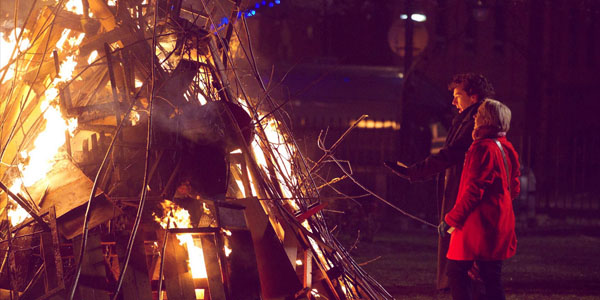
One of the smaller uses of foreshadowing in the show, one of Sherlock's huge hero moments of 'The Empty Hearse' is teased before John Watson even realises that his friend has returned from the dead. As John returns to Baker Street to see Mrs Hudson, we see his silent train journey, followed by a shot of him crossing the road to 221B. A pair of kids approach him, asking "Penny for the guy?" He ignores them. It's a bizarre question to hear in Sherlock, surely; I mean, when was the last time anyone ever asked you that? Sure enough though, John finds himself as a Guy Fawkes later on, tied up in a bonfire, waiting for Sherlock and Mary to save him. It's a subtle nod to a later event, and one that becomes obvious on multiple viewings. Or, if you're Sherlock Holmes, and you deduce things on first glance.

6. "He Needed To Do More Than Kill You..."
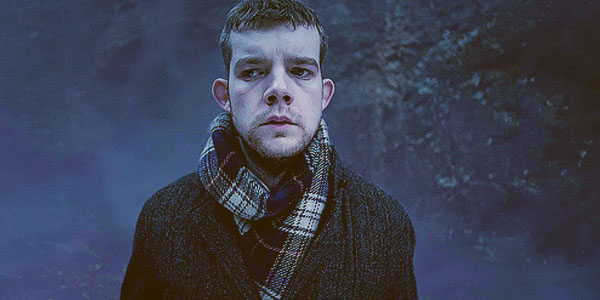
Let's cast our minds back to Series 2, and the episode 'The Hound of the Baskervilles'. Sherlock hasn't jumped from the roof yet, let alone returned, and we all know that Moriarty is around the corner, waiting for him in the series finale. There's a reference in that episode to Jim's masterplan though. As Henry realises that he isn't mad, that his father was right about the Hound, and that Frankland had indeed set all of this up, he hits the roof, hurling himself at Frankland and screaming in his face, "Twenty years! Twenty years of my life making no sense! Why didn't you just kill me?" And it's then that Sherlock answers for him, "Because dead men get listened to. He needed to do more than kill you. He had to discredit every word you ever said." He really was one step ahead of Moriarty; a whole episode before any of saga, Sherlock foreshadows Jim's evil undoing of him. Jim's plan wasn't just to kill Sherlock Holmes but to totally ruin his reputation, just as Frankland had planned for Henry. It's a wonderful nod, and one resonates watching back now.

5. There Is No Vault At Appledore

Of all the twists in 'His Last Vow', from Mary's identity, to John finding out, and from Sherlock shooting Magnusson, to Moriarty's return, perhaps the most heartbreaking of all was seeing the look in Sherlock's eyes when he realised that there was no such thing as the Appledore Vaults after all. It was all in Magnussen's mind. Should we have guessed that though? There's an offhand mention early in the episode, when Sherlock claims that the doorbell is in the fridge. "Oh Sherlock," Mrs Hudson says, "That isn't a vault." It's a reference to the bizarre objects that Sherlock keeps in there, but it isn't the first time that Sherlock will confuse himself what a vault actually is or isn't, in the episode. Later on, he plans to meet Mary somewhere only she'd know to ask about: Leinster Gardens. Leinster Gardens is a street that looked like any other normal street to the naked eye, but is actually, completely empty on the inside side. Rather like a certain room of Mr Magnussen's house. The fact that Sherlock knew Mary would know to find him at Leinster Gardens is also significant, as it's because of Mary that Sherlock risks everything. There are some beautiful references in Series 3, to things you wouldn't expect to be empty; and surely the ultimate one, is the hearse?

4. Molly's Life Mimics Sherlock's Series 3 Life

Molly always had a thing for Sherlock. There are those that still wish they'd get together, and I'm not just talking about Tumblr; Anderson didn't just dream of an elaborate death-faking from Sherlock, he also imagined a passionate embrace between him and Miss Hooper. As Molly finally gets over her crush on the high-functioning sociopath, she cites the ideals of her new life; a dog, he's met his parents, and they go to the pub. Sure enough, we were to meet Sherlock's parents just later on that very episode; they're actually Benedict Cumberbatch's parents, by the way, in case you've not seen the internet's excitement over that. In 'The Sign of Three', we were to see John's ill-fated stag night, and incidentally, Sherlock in a pub, and by the end of Series 3, we'd seen that Sherlock had a dog when he was younger. So after taking time to get over Sherlock Holmes, Molly actually gives three examples of things that she could have had with him after all. It's a wonderfully subtle piece of foreshadowing for the series, and a twinkle of hope, for any fan who hopes those do will eventually get it together.

3. "I Mean, Who Leaves A Wedding Early?"

Sherlock wasn't all that bothered about John's wedding. That could be because he believes love stands opposed to the pure, cold reason he hold above all things, and that a wedding is nothing short of a celebration of all that is false and specious and irrational and sentimental in this ailing and morally compromised world. Or it could be because he didn't want to let his friend go. He's not really listening when Mrs Hudson's wittering on about her own wedding. "Marriage changes you as a person, in ways that you can't imagine," she says, "My best friend, Margaret: she was my chief bridesmaid." Sherlock's still not bothered, but there's a clear parallel there, for us at least, between him and John. "We were going to be best friends forever, we always said that; but I hardly saw her after that," Hudders continues, "I remember she left early. I mean, who leaves a wedding early?" Obviously, Sherlock does, cat collar turned up. But also, John reveals later on that Sherlock's his best friend, just like Mrs Hudson and Margaret. Fast-forward to 'His Last Vow' and John's not seen Sherlock for weeks: is history repeating itself?

2. The Reichenbach Fall Was Hinted At In Series 1

Moriarty always a plan for Sherlock: he told him that he had something big planned the very first time he met him. But the colossal icon of the show, the faked death of the main character, was actually foreshadowed as early as 'A Study In Pink', the first episode of the first series. "Do people assume you're the murderer?" John asked. "Now and again," came the reply. It was to verge more on the now than the again in 'The Reichenbach Fall', when both Donovan and Anderson suspected that it was Sherlock who'd abducted the children during the sweet factory investigation. When we finally met the murderer in 'A Study In Pink', he gave us another clue of what was to come; here was a man being sponsored by Jim Moriarty, a criminal as clever, we presumed, as Sherlock, and he had a bizarre plan. He wasn't going to kill Sherlock. He was going to talk to him, and he was going to kill himself. It nearly worked: close, but no cigar. It was to be Moriarty himself, who'd use the same method, to get rid of Holmes in the Series 2 closer. "I don't like getting my hands dirty," Jim would claim in 'The Great Game': too right he didn't. He never actually killed Sherlock, did he?

1. "One Day We'll Be Standing Around A Body And Sherlock Holmes Will Be The One Who Put It There."

When Sally Donovan first met John Watson, she warned him of Sherlock Holmes. It was advice that was touched on a couple of times - Lestrade even mentioned that Sherlock wasn't a "good man" - and it was a piece of foreshadowing that would signify his downfall in Series 2; it was mentioned again then. But Donovan's advice to John also related to another case. As helicopters circled Appledore, the red dots of snipers focussing on Sherlock's head, Mycroft asked, "Oh, Sherlock. What have you done?" He had of course fulfilled the prophecy. There were three of the main characters all in close proximity to the dead body, and there was Sherlock in the centre; not the detective this time, but the murderer. It will be interesting to see in the fourth series how this dark event will be addressed, given that it was foreshadowed in the very first episode. What are your favourite uses of foreshadowing in Sherlock though? Which is your favourite episode? Did you notice any of these, or do you think they're just coincidence? Comment below!

Contributor
Contributor

Mark White hasn't written a bio just yet, but if they had... it would appear here.