Sherlock: Ranking Episodes From Best To Worst
 Since the show's debut in 2010, Steven Moffat and Mark Gatiss's 'Sherlock' has only grown in popularity and critical acclaim. With superb acting especially the incredible chemistry between Sherlock Holmes and Dr. John Watson (played by Benedict Cumberbatch and Martin Freeman, respectively) fantastic writing, excellent set design, and a gorgeous musical score, the series has amassed its fair share of fans over the course of two seasons. Now, these "Sherlockians" eagerly await the return of Sherlock for Season 3, but unfortunately the air date still remains a mystery. With the recent release of the Season 3 trailer as well as the inclusion of Sherlock in the trailer for Original British Drama, the hype for Season 3 has increased. With that said, I believe it's time to look back over Seasons 1 and 2 and relive what makes Sherlock, with all its memorable characters Sherlock, John, Mrs. Hudson, Lestrade, Molly, Mycroft, Moriarty, and yes, even Sally Donovan and Anderson such an incredible show. This is a list from best to worst episode, although with a show of this caliber, the "worse" episodes are still pretty great. Spoilers abound; you've been warned.
1. A Scandal In Belgravia (Season 2, Episode 1)
Written by Steven Moffat

2. The Reichenbach Fall (Season 2, Episode 3)
Written by Steve Thompson "One more thing, one more miracle, Sherlock, for me. Don't...be...dead." - Dr. John Watson The Fall has become notorious for unleashing a torrent of emotions within its viewers. This episode is the ultimate culmination of what both seasons have been building up to since 'Sherlock' began with "A Study in Pink." "Reichenbach" comes full circle with "Study" multiple times during the episode. The first time is at the very beginning, when John is back at his therapist's office, a place he hadn't been since he met Sherlock. The second time is when Sherlock is arrested on suspicion of kidnapping and attempted murder, and Sergeant Donovan recalls to John how, when they first met, she predicted that Sherlock would one day be discovered as the perpetrator of a crime. The third occurs when Sherlock is standing on the ledge, about to jump, telling John that he is a fake, and John refuses to believe him, referring back to when Sherlock deduced everything about John when they first met. The show comes full circle, and in doing so it shows just how much Sherlock has changed, how John has changed, how each of their lives has been enriched by the other. While "A Scandal in Belgravia" focused on love as its main theme, and "The Hounds of Baskerville" focused on fear, "Reichenbach" combines the two to great effect. As the episode plays out, paranoia over Moriarty grows, leading up to a climax where Sherlock's heart is revealed once more when he "dies" to save his friends. Moriarty is everything that Sherlock could be if Sherlock didn't have John, Mrs. Hudson, Molly, and Lestrade to keep compassion in his heart. This mirroring is showcased incredibly well in all of Moriarty and Sherlock's interactions, in scenes such as the rooftop before Sherlock's fall, and in 221B after Moriarty is acquitted from the trial. In each scene they banter back and forth, each testing the other's intelligence, weighing each other's weaknesses and strengths. Jim Moriarty is played to perfection by Andrew Scott; what other villain could dance along to a classical soundtrack as he steals the Crown Jewels, and still be as menacing and threatening as ever when confronting Sherlock? Moriarty's presence is felt throughout the entire two seasons of the show, even if he only makes a brief appearance within an episode, and the feeling of that lurking presence comes to a head in "Reichenbach" when he seems to be everywhere. For example. he's on the television in the cab as the storyteller and he is the driver of that cab ("No charge"). He makes his presence felt as he deliberately leaves clues behind in the breadcrumbs, the book of fairy tales, and the burnt gingerbread man. His influence is behind the spray-painted "IOU" appearing on the building, the camera within 221B, and the assassins living right across the street. There seems to be no escape from Moriarty. Even when Sherlock and John go seeking out answers from Kitty Riley, there he is in her flat, as an ordinary man, begging John not to hurt him and confessing that he's an actor hired by Sherlock to play Moriarty. It's a credit to Andrew Scott's acting ability that he almost had me believing for a second. While most of my brain was shrieking "That can't be true!" there was a tiny, horrified part going "But can it...?" Only when Kitty's back is turned and Moriarty drops the act for a second as he grins at John and Sherlock can we be sure that Moriarty is real, and wonder how we ever could have doubted. That is part of the brilliance of this episode - the audience is drawn in to feel the fear, the paranoia of the characters, and then even feel the doubt, if only for a second. The fact that Moriarty is capable of such terrible manipulation is what makes him such a terrifying villain, and, as he says, "every fairy tale needs a good old-fashioned villain." This begs the question: if Moriarty is the villain, does that make Sherlock the hero? Back in "The Great Game," Sherlock says, "Heroes don't exist, John, and if they did, I wouldn't be one of them." Yet at the beginning of "Reichenbach," Sherlock acquires the title of "the Reichenbach hero." And by the end, he certainly performs a heroic deed by sacrificing himself in order to save his friends, even if he was clever enough to fake his death. Even though he and Moriarty are so similar, Moriarty dies only to beat Sherlock and ensure himself of being the winner and the resolver of the Final Problem, while Sherlock dies to save the lives of John, Mrs. Hudson, and Lestrade. While Sherlock may still be characterized as more of an anti-hero, across the series he has learned to be heroic. He becomes a hero for his friends, and they don't even know it. Sherlock saves everyone...including himself. That still leaves the question of HOW he actually did that, which unfortunately will be left unanswered until "The Empty Hearse," which hopefully will air in early 2014. Until then, we can only speculate, and stand in awe of such an emotional roller-coaster ride of a season finale!
3. The Great Game (Season 1, Episode 3)
Written by Mark Gatiss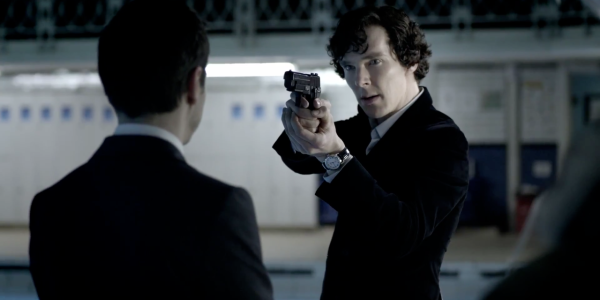 "I will burn the heart out of you." - Jim Moriarty Jim Moriarty's presence hangs over Season 1 like a shadow. He is referred to as a "fan" of Sherlock's by the cab driver in "A Study in Pink," is only shown as "M" when communicating with Shan in "The Blind Banker," and uses different people as his "voice" to communicate with Sherlock via phone in "The Great Game." His absence from the scenes of his crimes makes him even more of a mystery, and so his reveal during the brilliantly-written pool scene at the end of "The Great Game" finally gives us a face to put with the name and what a bizarre, hilarious, creepy, and fascinating face it is! One can never quite forget meeting Jim Moriarty. Essentially, the entire episode is about Sherlock and Moriarty, and how Moriarty is the perfect adversary for Sherlock simply because they are near-perfect mirrors of each other. Their lives have been intertwined from the beginning when Moriarty allegedly committed his first murder, killing Carl Powers, and Sherlock, even young as he was, was right on his trail, stopped only by the disbelief and apathy of adults who had no faith in a child detective. Moriarty realized this, and kept Carl's shoes all those years in resentment? admiration? waiting to give Sherlock another challenge if he proved a worthy adversary. They each invented their jobs: one became a consulting detective, the other a consulting criminal. They are both bored by the ordinary minds around them and want a distraction. So, when Moriarty sends Sherlock a puzzle, using ordinary people and their lives as both the stakes and the puzzle pieces to put together, Sherlock plays along, because he and Moriarty view people the same way: as puzzles to be solved and/or tools to be manipulated and used to their advantage. Even within the visual cues they are mirrored. Sherlock proclaims "The art of disguise is knowing how to hide in plain sight" as he is disguised as a security guard at the art gallery. Little does he know, only a short time earlier he encountered Moriarty disguised as Molly's boyfriend, Jim from IT. Within their banter you can tell that each holds a grudging respect for the other, and even a strange sort of gratitude that someone else understands how they see the world and is able to provide a much-needed distraction. Yet they still must hold the other in contempt, for the game is only distracting if there is ample competition, and in the end one of them must win. They both seem heartless, and yet this exchange shows the one thing that separates Sherlock from Moriarty: Moriarty: "I will burn the heart out of you." Sherlock: "I've been reliably informed I don't have one." Moriarty: "But we both know that's not quite true." John chooses this moment to launch himself at Moriarty, yelling, "Sherlock, run!" At that moment we see the one thing that stops Sherlock from becoming like Moriarty: John. John has been there through everything, seen Sherlock at his most caustic and most inhuman, and, when anyone else would have left, John stayed. In seeing Sherlock's worst and staying with him through that, he is able to bring out the best in Sherlock. Little by little his loyalty makes Sherlock care about someone other than himself, something Moriarty could never understand and may no longer even be capable of. To Moriarty, people are disposable; to Sherlock, John is the one person he needs with him. Earlier on Sherlock mockingly states, "I'd be lost without my blogger" to John as a sarcastic remark. Yet John is the one person he truly cares about. In Season 2 we see that circle of affection expand to Mrs. Hudson, Molly, and Irene, and apparently even Lestrade, but John is the one who shows Sherlock how to care. "The Great Game" has Sherlock at his sharpest and most cerebral, but in the end what is really revealed is his heart and how much his friendship with John has grown. Their love for each other is the real heart of the show.
4. A Study In Pink (Season 1, Episode 1)
Written by Steven Moffat "You're not haunted by the war, Dr. Watson; you miss it. Welcome back." - Mycroft Holmes Ah, the beginnings of what would become the wonderful phenomenon that is 'Sherlock.' Here we meet characters familiar to us through the Conan Doyle stories and pop culture in wholly unexpected ways. We meet Sherlock Holmes as he violently whips a corpse with a riding crop. We meet Dr. John Watson, who has a form of post-traumatic stress disorder and a leg injury that we later find out is purely psychological. Detective Inspector Lestrade is a gruff police inspector who has no patience for reporters' obnoxious questions. Mycroft Holmes appears at first to be the villain of the series and then turns out to be simply Sherlock's concerned older brother. And Mrs. Hudson is the ever-charming and very flappable (not your) housekeeper. There are new faces among the characters as well: Molly Hooper, the adorably awkward mortician who, for whatever reason, has a crush on Sherlock, and Sergeant Sally Donovan and Anderson, the two characters we all love to loathe. This is a great set-up for an incredibly satisfying episode, set off by the fact that Sherlock and John are only starting to get to know each other. While we see a lonely, depressed John at the beginning, we also see an uncaring, crueler Sherlock, who describes four serial suicides (and a note) as "Christmas" and doesn't understand why a woman would still be upset over the death of her stillborn child. Still, together Sherlock and John make a formidable team, and so they dash about the streets of London, searching for the serial killer who, in the end, nearly becomes Sherlock's undoing. The cabbie is a great villain in that he knows just how to play Sherlock in order to get him to do exactly what he wants. Even when his gun is exposed as a lighter (a brilliant gag - still makes me laugh whenever I watch the episode) and Sherlock is safe to go, the cabbie still manages to get him to risk his life by (almost) taking the pills, just to prove that he's right. He plays on Sherlock's pride and arrogance with taunts like "Clever enough to bet your life?" and "What's the point of being clever if you can't prove it?" In the end Sherlock is saved from himself by John, ironically a person who Sherlock had given pride back to, with the restoration of the mobility of his leg. The cabbie dies by John's gun, but not before Sherlock can demand from the dying man if he got the answer right, showing the true depth of his lack of compassion. Interestingly, the cabbie doesn't answer the question, so we are left not knowing whether Sherlock chose the fatal bottle of pills. I like that it was kept open-ended. The implications of his choice are definitely intriguing. If Sherlock picked the safe pills, then he is still smarter than the cabbie, which is plausible, although a bit predictable. If he chose the poison, then Sherlock is no longer the smartest person in the room, which is a bit disappointing. In not revealing if he made the right choice, we are left in permanent suspense, which makes the exchange between the cabbie and Sherlock all the more memorable. Another unforgettable detail of the cabbie's death is the moment Sherlock steps on his wound hard enough to cause him severe pain as he's dying, pain torturous enough to give Sherlock the information he wants - "Moriarty!" Would the Sherlock at the end of Season 2 still be capable of such cruelty?
5. The Blind Banker (Season 1, Episode 2)
Written by Steve Thompson "No, I'm Sherlock Holmes and I always work alone, because no one else can compete with my massive intellect!" - Dr. John Watson While I would give "Scandal," "Reichenbach," "Game," and "Study" all 10/10 for being truly outstanding examples of great television, for me "The Blind Banker" would probably get an 8/10, which is still a decent score. It may not be amazing like the aforementioned four others, but it's still good, with many clever plot points - I liked the book code especially - and an intriguing premise. It's also interesting to see the more domestic side of Sherlock and John's life. Over the course of the episode, John argues with a self-check-out machine at the grocery store, gets angry with Sherlock for never doing the shopping, and, as bills pile up, gets a job at a clinic. There he meets Sarah, another great plot point for the episode, as Sarah is dragged into Sherlock and John's investigation of a band of Chinese smugglers. Sarah is actually pretty cool. She takes Sherlock's presence during her and John's date in stride, she beats off Sherlock's attacker with a stick, she inadvertently helps Sherlock solve the book code, and she and John have pretty great chemistry although not as good as Sherlock and John, of course. Knowing now that Mary Morstan is in John's future, I like to think that this episode is a glimpse of what it's going to be like in Season 3 when Mary, John, and Sherlock are inevitably thrown together in the same awkward mix as in "Banker," only probably ten times more awkward. I liked Sarah; it was good to see her return for "The Great Game," but then by Season 2 she had disappeared, and John had moved on to considerably less awesome girlfriends like Jeanette. After enduring a life-threatening first date with John, I was surprised and pleased that Sarah stuck around for another episode after "Banker" (if only for a couple minutes), but I suppose we won't be seeing any more of her. Pity. While containing many minor characters that aren't that memorable, this episode boasts a villain as over-dramatic as the cabbie in "Study" was subtle. While General Shan's dialogue can lean towards becoming campy (I'm thinking especially of her "I need a volunteer from the audience!" speech as she's threatening Sarah), the tension and danger is still real, especially as the trap slowly draws closer and closer to ending Sarah's life. Luckily John saves the day (again), Sherlock solves the mystery, and all is back to normal at 221B...which is to say, not normal at all. The most striking visual comes in the next-to-last scene, when an eye is spray-painted in white outside 221B so that it seems to be looking in at Sherlock and John through the window. It's a (not-so-subtle) sign that Moriarty is watching them more than ever, which, given how Moriarty has been behind both villains they've faced, is a particularly chilling thought.
#6 The Hounds Of Baskerville (Season 2, Episode 2)
Written by Mark Gatiss "I meant what I said before. I don't have friends; I've just got one." - Sherlock Holmes, to Dr. John Watson This is the one episode out of the six that's genuinely scary not just suspenseful or nerve-wracking, but with moments that have you on the edge of your seat in anxiety, that make you jump and leave you tense, wondering when the next scare is going to happen. The jump-scares are best when John is trapped in the lab and when Henry Knight, Sherlock, and John are on the moor at night, when there's darkness and strange noises all around, a scene made even more eerie by the fact that we still don't know anything about the hound. Another strength of the episode is its visuals. It has a plethora of beautiful landscape shots of the moor, which make it even more unsettling when night descends and the gorgeous landscape becomes dark, mysterious, and vaguely menacing. The two main settings are the Baskerville lab and the moor, both which become incredibly creepy when cloaked in darkness. In regard to Sherlock and John, we get to see them both in states we haven't seen before. Sherlock is at his most animated in this episode, showing his agitation with frustrated facial expressions and wild gestures that are bizarre and sometimes comical to watch. His most animated moments occur in the very beginning when he's searching for his cigarettes, and when he's seated in front of the fireplace with John after he's seen the hound for the first time. As for John, we get to see him pull rank, which is amusing and awesome to watch, and we also get to see him terrified and losing control of his terror when he's trapped in the lab. Obviously in "The Great Game" when Moriarty has him strapped to explosives John is frightened, but here we see John, the brave and level-headed soldier, unable to reign in his fear, as can be heard as his voice cracks as he pleads with Sherlock to save him. This open display of fear is new for John in the show; open terror is new for Sherlock as well. But Sherlock also faces something even more frightening (to him): doubt. Never before has Sherlock been unable to trust his own senses; the one thing he can count on to never fail him is the evidence of his own eyes, and yet that is betraying him in the moment he needs it most. While this episode has its share of clever aspects, its weak points make it the worst out of the six episodes, although I would still give it a 7/10 for quality television. First off, Sherlock and John seem slightly out of character in a couple scenes. At the beginning, Sherlock is begging John to tell him where he hid his cigarettes. The greatest detective in the world cannot find his cigarettes in his own apartment, because John knew where to hide them. I guess that's kind of sweet that John knows Sherlock that well, but I still had a hard time believing that Sherlock wouldn't be able to find them, especially when the cigarettes just ended up being under the skull on the mantle. Then, when Sherlock and John are sitting at the fireplace and Sherlock is visibly shaken from having seen the hound, it takes John an unusually long time to notice how upset Sherlock is. Sherlock has never acted that way before, so I suppose John wouldn't expect him to be affected, but shouldn't John of all people notice that Sherlock is acting strange? John's lack of concern and insight just seemed very odd to me. There are other strange things that pop up throughout the episode. When Sherlock gets into Baskerville by using Mycroft's I.D., why doesn' t anyone check the photo on the I.D. to make sure it's truly Mycroft? When John and Sherlock bump into Lestrade, how does Sherlock, the one who has pick-pocketed Lestrade's I.D. before, not know Lestrade's first name? I suppose the joke may be that the information isn't important enough for Sherlock to remember, but surely the first name of one of the detective inspectors at Scotland Yard wouldn't be something he would want to forget? This may be a sillier question, but in regards to the H. O. U. N. D. T-shirt that made Henry think that his father was killed by an actual hound, why did they have T-shirts when it was supposed to be a classified, top-secret project? As far as new characters, I wasn't a fan of Henry Knight. I have nothing against Russell Tovey as an actor, and I can imagine it would be difficult to procure sympathy for a character who psychologically is "still a child," as Sherlock says, but in the end I just found him irritating. A second point on visuals: the mind palace was a clever idea to integrate into the episode, and definitely a tool I could see Sherlock using, but the way it was carried out was a bit comical. I had to stifle laughter when Sherlock began making strange gestures and rolling his eyes back in his head. I just couldn't help thinking that, during filming, when there are no words or pictures on the screen, Benedict Cumberbatch probably looked like he was having a very strange seizure. In sum, it was a good idea, but I didn't feel the execution was quite right. Mark Gatiss took on an incredibly daunting task when he chose to adapt Sherlock Holmes' most famous mystery for the show. While many things worked, there were many things that didn't, but I still applaud Gatiss for taking on the challenge. While no official air date has been announced, rumors have been circulating that Season 3 will air in January 2014. We have been given the titles of the next three episodes: "The Empty Hearse" (written by Mark Gatiss), "The Sign of Three" (Steve Thompson), and "His Last Vow" (Steven Moffat). If the past is any indication, Season 3 will be even better than its predecessor. As anticipation (and impatience) from fans builds, I can only speculate on where the new episodes will eventually end up on this list!