Star Trek: 10 Secrets Of The Next Generation Uniforms
Everything you need to know about Star Trek: The Next Generation's Starfleet issue duds.

Arguably as recognizable as The Original Series' color-coded "pajamas" are in pop culture today, Star Trek: The Next Generation's Starfleet uniforms are a distinct part of Star Trek's unique vision of the future.
Originally designed by William Ware Theiss (and notoriously modified by Robert Blackman), Star Trek: The Next Generation's uniforms are deceptively simple creations. Dubbed "spacesuits" by the cast of TNG, these uniforms are more than just lycra spandex and/or wool gabardine television costumes.
TNG's Starfleet uniforms evolved over the course of its seven season run, been the subject of their own real world controversies and production problems, and inspired future generations of costuming – appearing as recently as Star Trek: Picard's first season and Star Trek: Discovery's third season.
Like Star Trek's many famous starships, its props, its sets, its aliens, its fictional history, Star Trek: The Next Generation's uniforms have their own lore and their own secrets.
From the inspirations of Wesley Crusher's acting ensign uniform (which never fully zipped up in the back for some reason) to the iconic and progressive skant to Starfleet-issue jockstraps, we've unfolded ten secrets of Star Trek: The Next Generation's Starfleet uniforms that you need to know (before you get suited up for your next convention appearance).
10. Starfleet Stank

Star Trek: The Next Generation's first take on the 24th century's Starfleet uniforms were formfitting and sleek, with bold color blocking reminiscent of The Original Series' iconic look. However, in order to conform to designer William Ware Theiss' strict "no wrinkles" rule, these costumes were held taught with stirrups that looped under the actors' boots and pulled down on their backs.
The discomfort associated with these early costumes is much storied in the legacy of Star Trek: The Next Generation and fodder for numerous tales told by the actors at Star Trek conventions. Jonathan Frakes even claimed to have "ripped more than one of them off in frustration." In at least one telling of the horrors of those uniforms, Patrick Stewart stated that the uniforms caused so much back pain that his chiropractor suggested he sue the producers.
Less talked about, however, is the smell.
TNG's OG uniforms were constructed out of lycra spandex, a material not know for its breathability. According to Theiss' successor, Robert Blackman:
There was no give in the shoulder and there was this constant pressure on the actors who were wearing the costumes for twelve to fifteen hours a day. They were very, very much disliked by the actors – uncomfortable to wear, hot, and they retained body odor.
So along with cat poop in corridors, the uniforms also apparently smelled. The set of USS Enterprise-D must've been Hollywood magic.
9. Wes-T Point

Following the departure of William Ware Theiss at the end of season one due to health issues, Durinda Rice Wood was Star Trek: The Next Generation's second costume designer.
Like her predecessor, Wood only spent a single year on the series but made a huge impact, designing the now iconic big hat look for Guinan and collaborating with Michael Westmore to create the Borg. Wood was also responsible for getting Deanna Troi out of the severe-looking denim jumpsuit and into the more flattering lavender and burgundy casual attire the character wore until she transitioned to a standard duty uniform mid-way through season six.
Wood also tackled Wesley Crusher's fashion... choices.
Dispensing with the rotating series of very 1980s sweaters, Wood created a standard acting ensign uniform, basing the costume on the uniforms worn at the United States Military Academy aka West Point.
According to Wood, if she had the opportunity, she would've given the entire TNG crew a similar makeover, but budgetary constraints meant only Wesley received a new uniform. Ironically, six years after Wood departed the franchise, Robert Blackman and Deborah Everton's redesigned uniforms for Star Trek: First Contact would harken back to Wesley's West Point uniform, featuring similar blue-gray, quilted shoulders and piping.
8. "Evolution"

Upon joining the show between TNG's second and third seasons, costume designer Robert Blackman was tasked by producer Rick Berman with redesigning the uncomfortable, smelly, and (worst of all for Berman) actor complaint-causing costumes.
The costume change is immediately apparent in the third season premiere "Evolution", with the command crew of the Enterprise-D now sporting two-piece uniforms with what Blackman considered "more noble" mandarin collars.
Less evident, however, is the fact that the uniforms were still a work in progress when cameras rolled on season three and evolved over the course of the first handful of episodes. According to Blackman:
We started trying to do a two-piece that looked like a one-piece, but made out of wool gabardine [instead of jumbo-weight spandex]. And that just didn't work. With the individual body shapes, there were problems involved. So quickly we had to – while shooting – come up with another concept and revise the garments. You'll actually see the uniform shape morph itself in the first part of the third season during this design process.
Ultimately Blackman settled on an "Eisenhower" jacket and the iconic look of TNG was finally cemented for the rest of the series, Star Trek Generations, and a few appearances in Star Trek: Deep Space Nine.
7. The Other Picard Maneuver

Recently referenced in Star Trek: Picard's first season finale (and originating in TNG's "The Battle"), the Picard Maneuver is canonically a tactical strategy wherein the captain used warp drive to fool an attacking Ferengi ship into believing there were two Federation vessels when there was only one. Behind-the-scenes, however, this phrase has an altogether different meaning.
According to Jonathan Frakes:
It's all because of those terrible one-piece spandex uniforms we wore for the first two seasons. Those things climbed up and bunched around your belly, so that nice clean line the uniforms were supposed to have was ruined. And the material stretched and shifted, so that you might look good standing up, but it was a different animal when you were sitting down.
To accommodate for said bunching, Patrick Stewart began to pointedly tug at his costume on set, making the necessary costume adjustment part of Jean-Luc Picard's dramatic mannerisms.
Even after the single-piece costumes were replaced with the jacket and trousers combo in season three, Stewart continued the habit, but for a different reason. Instead of straightening his costume as he did in seasons one and two, season three onward was all about keeping the short tailored jacket from riding up.
6. The Dye Is Cast

Despite the purported (though according to the episode "The Outcast", questionable) equality of the sexes in the 24th century, the men and women serving aboard the USS Enterprise-D weren't exactly treated the same. While the men in the cast of TNG were given two-piece uniforms in season three that were more comfortable and more forgiving in terms of body size, the women were still required to wear the same old single-piece, spandex jumpsuits.
According to the producers, these one-piece uniforms were preferred by Gates McFadden and later Marina Sirtis, but it's hard to believe either one loved having to wear such formfitting attire while their male counterparts didn't.
Either way, Gates McFadden did get her own, custom uniform in season three, distinct from the ones worn by other female Starfleet officers. McFadden's version of the sciences division uniform was nearly identical to the standard costumes used on the show, but made of higher quality material that better resembled the wool gabardine jackets worn by her male costars. Owing to its unique construction, Doctor Crusher's medical blue uniform was a slightly different shade of blue, which is very obvious (perhaps due to lighting) in season four.
The discrepancy in Crusher's uniform color was corrected in later seasons, but hers is not an isolated case. Over the course of Star Trek: The Next Generation, numerous uniforms that are supposed to be the same color simply aren't, likely due to variations in the fabric dying process and the fact that, in the 80s and 90s, nobody anticipated we'd be watching this show decades later in glorious HD.
5. "Dress" Uniforms

This one's kind of a bummer, but no discussion of Star Trek: The Next Generation's uniforms is complete without talking about the "skant", named by first season costume designer William Ware Theiss because it was intended to be a gender neutral hybrid of a skirt and pants.
According to Theiss:
Having the actresses and actors both in skirts was to diffuse any sexist accusations that might have been associated with designs from the old show. It's also fashionably probably that four hundred years from now, men would wear skants.
The concept of the skant is fully aligned with the aforementioned equality of the sexes in Gene Roddenberry's 24th century, but unfortunately problematic in the real world of 1980s television production. While it may not be a big deal to see a man in a skirt now, in the 80s it was both revolutionary and not readily accepted: "There was usually a problem on set, because some wisecracks were always made."
Because many actors just weren't comfortable wearing the costume, the skant was slowly phased out and no male member of the main cast ever wore the uniform.
The 80s and 90s weren't ready for the skant, but costume designer Gersha Phillips recently resurrected the distinct look for the recent Enterprise-centric Short Treks "The Trouble with Edward" and "Ask Not", so there may hope yet for a future of proudly bare legs.
4. Advanced Zipper Technology

What's that famous Gene Roddenberry quote? "In the 24th century, there will be no hunger, there will be no greed, and all the children will know how to read... and also there will be no zippers." Something like that?
Along with William Ware Theiss' edict that there would be no wrinkles in Starfleet's clothes, Gene Roddenberry also allegedly declared that zippers and buttons were a thing of the past. As such, every Starfleet uniform in the Roddenberry and Rick Berman eras of Star Trek was designed to hide closures, to the point where Hollywood magic was used when a script called for an officer to remove her uniform jacket.
As seen in season five's "Ensign Ro", even Starfleet uniforms that appear to be single-piece jumpsuits, are in fact made in two pieces, with invisible breaks in waist and an invisible closure running up the front. In real life, this was achieved simply by intercutting footage of Michelle Forbes in her regular jumpsuit with footage of her removing a specifically designed jacket, but the implications for clothes in the Star Trek Universe are interesting and profound and too complex to cover here.
Put simply: 24th century zipper technology is so advanced, it's akin to magic.
3. Generations' Wardrobe Malfunction
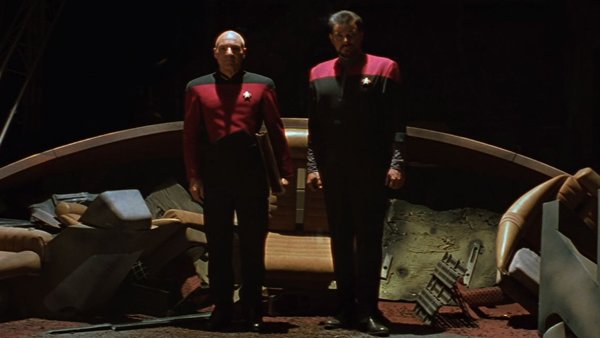
When Star Trek: The Next Generation ended its seven-season run on television, the cast and crew immediately kicked into gear on production of 1994's Star Trek Generations. While the show's sets, costumes, props, and models had all been designed to capture as much detail and realism as possible, certain elements simply would not stand up to the scrutiny of the big screen. What resulted were major renovations to the existing TNG sets, a full refresh of the 6-foot USS Enterprise-D filming model, and brand new costumes courtesy of Robert Blackman.
Producer Rick Berman encouraged experimentation with TNG's look, resulting in costumes that "looked great on paper", but, according to Robert Blackman, that's the only place they looked great:
...It turned out there was no way to really structure them. We kept fitting them and fitting them. The fabric choice was not working, we didn't have enough fabric to dye, nothing was working. It was like the perfect storm. Nothing went right.
Filming with Blackman's new Starfleet uniforms did take place but after a single day of production, it was evident that the costumes just weren't working and the decision was made to scrap them. Starfleet's new look was out, replaced with a combination of the old uniforms from TNG and the relatively new ones from Deep Space Nine.
Footage of that single day shoot with the revised uniforms is rare (blink and you'll miss it in this poor quality footage of LeVar Burton wearing his) and no photographs of the cast in these costumes have ever surfaced. However, Playmates toys produced their line of Star Trek Generations action figures anticipating the cast would be wearing these costumes and were unable to change the toys' look once the decision had been made to cut the new uniforms from the film... resulting in a lot of confused kids on Christmas Day 1994.
2. Picard's Lost Combadge

Following Star Trek Generations' new uniform snafu, costume designer Robert Blackman admitted "I overextended myself in a way that did not provide the best product". Blackman stepped aside for the following three motion pictures, restricting himself to co-designing the Starfleet uniforms that appeared in Star Trek: First Contact, Insurrection, and Nemesis and designing the wardrobe for every episode of Star Trek: Deep Space Nine and Star Trek: Voyager... slacker.
Blackman, though, wasn't the only one who apparently had a tough time in the Star Trek Generations costume department.
While the brand new uniforms didn't make it into the final film (though they did go on to inspire the Starfleet uniforms in Star Trek: Lower Decks), a unique costume was created for Patrick Stewart. Identical to the coveralls worn on Star Trek: Deep Space Nine at the time, Captain Picard's uniform featured a belt buckle. New combadges were also created specifically for Generations. Debuting first in Star Trek: Deep Space Nine's "The Search", the new combadge was designed by John Eaves and replaced TNG's oval backing with a rectangular one.
Unfortunately, when the Generations production crew traveled to Nevada to film the scenes set on Veridian III, someone forgot to pack Captain Picard's combadge.
In the finished film, Picard beams from the Enterprise down to the planet and his combadge somehow doesn't make the trip with him. Many simply assumed that the Duras Sisters had removed it, but the real-world explanation is that the production couldn't afford the time or the money it would take to retrieve a badge from Los Angeles, so filming continued with it.
And now you'll never be able unsee this mistake in Star Trek Generations, but hey, now you'll also notice Captain Picard's belt.
1. Starfleet-issue Bras And Jockstraps

Star Trek has never been shy about showing its heroes in various stages of undress and Star Trek: Enterprise found any excuse to get the crew of the NX-01 into their blue, Starfleet-issue undies. But Star Trek: The Next Generation was little more restrained and exactly what the crew of the Enterprise-D wore underneath those uniforms remained a mystery.
That is until a 1994 tour of the TNG costume department in which Marina Sirtis revealed the existence of specially made padded bras or for female officers and jockstraps or "support briefs" for the men.
About her Federation underwear, Sirtis said:
This is the industrial strength Starfleet regulation brassier. I think I'm partially responsible for everyone woman on the show wearing one of these and that is because they work. They add inches where there are none. I used to wear one of these and the girls would see me in the morning as me and then they'd see me as Troi and they'd go "I want a bra like that". We have them specially made now, we have dozens of them because every woman on Star Trek: The Next Generation wears one of these now.
Women weren't alone in having strategically padded Starfleet uniforms. Not only were male cast members of TNG forced to wear underwear that specifically hid "VPL", their costumes were also enhanced with pectoral pads to make their Starfleet uniform jackets more structured and more flattering.