10 Worst Decisions Eric Bischoff Ever Made
"Butts in seats", heel turns, unmaskings, Ultimate Warrior and those other WCW head-scratchers!
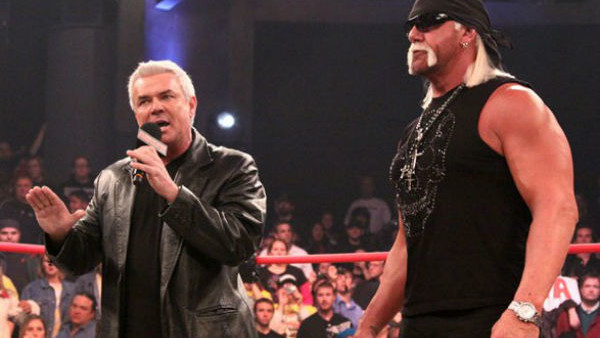
Recently inducted into the WWE Hall of Fame, Eric Bischoff is undoubtedly one of the most important people in the history of professional wrestling.
Love him or hate him, there is no questioning Bischoff's influence and impact on the wrestling business, and Eazy E was responsible for so much of the must-see content of the hottest time in the history of the industry.
In case you were wondering, this article isn't all about bashing Eric Bischoff. The man was a revolutionary, was a visionary and was the one person with the balls (and chequebook) big enough to stand up and better Vince McMahon and the World Wrestling Federation.
Of course, it wasn't solely unrelenting success for Bischoff during his time in WCW and beyond, and part of the charm of listening to Eric talk these days is that he's refreshingly prepared to own up to his mistakes or poor decisions. And it's with those poor decisions that the spotlight's on here.
Eric Bischoff is clearly a Hall of Famer for so many reasons, but here are ten examples of those times when Bischoff massively made a misstep.
10. Having Curt Hennig Turn On The Horsemen So Quickly

When it came time for Arn Anderson to call time on his wrestling career in 1997, it was a huge moment. Across a 19-year career, Double A had cemented himself as a true legend of the business - often as part of the iconic Four Horsemen.
As Anderson delivered a typically brilliant promo to announce his farewell, he had one last request: that Curt Hennig take his spot in the Horsemen.
It was emotional, it was poignant, and Hennig's "it would be a privilege" line of acceptance felt genuine. Not to mention, Curt Hennig ticked all of the right boxes to be a truly great Horsemen.
The problem is, all of this was quickly sh*t on when Hennig turned on his Four Horsemen brethren barely two weeks later to join the nWo at that year's Fall Brawl PPV. Making this situation even more groan-inducing, the week following Anderson's retirement speech, the nWo did a distasteful parody of Arn's heartfelt farewell.
Was it necessarily an awful idea to have Curt Hennig turn of the Horsemen? Maybe not. The problem here, is that this turn happened way, way too quickly. From the prestige of being handpicked to be the new Enforcer of the Four Horsemen, Eric Bischoff made the call to make Curt just another guy in the ever-increasing ranks of the New World Order.
9. Bringing In Ultimate Warrior

The above GIF is likely a perfect illustration of the Ultimate Warrior's WCW run. As in, a complete and utter clusterf**k.
Warrior would sign with WCW in May '98, would be officially gone from the company less than six months later, and he'd wrestle a total of three matches - one triple threat nine-man tag bout, one standard tag team match, and just one singles contest.
In regards to that singles contest, that was Warrior vs. Hollywood Hogan at Halloween Havoc '98, and it ended up with a botched fireball spot causing Hogan to singe his own moustache.
Many have speculated - including Warrior himself - that the Parts Unknown native was brought in solely so that Hogan could get his 'win back' from WrestleMania VI. Whether that's true or not, it was a stupid decision to hire Warrior in the first place.
This was a man who was notoriously hard to work with, who had held Vince McMahon up for money, and who had by then long established a reputation of simply walking out on a company. Did 1998 WCW need Ultimate Warrior? Absolutely not. And in the end, WCW got what was to be expected - a sloppy, unprofessional worker.
8. Moving TNA To Monday Nights

When Eric Bischoff and Hulk Hogan landed in TNA Wrestling at the end of 2009, one of the first major changes that Bischoff - who was working as executive producer as well as an on-air talent - made, was to move TNA's Impact! flagship show from a Thursday to a Monday.
Of course, in doing so, that put Impact! in direct competition with Monday Night Raw.
Speaking about this decision on his 83 Weeks podcast, Bischoff has claimed that this move wasn't done in order to try and compete against Raw. Instead, it was done as an experiment and to get people talking about TNA.
A one-off Monday Impact! aired in January 2010, and the full move to Mondays commenced on 8 March '10. For the first Impact! show of this move, TNA pulled in a 0.98 rating, which equates to around 1.4 million viewers - handsomely bested by that night's Raw getting a 3.6 rating and 5.1 million viewers.
Impact! airing on a Monday night would last just two months, before Bischoff and TNA higher-ups opted to return the promotion's weekly broadcast back to its previous Thursday night slot.
As an eye-opener on today's wrestling landscape, though, that 1.4 million number for the first Monday night Impact! isn't too far away from what WWE gets these days for Raw - and AEW is forever trying (and usually failing) to achieve that magic 1 million mark.
7. The Unmaskings

Only last month, a new generation of wrestling fans discovered via Twitter that Rey Mysterio Jr. worked unmasked for a spell in WCW.
For those of us old enough to remember this happening in real time, it felt utterly ridiculous back then - and it stills utterly ridiculous to this day.
The call to unmask Mysterio was an awful one, and it wasn't just Rey who would be unmasked, for poor Juventud Guerrera was similarly pressurised into losing his trademark mask.
Putting a mask on the line in a match can work well in bringing a sense of genuine intrigue to proceedings, yet the unmasking of either Mysterio or Guerrera had no real major fallout. It was just like, "Hey, here are these guys without their masks now. Enjoy!" - with there no reason to unmask either man bar unmasking them for the sake of unmasking them.
In Guerrera's case, the Juice was unmasked after losing a Mask vs. Title contest against WCW Cruiserweight Champion Chris Jericho. Even Jericho was against Juve being unmasked, as he detailed in his A Lion's Tale book.
For his part, Eric Bischoff has talked about how these unmaskings were done to allow the talent to emote better, for their facial expressions to be seen clearer. In the years since, Eazy E himself has admitted that he maybe didn't quite appreciate the impact that these decisions would have when it comes to Mexican wrestling audiences.
6. Turning Sting Heel

Much like Ricky Steamboat, Sting is one of those rare wrestlers who are forever the perennial babyface.
Throughout his entire WCW career, nobody ever particularly wanted to boo Sting. In the company's earlier goings, he quickly cemented his spot as the colourful, all-action poster boy of the promotion. By the mid-'90s, the Stinger gave himself a literal fresh lick of paint, taking on his Crow persona that reinvented Sting at just the right time. And as that decade went on, Sting became more than the Surfer, more than the Crow; he was the WCW lifer and loyal icon who never left the company.
Still, despite nobody clamouring for it, WCW opted to turn the Stinger heel at Fall Brawl '99 by having him attack Hulk Hogan with a baseball bat.
This came at a time when WCW was undergoing some major changes at the top of the food chain, with Fall Brawl the last PPV before Eric Bischoff was replaced by Vince Russo and Ed Ferrara in handling the bulk of the company's creative.
The Sting turn just didn't work, and it was a villainous run that lasted for not even two months before Stinger's character was reverted back to a good guy.
Despite heel Sting being a bust, that didn't stop TNA years later trying to do the exact same thing - largely with the exact same results.
5. Road Wild

Was WCW's annual Road Wild event (formerly Hog Wild) something fun and unique to watch from a visual standpoint? For sure. But away from the aesthetic, Road Wild was a show that always opened up so many potential problems for World Championship Wrestling.
The concept of doing Road Wild was one dreamed up by Eric Bischoff, and in fairness to Eric, the PPV did generate plenty of advertising revenue for WCW when it came to car and motorbike manufacturers and beer companies. Away from that, though, the negatives of Road Wild far outweighed that positive.
When it comes to those negatives, the glaring one that so many people circle back to is that the event was put on completely free of charge in terms of a live gate. Taking place to coincide with the annual Sturgis Motorcycle Rally, not a single person was ever charged an entry fee for a Road Wild event.
As Bischoff himself detailed in an interview with WrestleZone last year, though, the biggest issues with Road Wild were that flights to that area of the country were few and far between, accommodation was even more scarce, the cost of getting the WCW production out into the middle of nowhere was hefty, and the open environment meant that the show could easily be disrupted by bad weather conditions.
After four years, 1999 was the final Road Wild PPV. As Bischoff put it, "It works in a lot of respects, but the expense of doing it and the logistical challenges are overwhelming".
4. The Use Of Bret Hart, Period

While it was clearly known that Bret Hart was departing the then-WWF for WCW after the 1997 Survivor Series, what nobody could've predicted was just how Hart's WWF exit would go down.
Due to the very real events of the infamous Montreal Screwjob, WWF had handed WCW the absolute hottest star in the business.
Signing somebody of the calibre of Bret Hart was always going to be a big deal, but WCW was gifted a Hitman who was the talk of the wrestling industry and at the centre of one of the business' biggest ever controversies. This was someone who every single wrestling fan was dying to hear from, who was guaranteed to bring major eyes to any show he's on, and, y'know, he's one of the all-time greatest workers in the history of the sport.
Hart was 'can't miss' for WCW, yet the company handled his arrival - and largely his WCW career, period - appallingly.
As part of his WWF exit, the Excellence of Execution couldn't wrestle anywhere for 60 days. Okay, so that meant Hart couldn't lace up his boots and compete for WCW immediately, but it didn't mean that he couldn't appear on WCW TV and cut a promo or two.
A day after the Survivor Series, Eric Bischoff publicly announced Hart's impending arrival in WCW, yet it was over a month later that Hart made his first WCW appearance.
In terms of what they did with the most popular act in the industry, WCW turned Hart heel only three months after his in-ring debut for the promotion, with him quickly becoming just another generic member of the nWo.
3. Informing Viewers Of Raw's Huge Title Change

How do you get approximately 600,000 people to simultaneously change the channel?
"Fans, as Hollywood Hogan walks away and you look at this 40,000 plus on hand, if you're even thinking about changing the channel to our competition, fans, do not, because we understand that Mick Foley, who wrestled here one time as Cactus Jack, is going to win their world title. Ha! That's gonna put some butts in the seats."
Yep, that should do it.
Monday 4 January 1999 is an important date in wrestling history for several reasons. Not only was this the day that Mick Foley finally won the WWF Championship for the first time, but that Monday is viewed by many as the final nail in the coffin for even the most patient of WCW fans.
That, of course, is because the main event of that night's Nitro was the infamous Fingerpoke of Doom farce between Kevin Nash and Hulk Hogan. Added to that, WCW announced that their advertised Nitro main event of Nash vs. Goldberg wouldn't be taking place, as Tony Schiavone stated several times throughout the broadcast how Foley was to win the WWF Title over on Raw.
So, there's no Goldberg? And there's a World Title change on the other show? Where the beloved Mick Foley finally gets his moment in the sun?
It was Eric Bischoff who had instructed Schiavone to not only 'spoil' Foley's big win, but to openly mock it, and that decision backfired in a major way.
To his credit, the second ever episode of his 83 Weeks podcast saw Bischoff admit he F'd up on this one.
2. Turning Down Mike Tyson AFTER His First WWE Appearance?

Speaking on WrestleZone's Lapsed Fan show, Dave Meltzer claims that Eric Bischoff and WCW had the chance to sign Mike Tyson ahead of WrestleMania XIV.
That 1998 edition of the Showcase of the Immortals famously had Tyson walk in alongside Shawn Michaels and DX, but Iron Mike ultimately ending up laying out Michaels as Stone Cold emerged victorious and launched the Austin Era.
If Meltzer is to believed, Tyson's representatives approached Bischoff after Mike's initial Raw confrontation with Austin. Reportedly, the Baddest Man on the Planet hadn't actually signed a deal with the then-WWF at that point - and Tyson's reps asked WCW to match the $3.5 million guarantee that was on the table from Vince McMahon.
Deciding against this, Bischoff - again, if Meltzer is correct - turned down the chance to sign away the man who was a pivotal cog in turning the Monday Night War in the favour of WWF.
Similarly, these claims have been backed up by Bret Hart, who has also stated how WCW decided to pass on Tyson weeks prior to WrestleMania XIV.
For his part, Bischoff outright denies that signing Mike Tyson was ever offered to him during this period.
Eazy E has been so open with past failings and poor decisions, yet Dave Meltzer has a proven track record of largely being correct in his reporting - so it's up to you who you believe on this one.
1. Giving Goldberg Vs. Hollywood Hogan Away For Free

Was Goldberg vs. Hollywood Hogan on the 6 July 1998 episode of WCW Nitro one of the great moments of the '90s? 100%, it was.
Having seen the new kid on the block start to amass quick, impactful win after win for months prior, this relative rookie's streak of dominance suddenly had the wily old king of the jungle in its crosshairs. With the nWo having near-enough monopolised WCW programming at that point in time, fans were desperate to see someone step up and dethrone Hollywood Hogan as the WCW World Champion. More specifically, fans had quickly become desperate to see Bill Goldberg be the one to take Hogan's prize.
What do you do when fans passionately crave something? You milk the situation to its utmost, getting as much possible - in both a creative sense and a financial sense - out of that demand.
Instead, WCW gave away this dream match for absolutely free on its weekly television show.
The standing-room-only Georgia Dome was at fever pitch for Goldberg's big moment, and it was genuinely amazing to watch a white-hot crowd that supposedly generated a $1 million house for WCW.
The problem is, this is a match that fans would've paid to see and could've been built for weeks or months. What we got, was the call to hot-shot this match to pop a rating and beat Raw that week.
Nitro did indeed beat Raw that week, and the Goldberg vs. Hogan quarter-hour drew a mammoth 6.91 rating, watched by an estimated 10 million viewers. The issue is, the company left so much long-term money on the table here.