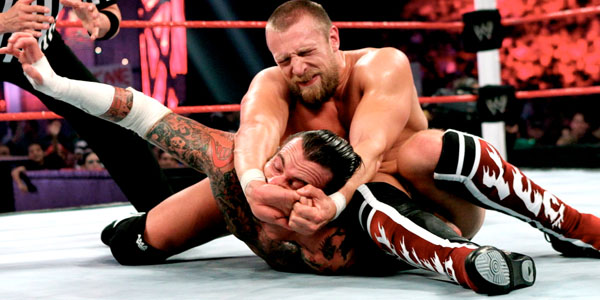
Whatever you might say about WWE's current PG rating, the fact is that Vince McMahon's company has always appealed to kids and young teenagers. As such, it falls to the WWE to be responsible babysitters to their audience who might not know the difference between real violence and fantastical, choreographed, scripted violence. One such way is the airing of vignettes like the one above during programming, which reminds us all that WWE superstars are trained, professional athletes, that serious injuries DO happen and that above all else we should never try anything we see on Raw or Smackdown at home. It's a sensible message that WWE have been broadcasting for generations of fans, and for generations, we the audience have thoroughly ignored it. The fact is, the majority of wrestling fans began watching as young, impressionable children, many of them boys. And young, dumb boys love nothing more than to copy what they've seen on wrestling with their friends or siblings. I remember once getting in trouble at a friend's birthday party when I was 7. Playing around on a bouncy castle, I give my young chum a Stone Cold Stunner, he runs off crying, I get shouted at by his mum. Little crybaby. Didn't want any of his birthday cake anyway.... What we quickly discovered, however, was that maybe we should have listened to the TV and not tried wrestling moves on ourselves, because a lot of them do hurt. A lot. Submission moves in particular were enough to end mine and my friends amateur "matches", as we found out through foolish experimentation that our limbs were not supposed to bend that way. Here, we look at ten submission holds that most of us will have tried out at some point, and weren't really keen to try out again afterwards. Don't try this at home.
10. Cross Armbreaker
https://www.youtube.com/watch?v=z0vUdbJ1iRU It's not really surprising that the Cross Armbreaker actually hurts, given that it's a legitimate martial arts hold that's been used for centuries. But hurt, it definitely does. In fact, it hurts a lot. The Cross Armbreaker is more commonly known as a straight armbar, and originated as a Kodokan Judo technique. Since then, it's been incorporated into Brazilian Jiu-Jitsu, Sambo, Jujutsu and catch wrestling. It's also one of the most common submissions in MMA matches, and is a particular favourite of Ronda Rousey's. It even crosses over into video games. The variation used by Del Rio involves crossing your leg over the opponent's arm and flipping them into the hold, which I first saw done by Paul Phoenix in the Tekken series. https://www.youtube.com/watch?v=gOVz5RZLkP8 How the move works is by fully extending your opponent's arm between your thighs, with your legs across his chest and holding his wrist against your chest with his palm facing up. From there, all you have to do is hold on tight to their wrist and lean back, arching your hips forward. This will hyperextend their elbow joint, causing massive amounts of pain and possibly breaking their arm. When the hold is locked in fully in a real martial arts fight, it's nigh impossible to escape from. Unless you tap out. Which you should. Very, very quickly.
9. Mandible Claw
https://www.youtube.com/watch?v=ZaZyGJDc24c I would bet money that a certain percentage of people reading this article are now making sceptical faces at their screens, shaking their heads and perhaps making disbelieving noises such as "pfft!" or "pshaw!". They're thinking of Mr Socko and how Mick Foley would suffocate his opponent's with a smelly gym sock that he had tucked down his sweatpants. Light comedy, maybe, but a painful submission hold?? Not likely! To those people, I say this... Right now, if you're not busy (and since you're reading wrestling articles on the internet, I'm going to assume that you're not) and no ones watching, try this. Take the second and third fingers of your right hand and place them in your mouth. You want to go underneath your tongue, towards where it joins the base of your mouth. Go ahead, I'll wait. Got it? Good. Now, with your thumb underneath your jaw, push down with your fingers on that point, as hard as you can, and try and get your fingers and your thumb to touch. Well, aren't you silly? While most people associate the Mandible Claw with Mick Foley, it was innovated by a physician and suspected murderer (I kid you not!) called Sam Sheppard. After serving 12 years in Ohio Penitentiary for allegedly beating his wife to death in 1954, he was acquitted and released following a retrial. He began a wrestling career three years later, billing himself as "Killer" Sam Sheppard (which, in terms of just being cocky, is on par with the time when O.J. Simpson wrote and released a book called "If I Did It"). It was here that he used his anatomical knowledge to develop a hold to specifically target the nerves and muscle tissue at the base of the tongue. As well as this, the upward force applied with your thumb and palm can easily dislocate a jaw with enough pressure. So to sum up, this is designed to really hurt. That, and you have someone's disgusting fingers in your mouth. Tap out quickly and gag.
8. Tazzmission
https://www.youtube.com/watch?v=Jszfrn23toM Popularised by Tazz in ECW and WWE, this is another hold that has it's origins in Judo, where it's known as the Katahajime, or "single wing choke" in English. It's a more advanced version of the more common rear naked choke, or "sleeper hold", which is so named because it can very easily cause unconsciousness. It is a common misnomer among people who aren't versed in fighting that chokeholds only target the flow of air through the windpipe, hence the term "choke". Not so. This hold puts only minimal pressure on the windpipe, and is instead designed to target the carotid arteries on one side of the neck. Tazz would normally leave the hand that wraps around the neck loose, so as not to lock the hold in for real, whereas in legitimate combat you would grab the opponent's lapel and pull it across while simultaneously pushing their head down with your other hand. And by controlling the arm as you do, the hold automatically pulls the arm back as you push their head forward, increasing the pressure still further. All of this will block one of the two big arteries on either side of the neck, restricting the flow of blood to the brain and will quickly render them unconscious in a matter of seconds. In my school, there was many a time when someone would put a sleeper or Tazzmission on somebody else, only to s**t themselves when they did it too well and their friend blacked out on the floor in a heap. Recovery from these blackouts is almost as quick as the blackouts themselves, but if you've ever accidentally done this to your little brother, you know exactly how the panic feels.
7. Sharpshooter
https://www.youtube.com/watch?v=Ku2HtEMkaG4 The most Canadian hold in the world. Not actually Canadian, though. Sorry to break it to you, Canadians, but since you gave the world Nickelback and Justin Bieber, it's high time you had some punishment. This is another hold that is unique to wrestling, innovated by Japanese wrestler Riki Chosu, who christened the move Sasori-Gatame, which in English translates to "scorpion hold", so called because of the way the opponent's legs curl up and behind them like a scorpion's stinger. Is "scorpion hold" and "stinger" ringing bells for any of you? Because it should (I can be coy sometimes) Sting popularised the hold in North America throughout his career, calling it the Scorpion Deathlock in tribute to it's origins. But the most famous practitioner of the submission is undoubtedly Bret Hart, who began using the move in the '80s and rechristened it as the Sharpshooter to go along with his "Hitman" persona. Since then, it's been used by many wrestlers, including The Rock, Shawn Michaels, Chris Benoit, Stone Cold Steve Austin, Edge and Bret's own relatives Owen Hart and Natalya. The hold can often be unique to the person using it, and there have been many variants throughout the years. Some wrestlers lead with their right leg, others their left. Some feed their arms through the opponent's legs differently for more torque and pressure, some squat down while others remain standing high. But the hold nearly always inflicts pain on knees, legs and lower backs. It is NOT fun to be locked in the Sharpshooter.
6. Cattle Mutilation
https://www.youtube.com/watch?v=W-8gvIjVgzw This move hasn't been seen a lot in mainstream wrestling, belonging more in Japan or the indies when used by the-artist-formerly-known-as-Bryan-Danielson. Hence, you don't see a lot of kids or teenagers attempting to copy this one. This is more in the reign of curious adolescents and young adults who watch a lot of Ring Of Honour and wonder if they could attempt a career in professional wrestling. The result being that you tend to hear a lot more inventive swearwords when this hold gets slapped on somebody for the first time. The Cattle Mutilation's more wordy name is a Bridging Double Chickenwing (you can see why the name was changed) and targets the arms and shoulders. It has a lot in common with the Butterfly Lock, where the wrestler's arms are pinned behind their back and pressure is applied by lifting up. The downside to this is that there is only so much force that can go upwards, and the hold will only do serious pain if you happen to be significantly taller than your opponent. There is also a lot of ways for the opponent to relieve the pressure or escape, especially if HE happens to be taller than you. This hold does away with all of that. By grounding the opponent face down, you limit his escape opportunities, especially with your position up and behind his head. The other benefit is that you now apply pressure by pulling down and towards you, which is infinitely easier for you and infinitely more painful for your opponent, as his shoulder blades contract to a position behind his neck. Ouch.
5. Liontamer
https://www.youtube.com/watch?v=H_WWuEVAyOs Let us be perfectly clear on this one... I am not talking about the Walls Of Jericho. The Walls Of Jericho is an elevated Boston Crab. It might be painful when Chris Jericho does it, but when me and my friends used to try it out, I don't remember it causing pain, it was just a strange kind of stretch. When actually sitting down and back on it, it's painful, but that is a Boston Crab. A Boston Crab is painful, the Walls Of Jericho isn't. The Liontamer, on the other hand, hurts like a bitch. Used by Jericho in his pre-Y2J days and rediscovered in the late 2000's, the Liontamer involves placing your knee in your opponents back or on their head. Now I've been reasonably in-depth with the descriptions of some holds and their history and their application, but you don't need me to tell you that someone kneeling on your head with all their weight will hurt. On top of that, your legs are being pulled back further than they would with a Crab or the Walls Of Jericho. It's not just your lower back, your ENTIRE back is bending like a bow. And there is not much room for escape, because let me remind you, SOMEONE IS KNEELING ON YOUR HEAD. Just tap out, man.
4. Kimura Lock
https://www.youtube.com/watch?v=8eZo9F7Uidw Again, this should surprise nobody. When Brock Lesnar added the Kimura armlock to his arsenal upon his return in 2012, it was a part of his new gimmick, an adaptation of his time spent in UFC. And the Kimura has been used in UFC and MMA fights since it's invention. The move is known in Judo as an Ude-Garami, and functions as a keylock, which cause pain to the shoulders, elbows and wrists depending on how they're applied. It was adopted by a famous practitioner of Judo known as Masahiko Kimura, and named after him when he used it to defeat the founder of Brazilian Jiu-jitsu in 1951. That's right, they named the move after him. The guy was GOOD. The Kimura is most often applied from the "guard" position, meaning you on your back with your legs around the opponent. From there, you grab your opponent's wrist with one hand, and thread your other hand around their arm to grab your own wrist, forming a figure four (SOON. Not yet, but soon). This gives an amazing amount of control, and from there you simply crank the arm away from you. It is easy to break the arm of your opponent using a Kimura, and many MMA careers have been ended due to it's use.
3. Figure Four Leglock
https://www.youtube.com/watch?v=VKrNGKO47ss I told you we'd get there soon! The Figure Four Leglock is one of the oldest and most famous wrestling submission holds that there is, innovated by the original "Nature Boy" Buddy Rogers and popularised by Ric Flair. There are a ton of variations on the move, such as the "Lucky 13" used by Corey Graves in NXT, but the original is still a classic, and arguably still the most painful. Ways of applying the hold can vary from wrestler to wrestler, but typically one leg is laid perpendicularly across the other at the knee (i.e. your right leg is horizontally laid across your straight left leg, just above the knee joint). From there, pressure comes from two places, your left knee and your right ankle. The pain inflicted on the straight leg operates in a similar fashion to a straight armbar, hyperextending the joint using a pivot point, which in this case is your other leg. This has been known to tear and damage the ligaments in wrestler's knees. As well as this, the downward force applied to your ankle by the opponents leg would bend the ankle sideways, in defiance of it's commitment to only-going-up-and-down. It is an extremely painful hold, especially if your opponent arches his body up. Before we move on, this needs to be said..... We're led to believe in wrestling that when you're locked in a Figure Four, you can reverse the pressure onto your opponent by rolling onto your front. This is complete crap. What it DOES do is relieve some of the pressure inflicted on you, as by rolling over, your opponent can no longer apply the same level of downward force to your legs. You can also get a slight bend in your straight leg, which will cause relief. But it absolutely will not inflict any serious pain on the other wrestler. So the next time The Miz puts a Figure Four on somebody, and they roll over and he starts screaming in pain, I want you to stand up, point your finger at the TV and say in a loud and accusatory tone of voice "LIES!!!!!!"
2. Ankle Lock
https://www.youtube.com/watch?v=87CxBxGsckQ This one is really popular, used by everyone from Ken Shamrock to Kurt Angle to Jack Swagger, and many people in between. How it usually functions in wrestling is to wrap your opponents ankle in a similar fashion that you would wrap their head in a sleeper hold. And while it looks very compelling on Raw or Smackdown, it has to be said that the version they do is not that painful. But that's by design, because a genuine ankle lock executed properly is excruciating. Right now, I want you to have a little experiment with your ankle (for the sake of argument, your right one) and just see what range of movement it has without also involving your leg. It will move up to a certain degree, it will move down to a certain degree. It will pivot inwards a little bit. It will turn clockwise or anti-clockwise a few degrees by itself, but any more and your leg will turn with it. It isn't the most flexible joint in the human body. Now, with the help of a chair or table, something to rest your right leg on, I want you to hold your shin steady with your left hand, hold your foot with your right hand by the big toe, and pull it clockwise. Seriously? If you fell for that again after the thing with the Mandible Claw, I have no sympathy for you. Ankle locks are used frequently in MMA, but they tend to be executed differently, more in the range of "toe holds" or "heel hooks" (such as this one used by Eve https://www.youtube.com/watch?v=at9fWmQwLP8 ) but because they all focus on bending the ankle in a way that it's not supposed to bend, they all come under the general heading of ankle locks. Tap out, and limp away.
1. Crossface
https://www.youtube.com/watch?v=XIsSk4JYn8o One of the most painful holds I can ever remember being in, the Crossface. All I can say is "Ow!" The Crossface attacks various parts of the body, notably the arm, the back, the face and most importantly, the neck. First of all, let's focus on the arm. Now the pain on here varies, depending on the hold. Chris Benoit's version was more or less a straight armbar, whereas Daniel Bryan's LeBell Lock (or Yes Lock, or No Lock, whatever the damn thing's called these days) utilises an Omoplata, which puts pressure on the shoulder in much the same way that a Kimura does. As such, the pain can either be great or negligible. But the arm isn't the main focus, it's just a tool of the hold. If someone is leaning on your back, crossing their hands over your face and yanking back, your instinct would be to use your hands to remove theirs. With two hands, piece of cake. But one arm is trapped in the Crossface, so you only have use of one. And if you attempt to use that, the pain instantly intensifies. Why? Because now you can't brace yourself to relieve the pain, and the only thing preventing your weight from falling forwards is your opponent's knuckles right on the bridge of your nose. The main target in the Crossface is the neck. You're cranking your opponent's head back as far as that sucker will go and then some. Their muscles will work to prevent the head from moving that far back, but you're using the muscles in your entire upper body, their neck is not going to win. If held in the Crossface for long enough, the muscles in your opponent's neck will rip and tear. After that, there is nothing to defend the vertebrae, the smallest and most vulnerable of which are located in - you guessed it - the neck. The hold can cause herniated disks, and from there broken vertebrae. And just to remind you of the biology you might have forgotten from school, the vertebrae's job is to protect your spinal cord, the intricate system of nerves that run through your entire body into the brain. A broken vertebra can sever nerves in the spinal cord, causing you to lose control of bodily functions and even total paralysis. And let's not forget that if you crank the neck back hard enough, you can break it, resulting in death. Any of these moves seen in a wrestling ring are normally altered so as to appear as painful as possible, when in actuality trying to do the opposite. The superstars of the WWE are trained performers who have learned their craft for years, and whenever people attempt to copy them, things can and frequently do go wrong, resulting in death or serious injury. Yes, we've all played around as kids, trying to imitate our heroes, but with the benefit of hindsight, we see just how wrong things could go. So once and for all, please, PLEASE..... don't try this at home. Thank you for reading, let me know your thoughts in the comments!
Stephen Maher has been a rock star, a bouncer, a banker and a busker on various streets in various countries. He's hung out with Robert Plant, he was at Nelson Mandela's birthday and he's swapped stories with prostitutes and crack addicts. He once performed at a Gay and Lesbian Mardi Gras by accident. These days, he passes the time by writing about music, wrestling, games and other forms of nerdery. And he rarely drinks the blood of the innocent.