The WCW Conspiracy Iceberg EXPLAINED!
WCW: Where The Big Boys Worked The Other Boys.
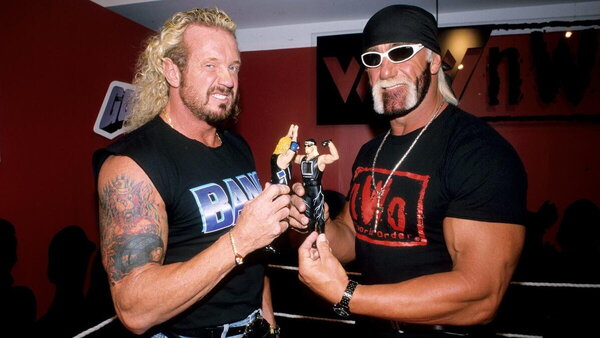
You have already braved the frigid waters and dove deep to find out the most sinister schemes frozen within the WWE conspiracy iceberg. Now, it’s WCW’s turn. But do conspiracy theories actually exist?
Those with a cynical disposition and an active imagination insist that they do. The world is too often a horrible place, governed by power-hungry psychopaths who will stop at nothing to maintain their grip over it. These people are scum. They make your daily life an anxious grind. They pit you against one another to conceal the fact that they are the real enemy. They wage wars to maintain their political interests, caring nothing about the deaths of thousands of pawns. Is it really so hard to believe that they would concoct evil, elaborate schemes to either tighten this grasp, or to obscure from you the horrific lengths to which they will go?
Others like to apply Occam’s razor to any given situation, preferring the simpler explanation: world leaders and executive management teams are open enough with their disdain for us. They don’t need to hide anything and are probably too dumb to get away with it. This brings us very neatly to World Championship Wrestling.
WCW was an institutionally stupid pro wrestling organisation. The promotion could not even tell you when its programming was scheduled to air half the time, let alone craft a masterplan to commit corporate fraud undetected a full quarter of a century later. WCW as a company was too dumb to reorder the earth to its liking - but some of its top stars were a damn sight cleverer than that.
At the start, you’ll find the more frivolous and amusing conspiracy theories - but down at the bottom of the iceberg, at the end of the list, is Where The Big Rumours Lurk…
28. Vince McMahon Reintroduced A WCW PPV Just To Remind You That It Sucked

Vince McMahon hated WCW. He hated the location of its offices. He hated that it was well-financed and thus able to sign the biggest stars in the United States. He hated that its backer Ted Turner was a more successful, prominent, and legitimate businessman. He hated that WCW, for a couple of years, beat him at the exact same game he played in the 1980s. He hated the promotion so much that he could never even bring himself to say its name without twisting his face in disgust and adopting a yokel drawl; it wasn’t called WCW, but rather Dubya See Dubya.
At various points since November 2001 - at which Dubya See Dubya was beaten to death by the mighty WWF Superstars at Survivor Series - calls were made to bring it back. The Invasion was a mistake, yes, but it’s not as if the brand split was a monumental commercial success or anything. It didn’t matter that SmackDown promoted a great in-ring midcard for a shorter period of time than you remember: WWE’s business was in a quite alarming decline in the early 2000s. Every single metric was down. Why not just admit that a mistake was made, pretend none of this silly business-killing business had ever happened, and reboot WCW - only properly this time?
Fans of the day pipe-dreamed about this on message boards constantly. Some very brave officials within WWE might have even floated this idea to Vince. If an ECW reboot was pitched, it stands to reason that, even just once, someone close to him might have wondered aloud about bringing back WCW when Vince was in one of his less intensely angry moods. Some Redditors have suggested that the WCW Great American Bash was revived as a WWE pay-per-view by Vince for the express purpose of petulant sabotage.
You want WCW to come back? Well, here’s one of their pay-per-views - and it stinks, pal.
The Great American Bash 2004 was one of the worst major wrestling shows ever - a bleak presentation of terrible wrestling, debutants who were nowhere near ready for the big time, and a Handicap match for a main event, which, notably, had never happened before nor since. WWE was terrible in 2004 - but the Bash was exceptionally bad, and was never going to draw money. Did Vince actively sabotage it, just to make a three year-old corpse look bad?
It’s actually not the dumbest conspiracy theory ever conceived - but Judgement Day 2004 was hardly WrestleMania 17. Perhaps WWE was simply very bad that year.
27. Lanny Poffo Actually DID Appear On TV

The art of pro wrestling is doing next to nothing. It is a devastating game that leaves even the safest of workers in tatters when it’s through with them; Hulk Hogan, a man famed for selling endlessly, shaking his head from side to side, and then hitting the big leg, was a physical wreck upon retirement. Randy Orton, notorious for slow-motion chin-lock festivals, almost retired in the early 2020s as a result of a debilitating back issue. While this argument is often weaponised in order to criticise AEW because that’s where the clicks are, there is a sobering truth to it. There’s also a funny extreme to the argument; if the best worker is the one who does very little, then by that logic, Lanny Poffo was the best wrestler of all-time.
That is because Poffo earned a six-figure salary for four years, working a maximum of two dark matches between 1995 and 1999. Signed to WCW as a favour to his brother Randy Savage, Eric Bischoff reckons that Savage voluntarily took less money to get the deal done, effectively donating the difference to his sibling - but it’s still very funny. Poffo earned nearly half a million dollars just by playing with his balls, which, since he had to get that hog out of the way, might actually have been harder work than Kevin Nash managed. But you know who else appeared in WCW between 1995 and 1999?
Wildcat Willie, the official mascot of WCW. He was a weird n’ goofy guy, a relic one year into a widely despised run, and yet he persisted for ages. He was a painfully pre-nWo act. Some speculate that this must have been Poffo - after all, why not get their money’s worth? The answer to that question is “because that would be far too simple”.
Poffo did not play Wildcat Willie; the mascot was played by Gary Hedrick. The timeline makes sense - but WCW so often did not.
26. WCW IS BACK!

In December 2020, a shockwave surged through the pro wrestling world with a simple press release: after a 19-year absence, World Championship Wrestling was set to make a miracle return. This was incredible; All Elite Wrestling had formed and altered the landscape just a year prior, and now, the new competition had a competitor. A Triple Threat wrestling war was upon us, ushering in the most intense promotional battle in the entire history of the sport. Financially backed by an entity named Skystorm Productions - a nice nod to the promotion’s old weekly show ‘Thunder’ - the new WCW was set to debut in October 2021 with its pay-per-view offering ‘Greed’. After intense negotiations with WWE, Skystorm secured 50% of the old WCW intellectual property, holding the rights to the name and selected pay-per-views and gimmicks.
Now, this was a hoax, obviously, but it took root because, in the click-crazed world of content production, various outlets and social media pages ran with the story because it was always going to grab the attention of even the most suspicious of fans, just in case. Some fans believed it because they wanted to believe it; others doubtlessly will run away with the conspiratorial idea that this was actually going to happen, and that the evil WWE quashed the idea to maintain their monopoly over the business. Because people are mental. A WCW reboot was basically untenable. Who was even left?
Goldberg could be tempted to concuss himself for a few quid, but was still under some sort of part-time agreement with WWE. Chris Jericho was still working to an improbably high standard, but was signed to AEW long-term. Sting, impossibly, could still be the Stinger…in AEW, to which he’d just signed. Hulk Hogan, Diamond Dallas Page, and Kevin Nash were broken to an extent that not even a 1980s-sized injection of stem cells could repair. Jeff Jarrett was more likely to launch a bid for the WCW rights himself.
But don’t let every single argument that could feasibly exist get in the way of a click. That’s the game now.
25. Diamond Dallas Page Only Got Pushed Because…

Diamond Dallas Page got over in 1997 - and he got over big, and he got over on merit.
He was a good babyface. He was a grafter, and the crowd sensed it. He probably doesn’t get enough credit for his pose-and-catchphrase “Bang!” schtick. In an era that would become defined by the call-and-response, DDP was quicker than most to grasp it. His Diamond Cutter finish was also a sensation. A cool and at that point in time rare move, his creative ability to transition into it from virtually any position cast him as a smart babyface - as did the brilliant, iconic angle in which he cosplayed as La Parka in order to get one over on the New World Order’s Randy Savage. This was key; WCW Nitro in 1997 was dominated by oppressive nWo heat angles, which were both plentiful and pointless, since the heels were over as babyfaces. That was one of very few flaws at the height of the storyline - but Diamond Dallas Page was smarter and equally as cool. Getting over as a babyface in opposition to the nWo was tough, and DDP managed it - which makes a bit of a mockery of the following conspiracy theory.
Some people contend that Dallas only ever got a push in WCW because he was both very close friends and neighbours with Executive Vice President Eric Bischoff. There might be a kernel of something to it. DDP was in his forties in 1997, and had only started training in his early thirties. He wasn’t exactly somebody you’d have in mind to push to the moon, and yet, somehow, he was.
Ultimately, this is a conspiracy theory - someone of influence might have controlled events in a shadowy manner so that a fellow conspirator benefitted - but Diamond Dallas Page ruled, so who gives a sh*t?
24. WHO Was Planned To Drive The White Hummer?

Ironically, since WCW was widely and rightly accused of ripping the WWF off and trying to have an Attitude Era all for themselves - thus collapsing into an identity crisis - the promotion got to a terrible car crash angle before the Fed.
The week before the Great American Bash 1999, Kevin Nash was the victim of an attempted murder when a mystery assailant, driving a humvee, crashed into his limousine. Macho Man Randy Savage didn’t take direct credit for the attack, but implied that he had hired the person, and, in a very cheap ratings hook, was willing to unleash them when the moment was right. The angle was all over the place, terrible to begin with, and dragged on and on even after the original target, Nash, retired in storylines. WCW had no clue what it was doing; Savage, who also bailed before any of this nonsense could get paid off, claimed that Sting was the perp, which brought about the return of the fake Stingers for a while.
Sid re-debuted, but not as the driver. Lex Luger started yammering about a returning Hulk Hogan being the culprit - this, after Savage had promised to reveal the real driver at Bash At The Beach, which didn’t happen. This awful storyline even survived a regime change, plaguing storylines after Eric Bischoff was bounced as Executive Vice President. The protagonist of the storyline and the guy who oversaw it were both gone, it wasn’t good, and it still happened: WCW, everybody. The summer-long saga was only mercy-killed without a resolution when Vince Russo jumped from the WWF in October. So what was meant to happen?
One conspiracy theory is that Rena ‘Sable’ Mero was in the frame to play the role - a move thwarted by a WWF legal threat launched after she was spotted as a “fan” in the crowd of the June 14, 1999 Nitro.
This might be a case of fans connecting dots - but Savage was the man behind the limo driver, and he had taken to associating himself with well-proportioned valets in his Team Madness act. Sable as their leader actually makes a lot of sense…
23. Vince McMahon Was Working WITH WCW

This one is outrageous, hence why it appears so early on the list, but somebody pitched it on Twitter and it generated far too many likes for comfort.
The general thrust of the theory is that Vince McMahon knew that wrestling was in a bad way in the early 1990s. His monopoly was a pyrrhic victory. In buying out every name wrestler and destroying the territory model, he had only served to nuke interest in the sport and drain the talent pool. The only way out was back; Vince, a super-genius, knew that he had to create the illusion of competition so that wrestling felt hostile and alive all over again.
And so, he struck a clandestine arrangement with Turner, negotiating an “everybody wins” deal. Firstly, Vince sent over Hulk Hogan to give WCW a shot in the arm. Hulk was no good to him by 1994. Neither was Randy Savage. They were dispatched down south to further garner interest in WCW. Then, the final pieces of the jigsaw: Kevin Nash, Scott Hall, and the Outsiders angle. With WCW overpowered and interest in pro wrestling at its highest since the 1980s, Vince set about his grand plan to inject ‘Attitude’ into his programming. Vince could only reclaim his greatness with his back against the wall. The ploy, to create a true “may the best man win” war, ultimately worked. The WWF posted record profits and enjoyed a second mainstream boom. In football terms, he sold his ageing luxury players as part of a huge squad revamp, placed his trust in kids, and won the league.
This theory is ridiculous, mostly because it’s an incredibly generous read of Vince’s abilities as a promoter - and that is before one even begins to picture the outrageous scene of Vince and Ted Turner meeting in secret, thrashing out the details of the nWo storyline.
It’s just funny to imagine Vince insisting that Michael Wallstreet was the man to take the Order to new heights in 1997.
22. All About The Third Man

Many theories have popped up in recent years as it pertains to the “third man” of the New World Order.
Weeks before the reveal, Dave Meltzer wrote in the Wrestling Observer Newsletter that Mabel’s name was discussed. But, because this totally undermines Eric Bischoff’s “Meltzer is a fraud” narrative, Easy E ignores that Dave called the fact that it was Hogan in print before Bash At The Beach happened. You can literally access the issue in the digital archives right now. But was it always meant to be Hogan?
Rumours abound that Sting was set to be revealed as the third man, and he probably was discussed internally when Bischoff first pitched the idea. He had grown a bit stale, which is why he eventually adopted the darker, mysterious, vigilante ‘Crow Sting’ persona. Given that Lex Luger was in the midst of a priceless bit, in which he played heel behind Sting’s back, Luger was likely in the frame also. The most interesting take is that Bret Hart was meant to be the third member of the Outsiders.
When the Outsiders debuted, Hart was on hiatus, having worked for the WWF for nigh-on a decade. In this era, with that schedule and that glorified concrete ring, it was a very long time. He’d done everything there was to do multiple times - he’d done so much, in fact, that Vince McMahon knew deep down that his run was probably over. Vince just couldn’t let himself allow Bret to go.
The timeline half-works, so there are dots to connect here, but the theory simply isn’t true. At the time, Bret was pretending that his acting career was going well, waiting for a panicked Vince to call with the highest offer imaginable, daydreaming about one last title run before putting Shawn Michaels all the way over in a rubber match. Bret never wanted to go to WCW, ever, even if it meant making more money for fewer dates; he was loyal to Vince and genuinely thought the WWF presented pro wrestling the right way.
All very bleak, given what would happen.
21. The Real Reason The Undertaker Became The American Badass

The Undertaker didn’t have the best run throughout the WWE Attitude Era.
This might strike you as odd, or plain wrong. ‘Taker headlined a super-hyped and box office monster of a pay-per-view in SummerSlam 1998 against Stone Cold Steve Austin. He also popped the biggest Raw main event rating ever against the same man, with whom he feuded extensively during the hottest ever period of the promotion. ‘Taker’s other major programme, against storyline brother Kane, is very fondly remembered by many millennial fans. But ‘Taker himself felt the character had grown stale; speaking to the True Geordie in 2022, explaining his evolution, ‘Taker said he felt “boxed in” by the original spooky character. He also reckoned he could do nothing in promo battles against Steve Austin and the Rock, and needed a new persona that would allow him to make witty retorts that would not sound incongruous - and thus, the zombie mortician became the American Badass. It worked; ‘Taker was a known backstage sh*t-shooter, which he translated to TV with ease. His gruff ‘Badass’ deadpan worked far better in the context of the trash-talk-heavy segments of 2000 and beyond. So that’s ‘Taker’s own explanation - but what did Kevin Nash make of it?
Back in 2015, speaking with Extra Mustard, the benevolent Nash reckoned that he was trying to get guys paid - one of whom was the Undertaker. “We had ‘Taker close,” reckons Nash. Nash claims that the Undertaker could not make the jump to WCW under that persona, since it was the intellectual property of WWE, and morphed into the American Badass to make the move feel less jarring. Mark Callaway was going to be the name, and riding hogs was going to be the game in his WCW run.
Nash is a known bullsh*t merchant. He might have made a few people believe this crap if he had said that ‘Taker was going to jump in 1997 or something, but ‘Taker - the conscience of the WWF, Vince McMahon’s most trusted wrestler - was never in one million years going to jump to WCW in May 2000. The promotion might as well have been the USWA at that point, it was so miniscule compared to the Fed.
20. The Original Identity Of The Black Scorpion

The despised Black Scorpion angle was a tone-setter for WCW’s pre-New World Order 1990s. Everything you knew about Jim Crockett Promotions was dead, killed by the venom of this preposterous storyline. A basic recap of the goofy nonsense follows:
Sting was tormented by his upcoming mystery opponent, named as the Black Scorpion and presented as a shadowy, potentially occult figure in vignettes. As the storyline progressed, the Scorpion, who was not remotely eerie, revealed that he was a figure from Sting’s past, specifically citing “California in 1986”. The Scorpion also let slip that he had a different face to the man that Sting once knew. A decoy Scorpion was portrayed by Al Perez, but a different, cloaked big bad emerged to intimidate Sting at Clash of the Champions XII. Who was this mystery man?
WCW, as Jim Ross confirmed years later, had no idea. The promotion had a shortlist of names and could never make their mind up; Ric Flair, ultimately revealed as the Scorpion and who very quickly took the piss out of the idea by parodying Ole Anderson’s silly monster voice, reckons it was between him and Barry Windham. Flair took one for the team, correctly surmising that he was too established for any of this b*llocks to hurt him. A conspiracy theory/urban legend persists that WCW thought they had a crack at signing the Ultimate Warrior, and this was meant to be his launchpad. The red herrings pointed hardcore fans in this direction. Sting and Warrior were indeed California gym bros in ‘86, and could that line about “a different face” pertain to his Warrior paint?
Maybe!
Probably not!
But Warrior did fancy leaving the WWF in the summer of 1989, alongside Owen Hart, when he was exhausted by the ‘Killer Kalender’. Owen advised him against a move to Japan. There’s probably nothing in this beyond some scheduling dots to connect, but who knows?
19. Hulk Hogan’s Convenient Vacations

Hulk Hogan was not stupid.
He was a racist, a compulsive liar, he destroyed WWE’s sole mainstream competitor to preserve his own ego, he was a cad, a notorious backstage politician, and generally, when speaking on the topics of John Graziano and dead children that he invented to make himself look good, a thoroughly nasty piece of work.
But he was not stupid.
He was a star who knew exactly when to win, jump ship, and bail. His business instincts were phenomenal. He knew to trust Vince McMahon and buy into the vision of the expansion; equally, he knew when the good times were over. He spent a couple of years behind the times in WCW, granted, but he also sensed that Hulkamania was as dead as the WWF Golden Age in 1996, turning heel to become the figurehead of a second wrestling boom. He also learned, in the 2000s, that Hulkamania was a powerful yet fleeting sensation, and adjusted his WWE schedule accordingly. He lowered his stock going to TNA, but he made a stupid amount of cash knowing that he’d be back to where he was the very second ‘Real American’ blared out on WWE television - which was never not going to happen. All of which is to state that a certain conspiracy theory might be on the mizz-oney.
Some cynics observed that Hogan, while in WCW, was prone to taking convenient vacations purely so that he could pop a number and cast himself as the saviour - which would then increase hs leverage to do what he wanted. (While this was written into his contract, he did have to justify his position somewhat.)
Hogan made one of his returns to WCW on the July 12, 1999 episode of Nitro, capturing the WCW World title in the process - just in time to skip the NBA finals and benefit from the ratings bump!