The Undertaker's Secret WWE Arch Enemy Nobody Talks About
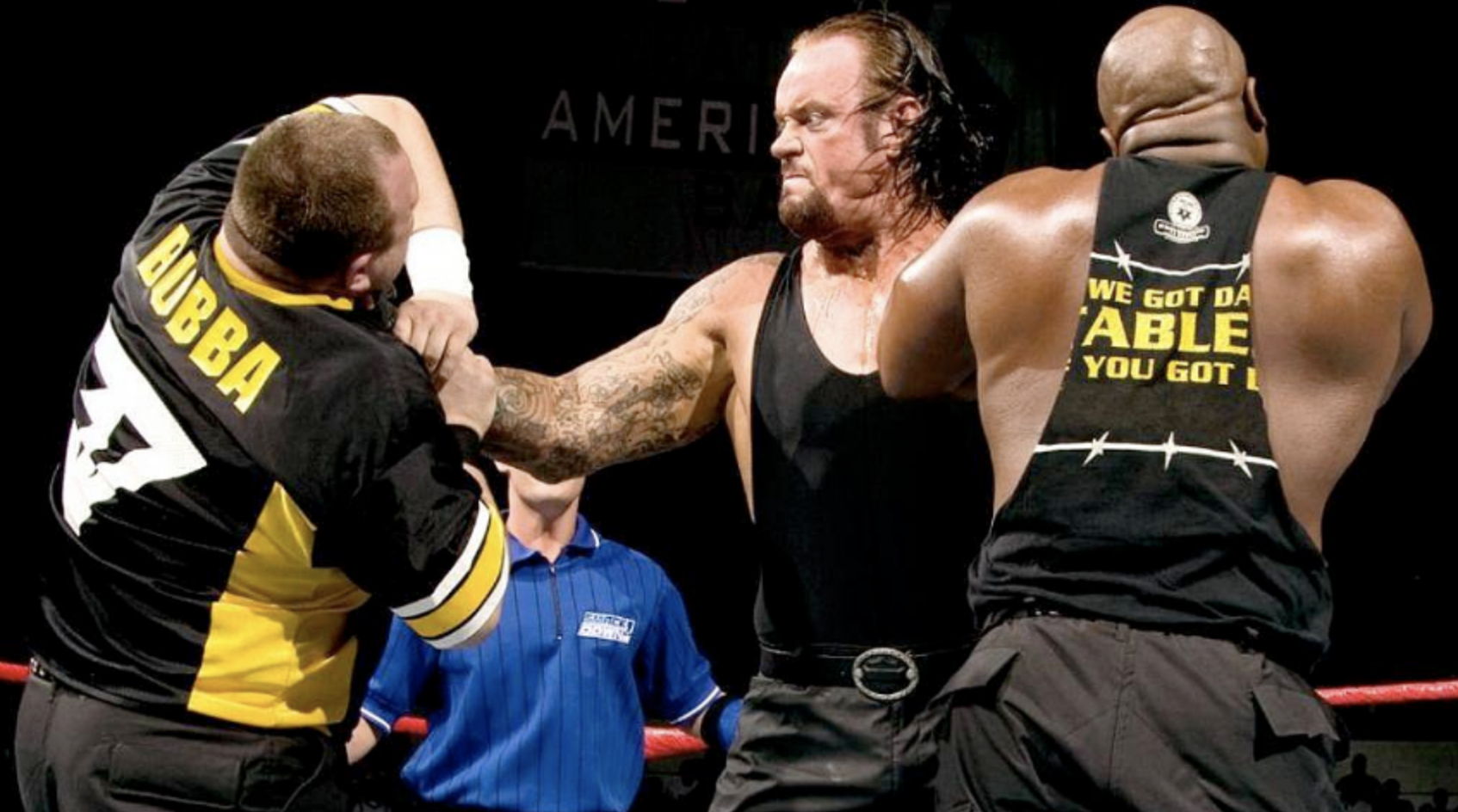
Undertaker's aforementioned 2004 return started on familiar footing when he toppled Kane for the umpteenth time, but his SmackDown television rivalries with Booker T, The Dudley Boyz, JBL and Heidenreich were indicative of the increasingly desperate creative malaise and worryingly shallow talent pool. Older heads could remember when this had been the case before, so when pretty much all of that was wiped off the board around WrestleMania season in 2005, the sense of panic settled. 'The Grandest Stage' went Hollywood for its 21st edition, and WWE promoted Undertaker's unbeaten record at the 'Show Of Shows' with cinematic gumption, setting the conscience of the company up as a legend for Randy Orton - by then in free fall as a babyface and in dire need of this reboot - to "kill". On the night, the duo had a tight and tidy match that was comfortably the best of Undertaker's last 12 months, creating a sense that maybe, just maybe, he wasn't stuck in a brand new vortex after all.
It was a false dawn.
Undertaker and Orton's match was very good, but it didn't grab the headlines for being the best of the night. That fell to a man that had recently coined himself "Mr WrestleMania" for how often he was able to be the 'Showstopper' on WWE's grandest stage. Shawn Michaels and Kurt Angle had an absolutely incredible outing, making good on sky-high in-ring expectations and capturing lightning in a bottle for the merits of the much-maligned brand extension. In their own way, they needed this too - Michaels hadn't exactly pulled up trees in his never-ending feud with Triple H nor follow-on series' with Kane and Edge, whilst Angle was as lost in the SmackDown mire as The Undertaker had been. WrestleMania 21 is an excellent show and is still remembered for elevating both John Cena, Batista and Edge, with their stereo title/Money In The Bank wins reflecting WWE's overdue commitment to the future rather than relying on its past. Elsewhere though, nostalgia and/or relative randomness ruled the day. Orton Vs Undertaker and Michaels Vs Angle were Raw Vs SmackDown matches and first-time main stage attractions, not payoffs to stories that had captivated fans week to week simmering on the shows since Survivor Series. Rey Mysterio and Eddie Guerrero failed to live up to expectations set by a match they'd had nearly a decade earlier. Roddy Piper and Stone Cold Steve Austin had an interminable Piper's Pit verbal joust that culminated in lone featured full-timer Carlito eating a Stone Cold Stunner. The Big Show was a busted flush by 2005, but his dignity-sapping sumo match with Akebono foreshadowed the type of stunt-casting typical of an early Saudi Arabia supershow from when the company first made a deal with the Kingdom in 2018. WrestleMania's marketing campaign had worked a treat, paying customers were at very least invested in happenings at the top of the card, and the show earned the strong number it drew. But in an effort to provide the all-encompassing everything-to-everyone event, WWE flew too close to nostalgia's ever-appealing rays. Never was this more apparent than when newly-minted Hall-Of-Famer Hulk Hogan made light work of Muhammad Hassan and Daivari.
The segment played out as many others do when during WrestleMania breather slots. A lower-status babyface (in this case, Eugene) is out there with the crowd ostensibly just to have a good time, they get interrupted and likely attacked by a middle-of-the-pack heel (in this case, Hassan) only to be saved by the higher-status babyface (Hogan), to create the capital-M moment and wedge somebody popular on the show. And so it went. Hassan and Daivari were cruel to Eugene, took their licks from 'The Hulkster' and most assumed that was that for all involved. But, uncharacteristically for the era, WWE were hiding something much longer term in plain sight. Hogan entered the heels' orbit so that, post-WrestleMania, when they turned their attention to Shawn Michaels, he could be the saviour partner for 'HBK'. This in turn kicked off their slow-burner of a story for a massive SummerSlam main event. Big names, big matches, big stories, but what of the heels that were the glue in all of this? Having been so quietly influential in getting this one-off dream match off the ground for the 'Biggest Party Of The Summer', were they rewarded with a similar platform?
Not quite. Or more accurately, not at all. More accurately still, they were gone from television completely and forever, written off as an act entirely less than six months after being introduced. What the hell happened, and what the hell would it all eventually have to do with The Undertaker?
(CONT'D)