6 Times Wrestling History Was Almost COMPLETELY Different
The moments where everything ALMOST changed, featuring Stone Cold Steve Austin, the nWo & CM Punk
Everybody wants to believe that every good wrestling development or payoff is result of several careful weeks/months of storyboarding, not least because Triple H and others like him will tell you that at every possible opportunity.
WWE Unreal on Netflix is the latest and perhaps most detailed reveal of how the sausage is (occasionally) made, but every former head honcho from Eric Bischoff, Jim Cornette, Vince Russo to Jerry Jarrett, Bill Watts and the late Dusty Rhodes have spoken at length in shoot interviews, podcasts and/or long-form Q&As about how all your favourite memories came as result of their meticulous brilliance.
But this is the case less often than you might realise, or they might want you to realise. Injuries happen. Wrestlers leave. Wrestlers stay, but politic their way into something at the last minute. It's a workplace hazard, very occasionally a workplace benefit, but always one of the many reminders that wrestling isn't really a functioning workplace. The best of the best laid plans are the best the business gets - think Bret Hart/Steve Austin at WrestleMania 13 with months of build to the double turn that finally occurred during the match itself, or CM Punk and Eddie Kingston turning a backstage shoulder-check into one of the greatest promo/match one-two punches in wrestling history - but the butterfly effect had things been tweaked even slightly might have robbed us of these iconic moments.
In Austin's case, it happened quite a lot...
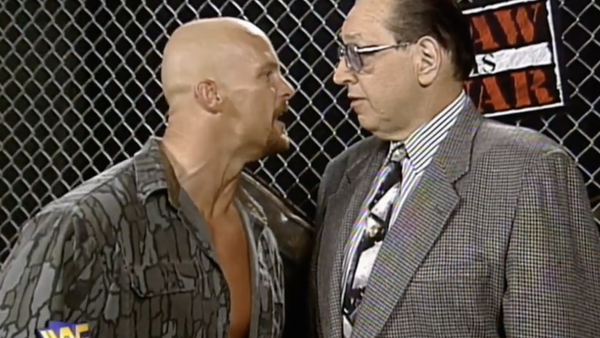
6. Steve Austin Vs Mr...Monsoon?
As soon as the aforementioned classic between Stone Cold Steve Austin and Bret Hart at WrestleMania 13 had concluded, there could be no doubt that a new babyface megastar was born. The new babyface megastar. The good guy who definitionally wasn't a good guy, but at long last fit the profile of the performer mid-1990s fans had been searching for much of the decade.
It being WWE though, lies are still told about the nature of his rise, even beyond the absolute whoppers relating to the push that supposedly materialised after his King Of The Ring 1996 win. Austin's ascent was meteoric, but it wasn't without certain hurdles, unique side quests, and an incredible amount of happenstance that merged the absolute worst luck with the absolute best. It didn't start the night after he coined a catchphrase that saved an entire country, and even when it kicked off in earnest a year later, there were still kinks to iron out.
Austin lost nothing when he lost to Bret at the 'Show Of Shows', and fans let WWE know every single week. He was the guy that drove the ratings spikes, the guy that drew the loudest reactions in buildings that were growing in numbers, the guy they couldn't get enough of. The Guy. But a guy in many segments needs many enemies. Bret Hart had The British Bulldog, Owen Hart, Jim Neidhart and Brian Pillman as his goons in a revived Hart Foundation to supply Steve with warm bodies to drop with red hot Stunners, but Austin had no problem doing the same to his allies in this brand new turf war. He wasn't mates with Shawn Michaels or Ken Shamrock or The Legion Of Doom or - jesus christ, son - The Patriot just because they had common enemies. Mid-babyface-turn Mick Foley actively campaigned to be his friend and still took a kicking until Dude Love forged the oddest of odd couples with "Ol Steve-O". He was out-of-control, and before Vince McMahon took the headset off to take the the spot as the guy to do something about that, all eyes turned to who else but President Gorilla Monsoon.
The pair had a couple of absolutely electric exchanges together that signified the changing times. As early as January, Austin got his famous "you call yourself a gorilla but you're out here hee-hawing like a jackass" line off for a pop back when nobody scored points on Monsoon. By April, he was a weekly headache for a kayfabe front office still represented by the legendary announcer. It was interesting to watch the booking work out where the line was with Austin's anti-authority stance, and how they didn't allow him to truly cross it until Gorilla (by then not somebody who could be physically involved) was out of the way. By the time he was taking out Titan Suits in the fall (itself a necessity due to a neck injury sustained at SummerSlam), it was Sgt Slaughter and Vince McMahon as Commissioner and Owner respectively that took the bumps.
5. Triple H Wins The 1996 King Of The Ring
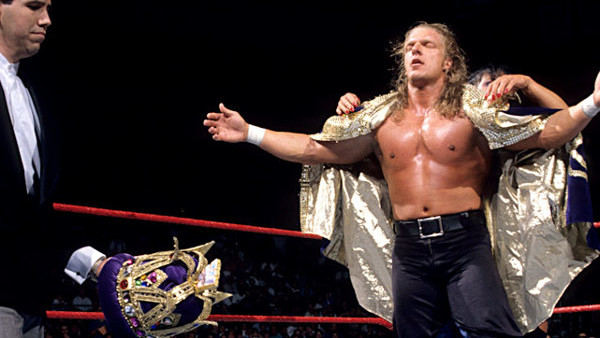
It's one of the most familiar butterfly effect stories in wrestling history - after about a year in WWE, Hunter Hearst Helmsley's winning streak is obliterated by the Ultimate Warrior in humbling fashion at WrestleMania XII. The 'Greenwich Snob' is a warm body for Warrior's unexpected and slightly weird return, but he does business knowing that the pot of gold at the end of the rainbow will usurp his 'Show Of Shows' payoff by some margin. He's going to win the 1996 King Of The Ring tournament, his best friend is the extremely powerful new WWE Champion and top star Shawn Michaels, and prior heel winners Mabel and Owen Hart were crowned in June and main eventing SummerSlam by August. Paul Levesque has every reason to believe that this will be his turning point, and even feels confident to join his Kliq friends Michaels, Razor Ramon and Diesel as the latter pair bid farewell to the company, mid-ring, at a May 19th house show at Madison Square Garden. Vince McMahon gives his approval for the group to take the moment, but immediately has to walk that back when the locker room threatens revolt at the contravention of kayfabe and supposed killing of the business.
Hunter's big win is ripped away and replaced with a summer of doing jobs (he wins the Intercontinental Championship in October, but let's not kill his narrative that he was buried below the surface of the earth and had to claw his way back from the brink), and the King Of The Ring spoils are given to Stone Cold Steve Austin, who obliterates Jake Roberts physically then verbally in a tour-de-force that ends with the birth of the Austin 3:16 catchphrase, about four other billion dollar lines, and in general a night that at long last teases the idea of what the Stone Cold character could actually be. Of course, so much of this wasn't exactly Plan A, and that's reflected in the months of television that follow. Austin has a role but not the role, not really anyway, until whispers of Bret Hart's return begin in earnest and he has something to sink his rattlesnake-like fangs into.
So exactly how much does the wrestling world change if the Kliq never hug, and Hunter simply goes over? This is tricky to assess. Centrally, the problem with the timeline is that Triple H was only ever going to be Triple H, and Stone Cold Steve Austin had such a burning desire to make it as the volume-up version of himself in wrestling that he may well have done so anyway. "Austin 3:16" was the money shirt that eventually reflected WWE's return to pop culture significance (in the exact same period as the nWo one because mainstream staple too, just to contextualise wrestling's growth then too) and who knows how he would have landed on it with Roberts and the bible and all of that, but Austin the man might have just found something else just as marketable instead. Hunter, meanwhile, was going nowhere fast with or without a crown. He only became a king of anything when he found his queen - Chyna, as opposed to a cape and sceptre, was the missing ingredient of his act, as evidenced by just how over she was when he was still finding his way a full year later. Wrestling history really would have been different, but an iconic tee would have only been replaced by a different one down the line. Before "undesirable" and "undeniable" were brought into wrestling vernacular by Cody Rhodes, Hunter and Austin respectively summed up both.
4. Sting Is The Third Man

Hulk Hogan turns heel in 1996 and absolutely everything changes in professional wrestling in the United States forever.
This isn't really up for debate or discussion - Hogan was a theoretical boon for World Championship Wrestling in July 1994, with box office receipts to prove it, but the notion of Hulkamania was dying on its a*se by December. WCW fans saw through an act they'd never particularly cared for when it was on the other channel anyway, and weren't necessarily charmed by the way his friends' arrivals had changed the undercard too. Not that this hugely mattered to Eric Bischoff at the time. Hogan was a bigger picture signing, and the vision 'Easy E' had was absolutely massive. Hogan was the closest a struggling industry still had to a household name, and though Vince McMahon's trick in the 1980s was to make WWE the shorthand for all wrestling, it wasn't so ingrained amongst a diminished audience that a young cocksure Bischoff didn't think he could come for the crown. He was right, too.
Less than a month after the aforementioned anointing of Stone Cold Steve Austin as King Of The Ring, the WCW gaffer proved himself just as worthy of a throne when he convinced Hogan to turn heel and completely reboot himself as the leader of the New World Order with new arrivals Scott Hall and Kevin Nash. It took a lot for the biggest star the industry has ever produced to make the switch though, and per all reports (including some that have bean angrily debunked by Bischoff himself because they happened to allude to other names in the weeks prior), Sting was the safety bet for shocking the world if Hogan balked last minute.
WCW loses twice here really - not only does 'The Stinger' simply not have the shock value of Hulk in the spot, and then also can't be the company's potential saviour over a the 18 months that follow. The lack of a mid-'90s boom for one company might have seriously dampened the prospect of one for another, or even created the general need for introspection. "Attitude" might have borrowed liberally from things happening in ECW, but whether he was willing to admit it or not, Vince McMahon needed the competition out-performing him to light a fear to even steal those concepts in the first place.
3. Cody Rhodes Never Leaves WWE

At WrestleMania 32, Zack Ryder became Intercontinental Champion in a result that existed mostly so he could take a picture with Scott Hall backstage that called back to a shot the two had got when young wrestling-obsessed Matt Cardona met then-titleholder Razor Ramon in 1994. It was a genuinely nice moment to create for the longstanding fan from a company that had never been more cynical; the picture was designed for social media numbers as anything else. The proof was in the pudding, which - to paraphrase Hall's friend Sean Waltman - "tasted like sh*t anyway" when Ryder lost the belt to The Miz just 24 hours later.
Ryder at least got to be the one holding gold aloft at the end of the heavy duty stunt bump exhibition that opened 2016's 'Show Of Shows'. Elsewhere, it was a relentless parade of compromises without the spoils of victory to show for it. Kevin Owens and Sami Zayn's hotly-anticipated singles showdown was punted to Payback in May in order to throw them both in here. Miz will fit anywhere on any WWE show, and in he slotted here for winning the belt for real the next night. Sin Cara and Dolph Ziggler were long cast with jobber-to-the-stars stones no matter how hard they worked, with this match as perfect evidence. Cody Rhodes' pyrrhic was to pay loving tribute to his late Father with a polka dot Stardust outfit.
It wasn't enough. It was his last WrestleMania until he returned to the company in the very same building, in the biggest wrestling story of the year, six years later.
His WWE situation had become, fittingly, a nightmare. And it was one he couldn't simply just wake up from unless he took control of it, and everything else. Rhodes foretold of All Elite Wrestling, of finishing a story, of WrestleManias he truly believed he could headline, and just about everything else he wanted to achieve in wrestling in a backstage segment with future wife Brandi (interviewer "Eden Stiles"), noting how desperate he was to do away with the nostalgia obsession that had ripped through generations since the Attitude Era. "Old men walking, young men dying" was the most powerful and revealing line, and the one that signalled the beginning of the end. Had he not followed through, he wouldn't have been able to help Change The World...
2. The Elite Take The WWE Deal In 2018

Remember when The McMahons opened a December 17th 2018 Raw with a really weird apology segment that promised the earth and changed absolutely nothing?
If so, advanced apologies for the flashbacks. For the uninitiated, Vince, Shane and Stephanie (joined by Paul Levesque, skirting a weird line between a worked role as an on-screen authority figure sort of, and the shoot gaffer down in NXT) turned up out of nowhere to admit that they "hadn't been doing a very good job" for the WWE Universe. Well, three of them did; Vince effectively walked back half of the sentiment before the segment even concluded, but in a bizarre worked shoot promo, they admitted the show stunk, tried to heap some of the blame on storyline authority figure Baron Corbin, and then pledged to do a better job. In December 2018, a month or so before kicking off the consensus worst creative year in the company's history.
What was this all about? WWE had been mostly terrible for years without the out-loud acknowledgment. The Constable Corbin gimmick absolutely sucked from the off and didn't get any better either side of this odd bollocking. Rumble-to-WrestleMania season was just weeks away, and historically serves as a time where things are exciting by default, even in the most brutal of times. As it turned out, those at the top table felt as though they had a stacked hand to play, not counting on several new star signings deciding to go all in elsewhere instead.
It was later revealed that future All Elite Wrestling Executive Vice Presidents Cody Rhodes, The Young Bucks and Hangman Adam Page had been offered insane deals to join the market leader rather than head up a challenger brand, and WWE - Levesque in particular - was confident he was going to get them over the line. The terms were so favourable that 'The Game' or others around him had to know that AEW was coming. Cody and The Bucks were offered immediate main roster spots on huge money, with Page getting the same wage for the top spot on NXT. The figures were compared to the numbers then-WWE Champion AJ Styles was earning at the time, and in an unprecedented add-on, they could all leave after six months if they weren't happy with their creative. Inevitably, they probably wouldn't have been, but by then WWE might have neutralised the AEW threat. The wrestlers didn't take the deal, WWE didn't change, but the wrestling world did.
1. CM Punk Doesn't Stage Dive After Winning The AEW World Championship

It'd be too utopian to assume that if CM Punk hadn't injured himself (and in a particularly ridiculous fashion, no less) on the June 1st 2022 edition of AEW Dynamite, the events of Brawl Out might never have happened.
Even knowing what we know now as opposed to what might still be lurking under the hood of various NDAs or other such legal agreements, the apparent beef between The Elite and 'The Straight Edge Superstar' was only going to get worse before it got better. The moment it was even alluded to by Hangman Page in a go-home promo for their World Title match, Punk felt he couldn't trust him or his mates, and had absolutely no intention of not winning the belt. Post-All Out 2022 wasn't even the first time he'd fired a shot at a press scrum. At the Double Or Nothing post-show, with his newly-won belt front-and-centre, he answered a question related to the infamous exchange with Page about how he was blending in, and said; "If there's people backstage that don't like me, it's a minority, and if anybody says nobody wants me or nobody likes me, I'd like to say nobodies don't want me and nobodies don't like me".
The time bomb was ticking, and it exploded right around the time Punk's own foot did, seconds after he looked at the fans in the aisle and said "you f*ckers better catch me". He undershot anyway and hit the rail on the way down. The delay didn't heal the wounds - it exacerbated them. Punk's return featured a hugely divisive World Title hot potato situation with Jon Moxley and an aborted programme with MJF before the Mindy's Bakery products came out alongside every single frustration he'd harboured over a summer in recovery. On the pay-per-view itself a couple of hours earlier, Kenny Omega told the camera "don't you dare f*cking back up" as he said "try to beat that, b*tch, try to beat that" to ostensibly nobody in particular but, in hindsight, almost definitely one man. The wound was deepening.
Could a summer of crisis talks have fixed what appeared irrecoverably broken between the company's biggest star and the company's founders and most beloved figures? Possibly not, but the dirty laundry might not have been aired in such a way that it effectively ruined fictional storytelling in All Elite Wrestling for the next three years. Nothing from the brain of Tony Khan nor pencil of one of his inner circle members compared remotely with the intrigue and speculation of what could happen the next time Punk and The Elite even shared a locker room. The fight that erupted might have still happened, but with less of a dramatic build-up or even as detailed reporting, could it have been smoothed over when everybody just got things out of their systems? This - as opposed to Khan's weak Collision/Dynamite split roster plan - was the only solution to at least promote the relationship status from untenable to unideal. Without Punk being around as recovered from the injury, the chances clearly fell from slim to none.