8 Wrestlers That Visibly Hated Working For WCW
For 83 weeks and change, WCW replaced WWE as pro-wrestling's market leader. Nobody told this lot...

Ric Flair was something of a "break glass in case of emergency" wrestler for World Championship Wrestling, and it's sad that the company's long and painful decline did such a number on his confidence and self-belief as a result.
Far from the dramatic out-of-nowhere fall-off many WWE-branded documentaries boil it down to, the end of the promotion was a protracted, messy and unworkable grinding down of a failing business. Time in wrestling moved at warp speed back then but a year is still a year, and WCW spent about two of them collapsing around the talent, creatively and commercially.
Rooted in his love of his time as the touring NWA Champion and fleeting moments of real magic in the 1990s, the company had Flair's heart even when it when it was only too happy to break it. When he opened the final edition of Monday Nitro with an impassioned speech about the abridged history, the uncertain future, and a promo for one last match with (who else?) Sting, he did so with such emotion that it didn't even scan as him fighting through the various stages of grief for its demise.
Down to the very bitter end, 'The Nature Boy' couldn't have looked more like he was fighting for the cause, long after that very same cause had stopped fighting for him. The same couldn't really be said for...
8. Bobby Heenan

Visibly, aurally; it's was clear for anybody tuning in and Bobby Heenan was the first to admit it - he was there for the paycheque rather than the product when it came to calling the action in WCW.
A fantastic manager, wrestler and "broadcast journalist" in the 1970s, 80s and early-90s, Heenan moved many to consider him the best all-rounder in wrestling history, and the evidence is stacked so high it's little wonder he was viewed as quite a coup for WCW when he left WWE at the very end of 1993 to rejoin Mean Gene Okerlund on the other side of the mainstream wrestling divide.
But, by his own review and the sentiment of the vast majority of the viewing audience, WCW just didn't get the best of 'The Brain' during the six years he was on the call.
From some middling first impressions, Heenan sensed the outfit wasn't going to be the sort he was used to, and rationalised that he might as well earn good money even if only passable work was expected out of him. Far removed from the locked in legend that sat alongside Gorilla Monsoon and Vince McMahon and brought the best out everybody around him, Heenan merely played the generic and disinterested sidekick to Tony Schiavone, and - when the nWo blew up - coward WCW staffer and situational babyface.
The 1992 Royal Rumble is beloved as much for Bobby's call as Ric Flair's work, and it was only when covering matches for 'The Nature Boy' and a select few others did it feel like that legendary spark was still there.
7. Scott Steiner

Perhaps it's unfair to claim that Scott Steiner was visibly upset with World Championship Wrestling in the latter days of the company and his run atop it. Or at very least inaccurate. He was in fact visibly upset with everything, and was only able to ride it out as being a character choice for so long.
As the company went to pieces, scripts were as ripped as he was, and 'Big Poppa Pump' was only too happy to take advantage of the chaos and get a lot of thoughts off his chest. Particularly as it pertained to somebody he was a little bit sick of in Ric Flair.
Taking to the ring in a sequinned purple suit on the February 7th 2000 edition of Nitro, Steiner - mere months away from becoming World Champion and nearly a bankable longterm prospect for WCW, Steiner decided to use valuable promo time not to sell an upcoming story but air some pretty heavy duty grievances with Ric Flair. In his own words; "I watched a 53-year-old man - who has more loose skin than a Shar Pei puppy - come out here and say he's still the man, Ric Flair...supposed to be the limousine riding jet-flying son-of-a-gun, but I'm saying one time, you should (have) took a cab and used that money to fix your crooked yellow teeth."
Steiner wasn't done, and going up the gears, he took aim at his employers in ruthlessly brutal fashion.
He said; "When you (Flair) walked down that aisle...the people at home, they grabbed the remote, changed the channel to the WWF, and watched Stone Cold; a person you and your old friends got fired here, because you're a jealous old bastard. Ric Flair, remember this - in this wrestling business, there's never been a bigger ass-kissing butt sucking bastard, but also in life...and you belong where you're at in WCW, because WCW sucks, and so do you!"
In a sign of the times, 'The Big Bad Booty Daddy' wasn't made to pay for his crimes but was actually paid more for committing them. He was sent home with full pay, earning a few free weeks off the schedule for two-footing Flair and the company itself into the sun.
6. Paul Roma

Either a moment of a madness or a choice he made that he simply imagined would go better than it actually did, Paul Roma brought his WCW run (and mainstream TV wrestling career) to a total standstill when he disagreed so profoundly with the booking of his character that he gave up working completely in a pay-per-view match.
Somewhat callously labelled the worst Horseman of all time in retrospective assessments of a very solid career in the 1980s and early-90s, Roma's bout with Alex Wright was the best piece of evidence that the haters might have had a point. Allegedly a little angry with the opportunities - or lack thereof - presented to him in WCW, Roma did less than nothing for unassuming opponent (and innocent victim in all this) Alex Wright at SuperBrawl V.
Supposedly not best pleased that he was on jobbing duties in the pay-per-view opener, he was so abysmal selling for offence in the first half the match that the second was rendered mostly redundant. Having straight-faced everything being done to him like the shoot version of that wretched Buff Bagwell worked effort on Vince Russo's first Nitro, he then managed to outdo the usual 3.1 finisher kickout get-out by actually escaping at 2.9. The ref counted him out anyway, and so did the company - he was gone 24 hours later.
5. Mick Foley

He just waited until he got to ECW to make it explicitly clear.
Mick Foley had to know that when he spat on his WCW Tag Team Title and threw it on the ground that a) it would get back to management and b) it wouldn't be taken in the spirit intended. For the uninitiated, the artist formerly known as Cactus Jack had been given a brief break from World Championship Wrestling in 1994 to head to ECW for some of-the-time dream matches with Sabu. The very idea of the contest lit Philadelphia ablaze - the coming together of the two men considered to be the wildest in the business, in the wildest and most fitting venue.
The match as much to Foley as it did the fans, and in perhaps the first of countless epic ECW promos down the lens in Paul Heyman's basement, he committed cardinal sins against the gold whilst trying to make the point that the fights with Sabu were so important that they meant even more than one of WCW's richest prizes.
He wanted to be he craziest wrestler alive more than he did a doubles champion, and chose the most transgressive way to make his point - surely the naivety he claims in his autobiographical re-telling of the story is just an "aw shucks" smokescreen?! For his part, Foley speaks candidly about his issues with then-booker Ric Flair, and that was probably at the core of all of this - the disrespect of the gold may have been a genuine misread, but taking aim at Flair and the Atlanta-based outfit was at very least a subconscious choice.
4. Eddie Guerrero
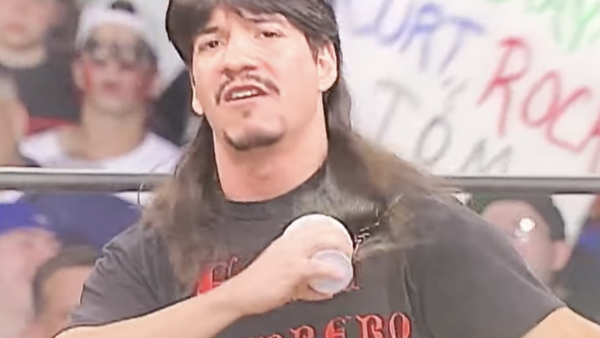
Really, all four soon-to-be-labelled Radicalz could be included in this list.
It took some doing to up sticks and walk with no cast-iron promise that it would work out for any of them in WWE after years plying their trades any and everywhere but the market leader. But while Dean Malenko, Perry Saturn and Chris Benoit all had their reasons for leaving, only one of Eddie Guerrero's beefs was public enough that it made it onto national television.
As WCW crumbled under the weight of its own successes in 1998, Eric Bischoff found himself inadvertently alienating many of the talents that had helped carry the company from the outhouse to the penthouse underneath Hulk Hogan and the New World Order over its halcyon era. As well as overlooking wrestlers creatively, Bischoff developed a reputation as a bit of a hothead, particularly when stories like this one leaked.
Per multiple reports and eyewitness accounts, as the two engaged in one of their familiar backstage rows, 'Easy E' either threw a coffee to the ground in anger and it splashed on Guerrero, or threw the hot drink directly at 'Latino Heat'. Either way, when time came for Eddie to cut a (not that great) worked shoot promo on the August 17th edition of Nitro, he re-enacted the moment with a scowl to confirm it for those who knew and confuse those who didn't.
Its effectiveness wasn't really the point for Eddie and many of the disillusioned wrestlers he was effectively representing; more that any opportunity to vent about the mismanagement wasn't to be wasted.
3. Hulk Hogan

Hulk Hogan lived life in the balance in the WCW, getting far more from the monied Atlanta outfit that it asked for from him in an insane six year run, but few could have imagined how he'd depart the company when he first entered via papered ticker tape parade in 1994.
Going over absolutely everybody as both babyface and heel during a run that featured multiple long World Heavyweight Championship reigns, big feuds and even bigger paydays, Hogan was seemingly one of the big targets of a Vince Russo determined to move old talent out of the topline picture during his stints at the top of the promotion in 1999 and 2000.
Much of this played out behind the scenes, but the more Russo became obsessed with vague worked shoots as the televised norm, the more there was an inevitability to it all blowing up on screen. The infamous Bash At The Beach 2000, four years on from the night Hogan first turned heel, was the night of said explosion.
Russo went into business for himself on the show long after 'Hollywood' had left, verbally going in much harder on Hogan's real and fictional persona than had allegedly been agreed beforehand. This followed a worked element in which Jeff Jarrett lay down to get pinned by 'The Hulkster', but even that was a little too weary to be entirely fake. Hogan's "is this your deal, Russo? That's why this company's in the state it's in...because of bullsh*t like this" had a weathered quality to it that allowed everybody to read between the blurred lines.
2. Booker T
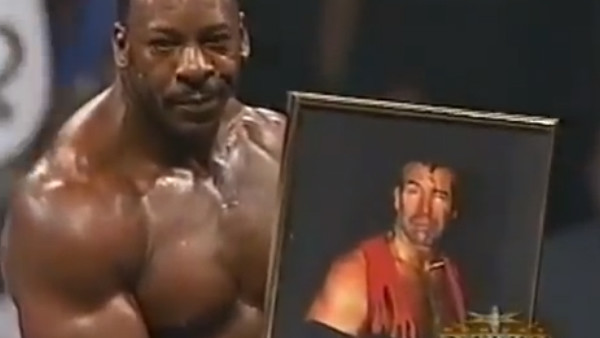
If a picture paints one thousand words, does the above image cover two?
The framed photograph of Scott Hall was included in one of the four boxes suspended above the ring during the Jeff Jarrett/Booker T San Francisco 49ers match on the October 2nd 2000 in which the object was to find the World Heavyweight Championship belt in one of four mystery boxes suspended on poles above the ring. Finders keepers, losers all of us.
The match was a semi-catastrophic reflection of the joke promotion WCW had become during its penultimate year, where even some passable wrestling was deemed moot against yet another zany Vince Russo backdrop. This time, the wackiness came from the "weapons" in the other boxes the two arrived at before claiming the gold. The first box fell off the pole, allowing Jeff Jarrett to break into it and reveal a blow-up doll. The aforementioned framed Hall image was in Box 2, before Booker discovered a coal miners glove in the third one in a callback to another infamous WCW weapons-based shocker between Sting and Jake Roberts just under a decade earlier.
The whole match had been one bad gag, and unsurprisingly the belt itself had turned into a joke title in the industry by this point too. So much so that when it fell out of its box and into the hands of ring announcer Dave Penzer acting on instinct, increasingly online audiences of the time were more than content to consider him the real and lineal champion instead of the two doomed performers.
No wonder the otherwise-magnetic Booker looked so incredibly checked out.
1. Bret Hart
Bret Hart is a steadfast and meticulous individual. It's what made him the person and pro wrestler he was. It's what made his autobiography the most reliable and engaging of any wrestlers' from the boom era of legends and their books. It's what continues to make his words the most powerful when he readily chooses to share them.
But was he slightly - just slightly, so slightly - more at fault for the failure of his WCW run than he'd ideally like to let on?
The short answer is actually probably "No". Ignoring everything that happened to Bret between WWE Over The Edge '99 and his enforced retirement shortly after Starrcade 1999, Hart was middled from the off thanks to the absolute mess the company made of Hulk Hogan Vs Sting at Starrcade 1997, politically schooled by Hogan throughout much of 1998 when they were paired together in the New World Order, and ultimately left to rue the company's mistakes when the character was just another flip-flopping midcard 12 months after his debut.
As one of the regular victims of Hart's vitriol, Eric Bischoff is only too aware of where 'The Hitman' believes he was failed, but beyond attempting to simply silence the criticims, 'Easy E' has noted several times that the Bret Hart that arrived in the company was a one so damaged by the Montreal Screwjob that he couldn't be compared to WWE's 'Excellence Of Execution'.
Bell-to-bell, Hart's mostly-only-okay output might support that, but it's extremely hard to stay at the top of your game when you've never even been considered to be at it by both your boss and, crucially, the co-workers that are supposed to help you stay there.