10 Major Problems With The Fantastic Four No One Wants To Admit

Fantastic clearly doesn't mean what it used to.

Up until now, the Fantastic Four have been presented in a fun, lighthearted way in both comics and on celluloid, but the new Fantastic Four film is all set to break with tradition by portraying Marvel's "first family" in as serious a manner as possible. Quite frankly, that strategy is bound to backfire. By adopting a grim and gritty approach to the Fantastic Four, the makers of the latest film are inviting audiences to judge the film by the standards of similar, more normal movies. This approach will inevitably call unwanted attention to the inherent silliness of the characters. Audiences are willing to overlook countless absurdities in a story that's frothy entertainment but the second the film attempts anything approaching gravitas, the viewers will inevitably start thinking. And when it comes to the Fantastic Four, the last thing the film's creators want is for the audience to think. For a start, they might actually start applying logic to what they're watching. Rather fatally, the Fantastic Four can't even survive the most basic examination. The group consists of a man who's on fire but never gets burnt and a woman who can do some astoundingly useful things but who never actually does. Then there's the genius who prefers to stretch his arm over to the far side of the room to pick up an object rather than simply arranging his equipment so the stuff he needs is close at hand. Lastly, there's a big guy made out of rock who can somehow hear even though he doesn't have any ears. Casual film goers aren't going to care less about explanations shoe-horned into decades-old comics. They're only going to care about what they've paid to watch on the big screen. And here are the 10 biggest problems intrinsic to Marvel's greatest heroes that those casual film goers will gleefully be pointing out as they leave the cinema.


10. Why Don't Governments Simply Negotiate With Doctor Doom?

Even though the despotic ruler of Latveria is pure evil, why aren't the governments of the free world lining up around the block to negotiate with him or even beg him for a favour? This is a man whose genius rivals that of Reed Richards, purportedly the smartest guy on the planet, so Doom's bound to have one or two ideas worth paying billions for. The US government could, say, buy the blueprints of those doombots of his, mass produce them as an army and rename them "freedom bots". In the real world, Nazi scientists were shipped over to the USA at the end of the second world war to help Uncle Sam. Would dealing with Dr. Doom really be any worse? The horse trading wouldn't even need to be done in public. And if Doom was treated with some respect - even publicly thanked for selling his ideas - he might feel that he didn't need to keep on trying to conquer the Earth. If there was ever a man who needed a good ego stroking, it's Victor von Doom. With the right handling, he could become an extremely useful ally of the West.

9. Why Does The World's Smartest Guy Waste His Time Being A Superhero?

For the smartest man in the world, Dr. Reed Richards certainly does waste an awful lot of his time chasing costumed nut-jobs around town. Many of these threats could be easily handled by any number of other superheroes - Richards doesn't need to be dirtying his own hands with these plebeian chores. In fact, if Richards was truly worried about all the super-villains running rampant in the world, he could do a lot more good by designing equipment the police could use to bring these menaces to book, since arresting criminals, super powered or not, is actually the job of the police. Also, given their numbers and experience, properly armed police could do a much better job than Richards. With all the time that would free up, Richards could concentrate on more important matters. Basically, Reed should stay in the lab and get some work done. The world is waiting for that cure for cancer.

8. The More Mr. Fantastic Stretches, The Weaker He Should Get

Think about each time Mr. Fantastic is shown to stretch on screen. There's something not quite right about the effect, isn't there? And here's why the effect looks silly: impossibly, his limbs retain the same thickness no matter how elongated they become. For example, as his arms stretch out, his wrists, forearms, elbows, etc. are just as thick as they are at their normal length. But that shouldn't happen. As his body part stretches, it should naturally become thinner. After all, his mass isn't magically increasing. When the limbs are shown to be longer without being any thinner, the visual just appears wrong to the audience. Also, consider what would really happen to his muscles as his limbs get longer. The longer he extends a limb, the weaker it should get - the muscles are operating over more and more distance. At a certain point the muscles would become so weak, the limb wouldn't be usable any more. Also, the bones would be so thinned out, they'd likely shatter. And don't even try to work out what's happening to Reed's skeleton or internal organs when he becomes different shapes.

7. The Human Torch Shouldn't Be Able To Fly
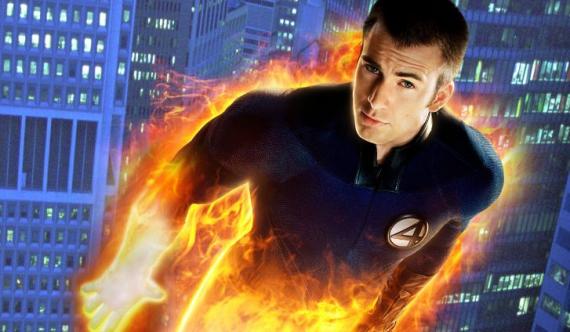
Of course, any comic or film that features super powers is going to need various plot devices that allow the impossible to happen. For the Fantastic Four, one problem that is always mentioned concerns the costumes: namely, why isn't the Human Torch's uniform burnt up whenever he "flames on"? Similarly, why does Reed's costume stretch along with him and how does Sue's costume turn invisible along with her body? To address these issues, "unstable molecules" (whatever they might be) are invoked. People are generally happy to accept that the uniforms are made from this convenient material, simply so the story can get going. But there are other problems with Johnny Storm's powers: problems that are so big they make his clothes not burning away seem reasonable by comparison. What's worse is that the biggest of these problems completely undermines his coolest ability, flight. In the comics, Johnny's flying is explained away by saying that flames are lighter than air. This explanation doesn't hold up to any scrutiny whatsoever. Regardless of what the flames are doing, Johnny doesn't lose all his weight when he catches fire. A burning man is no more able to fly than a not burning one since he's just as heavy. Compared to that, asking what exactly is combusting around Johnny's body and producing those flames seems a moot point.

6. Ben Grimm Weighs So Much He Should Hardly Be Able To Move

The closest the Fantastic Four has to an X-Men-style allegory is Ben Grimm's plight as the Thing. With the X-Men, obviously, the allegory uses mutants to represent an outcast section of society being persecuted: with the FF, the Thing represents the "other" being judged unfairly. However, in the films, this interesting story idea is usually ignored in favour of making Ben a genuine grotesque, with the prejudice he suffers being glossed over or not mentioned at all. Once the audience is told to regard Ben as a monster rather than as a genuinely sympathetic figure, the focus shifts to what's on the outside rather than what's on the inside. In other words, presenting the rocky facade as the most important aspect of Ben's character causes viewers to ask questions about that very facade. The first and most urgent question being, "How heavy must this guy be? He's made outta rocks!" It's a good question and, according to the comics, he only weighs about 500 lbs despite looking like a collection of orange boulders. This surprisingly light number is due to the fact that he's only covered with a "rock-like" substance. Nonetheless, even a thin layer must weigh much more than even a bodybuilder could lift. It's a good job that super-strength came along with that rock-like coating, otherwise poor old Ben wouldn't even be able to move. He'd be grunting with exertion just to move an arm or a leg.

5. Why Doesn't The Invisible Woman Use Her Force Fields More Creatively?

Sue Storm also has an enviable range of powers: she can make herself invisible, create force fields and even exert a small degree of telekinetic control over objects. With those abilities, she should be one of the greatest heroes on the planet. Not so much. The early comics sometimes addressed this point, trying to convince readers that Sue really was important, but the creators often undermined this point by showing her as a conventional housewife, vacuuming around the menfolk. Once a modern audience starts to give her character any thought, they're going to ask why she isn't doing more with her powers. If Magneto can tear apart an entire installation with nothing more than a couple of iron marbles, then why can't the force field generating Sue be more of a powerhouse? For a start, she could manipulate the shape of those fields a little. If the situation demanded it, she could use her force fields to create bridges, glider wings, and other useful objects, easily proving herself to be the most valuable member of the team. The comics sometimes touch on the least of these possibilities, most often showing her battering enemies with shock waves of psionic energy. But the true scope of what can be done with her powers has yet to be truly explored, even after decades of stories. This is a disgraceful state of affairs that stinks of sexism.

4. Where Does Sue Get The Energy For Those Force Fields Anyway?

The greatest problem with Sue Storm's powers has to be the energy requirements. Basic physics says that something can't be made out of nothing, but that's precisely what the Invisible Woman does each time she projects a force field. Experimental force fields, like the supercharged electromagnetic fields being developed to repulse attacks on tank armour, release a burst of energy from supercapacitors to deflect small missiles. Presumably, Sue is using herself as a capacitor, drawing the energy from her own body. But - and this is a big but - real-life force fields only work for a split second. Sue's fields are shown as operating continuously for long periods of time. To sustain a field for that duration would take way more energy than a human body could safely provide. So the energy for her fields must be coming out of thin air. Neither the comics nor the films even bother to show Sue eating like a horse to try and make up for the massive energy deficit. It's as if the creators aren't even trying to flesh out her character or abilities.

3. The Thing Should Be Crashing Through Every Floor In Town

The official weight of 500 lbs for Ben's rocky form assumes a height of 6 feet, but Uncle Benjy is often depicted as being much, much taller than that. In many issues, he's shown as being closer to 7 feet tall. At that height (and the accompanying Hulk-like bulk), he'd more likely weigh in at 700 - 750 lbs. As any builder can testify, putting that much weight in a small area on any normal floor can cause serious problems. Heavy objects like safes and large fish tanks are supported by having the load spread out across multiple joists or by carefully positioning the weight in a corner. No matter how careful he's being when he's walking, Ben is bringing all his incredible weight to bear through the much smaller footprint of his boots and no one puts Ben Grimm in the corner. The inevitable result is that his feet are going to go right through the thin floorboards of most buildings. If he's lucky, the joists under those floorboards will only bow and bounce like a creaky, wooden trampoline. If he's unlucky and the beams are rotten or cracked, the joists will fail too and Ben's considerable form will crash right through to the floor below. The best scenario is that he scares the hell out of the people unfortunate enough to be in the room underneath the disintegrating floor. The worst scenario is that he crushes them to death. Great work for a superhero!

2. The Human Torch Is A Menace To Everyone Near Him
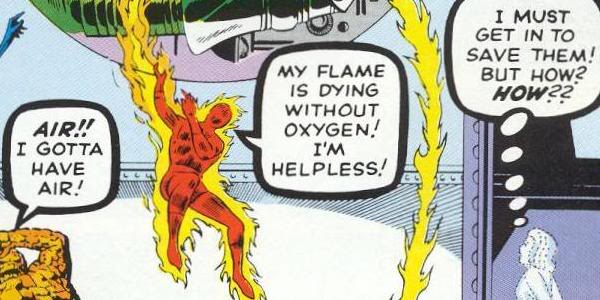
The comics make it clear that Johnny's flames need oxygen to burn. Wherever he goes, his flames consume the oxygen in the air around him. Except, that's pretty damned dangerous in many of the situations he and his teammates regularly find themselves in. Suppose Johnny is battling the armies of the Mole Man deep underground. How long would it take for him to use up all the air in those oxygen-poor tunnels? That's not the only environment where the Human Torch would be just as lethal to his friends as he is to his enemies; there's space as well. Usually, the creators of the comic are clued in enough to avoid showing Johnny flying through the airless void but they make the almost-as-bad error of drawing him on fire inside the ship. Leaving aside the issue that the air supply in real spacecraft used to be 100% oxygen which wouldn't react at all well to Johnny activating his flames, there would be life-threatening repercussions even on board less oxygenated modern space vessels. Such as, again, using up the available oxygen supply and condemning both his teammates and himself to death by suffocation. Additionally, there would be a huge danger of Johnny setting fire to the ship and accidentally burning his friends and sister to death. Still, these dangers assume the ship has artificial gravity. In the more likely case of zero gravity, Johnny's fire would smother itself and quickly go out, since fire can't sustain itself without gravity. Either way, the Human Torch is pretty much a liability underground or in space.

1. Anyone Could Tear Mr. Fantastic Into Hundreds Of Blood-Soaked Pieces

The worst of all the problems with the Fantastic Four lays at the bendy, elastic feet of Mr. Fantastic. It's bad enough that he's still capable of exerting normal strength on objects and people when he's at full stretch, but he's also shown as being nigh-on indestructible. Galactus can't tear free from his rubbery coils, Wolverine can't stab his claws through his suffocating embrace, and even Klaw can't blow a hole through his all-encompassing grasp. But that makes no sense at all. When Reed Richards uses his favourite tactic of wrapping his stretchy body around a foe to immobilise him, that enemy should be able to tear free without any trouble at all. As discussed earlier, the more Reed stretches, the thinner he should get. And if he's stretched so much he's completely wrapped up an enemy like a mummy's bandages, his body should be tissue thin. Under those circumstances, Galactus would walk right through the coils of Richard's body without even noticing, Wolverine's claws would slice through him like a hot knife through butter, and Klaw's sonic blasts would vapourise Reed into nothing more than a red, sticky mist. Even Spider-Man's Aunt May would be able to rip Reed Richards into hundreds of blood-stained shreds without working up a sweat. All thing's considered, it'd be best to keep the audience's minds off just how implausible the Fantastic Four really are.

Contributor
Contributor

Mike has lived in the UK, Japan and the USA. Currently, he is based in Iowa with his wife and 2 young children. After working for many years as a writer and editor for a large corporation, he is now a freelancer. He has been fortunate enough to contribute to many books on Doctor Who over the last 20 years and is now concentrating on original sci-fi & fantasy short stories, with recent sales including Flame Tree, Uffda, and The Martian Wave. Also, look for his contribution on Blake's 7 to "You and Who Else", a charity anthology to be released later this year. You can find him on Tumblr at https://www.tumblr.com/blog/culttvmike