10 Problems No One Wants To Admit About Green Lantern
He's more than just Hal Jordan, people.

Despite being one of the most beloved and richest aspects of the DC universe, Green Lantern today is still a somewhat divisive character. Whether it's his 2011 film sullying his perception in the mainstream public, or the fact that every comic book fan as their favourite version of the character, to love the Lantern is to dive into one of the most gratifying and yet simultaneously frustrating comics in DC's library.
For all the potential that corner of the mythos has, it never seems to be far away from the next big controversy. It was a Green Lantern storyline that denoted the 'women in refrigerators' trope in the mid nineties, while the series itself always seems to be at the centre of DC's most divisive retcons, whether introduced in a Lantern comic itself or in a Crisis further down the line.
Then there are the generational aspects of the character. For each wave of comic book readers there always seems to be a new Lantern for them to latch onto. For those in the fifties and sixties their favourite is likely to be Hal Jordan; ask those who grew up in the early noughties, and Kyle Rayner or John Stewart are the more likely answers.
Ultimately, it's this big old, loveable and endlessly frustrating aspect of DC continuity. And even if you love GL, there are certain things fans will have to admit about the character sooner or later...
10. Hal Jordan Is The Least Interesting Lantern

Hal Jordan is, in many ways, the quintessential superhero. He kickstarted the most interesting aspects of the Green Lantern mythos all the way back in his first appearance in 1959's Showcase #22, and fits the definition of an establishment superhero. He's a former pilot, a middle-aged white man, and the very picture of authority, policing on a planetary scale.
It's worth noting too that Jordan has featured in some tremendous storylines over the years. When Dennis O'Neil and Neal Adams opted to dive into Nixon's America with Green Lantern/Green Arrow, they chose Hal to juxtapose with Oliver Queen, who embodied the firebrand politics of the New Left. Jordan was criticised from start to finish, but ultimately left the series a changed man. He'd had his head in the stars for so long, but it took his Earth-based partner to force him to reappraise his role as an establishment figure, and one ambivalent to Earth's own issues at that.
Factor in the likes of DC: The New Frontier (a departure from Hal's typical characterisation anyway) and much of Geoff Johns' run too, and it stands to reason that Jordan is DC's most storied Lantern. But he's not the publisher's only one.
A few decades, a death and a surprise resurrection later, and Jordan is once again DC's main GL. However, this has often come at the expense of his comrades, with Hal once again an unremarkable, establishment character.
Grant Morrison and Liam Sharp are doing great things in The Green Lantern, but Hal has, for so many years now, cut a very uninspiring figure on and off the page. Compared to his fellow Lanterns, he just seems to contribute little of value.
9. ...And GL Rebirth Made Things Worse

From the sixties through to the early noughties there were several Earth-based Lanterns. Jordan was the first, but soon after that came Guy Gardner and John Stewart. Kyle Rayner, meanwhile, would emerge as a potent force in the mid-to-late nineties, around the time Hal's presence began to decline.
A storyline called Emerald Twilight was meant to spell Jordan's doom, and for a while it did just that. The storyline saw the Silver Age Lantern go insane after Mongul destroyed his hometown of Coast City. He took on the Lantern Corps itself, tapped into the Power Battery on Oa, and renamed himself Parallax. He killed the entire Corps which made Rayner the last Lantern, and himself a recurring villain - up until Zero Hour: Crisis in Time! came along.
That story saw Jordan sacrifice himself to save the galaxy, where he would then become the new version of the Spectre. Other Lanterns filled the void, but writer Geoff Johns decided to resurrect him in 2005 with GL: Rebirth, which retconned the whole Parallax business to have been an alien entity that controlled Hal to commit the aforementioned genocide.
Hal's return was itself a little obtuse, but erasing the red in his ledger made it so much worse. He was no longer accountable for his actions, and him lashing out at Batman was the petulant cherry on top of an already contrived cake.
8. John Stewart Has Been Criminally Underused Since Justice League

If you were raised on the DC Animated Universe - i.e., shows like Batman: The Animated Series, Batman Beyond and Justice League - you probably have a thing for John Stewart. Maybe not a 'thing' thing, but like, a thing all the same.
John was the Lantern in both Justice League and Justice League Unlimited, and was brought to life by Phil LaMarr. The show's creators actually faced pushback from fans for John being included, but several seasons and dozens of wonderful episodes later, and they'd more than justified Stewart's inclusion.
Introduced in 1971, John Stewart has always had to settle for second-best when it comes to his comics. He's been a staple of the DCU for decades but he's never really been afforded the opportunity to lead a comic like either Hal or Kyle has - at least not for as long a period - and when the perfect opportunity for him to be the main GL came around after Justice League, DC didn't take it.
Instead, John has constantly been overlooked in favour of others - particularly Hal. The ex-marine deserves better.
7. The Hate For Guy Gardner
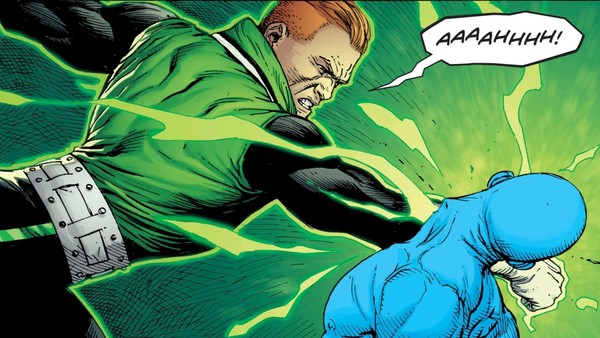
Woe, woe is Guy. Always the bridesmaid, never the bride, Guy Gardner is constantly seen as DC's most derided Lantern, a hate figure for both GL fans and wider DC readers to rail against whenever he appears - hence the admittedly hilarious "one punch!" moment Justice League: International.
But... that's kind of the point. When Steve Englehart and Joe Staton turned Gardner into the GL corps' very own jingo representative, they did so to provide a foil to John Stewart. Gardner was brash, abrasive and generally unlikeable, but his cartoonishly toxic personality also makes him extremely enjoyable to read, and thus as the years went by, Guy became more and more likeable and heroic - he attained nuance.
Unfortunately, like John, Gardner has found himself taking a backseat since Hal's resurgence. He's still around, and has had the spotlight at numerous points, but he's never been anything more than a backup, and one derided by plenty of readers at that.
Ultimately, Gardner might be pig-headed and combative, but once you embrace it, you're left with a multi-dimensional character. An unlikeable hero? What a concept.
6. Kyle Rayner Should've Been The Main Lantern For Longer

If you stumbled across an obnoxious 'Only Nineties Kids Will Remember' quiz, and that quiz just so happened to feature a GL segment, there's a strong chance Kyle Rayner would be on there.
Introduced in the very same story-arc that was meant to spell Hal Jordan's end, Kyle was a hero unlike most seen in the DCU. For starters he was an artist - not a soldier, businessman or reporter - and for a hero that draws their power from imagination and creativity, that is genius. He was also half-latino, and his experiences living and working in the west coast would go on to form the kind of Lantern he'd go on to be known as in the years to come.
Next to Hal, Kyle is probably DC's longest-serving 'main' Lantern. He took on the identity in the early nineties and was only displaced in 2005 with Rebirth. That's a full decade as DC's frontline GL - longer than either Guy or John had the honour - but here's the thing... it should've lasted longer.
Rayner is an interesting case because he's constantly seen as the most powerful Lantern in the biz. He was literally Ion, and wielded the power of the White Lanterns thereafter. And yet, despite his perceived power, he's not been at the forefront of the Lanterns for what seems like ages.
5. His Comics Are Way Too Action-Heavy
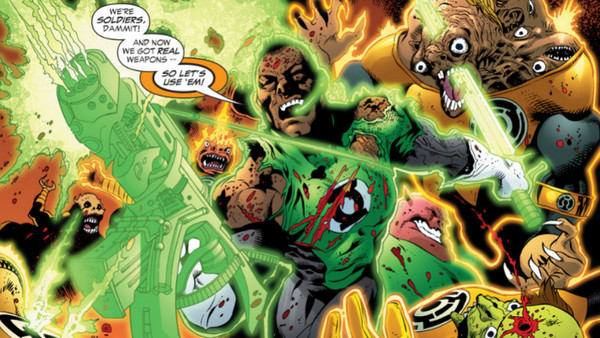
First thing's first - Green Lantern has one of the coolest powers in comics history. He can create anything that comes to mind and use it as a weapon, mode of transport or whatever else springs to mind. The possibilities are boundless, and it enables artists to go wild with what's on page, with humans likely to create Earth-based constructs, and aliens more likely to factor what we perceive as the unknown into their arsenal.
With that in mind, it's only natural that a lot of GL's books have focused on action. Factor in how the series is basically DC's own version of Star Wars, and it would be fair to say that a GL comic without a big set-piece would seem lacklustre compared the one on stands that did.
In truth, the problem isn't even that there's action - it's more that it takes primacy over other, more interesting questions that could be asked of the Corps, and namely the kind of ones O'Neil asked in GL/GA back in the seventies.
Are the Corps are a police force, or a paramilitary organisation? What are the ethical quandaries of having galaxy-wide jurisdiction, and is there something to be asked about the role of an intergalactic space cop when police forces continue to be scrutinised for brutality, rights violations and institutionalised discrimination?
These questions have absolutely been broached in the past, but they've taken a back seat in more recent years. A more introspective story is called for, and it's one Grant Morrison and Liam Sharp have delivered in The Green Lantern, but it's the exception and not the rule.
4. Their Weakness Shouldn't Be A Big Deal

Anyone who derides - or even supports - Green Lantern is aware of two things: Alan Scott's weakness to wood was ridiculous, and so was Hal Jordan's susceptibility to the colour yellow. Both were relics of the Golden and Silver Ages and neither had a place in a maturing industry filled with a fish-man space-cop, a cabal of blue-headed intellectuals, and a sentient planet that was also a space officer.
See what I mean?
Look, no one's saying that having your character be vulnerable to wood and yellow isn't pretty goofy, but so are plenty of things about comics. They're comics, and GL in many ways represents the pinnacle of Silver Age goof when it comes to the DC universe - and that's a good thing.
In a bid to modernise the character both Scott and Jordan's weaknesses have been retconned into something slightly more believable, but did they even need that sort of treatment in the first place?
3. Nostalgia For The Silver Age Has Hurt The Character
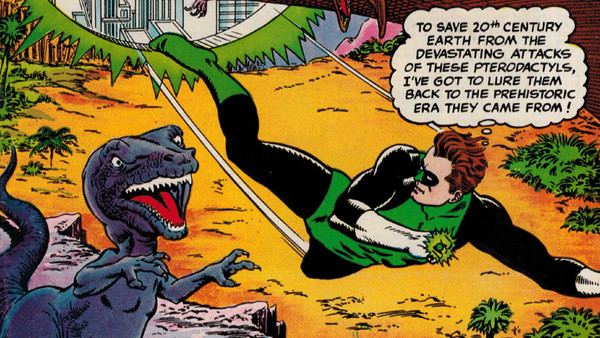
Conversely, while a general dislike for the less "believable" aspects of the Silver Age has pervaded DC in the modern era, the company at the same time seems to be obsessed with that period. It's yielded some wonderful results, but sometimes the focus can get a tad overbearing.
It's a consequence of most writers and artists at the company having grown up on the original Flash and GL comics of the fifties and sixties, but it's a double-edged sword; for every wonderful, zany commentary about DC's most bonkers period, there are about several more that limit their reappraisal to the surface level, looking to reinstate childhood icons in what - from the outside at least - looks like a nostalgia-driven obsession.
The Silver Age resurgence arrived towards the middle of the 2000s and it's what saw the likes of Hal Jordan and Barry Allen (the second Flash) to return to mainstream continuity. Barry had a fantastic resurrection in Final Crisis, but Flash fans will be the first to tell you that him replacing Wally West as DC's main speedster felt out-of-step with where the character was heading, with Wally boasting a dominant presence across comics, animation and video games during that decade.
The same goes for GL. Hal came back to the DCU not out of any given need, but because he was the 'first'. A pioneer he may be, but far more interesting Lanterns had emerged in the years since Jordan absented the spotlight. It's time they moved on, lest the other Lanterns be relegated to a supporting role for years to come.
2. Alan Scott Is Criminally Overlooked

Alan Scott might not be a Lantern along the same lines as Hal, Guy or John, but he's no less important. The character arrived during forties as a part of DC's first generation of heroes, utilising magic while donning an extraordinary cape to battle mobsters and spies during his earliest adventures, and while there's no denying the comic's space-age reboot is superior, that's no reason to overlook the publisher's first Lantern.
For starters, Scott's focus on magic over science is a big strength. Marvel may have Doctor Strange, Ghost Rider and Blade, but DC have had their rivals beat in the supernatural department for decades, mainly because they've focused on that corner of their mythos more than the House of Ideas have.
Scott is a cornerstone of that mythos alongside the likes of Zatanna and Doctor Fate, and his position on the Justice Society of America makes him a storied character in DC's library. Add in the New 52 reveal that the character was gay too, and it's clear DC have an amazing platform with the hero that they're yet to take full advantage of.
Fortunately the Golden Age Lantern is staging a comeback in the pages of Young Justice, but the fact remains he's an overlooked aspect of the GL mythos.
1. The Focus On Humans Is... Kind Of Boring

Of all the problems present with DC's Lantern, this one seems the biggest pitfall.
To date, the publisher has spotlighted six human Lanterns at any one point in time. They head to space and interact with all sorts of colourful aliens, but in the end their roots are all planted firmly on Earth. That in itself is fine - the book has constantly put forward a compelling case for that focus - but what about the beloved supporting cast of aliens?
The likes of Kilowog, Tomar-Re, Laira and Katma-Tui have all developed followings over the years, and there are all sorts of weird and wonderful aliens to have served on the Corps.
In the grand scheme of things human Lanterns are only a recent phenomenon, and while it's understandable as to why storytellers elect for human voices in their GL books, what about all the weird and wonderful extra-terrestrials? Is it not time they got their own chance to shine (more regularly) in the spotlight?