10 Spider-Man Costumes More Effective Than The Original
Take a look inside the Web-head's wardrobe.
This July, everyone's favorite arachnid themed superhero (sorry, Tarantula) will be swinging back onto the silver screen to star in his sixth feature film “Spider-Man: Homecoming”. His familiar red and blue threads are also making a reappearance but with a few tweaks. This time the suit has some tech upgrades courtesy of the MCU’s resident genius billionaire playboy philanthropist, Tony Stark.
We’ve already gotten a close look at Spidey’s new suit in last years “Captain America: Civil War” and the “Homecoming” trailers. The web-head’s new duds boast upgraded web-shooters, underarm webbing for gliding, camera-like lenses in the mask to improve focus, a parachute, a spider-drone, and an AI similar to Ironman’s F.R.I.D.A.Y system. As cool as all these enhancements are, in the comics, Spider-Man changes costumes pretty regularly.
An aspect of Peter Parker that's often overlooked in the movies is that he’s one of the smartest characters in the Marvel Universe. He’s perfectly capable of making his own super-tech suits without Tony’s help (except that one time) and has more times than you're probably aware.
There have been multiple occasions when Spidey’s spectacular abilities weren't quite spectacular enough for the job at hand. At times like these, Parker uses his scientific acumen to give himself an advantage over his foes. Other times he's just happens upon an upgrade. Some of these suits seem so much more effective than the traditional one, you can’t help but wonder why he ever goes back to it.
10. Spider- Armor

Even though Peter only wore this chromed out number for one issue in “Web of Spider-Man” #100, it seems to have made an impact. It’s still referenced in various videogames and comics decades after its brief appearance.
This disco-ball-esque variant is likely remembered so well because its prominent appearance on the milestone issue’s cover. So prominent, Spidey web swinging in it in front of a web background is the entire thing. The only accompanying image is large, colorful, stylized lettering advertising the “all-new, all-daring, SPIDER-ARMOR.”

Other than the purpose of being newsstand era click-bait, the in-story reason for the costume change seems like a no-brainer. As it turns out criminals have a tendency to carry guns and even if Spider-Man is more durable than most, he isn’t invulnerable.
So why hadn’t Peter made a suit like this before? The comic doesn’t address that but we are told that the bad guys are equipped with high caliber enhanced ammunition. Regular gunfire just wasn’t deadly enough to warrant any kind of protection we suppose.
The suit only lasts for about eight pages until is gets destroyed with acid, never to be seen again in the main continuity Marvel Universe. This is just the beginning in a series of progressively more impressive Spider-Armors.
9. Scarlet Spider

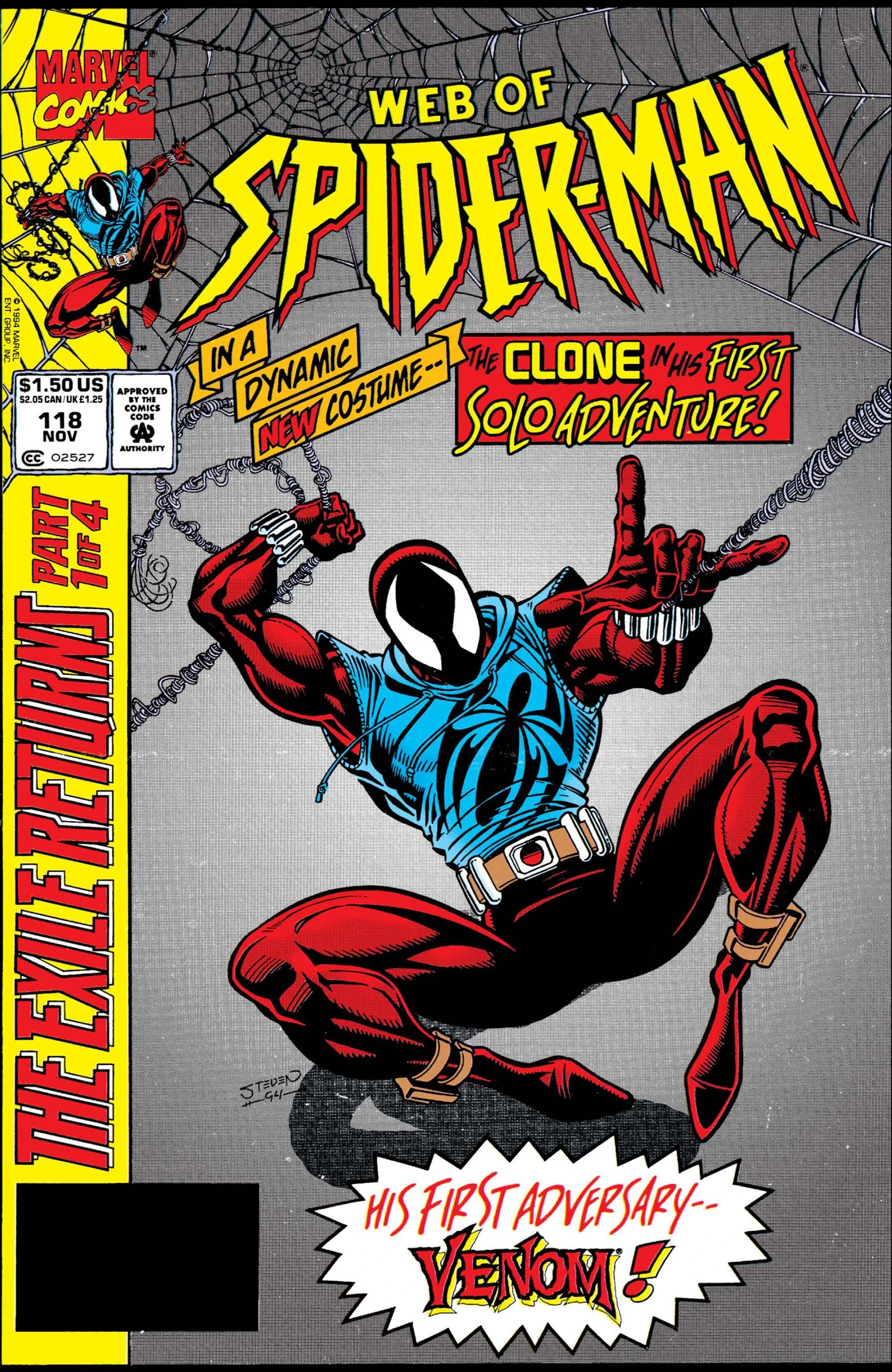
Arguably one of the only good things to come out of the “Clone Saga” the Scarlet Spider costume is usually associated with Peter's clone, Ben Reilly, although Peter wore it for a while as well.
Ben Reilly was introduced as Peter’s clone in a single issue from the ‘70s, having survived after being seemingly killed at the story's conclusion. Ben shared Peter’s personality and all of his memories up until their first meeting, taking the moniker Ben Reilly after his Aunt May’s maiden name and Uncle Ben.
Ben started operating as a superhero in a makeshift costume consisting of a red bodysuit and a tattered blue hoodie featuring the spider symbol. He also had a mullet because this was the ‘90s and we didn’t know any better. What makes his suit better than the original, aside from being a bit warmer, are the web-shooters. Ben modified the original design to add three new features: impact webbing which shoots a small blob of fluid that expands and encases the target on impact, stinger darts thats contain a non-lethal paralytic agent, and tracer discs that adhere to the target and tracks their movement.
Ben was meant to replace Peter permanently but fans weren't too receptive to the idea that the Spider-Man they had grown up reading about was a fake. Marvel scrambled to try to correct their mistake, ironically muddling Spidey’s canon even further. Fanboy’s opinion of Ben Reilly has softened over the years, however. He was reintroduced as Scarlet Spider recently in his own book with a different costume, but due to fan outcry, the blue hoodie is back.
8. Identity Crisis

Following the Clone Saga, Spider-Man and comics in general were floundering, prompting a lot of gimmicky stories to win back readers. At the time, there were four monthly Spider-Man titles. Identity Crisis was a cross-over incorporating all of those books, with Peter adopting a different persona and costume in each one.

Framed for murder by Norman Osborn, Peter utilizes four new constumed identities to collect evidence and clear his name. Each of these identities comes with its own abilities and represents an aspect of the web-slingers personality.
The first alter-ego Peter adopts is Ricochet, meant to represent the wisecracking, swashbuckling side of Peter. Ricochet poses as a criminal and utilizes Peter’s heightened agility and strength as well as disks that would ricochet similar to Captain America's shield.
Next up is Hornet, representing the intellectual side of Peter, this costume is similar to Hank Pym’s Yellowjacket suit. This persona uses a jetpack for flight and incorporates Scarlet Spider’s stinger darts.
Third is Dusk, utilizing a suit from a dimension called the “Negative Zone”. Meant to illustrate the clandestine nature of Peter’s dual identities, the suit blends with shadows and has underarm wings, allowing the wearer to become nigh-invisible and glide.
Finally is Prodigy, Inspired by more traditional heroes like Superman and Shazam. The gold and silver suit’s only capability is being bulletproof. Peter uses his super strength and agility to leap tall buildings in a single bound and appear as though he’s flying similar to Superman’s early appearances.
After the arc, the four identities were adopted by a group of new teen heroes in the short lived spin-off “Slingers”.
7. Iron Spider

In the comic version of Civil War, Tony and Peter’s relationship is similar to the movie but not quite the same. One big difference is Peter is a grown man. He’s been leaving footprints all over NYC’s skyscrapers and being the bane of window washers everywhere for most of his life at this point. Tony does act as a mentor to Peter and make him a freaking awesome suit though.
Visually and functionally this suit is very different from its movie counterpart. Dubbed the “Iron-Spider” armor, it shares the metallic plated appearance and red and gold color-scheme present in most incarnations of the Ironman armor. Not only that, it also has three mentally controlled, mechanical spider-leg like appendages with cameras on the tips, allowing him to see behind himself or around corners.
Among these immediately apparent advantages, the suit is also made of a "'smart' liquid metal" that can change shape, camouflage, or appear as different costume or street clothes.

Peter becomes disillusioned with superhero registration and joins Captain America’s anti-registration side, but not before Tony takes back the suit, with peter going back to the classic red and blue. The suits were seen again, when three members of the government sponsored superhero “Initiative” used modified versions and called themselves the “Scarlet Spiders.”
6. Stealth Suit

We’re first introduced to the Web-Heads Tron-like outfit on the cover of another milestone issue, Amazing Spider-Man #650. At the time, Peter was working at Horizon Labs and would often incorporate tech he’s researching at his day-job into his nightly work as NYC’s friendly neighborhood Spider-Man.
After encountering a new Hobgoblin with a debilitating super-sonic laugh, Petey gets to work on building a suit that would be able to withstand it. The end product is a dark suit with neon green lines emanating from a spider symbol on the chest, the only thing missing is a CGI Jeff Bridges and a light-cycle.

The suit is made from a “omni-harmonic mesh” and based on a design by Hank Pym aka Ant-Man. This fictional tech grants it several capabilities:
Camouflage Mode: Makes him virtually invisible and absorbs any sound he makes. The green neon can be seen only with special lenses, making him visible to allies and himself.
Sound Proof Mode: Turns the neon parts red and disperses any sound directed at Spidey, keeping him safe from Hobgoblins laugh as well as any other sonic attacks.
Anti-metal Spiders: Made of Antarctic Vibranium, they can be fired from his web-shooters, dissolving any metal they come in contact with.
Unstable Molecules: Also found in the Fantastic Four’s costumes, making it nearly indestructible and able to fit the wearer perfectly.
The suit would eventually make its way to Kaine, another of Peter’s clones. With the suit stuck in its red mode, Kaine became the second Scarlet Spider as he served as Houston Texas’ local spider-themed superhero.
5. Spider-Armor MK II

Only six issues after the debut of the stealth suit, we’re introduced to the Spider-Armor MK2. During the time since the stealth suits creation, peter lost his most useful power, his spider-sense. To make up for the fact that instinctively dodging gunfire was no longer a part of Spidey’s skill set, Peter built the far more capable follow up to the bulletproof Spider-Armor.
This armor also deflect bullets, but isn’t as bulky or unwieldy as the original. Being incredibly durable for its light weight design, Peter took a direct impact from a grenade launcher with no long lasting ill effects. The MKII also includes built in web-shooters in the forearm instead of the wrist. The web-shooters contain a magnetic webbing that can block radio frequencies.

Like the original Spider-Armor, this suit was made specifically for one occasion and was never used again. The suit was made specifically to rescue hostages being held by the villain, Massacre. Spidey used his magnetic webbing to block Massacres signal to bombs he had hidden throughout the building before taking him down. Like the spider-armors previous incarnation, Peter only used it during this one issue, the suit wasn’t destroyed this time though, which makes you wonder why he didn’t make the MKII his default costume.
4. Symbiote

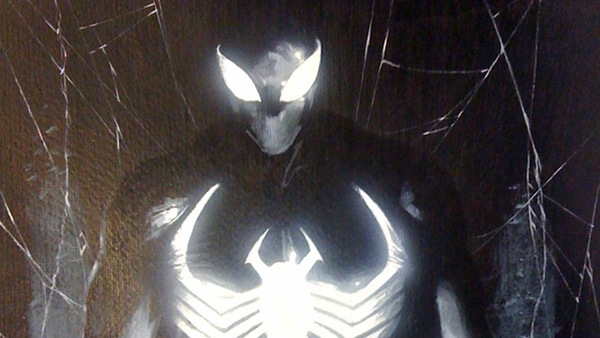
Probably the most recognizable costume outside of the original one, the symbiote “suit” is actually a sentient alien life form that must bind itself to a host in order to survive. If you aren’t an avid comic reader, you’re probably familiar with the black suit as being responsible for the infamous “emo” Spidey in Sam Raimi’s “Spider-Man 3”. In the comics it appears as a jet black bodysuit with a large white spider on the chest.
Peter originally encountered the mood-swing causing suit during the 1984 crossover event “Secret Wars” on the planet Battleworld. The symbiote is actually a member of an alien race called the Klyntar. Amorphous on their own, when these creatures bond with a host it takes on attributes of the wearer while enhancing their abilities. Not only does the symbiote boost the wearer's innate attributes, it also grants them a number of superpowers, including but not limited to: super strength, speed, agility, and endurance, a healing factor, camouflage, and shapeshifting.
Unlike most members of its species who peacefully coexist with their partners, this symbiote is seen as a villainous entity. When Peter realized it was influencing his personality and causing him to become more aggressive, spiteful, and just a jerk in general, he rejected it, leaving it to search for a new host.

In a recent retcon, it was revealed that Spidey wasn’t the Venom symbiotes first host It actually fused with Deadpool shortly before being found by Peter. The brief while it shared a mind with the Merc With a Mouth proved too much for the poor little gooball and drove it insane, making Deadpool the reason for why it has such an attitude problem.
3. Spider-Armor MK III

While the MKI and MKII armors were designed to take down one specific enemy, the MKIII was made to combat the entire Sinister Six. A terminally ill Doctor Octopus recruits the rest of the Six (Chameleon, Mysterio, Rhino, Electro, and Sandman) to assist him in his final scheme before his death.
Ock takes control of satellites capable of increasing the temperature of Earth to a lethal level but claims his intention is to use it to stop global warming. While other heroes buy into this ruse, Spidey knows better. He equips himself with his most advanced armor yet and sets out to stop the SInister Six.

Among its many features, the MKIII includes:
Hearing Acuity Device: Using tech based on Daredevil’s enhanced hearing, Peter can recognize Chameleons heartbeat regardless of his disguises.
Comm-Link: Able to communicate with the Avengers and other allies.Enhanced Lenses:
Holographic Visor: Able to see through Mysterio’s illusions.
"Pink Hippo" App: Combined with a special radioactive substance, the app can control Sandman’s shape and consistency.
Electro-Proof: Able to nullify Electro’s energy and depower him.
Built-in Web-Shooters: Able to fire larger amounts of webbing than his normal ones.
Jet Boosters: Enables flight.
Enhanced Durability: Able to withstand blows from Rhino.
Built-in-Utility Belt: Contains a variety of webbing types.
With these enhancements, Peter was able to put an end to Doc Ocks plans. Though Octavius’ health was deteriorating quickly and it seemed like this would be his final villainous endeavour, we soon find he has one last trick up his sleeve.
2. Superior Spider-Man

Through trickery and comic book tech, a dying Doc Ock manages to switch bodies with Peter Parker but Peter was able to imbue Ock with all of his memories and ethics. After Peter’s death, Ock in his new spider powered body, decides to pick up where Peter left off. Determined to be a better hero than Parker ever could, he dubs himself the “Superior” Spider-Man.
While this new Spider-Mans methods are more cold and methodical, they may have actually been more effective than Peter’s. Otto also does what he can to improve Peters civilian life, founding the company Parker Industries. Along with a modified methodology, Ock uses his technological expertise to add some new gadgets to Spidey’s arsenal.

His costume, being darker than the original, also includes:
Carbonadium Plating: Protects against any attempted “mind-swaps”
Talons: Used in combat as well as to implant spider-tracers
Enhanced Lenses: Adds a HUD with GPS and tracking abilities
Spider Button: Used to activate traps and other gadgets
Spider-Arms: four mechanical spider-arms similar to the Iron-Spider armor but with the added ability to shoot lasers.
Communication Device: Able to answer and make calls through a device in the wrist.
Web Wings: Used for gliding.
Nerve Hacking Technology: Able to remotely stimulate other's nervous systems.
After Peter reclaims his body and Octavius dies for real, Spidey discards the costume and goes back to the classic red and blue for a bit.
1. Spider-Armor MK IV

After Peter took the role of Spider-Man back from Doc Ock, he found himself with the near infinite means to work on Spidey-tech as the CEO of Parker Industries. Peter begins working on projects that benefit mankind as well as assist his crime fighting activities.
His current suit dubbed the Spider-Armor MKIV, takes inspiration from Spideys previous enhanced costumes while looking nearly identical to the traditional one. While it looks familiar aside from a glowing spider chestpiece, this is by far his most capable suit to date. The MK IV boasts various abilities that can be controlled mentally or verbally, including:
Sensors and HUD: Infrared and X-Ray vision. Able to diagnose injured people and track spider-tracers.
Upgraded Web-Shooters: Forearm mounted web-shooters, containing a number of projectiles. Stronger web-fluid, exploding spider-tracers, “bug-zappers”, acid webbing, concrete webbing, expanding web foam, spider-drones and sonic disruptors.
Brain Control Override: Able to shock the wearer’s nervous system, leaving them temporariily paralyzed.
Temperature Control: Able to lower the temperature of the suit as to not give off a heat signature and can apply heat to his fists during combat. Physical and Energy Durability: Able to withstand gunfire and blunt force as well as energy blasts.
Stealth: Able to project holograms to change its appearance.
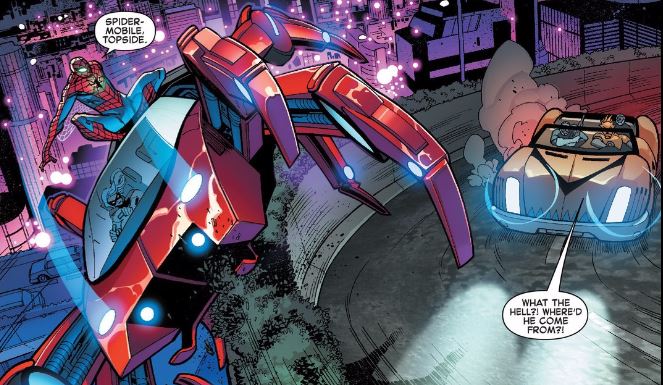
Along with becoming a one man arsenal, Spidey also built himself a new flying Spider-Mobile and Spider-Copter. While we don’t expect Peter to continue wearing this suit forever, we imagine the writers will be hard pressed to find a reason for the Web-Spinner to leave this one behind.