10 Star Trek Comics Fans Need To Read
Star Trek is an iconic franchise on film and television, but it has a long history with comics too.

When it comes to major franchises like Star Trek, what's on the screen tends to get more attention than what's on the page, which is a shame because Star Trek comics often take the franchise to places that it never dared to go on screen.
They may not all be canon but they are all loads of fun, and with so much time travel and so many quantum realities out there, canon is only as important as we choose to make it.
The series on this list don't just build on the franchise, but elevate it too. These books approach Star Trek in interesting ways and tell classic stories which deserve the attention of fans. They are not just good Star Trek comics, but Star Trek at its absolute best.
Some stories are too wild to make it to screen but too good to never be told. Some series have more and sometimes better adventures in them than the screen can provide. Some characters can only reach their full potential on the page, which the following comics all illustrate.
Here is a list of 10 Star Trek comics which every fan needs to read.
10. Spock: Reflections

Essential reading for any fan of Spock, this series is a character study that looks back on many of the events of the character's life. It's not a big or epic story but an intimate look on Spock's evolving views on loyalty and friendship.
The comic touches on every era of Spock's life prior to the 2009 film. We see him on an early mission under Pike, during the original series and during the time period of the films. Each flashback tells us something about Spock's journey as a character, how he grows to a point where he would take serious personal risk to make a gesture to a departed friend.
The primary arc of the series follows the events of "Generations" and Spock's response to learning of Kirk's death for the second time.
Following a letter from Picard, Spock journeys to Nimbus III and is resolved to do for his friend what his friend once did for him - return him home. It is an action that is in no way driven by logic but feels like the right thing to do.
There are a lot of classic moments in this series, including Spock's visit to the Enterprise-B following Kirk's initial death. A sequence in which Captain Harriman has a rare moment to shine, his character receiving some much needed expansion.
That said, the book's intense focus on character leaves little room for action. It has a much more meditative feel than the typical wham-bam action readers have come to expect from the franchise.
9. Mission's End

This series tells the story of Kirk's promotion and the final adventure of the legendary five year mission.
It does its best to represent itself as an unaired TOS series finale, building strong connections with the past and closing this chapter of several character arcs. It also takes full advantage of the comic medium, presenting a wild scenario that would be expensive to film today and would have been utterly impossible for the live action series to even attempt back in the sixties.
The series begins with Kirk's very first mission as captain of the Enterprise. A mission to a strange new (and artificial) world inhabited by giant insect-like creatures, some of which have evolved intelligence and build a society. A highlight of this first mission is the inclusion of Gary Mitchell, who fans will recognise from "Where No Man Has Gone Before".
The rest of the series deals with the fact that this primitive culture has inherited a technology so advanced that it could bring the galaxy to its knees. The Federation's flawed solution is to attempt to grant this society membership long before it's ready - an option which is better than the terrible alternative of invoking general order 24 and killing everything on the planet.
It falls a little flat in fully delivering the personal touches of character. There is a lot of big stuff happening but the alien characters never feel that interesting. Part of this is due to the fact that rather than focusing on one or two antagonists the story keeps jumping around. The Starfleet characters feel more developed but are very much in their assigned roles and not showing a lot of additional nuance.
In classic Trek fashion, this series presents a lot of heavy philosophical issues wrapped in a big, action intense plot. The artwork is top notch and the setting is visually interesting. it delivers on providing good reasons for Kirk to accept the much regretted promotion and for Spock and McCoy to both leave Starfleet.
8. Star Trek (1989)

Sometimes it's hard to remember that there were great Star Trek comics before IDW took command of the franchise. However, DC Comics' 1989 series stands out for a number of reasons.
Sadly, we only got to see the first and final missions of the Enterprise-A on screen. This series fills that space with more than 70 issues of monster maroon goodness. Taking place just after Final Frontier, the series follows the continuing adventures of Captain Kirk and his crew in their early years aboard the Enterprise-A.
While not the only or even the first Star Trek series published by DC, this one feels special in that it occupies the most solid space in canon. Other volumes of the time often stepped on the toes of the films, writing themselves in circles trying to work their way around the plot threads left hanging by the ongoing movie arcs. But the six year gap between Final Frontier and Undiscovered Country gifted the writers with a time range to freely explore and make their own.
Though this run of comics doesn't always jive with known canon, the deviations are nothing especially egregious. What it succeeds at is expanding on many of the character arcs and plot threads set up by the films and in building a world that feels like it belongs somewhere between TOS and TNG. Kirk's command style hasn't changed much but Starfleet as an organization is becoming more strict. He may settle a situation the way he would back in the original series but now consequences come down on him.
This comic delivers the Enterprise-A fully in its prime as the ageing crew deal with a galaxy that's starting to change on them. DC's 1989 volume of Star Trek is a must read for any fans of the first six movies.
7. Year Four

This series picks up where TOS left off, continuing the five year mission with Kirk, Spock, McCoy and the rest of the original crew. While the first volume is a straight forward revisit of TOS storytelling, it has some pacing issues. It's very episodic, which is fine, but the individual stories often feel rushed through.
While the first six issues are entertaining and present interesting ideas, the writers ultimately fail to fully explore most of those ideas. These issues spend a lot of time setting up the plot and then end abruptly, spending very little time on character. Though it does make a point of bringing back Arex and M'Ress from TAS.
However, the second volume "The Enterprise Experiment" takes a sharp turn in its approach by handing the reigns over to the legendary D.C. Fontana. In what would be her final Star Trek story, Fontana seeks to introduce some much needed continuity to the original series and brings together several hanging plot threads.
The story serves as a direct sequel to "The Enterprise Incident", which was originally written by Fontana and an indirect prequel to the TNG episode "The Pegasus." In the story, a test of the stolen cloaking device leads to an accident in which the ship and crew begin to phase uncontrollably. The potential tactical advantage of this as a perfected technology is not lost on either the Federation or the Romulans, and leads to political consequences well after the experiment.
Fontana not only brings back fan favorite characters like her Romulan Commander and Kor but makes a serious effort to provide explanations for many longstanding fan questions, one of the most important of which is why the Organians stopped enforcing their treaty.
Sadly this last, excellent story by D.C. Fontana has flown under the radar of most fans and deserves far more attention than it's gotten. Superbly written and essentially a love letter to the fans, this series is a fitting capstone to her illustrious career.
6. Star Trek/Doctor Who: Assimilation2

Star Trek and Doctor Who are very different franchises which on paper shouldn't be compatible, and yet in this crossover series they absolutely are.
The Enterprise-D is perhaps the worst ship in all of Star Trek for the Doctor to have wound up on as his renegade nature, inability to follow rules and dislike of authority are inherently at odds with Picard's by the book attitude and strict disposition.
Interestingly the two shows have existing plot tropes which combine well together in this book. In the case of Doctor Who, this isn't the first time the TARDIS has appeared on a starship with a militarily organized crew who are initially distrustful of The Doctor and his motives. Likewise this is not the first time in Star Trek that a mysterious character has appeared aboard the Enterprise.
The story is centred on a terrifying alliance across realities between The Borg and The Cybermen, two races which have long been argued to be overtly similar by certain fans of Doctor Who.
This breach between universes leads to the Eleventh Doctor ending up aboard the Enterprise. But things go from bad to worse when the Borg and Cybermen double-cross each other and threaten a war which will plunge both realities into chaos.
The series makes an effort to capture what is unique about both Doctor Who and Star Trek but does not limit itself to the later incarnations of ether franchise. We get to see a fun crossover between Captain Kirk and the Fourth Doctor as well.
Overall "Assimilation2" manages to craft a well balanced story that gives readers the best of both worlds. Both casts are given plenty of moments to shine in a story of sufficiently epic proportions, complimented by a unique art style.
5. Countdown To Darkness

Unique in that it's one of the few comics considered more or less canon, this series set between the first and second Kelvin timeline films also has the distinction of featuring a rogue Robert April.
In the prime timeline Robert April, the first USS Enterprise captain, was considered one of the greatest captains in Starfleet history. He would rise to the rank of commodore and become an ambassador at large. The Kelvin timeline's April, however, becomes disillusioned with the Prime Directive and Starfleet as a whole and as a result chooses to begin making his own rules.
Such a stark difference in characterization may seem hard to reconcile for readers but the comic does provide a subtle explanation. Kelvin April is a single man with only a few estranged relatives. In the Prime timeline April fell deeply in love with and married his chief medical officer, Sara - a person whose effect on his life and career seem apparent by her absence.
April goes rogue and fakes his own death in order to supply a pre-warp civilization with the advanced technology they need to fight their enemies. This is where Kirk finds him, leading an army and having in effect assimilated into the native populace.
"Countdown to Darkness" is a classic Prime Directive story in which the right thing to do is not entirely clear. April may be half mad and care nothing about the consequences of his actions but his immediate goal is to prevent genocide, which is admirable.
April's quest to save the natives takes precedence over everything else. To accomplish it he's willing to bend the knee to the Klingons and even plunge the galaxy into war.
Ultimately it amounts to a battle of wills between Kirk and April, the resolution of which leaves Kirk with many doubts leading into the events of Into Darkness.
4. Star Trek: Crew
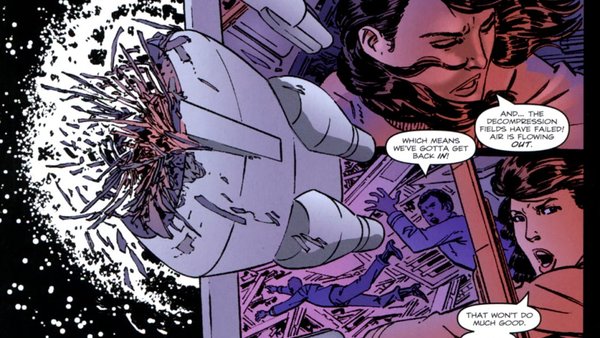
A prequel set eight years before "The Cage", this series follows the adventures of a young Number One, starting when she was a cadet and moving through her early Starfleet career.
Yet, while it is made abundantly clear who she is meant to be, her name is never said out loud, likely because the writers weren't entirely clear on what to call her, the name of this character being a matter of some debate before Discovery officially referred to her as Una.
The team behind this comic took painstaking efforts to make this feel not only like the original series but like the pilot episodes of the original series, not just in the look but in the dramatic pacing and even in the jargon, with ample uses of the term 'laser' instead of 'phaser', 'lithium' instead of 'dilithium' and so on.
Each issue feels very much like a classic stand alone episode of Star Trek. It's high stakes adventure with the young Una going from one hopeless situation to the next. After being present for a disastrous shakedown cruise for the Enterprise, she moves to a new posting with each issue until she makes her way back to Robert April's Enterprise.
With a high body count and a sense of ever-present danger, this series emphasizes how truly frightening a life in space can be, especially when you aren't in command and don't know what's happening. Number One rolls with the punches and with intellect and guile helps to pull each crew from disaster.
3. Mirror Broken/Through The Mirror/Terra Incogneta
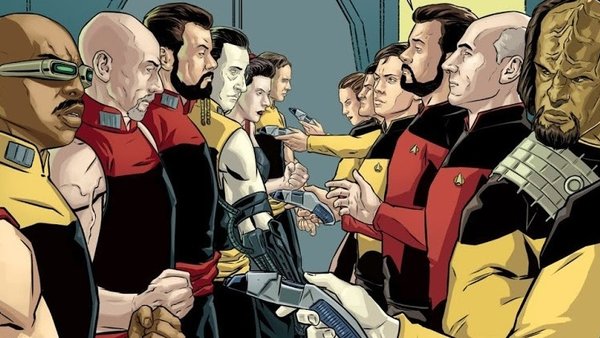
The mirror universe holds a special place in the hearts of Star Trek fans. It offers a chance to see the worst versions of favorite characters in a rough, dystopian counterpoint to the more hopeful and ordered Federation.
Unfortunately, while a celebrated staple of the franchise, not every series gets explore the Mirror universe and The Next Generation was one of the shows left out.
This spectacular three part epic gives TNG fans the mirror universe adventure that they've always wanted. It's a story that begins with the rough cut and treacherous remnants of the Terran Empire fighting over control of the high tech flagship, The Enterprise-D. The second part of the arc leads into a conflict between the two Enterprise crews as Mirror Picard attempts to steal a fleet of ships from the prime universe. Lastly is the weird tale of the Mirror Barclay's attempt to escape his reality by replacing his counterpart and stealing his life.
The TNG mirror universe arc has a little bit of everything that a Star Trek comic needs. It's rife with grey areas and philosophical questions and is filled with action and twisty intrigue. Not to mention the cool alternate versions of characters we know and love; Mirror Wesley, for instance, is a trip.
It's a series of books which paints a not so simple picture of the mirror universe. Characters can be heroes one moment and villains the next but generally fall somewhere in between. Mirror Picard has ambitions of power but he wants to free his people from oppression. And Barclay's plan may be twisted, but it's coming from a place of desperation - he notably doesn't harm his double and is actually a model officer in his place.
In the end "Mirror Broken", "Through The Mirror" and "Terra Incognita" collectively represent a ride every fan should take. They succeed at doing what every Star Trek comic should do: present a story which can't be told on TV but feels like it exists in that world.
2. The Q Conflict

In this wild miniseries, Q initiates the ultimate Star Trek crossover between every crew of the classic era. It's the kind of story that can likely never be told on screen and which certainly could never be done in live action today.
The story centers on a conflict between Q and several of the other familiar godlike, noncorporeal entities. These belligerent parties include the Orgonians, the Metrons and Trelane. Their celestial battles have spread collateral damage across the galaxy. Inspired by Picard's admonitions, Q decides to shift their war into a more peaceful contest, using humans as proxies.
Under these circumstances, Kirk, Picard, Sisko, Janeway and their crews are summoned and made to compete. Of course, as with any situation involving Q, it quickly escalates and spirals out of control.
This series is a mad barrage of Easter eggs and fanservice and about as much fun as anyone can have reading a Star Trek comic. The fun comes not just from the many crews in the franchise interacting in new ways as they mix and match but also in the crazy scenarios which come about in the course of the competition.
Nowhere else is a reader likely to encounter the doomsday machine, the Prophets and the Borg all in a single story - to say nothing of omega particles, Q weapons and Iconian portals.
That's not to say the series doesn't miss the mark in some places. Post-DS9 Worf spends the entire series working alongside Jadzia and it only really comes up once. Aside from this and similar squandered opportunities for drama it's also notable that Voyager's Doctor is pretty much left out of the whole story.
The series does succeed in its ambition to explain such things as Wesley's return to Starfleet prior to "Nemesis". It's also an incredibly entertaining story that makes a lot of bold choices without ever betraying the spirit of Star Trek.
1. The Last Generation
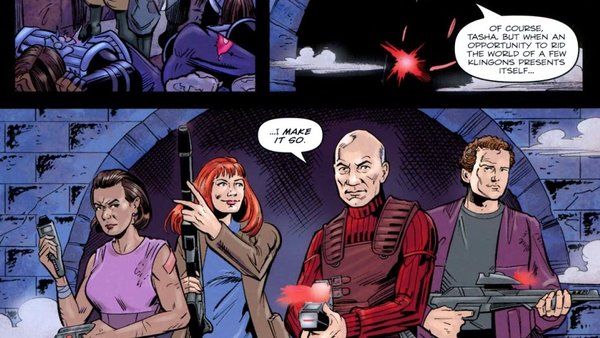
This series tells an exciting what if story in which the Federation lost a war to the Klingons following Kirk's failure to prevent the assassination plot in Undiscovered Country. This comes as a result of Captain Braxton's scheme to alter all of history and prevent the Federation's continued existence.
In this dystopian reality the Earth has been conquered, the Federation broken and the resistance has been fighting a losing war. Guinan has given Picard the clue for a slim hope with the knowledge that time is not as it should be. To that end, the Data of this reality has been specially designed to do time travel calculations.
The characters progress in ways which both feel entirely true to what's established and go against expectations. Renegade Wesley Crusher is a great example of this as his open insurrection against Picard feels both very different than the Wesley we know, but in this setting very true to character.
Another great highlight from this series is the bitter rivalry between Worf and Sulu. In this timeline Excelsior has gained a legendary status as a renegade ship that continues to fight long after the fall of Starfleet. Worf - leader of the Klingon forces - and Sulu, have become arch enemies; a conflict which ends in a climactic duel.
The attempt to restore history doesn't wrap things up in a tidy bow as is so often the case. Instead the series resolves quite differently, cementing the events as happening outside of the prime universe - a fact subtly hinted at by the inclusion of a certain bat'leth competition trophy in Worf's quarters.
Andrew Steven Harris delivers a well written stand alone epic adventure. The thought provoking, action packed time travel story is paired with superb character drama and loads of fan service as he crafts a rich Star Trek setting remarkably different than any that have come before.
Watch Next
Star Trek: Where No Quiz Has Gone Before
