10 Terrible Mistakes That Nearly Ruined The Joker For Everyone

Those Jared Leto pics didn't even make the top 5.

The Joker is a source of endless fascination, one of the most eerie and magnetic supervillains of all time, inspired by nothing more profound than a playing card Jerry Robinson owned when he was working for Bob Kane. He is so popular that, at times, his place in popular culture seems inevitable - like a law of nature. But the truth is anything but. The Joker has had a lot of material created about him over the years. Some has been great, some middling, and some terrible, but there have been a number of devastating blunders (some of them in bad stories, and some in surprisingly good ones) that threatened to harm the character beyond all repair. This isn't just a list of worst-ever Joker ideas, because some bad ones were pretty easy to forget. Merging him with other villains like Lex Luthor in Speeding Bullets (1988) or Sinestro in Batman: In Darkest Night (1994) was weird, but easy to forget. His bad portrayal in All-Star Batman and Robin (2005-?) barely even stood out against that series' whole melange of tastelessness. Even the eyeball-assaulting Joker of The Batman (2004-2008) didn't harm him too much: there have always been a few cases where DC's characters have been badly drawn. Doing permanent damage to the Joker is a little more difficult. But these instances almost managed it.

10. Really, Actually Killing Him

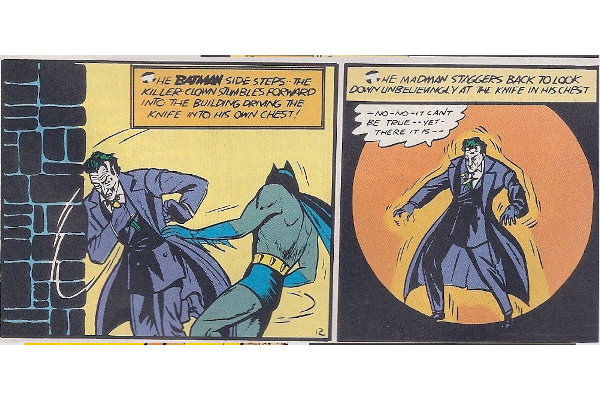
When Jerry Robinson, Bill Finger and Bob Kane introduced the Joker in Batman #1, they didn't think they'd created anything all that unusual. After all, Dick Tracy was churning out similarly misshapen villains and killing them every month. And therefore, they saw nothing wrong with killing the Joker off in his first appearance. Today, comic-book death is barely more permanent than a power nap, and even in the 1940s, villains could often appear to die and then return, but when we say "killed off," we mean they really never meant to publish another story with him. What Fixed It: Editor Whitney Ellsworth, who later enforced Batman's code against killing, recognized the Joker was too good to die, so the team hastily added a last panel that showed him still alive, even though the means of his survival didn't make a whole lot of sense.

9. Making Him Always Nasty

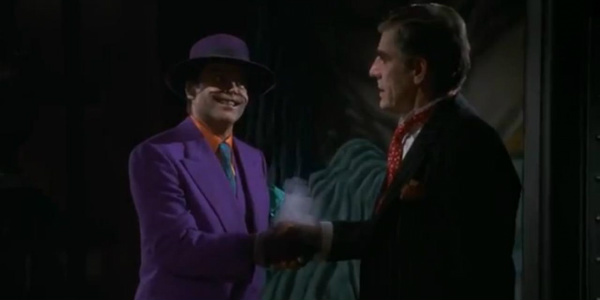
Jack Nicholson's Joker, as seen in 1989's Batman, is one of the best-remembered versions of the character, and he's certainly great fun to watch. But he's scarcely nastier than his original identity of Jack Napier, the gangster who (in the movie version) killed Bruce Wayne's parents. Before the chemical accident that ruined his face, Napier was already homicidal and venal and already a little unhinged, asking his victims a meaningless riddle before shooting them dead. In other words, changing him into the Joker didn't really seem to make that much difference, which ultimately diminished the story. What Fixed It: The Killing Joke, which came out a year earlier, showed a much more dramatic transformation and was a lot more influential. Many versions of the character (such as the one in Christopher Nolan's The Dark Knight (2010)) also give him no definite origin story at all.

8. Making Him Look Like A Tryhard

It's too soon to really know whether next year's Suicide Squad will be a good movie or a bad movie. It certainly has some talented people involved, including Jared Leto as the Joker. The Squad is all about our government putting super-criminals to work in exchange for sentence reduction, and the idea that it might employ a young Joker before realizing he can't be controlled is a nifty one. However, the images released of Leto this year make his Joker look desperate for attention, which hasn't left a good early impression with either comics fans or just those who remember the restrained performances of Nicholson, Mark Hamill and Heath Ledger. What Will (or Won't) Fix It: The movie itself. Since it's part of DC's "cinematic universe," which will be using Ben Affleck as Batman at least five times, this version of the Joker will probably be mainstream for years to come.

7. Making Him An Iranian Diplomat

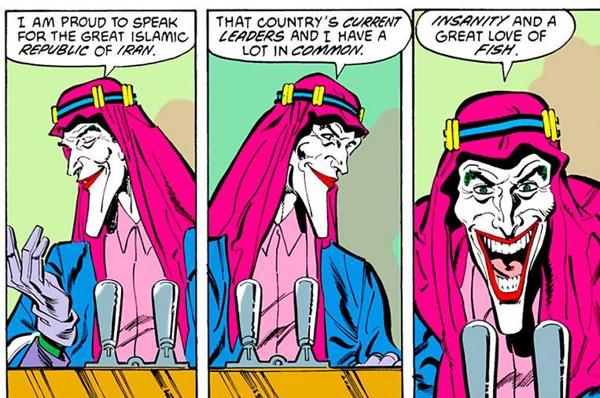
Most Batman fans remember "A Death in the Family," the story where the Joker beat the second Robin, Jason Todd, to death with a crowbar. The readers were invited to vote on whether Todd should live or die, and Todd, an irritating replacement for Dick Grayson, got the thumbs down. But that was far from the craziest part of the story: the Ayatollah Khomeni also recruited the Joker as an ambassador, meaning Superman had to hold Batman back from beating up the Joker because of diplomatic immunity. This over-the-top attempt at political satire diminished everyone involved with it - the creators, Superman, Batman, the Joker, even Khomeni. What Fixed It: DC later revised the Joker's ambassadorship so that it was for the fictional nation of "Qurac," which was later destroyed, but has yet to publish a Khomeni-less version of this tale.

6. Making Him All About Boners

Every oddball Joker list mentions this 1951 story, but they're all correct. In those more innocent days, the Joker committed colorful and ultimately harmless crimes. When the newspapers laughed at him for making an embarrassing mistake, he promptly committed a set of crimes themed around embarrassing mistakes. In the 1950s, a common word for embarrassing mistake was "boner," and the story, "The Joker's Comedy of Errors," uses the word "boner" at least 28 times. However, by the 1950s, the word "boner" was also taking on its modern meaning of "erect penis," and it's hard (har har) to think writer Bill Finger was unaware of that. What Fixed It: Even though Fredric Wertham's Seduction of the Innocent would attack Batman and Robin for sexual innuendo in a couple of years, this story came out after Wertham's research was complete, so it got buried until the audience aged enough for it to no longer be an issue.

5. Making Him A Hero

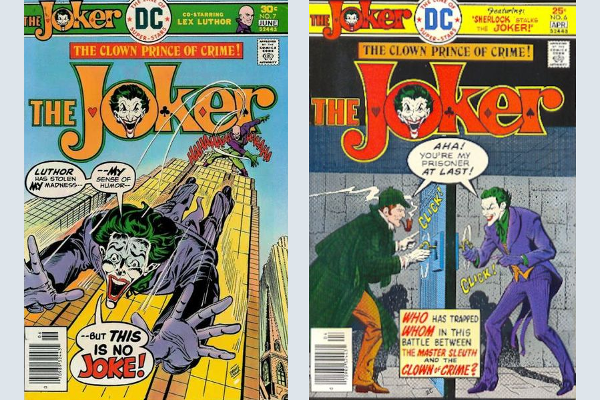
In 1975, the Joker was popular enough that Denny O'Neil thought it would be a good idea to give him his own Batman-free book, in which he fought both heroes and rival villains. While there can be interesting Joker stories where Batman has no role or a greatly reduced one (the Batman: the Animated Series episode "The Joker's Favor" would be a classic even without the first appearance of Harley Quinn), he really doesn't work as a series regular. He can't evolve in a narrative arc, and he can't represent much of a status quo to be challenged like the traditional super-hero. Cast in a role he was never meant for, the Joker bombed like Letterman at the Oscars. The series lasted nine bimonthly issues. What Fixed It: Cancellation.

4. Making Him A Whipping Boy

It's a gimmick that keeps coming back, if only because it's so easy: if you want to build up your new character, have him overpower someone whom readers know is a big deal. In "Hush Returns," in Batman: Gotham Knights #50-55 the Joker gets this treatment. Outmanoeuvred by the then-new villain, the Joker loses his men and gets beaten to a pulp, only escaping when Batman interrupts. Just getting beaten up wouldn't be so bad - the Joker does that all the time - but he usually has a sense of humor about it. Here, he snivels lines like "Do you know who I am?" then goes running back to the funhouse from The Killing Joke like a kid running back to mommy. What Fixed It: The Joker got revenge on Hush in their next encounter, knocking him out and fixing him with a faulty pacemaker. Scans of Hush's defeat of the Joker are really hard to find, indicating the Internet itself is trying to forget this one.

3. Giving Him A "Daughter" And Ex-Girlfriend
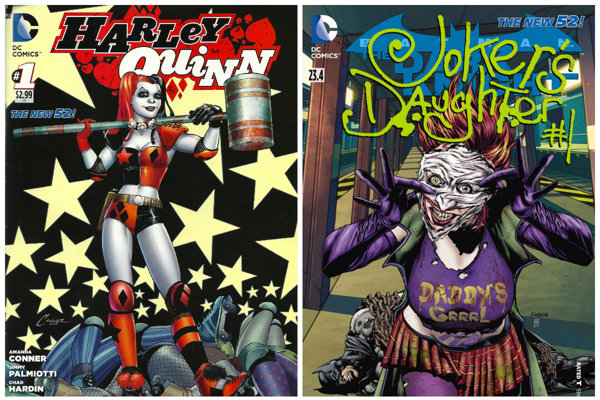
Harley Quinn was a great character when introduced in The Animated Series, but her comedy always had a dark tinge to it: one day, the Joker would show her how little he cared by leaving her to die or killing her himself. But she was too popular to die, and when she moved to the more adult world of comic books, the cycle of abuse got too depressing, so eventually Harley left the Joker and started headlining her own series. Duela Dent, a delusional woman who believes herself to be the Joker's daughter, has been running around comics on and off since 1976. While comics can always use another empowered woman or two, it's hard to explain why the Joker hasn't made an example of them. It seems like every moment they're free and alive, they're diluting his brand, and the Joker is always brand-conscious. What Fixed It: It's hard to fix this one entirely, though Suicide Squad #13-15 (2012) and Scott Snyder's "Death of the Family" storyline at least made an effort, putting the old Joker-Harley dynamic in a much more macabre light.

2. Forgetting He Existed

Even though he was Batman's #1 villain in the 1940s and 1950s, the Joker fell on hard times in the 1960s. New DC editor-in-chief Julius Schwartz didn't care for the character and his appearances dropped significantly. He might have died out if the 1966 Batman TV series hadn't revived some interest in him- but that series' popularity didn't last long either, and as its memory faded, the Joker vanished completely from 1969 to 1973. What Fixed It: It wasn't until '73 that Denny O'Neil and Neal Adams brought him back for good, by bringing both him and Batman back to basics: "The Joker's Five-Way Revenge!" was the first Joker story in about thirty years that involved him actually killing someone. O'Neil's success with the Joker there might have explained his eagerness to do that Joker-centered series mentioned above. But it sure wasn't foreshadowed by what he did with the Joker in the Justice League...

1. Making Him Just Kind Of There For No Reason
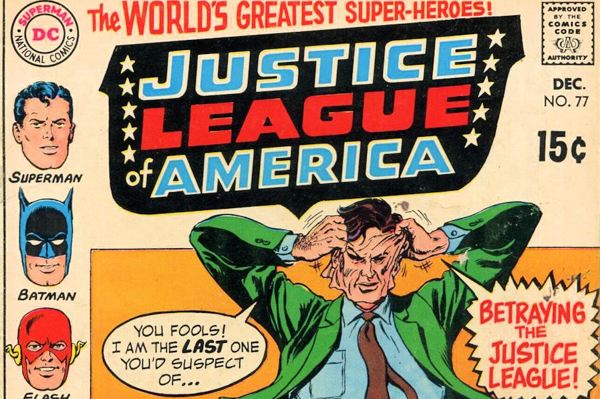
"Snapper Carr- Super-Traitor!" from 1969's Justice League of America #77 is an interesting story, marking the decisive end of the Justice League of America's earliest, most kid-friendly adventures. O'Neil had just taken over the writing from Gardner Fox, and his first move was to get rid of the JLA's irritating teen sidekick, Snapper Carr, by having Carr fall in with a demagogue named John Dough. Dough uses both public speaking and secret crimes to smear the League, hoping to drive the government itself to make superheroes illegal. At the end of the story, Dough is revealed to be the Joker, which makes Carr look even dumber. Unmasked, the Joker doesn't say a word, and as John Dough, he gave absolutely no clue he was really the Joker. He could've been unmasked to be Lex Luthor or literally any other supervillain, and this key story in JLA history would've been unchanged. What Fixed It: It's not totally fixed. Occasionally the Joker has been treated as a "generic bad guy" instead of the unique creation he is, as he was in the TV series Galactic Guardians and Young Justice. That's just plain boring. And nothing kills a joke like boredom.

Watch Next


In this post: 
the-joker
 
First Posted On: 
Contributor
Contributor

T Campbell has written quite a few online comics series and selected work for Marvel, Archie and Tokyopop. His longest-running works are Fans, Penny and Aggie-- and his current project with co-writer Phil Kahn, Guilded Age.