12 Superheroes Ranked By Science (From Lame To Awesome)
Scientists spent SEVEN YEARS studying superheroes, so who will come out on top?
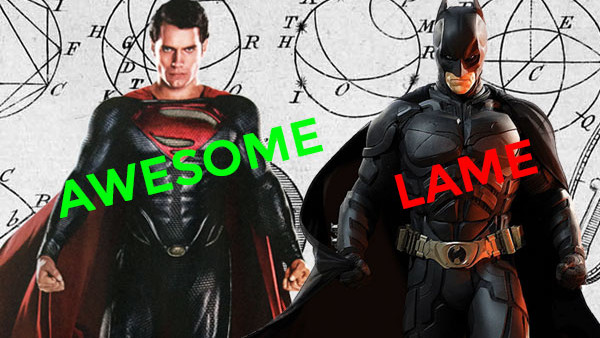
We can sit and argue for hours about the various pros and cons of our favourite superheroes, but most people tend to limit their debates to the pub and/or angry comment sections on pop culture websites.
Well, a group of students at the University of Leicester decided to make it all a bit more official and set about ranking superheroes from a range of universes and backgrounds, using real proper science to examine each contender's standing on the superhero world stage.
Yeah, scientists are nerds. Who knew, right?
The research was conducted over a period of seven years and the results were published by the university in celebration of Superman Day, which falls on the 12th June. The official ranking is the culmination of 25 supplementary papers with pleasingly bonkers titles such as Trajectory of a falling Batman and The Spectacularly Exploding Iceman.
Here are the students' findings, in the order they proposed and their observations about each superhero* - they've even compiled them into a handy table for your reference purposes.

Not every scientist can cure cancer and send humans to Mars, I guess, so why shouldn't they use their science superpowers for the benefit of nerdkind?
*N.B. This is the order that the students put them in, so take it up with them if you disagree.
12. Batman

Sorry, Bat fans, but the caped crusader has been roundly denounced by science as about as useful as a fart in a jacuzzi.
Compared to the other heroes on the list, Batman's positives (of which there are few) definitely do not outweigh his drawbacks. One of the major issues that students David Marshall, Tom Hands, Ian Griffiths, Gareth Douglas take with The Bat, is that his mode of travel - gliding about the city with his batcape - would more than likely turn him into a pile of Bat Jam on landing.
The students ran the numbers and found that, using the batcape, Brucie would be travelling at speeds of up to 110 km/hr which, in the absence of a bat-parachute, would be like getting hit by a truck.
When you factor in the reality that Batman, whilst armed to the teeth with gadgets and rippling biceps, has no real powers to speak of, particularly ones that might protect his squishy mortal body from the trauma of violent vigilantism. Not to mention the fact that he has so far not managed to bring Gotham's crime under control in over a decade of beating up street level crims whilst breathing through his mouth, despite it being his sole raison d'etre.
Science has it, Batman is lame.
You can read the study for yourself here:
11. Ice Man

Next, the scientists turned their attention to Marvel's Iceman.
To kick off, they look at the mechanisms that could be behind Iceman's ability to pull ice out of thin air. They suggest the he is able to produce a kind of organic refrigerant that can be compressed in the body and directed through vein like channels. This then draws heat energy from the atmosphere as it expands and causes water vapour in the atmosphere to freeze.
This, it is fair to say, is a pretty cool (fnarr) super power but, as is so often the case in science, it all comes down to the issue of energy.
Energy cannot be created or destroyed (conservation of energy, fam), and so Iceman would need to get his refrigeration energy from somewhere in order to organically generate it. Traditionally, humans get their's from food, and this is what the paper goes with. They calculate that Iceman would have to chow down on 10,000 kilocalories to produce just 1kg of ice - that's four times the amount needed for the average man.
What's more this would leave him no surplus for powering his basic bodily functions, and so he would have to scarf down an additional 1,000-2,000 kcal just to remain upright and breathing. All of this eating would leave very little time for any superheroing.
Read more:
Vol 14, No 1 (2015), PST, The Spectacularly Exploding Iceman
10. The Lizard

The students' study of The Lizard focusses, understandably, on the ability to regrow limbs.
After looking at the phenomenon of limb regeneration in nature, they conclude that human limb regeneration might just be possible due to the fact that "the key genes expressed during limb regeneration in animals with high regenerative potential are identical to the genes expressed during human development supports the idea that humans possess the appropriate genetic machinery".
Basically, we have the genes for it, we just need something to activate them Something like, I don't know, a special serum.
So, that good news is that, yes, it could be possible to regrow severed limbs. The bad news, however, is that according to the students' calculations, this would take a long !*$% time, with a growth rate of around 0.1 to 0.4 mm/day.
At that rate it would take about a year and a half to regrow the arm below the elbow, which is a little underwhelming.
Read more: Vol 3 (2014), JIST, Is Dr Conners regenerative transformation possible?
9. Iron Man

Although Iron Man is essentially on a par with Batman in terms of actual superpowers, his technological aids are sufficiently advanced so as to save him from the Bat's fate in last place.
The students at Leicester focus on two major elements of Iron Man: His suit and his arc reactor.
As it is suggested that the arc reactor could be powered with Vibranium (which was unhelpfully retconned by Captain America, but we'll go with it), the students set about trying to figure out its nuclear properties, using the holographic evidence from Iron Man 2. Using a real-world analogue of Hassium as a reference point, they figured out that the half life of the most stable isotope of a Vibranium core would be around 14 seconds, which makes it a less than useless power source.
Presuming Iron Man can stabilize his arc reactor somehow, we then of course have the issue of the impossible shock absorbency of his suit. Although they come to the conclusion that Stark's suit would be unfeasible for protecting a single human (either that or they're just not as smart as Stark), they do find that it could have application in larger military vehicles.
Read more:
Vol 14, No 1 (2015), PST, Iron Armour
Vol 14, No 1 (2015), PST, Inferring the Nuclear Properties of Vibranium
8. Spider-Man

Moving further towards the "awesome" end of the spectrum, we now move on to discuss the ins and outs of everybody's favourite friendly neighborhood Spider-Man.
One aspect of spidey's powers that the students take into consideration, is the speed at which he is able to move around the city. Not only does this save him the hassle and frustration of sitting in traffic, but it helps him get to crime scenes with great speed. They calculate that spidey can travel through the city at speeds of up to 68.83 mph.
Spider-man is obviously able to do this thank, in large part, to his silk. In the comics and movies, this silk appears to possess supernatural strength and durability, however, in the paper Doing whatever a spider can, they calculate that Spidey's silk strength is actually comparable to that produced by actual spiders.
It appears that Spiderman really does do whatever a spider can.
Read more:
Vol 2 (2013), JIST, Spidey Motion
7. Silver Surfer

Next up we have the Silver Surfer who, according to the scientists' calculations, has two powerful abilities, which isn't exactly mind blowing, but no weaknesses.
One aspect that is focussed on in the paper on the Surfer, is the amount of power that would be required to knock Doctor Doom off his feet and sailing 30 metres through the air. Contrary to what action movies would have you believe, throwing a body any distance takes a massive amount of power, and the students calculate that he would need to generate a shockwave with a force of at least 214.5 N.
However, considering the Surfer is supposedly capable of travelling faster than the speed of light, it seems as though the students might have focussed on the wrong area here. Considering it would take infinite energy to approach the speed of light, slamming Doctor Doom back a few feet would be no more effort than breathing.
Read more:
6. Black Bolt

Given the claims that the merest whisper from Black Bolt produces enough energy to level a city, it's probably fair to say that he's one of the more high-powered superheroes.
In their paper, the authors attempt to figure out just what we mean by "whisper", "power" and "level a frickin' city" to get a handle on just how powerful Black Bolt is.
By scaling the average level of a whisper in dB to the amount of energy needed to destroy a city the size of New York, they actually found that even the merest mutter from Black Bolt would produce enough energy to completely annihilate the planet's surface.
No wonder he keeps his mouth shut most of the time.
Read more:
Vol 4 (2015) JIST, Modelling the destructive force of the Black Bolts voice A Vocal Nuke
5. The Flash

The student's go into a fair amount of detail regarding The Flash, with no fewer than four papers on the quick footed superhero.
First of all, we come back to the issue of energy. Scientists love energy. In the paper A model to determine the maximum instantaneous speed of The Flash, they calculate the maximum speed that The Flash should be able to reach, given his daily dietary intake as depicted in the CW incarnation. Unusually, given that we tend to find that superheroes expend a lot more energy than they consume, they found that this version of The Flash should actually be able to run nearly three times faster than is stated in the show (or just get very fat, very quickly).
There is a downside to all this, however, as outlined in The Flash: Hero or Villain?. The speed at which the Flash moves has the potential to cause extreme harm to civilians such as when "a cyclist is almost struck by a taxi, but is pushed to safety by The Flash. Upon studying the footage, it was postulated that this act occurs at such a speed that the impact may be more damaging than if the cyclist had been hit by the taxi."
So, in order to prevent himself from reducing the cyclist to red mist, The Flash would have to decelerate at a breathtaking rate. Unfortunately, this would probably cause his brain to come flying out of his eye sockets with the momentum, but you can't win them all, can you?
Read more:
Vol 4 (2015), JIST, Modelling the mutation rate of The Flash in context
Vol 4 (2015), JIST, A model to determine the maximum instantaneous speed of The Flash
4. Mystique

According to the University of Leicester, Mystique is the ultimate mutant. She'll surely be thrilled.
The reason for this is that, not only is she a mutant, but she continually mutates her genes in order to shapeshift at will.
The paper's authors put forward the assumption that Mystique's specific mutation has given her the ability to alter the expression of her genes at will. Switching different genes on and off would allow her to switch between eye colours, hair colours, skin tone and body shape easily.
The authors also attribute her ability to alter the appearance and texture of her skin to a type of nanocrystal in her skin known as a chromatophore. As sci-fi as this sounds, this ability is actually naturally occurring in certain species of cuttlefish.
This is a cautionary tale, however, as the authors note that Mystique's continuous tinkering with her genetic make up could expose her to the dangers of cancer, osteoporosis and sarcopenia
Read more:
3. Thor

Aside from his magnificent nostril flaring abilities, one of Thor's major powers comes in the form of his trusty hammer, Mjolnir.
In the name of not-being-too-much-of-a-d*ck, the scientists take it as read that the hammer has a magical "worthiness" enchantment on it, and concern themselves more with just how much it would sting if he threw it at you.
In the paper, after establishing the Mjolnir is probably made out of iron from the heart of a red dwarf, they calculate the amount of kinetic energy that Thor would be able to draw from lightning storms. The numbers they end up with are colossal.
They calculate that, if Thor were able to redirect a continuous flow of lightning strikes from the thunderstorm he could attack with a power output reaching 2 x 10¹² W. To put that into some context, that is about 100 time more power than is produced in the largest nuclear reactor currently in operation.
He is a god after all.
Read more:
2. Wolverine

Wolverine's amazing healing abilities, according to the authors of X-Men: Wolverine, are due thanks to a very special set of stem cells in his system.
In order for these cells to continuously differentiate and replicate, they would have to overcome an effect known as the Hayflick limit. This is due to a preloaded "suicide switch" in cells that will only allow them to replicate 40 60 times before undergoing cell death and it is due to the damage that occurs in cells when they reproduce.
If Wolverine's cells could not only get around this limit, but reproduce at a much accelerated rate, they would (a) account for his incredible healing abilities and immortality and (b) closely resemble cancerous cells.
They also suggest that he could also possess the enzyme telomerase, which would allow his cells to reproduce without accumulating damage and allow him to remain in peak condition.
Read more:
1. Superman

So ultimately, after all of that rigorous scientific enquiry and seven years of research, those plucky young scientists at the University of Leicester have come to the radical conclusion that Superman is the best/most powerful/awesomest superhero out there.
Groundbreaking.
Their reasoning being that Supes, amongst other things, appears to be the most efficient solar panel in the universe with the ability to store 3.86 x 10¹⁰ J of energy every second. This would convert into each "Super Flare" released by him containing the equivalent of multiple atomic bombs.
Now, this doesn't sound as impressive as, for example, Black Bolt's planet-obliterating powers. But, when combined with his many other powers, including increased muscle density and the ability to reverse the polarity of the Earth's spin, his powers far outstrip his weaknesses, and Superman ends up at the top of the pile.
They go into a breathless amount of detail as to exactly why and how Supes is just, well, super. You can peruse it at your leisure via the links below.
Read more:
Vol 4 (2015), JIST, How much energy can Superman release during a super flare?
Vol 2, No 1 (2013), PST, The Solar Efficiency of Superman
Vol 9, No 1 (2010), PST, The Last Son of Krypton
Vol 14, No 1 (2015), PST, Solar Superman
Vol 14, No 1 (2015), PST, Superman reverses the polarity of Earths spin
Vol 9, No 1 (2010), PST, Can superhuman muscles stop bullets?
That hit the spot? Like us on Facebook and follow us on Twitter for more articles to tickle your science receptors.