4 Unfair Assumptions About Comic Book Readers
Setting the record straight.

It’s plain to anyone with even a slight interest in comic books and pop culture in general that there is a huge push for diversity in almost all areas these days. We are often told that minorities have been interested and invested in various “geeky” media for years, but are craving more representation; they want to read and watch stories about people who resemble themselves. There is a sort of counterintuitive feeling here: on the one hand we hear that geekdom has never, ever been solely limited to white males, yet we are also told that sweeping changes need to be made in order to make minorities comfortable within geekdom.
The optimistic view is that while white males may have been the target audience in years past, a silent majority of non-white, non-heterosexual, non-male readers have always been present and are now able to be more vocal regarding their favorite media. The more cynical take is that corporate interests have now fixated on the possibility of capitalizing on minorities. One could look at The Force Awakens as an open and honest attempt to make Star Wars for everyone or as a blatant cash-grab designed to start sucking the cash from the wallets of a whole new demographic.
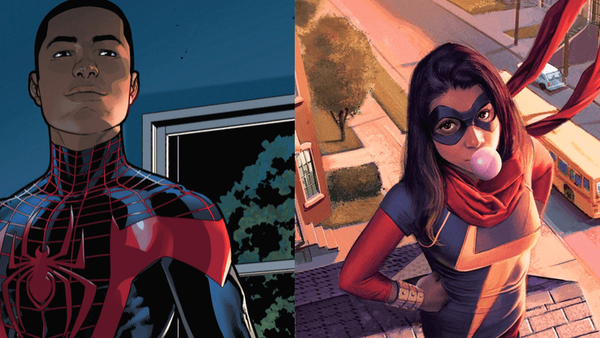
Focusing more on comics published by Marvel and DC, we’ve seen over the past few years a very in-your-face initiative to sell more books with minority characters. Marvel has been the most obvious about their pursuit of progress. Perhaps starting with the highly publicized wedding of Northstar and his partner, a same-sex wedding that took place years before it was made legal in the United States, and continuing on with decisions like: the creation of Kamala Khan, the muslim Ms. Marvel; the passing of the Thor powers and mantle to Jane Foster; a black Captain America; and now a young black girl taking over the pages of Iron Man from Tony Stark, Marvel has made it very clear that their interests lie with anyone who isn’t a straight white man.
DC has made strides as well: Batwoman is a lesbian woman who is just shy of being as capable as the Dark Knight; a white Wally West has returned to the DCU, but they haven’t abandoned their recently created black Wally; they have their own muslim powerhouse with Green Lantern Simon Baz; new and old Hispanic characters GL Jessica Cruz and Blue Beetle Jaime Reyes; not to mention the race shifting of ancillary characters like Etta Candy and General Eiling. Both companies are trying to make their stables look less homogenous.
Throughout this entire process, anyone who objected to these mandates or even questioned them was dismissed as a racist, homophobic, misogynistic troll. If you prefer a white Cap then you obviously hate black people. Do you think the name of “Thor” specifically passing to someone else instead of just the hammer and abilities is stupid? That’s only because you’re afraid of strong women and would prefer them to all be in the kitchen, making you sandwiches.
There’s very little room for debate or discussion; if you feel anything short of ecstatic about these decisions then you’re a bigot. That’s not to say bigotry doesn’t exist or that there aren’t legitimate racists out there who honestly hate any character that isn’t white. It’s just that there are a lot of unfair assumptions being made that need to be addressed.
4. Fanboys Are All Basement Dwelling Losers

Often when a longtime fan objects to one of their favorite characters getting a race lift, or being replaced by a minority, he is dismissed as a virgin who lives in his mother’s basement, is afraid to go outside, and reads comics instead of interacting with people. While there are undoubtedly comic readers who do, in fact, reside underground and shy away from social interaction, anyone who goes to a comic shop on Wednesdays can attest to seeing all manner of regulars there, from antisocial youngsters to successful small business running adults. Many shop owners are themselves devoted fans - surely they are capable of more than merely trolling from the cellar. Just seeing the debates whenever some controversy occurs (e.g., the recent Mockingbird cover fiasco) proves that there is a wide range of diverse opinions throughout comics fandom.
Also, let’s not forget about these supposedly progressive people using all kinds of tactics they are supposed to be against: they body-shame overweight men and call them “neckbeards,” implying that they are incapable of growing full beards like a proper man or that they are unkempt and ugly. Why be shackled by these outdated standards of appearance? If someone describes feminists as being fat with ugly, multi-colored hairstyles, there is an appropriate uproar, yet body type and living situations are used against male comic book fans constantly. So what if a man has to live in his mother’s basement, anyway? Have you seen the state of the economy? How does that invalidate what he’s saying?
Why is there even an assumption that anyone who is objecting must be a straight white man? One could make certain assumptions about the writer of this very article due to its subject matter, assumptions that would be incorrect. There is some fallacious thinking that states “No true Scotsman would ever disagree with me.”
Why are we demonizing being a “loser?” Isn’t geekdom striving to be inclusive to all types? Isn’t that what we’re supposed to be working toward? An environment where nobody has to worry about not living up to some predetermined idea of what it means to be a cool kid? Geeks, nerds, otaku, whatever you want to call them, are all in support of the idea that obsessing over fake reality is preferable to dealing with actual reality. “Wow, you’re so obsessed with Spider-Man that you take any changes to the character personally? Get a life!” Yet, if you spend all day baking a Spidey cake or create some elaborate costume for your three year old daughter, that’s amazing behavior that needs to be posted, shared, and eventually go viral in celebration of “Best Dad Ever.”
Of course, if you’re someone who behaves inappropriately online and harasses other fans and creators, that’s indefensible. Nobody is saying that’s okay. But don’t pretend that only one side brigades others when they feel justified in doing so.
3. Fanboys Are All Against Diversity
It’s no secret that serious fans hate change. That’s one of the things that makes us so hard to please: we hate stagnation, but we also hate making things different. Just give me the same Batman story over and over for years, but also shake things up and keep me guessing. That’s a big reason why a lot of fans have complained about decisions made by Marvel and DC.
There was no outrage when Jaime Reyes debuted because he was a fresh character who, despite taking the mantle of an established white guy, didn’t feel like he was being shoved down our throats to meet some quota. There was no outrage when Ryan Choi took over for the Atom a decade ago; nor was there any fury when Cassandra Cain became Batgirl years before that. Green Lantern Kyle Rayner was revealed to be half-Mexican; Green Arrow Connor Hawke, Oliver Queen’s son from the 90s, had a mother who was half-Korean and half-black. At the time, these were just natural developments of the stories; there was no “look how diverse we’re becoming” message being pushed.
Contrast that with the Jane Foster Thor, who within the first few issues of her tenure was confronted by a sexist rant from Absorbing Man that was very clearly meant to echo the internet detractors. She also had Titania, a female villain who regularly fights She-Hulk, surrender to her simply because she respects her so much as a fellow woman. She actually says “This is your one-time girl-power pass.” As if this Thor is some trailblazer for female superheroes. That is such ham-fisted writing that women should be insulted. Even Sam Wilson, whose ascension to the rank of Captain America at least makes sense due to his long running association with Steve Rogers (unlike Riri Williams’ takeover for Iron Man), had in-story racism hurled at him that was deliberately invoking the online bigotry. The message from insecure writers is: “if you don’t like these choices then you’re just as awful as the bad guys in the story.”
It is very possible to agree with the politics that inspired a decision without wanting them to be front and center in your superhero media. Superheroes can often tackle real world issues, but at least have some subtlety in your approach. The X-Men have been stand-ins for racial and sexual minorities for decades and many stories have been written about them that are metaphors for racial genocide, civil rights abuse, and human rights violations. Political statements were made via the plot and not with ridiculous dialogue that hits you over the head. It’s the difference between recognizing the similarities that the Mutant Registration Act has with the communist fear-mongering of the Hollywood Blacklist and lazily having the hashtag #MutantLivesMatter trending on twitter in the pages of an issue. One can be in support of social justice and also object to the lazy shoe-horning of social justice issues into the books that are designed to make them look more progressive than they actually are.
2. The Problem Is With Fans Not Publishers
With only a few exceptions of real note, most comic book creators are white men. That much is undeniable. Both Marvel and DC appear to be making efforts to hire a more diverse staff, but it seems that a lot of minority creators have a hard time separating their politics from their work. Again, this isn’t always a bad thing. William Moulton Marston had a very clear agenda when he created Wonder Woman and that character has endured for seventy five years. Black Panther was also politically charged when he was created in the wake of the Civil Rights movement. But T’Challa wasn’t fighting characters who used water hoses as weapons or getting called “boy” by southern redneck supervillains; he was a character in his own right, not a political mouthpiece.
Note that Marvel and DC can point to the increase of diverse characters and use that as an example of their progress in the right direction. The issue of a more diverse pool of writers and artists is dealt with much more quietly. The point is, even though there has been a significant rise in minority characters, most of them have been created and written by white men. Instead of forcing white guys to work on bumping the numbers, maybe a stable of creators with different backgrounds would cause a natural and organic expansion of diversity within the books. That’s not to say that minority characters should only be written by minority creators. That would be absurd. It’s just that maybe Geoff Johns isn’t the best person to envision what it might feel like to be a Muslim man who is suspected of being a terrorist. How is Simon Baz, who was designed with what is essentially a ski mask and carries a gun despite having powerful alien technology, supposed to be a step in the right direction? G. Willow Wilson may be Muslim herself, and in theory a more appropriate writer for the Muslim Ms. Marvel, but she’s still a white woman from New Jersey.
Could it be that Marvel and DC’s obvious tokenism is failing to resonate with the minorities they’re trying to woo? Perhaps that’s why books like Nighthawk and Mockingbird end up getting canceled. What are the Big 2 doing to actually broaden the market? Are they devoting money to advertising in all-new, all-different places? Are they legitimately trying to appeal to the large audience of moviegoers who make these superhero films into billion dollar juggernauts? Or are they only cynically ordering changes that will make the headlines on comic book sites that are only seen by people invested in the industry to begin with? When Nighthawk was canceled there was a huge outcry and a lot of talk on social media, but it felt like a lot of people didn’t even know about the book until the announcement. What is really being done to appeal to these very vocal people who are supposedly clamoring for more minority characters? It’s not enough to just push it in the Previews book.
How about just one advertisement before a movie? Is it really that much of a waste of money?
1. Only White Guys Are Upset

Frankly, the assumption that minorities must support these decisions one hundred percent is its own form of racism. The idea that anyone who stands against the current status quo must be a white man who is afraid of not being the center of attention is naive and insulting. It’s binary, black and white thinking that doesn’t account for any gray areas. As I hinted before, I am not white, and there are a lot of causes and movements that I fully support, yet I do not want to be bullied into taking a side on a complex issue by a comic book I picked up to escape from the real world. Do we assume that every black guy’s favorite character must be either Black Panther, Falcon, or Luke Cage?
There is a mentality that pop culture has been straight white male centric for decades and now it’s time to counteract that, but the object is not to have the pendulum swing completely in the other direction - the goal is for the pendulum to be in the middle. Demonizing the white male viewpoint does not heal the wounds of oppression, it just causes new wounds. Perhaps those who would’ve been fence sitters were pushed into feeling targeted by these recent decisions and have their own sense of marginalization. And being told “oh, boo hoo, cry your white tears, we’ve been dealing with this way worse for much longer” does little to build cooperation and further fans the flames of the Us vs. Them mentality that has infected not just pop culture but culture at large.
There have been all sorts of successful diverse superhero characters since the 60s and they were able to gain popularity without stealing the spotlight from others. It seems like editorial believes that the only way a minority character can succeed in the current climate is by having it inherit the title of an already established white hero. Some would say that being in the shadow of a white hero is detrimental to the new character. Sam Wilson was perfectly fine as the Falcon, but upon becoming Captain America he transforms into the Cap who is black. He is no longer a hero in his own right but the black version of another. If original minority characters were able to find success in the 20th century, shouldn’t they be able to find an audience in 2016? How about minority readers who feel pandered to with these new creations? Those of us who feel that Marvel and DC care less about actual diversity and more about making non-white dollars?
The bottom line is, reducing the other side of the argument to a strawman is wrong. To reiterate, actual bigots: real, honest-to-goodness readers who hate non-straight, non-whites and don’t want them to have comics are bad. They’re bad for the industry as a whole. But assuming anyone who doesn’t like what’s happening lately is some white supremacist crusader is dismissive as saying anyone who is in favor of these changes is a SJW feminazi, foaming at the mouth for the end of the white man. Without civility in these discussions there will be more division when really we should all be agreeing that at the end of the day, everyone just wants good comics to read.