7 Superpowers You've Had All Along
Not all heroes wear capes. Sometimes they wear sweatpants and eat Doritos in front of Netflix.

Okay, so you can't fly, make yourself invisible or shoot lasers out of your eyes, but even your Doritos eating, Netflix binging body is capable of some truly superhuman feats.
Some of these super powers require some pretty special circumstances to come to light, many of which, to be perfectly honest, you probably wouldn't want to find yourself in. Others, however, are always within you, just waiting to be discovered. There, now isn't that inspiring?
Up until now, your special party tricks might have been limited to wiggling your ears or tying a cherry stalk in a knot with your tongue (which, by the way, doesn't look as sexy as you think it does), but with just a few tweaks you could have the strength of the Hulk, the healing abilities of Wolverine and even the hyper sensory awareness of Daredevil. Depending on the local laws in your area, however, we have to strongly recommend that you don't use your newly discovered super abilities to indulge in any casual vigilantism.
So, all that's left to do now is decide on your superhero name, get working on that lycra suit and maybe do a bit of light stretching every once in a while to ensure you're up to beating those supervillains at a moment's notice.
7. Super Strength

So you might not turn green and bust out of your clothes (except for the magic shorts, of course), but under certain circumstances, it's perfectly possible for your average human to Hulk out and gain superhuman strength.
Unfortunately, it usually takes some pretty extreme, life threatening, oh-my-god-we're-all-going-to-die circumstances for it to happen, due to the massive surge of adrenaline or possibly noradrenaline that surges through the body. The phenomenon is known as hysterical strength and, although its extreme nature makes it difficult to study, there are a handful of anecdotal examples that seem to fit the bill.
Most instances tend to involve people lifting vehicles off of loved ones, such as in 2013 when teenage sisters Hanna (16) & Haylee (14) lifted a tractor to save their father pinned underneath, but in 2006, Canadian Lydia Angiyou fought a polar bear to saved the lives of several children.
6. See In The Dark

Daredevil never let it hold him back, so neither should you.
Relying so heavily on our vision means that, should the lights go out, we're pretty scuppered and obviously unable to stop villains and bad guys in their evil deeds. Some people, particularly those with a visual impairment, however, have taken inspiration from the animal kingdom and learnt how to echolocate.
In much the same way bats and dolphins emit sonar signals to build up a picture of their surroundings, humans can use tongue clicks to visualise the physical world when we can't see it with our eyes. How much detail you can “see” with this technique depends on the speed and frequency of the clicks. The higher the frequency, the more precise details you can see.
It might sound pretty crazy, but within a few weeks, researchers at the University of Alcalá de Henares in Spain had taught a group of 10 students and colleagues the basics of echolocation in just a few weeks.
5. Bioluminescence

Advertisements for expensive moisturizer are always claiming that their product can give you a radiant "glow" but, save your pennies, because you already glow thanks to the magic of bioluminescence.
We've all seen those weird deep sea creatures that can twinkle like a Christmas tree and, although you might not quite be able to light yourself up that much, there are similar chemical reactions taking place in your body that produce a very tiny glow. Don't believe it? Well scientists have managed to see it.
Unfortunately, the light is 1,000 times less intense than can be detected by the naked eye, but it is definitely there as a visible light emission in addition to the infrared radiation, just a little further along the electromagnetic spectrum, given off as heat.
So, maybe not quite the human torch, but rest assured that you do indeed shine bright like a diamond.
4. Immunity To Pain

Whilst most of us tend to think of pain as a bad thing, it has a pretty vital function as one of the most advanced damage report systems in the world. If you didn't feel pain, you'd go around bashing into things, casually leaning on stovetops and running around on injuries. It wouldn't take long to reduce yourself to a bloody, charred lump of flesh. Long story short, we need pain.
There are times, however, when you could really do without it, albeit temporarily. Whether you're getting yourself to safety after an injury or knocking seven bells out of some bad guys, there are times when you just have to suck it up. Luckily, your body has adapted for just such an eventuality, and it's all thanks to a little thing called endorphins.
These are hormones that zip around your body during exercise, sex and in emergency situations. They're essentially the body's own version of morphine and can completely suppress the sensations of pain. Luckily, your body only deploys them when you need them, so you can go about your day to day business without causing yourself irreparable damage.
3. Super Healing

Okay, everybody heals, but now you too can have the magical healing powers of Wolverine. Quickly repair any damage in your body through the power of stem cells, all you have to do is (a) be a woman and (b) get knocked up.
Sorry guys, this one is limited edition.
Anyway, it turns out that, during pregnancy, the developing foetus could help the mother heal damage and disease by sending stem cells into her system. It was found that mouse foetuses will give up stem cells to repair their mother’s heart, which could explain why half the women who develop heart weakness during or just after pregnancy recover spontaneously if it also occurs in humans. They have also been known to produce cells that protect the mother from cancer.
It makes sense really, as the foetus is protecting its own survival whilst it is dependant on the mother. A bit like Voldemort and Wormtail, and only slightly less creepy.
2. Whatever The Hell Is Going On Here
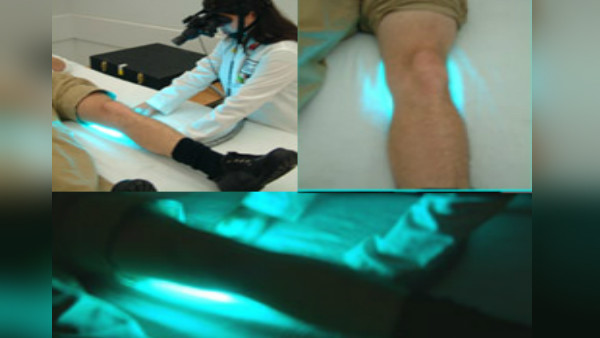
We've all heard of someone having eyes in the back of their head, but what about the back of their, er, knee?
A study done in 1998 found that, by shining a light onto the back of their test subjects' knees at certain times, they could reset their circadian rhythms, or their body clocks, even though the participants' eyes were shielded the whole time. It's uncertain what kind of drugs the scientists were on when they devised that little experiment, but it sounds like one hell of a party.
Although the results of the experiment are still debated by scientists who have the time for that kind of thing (as it turns out that the circadian measurements in the original experiment may have been unreliable), it could perhaps form the basis of the weirdest superhero yet? Get on it, Marvel.
1. Stop Bullets

So Superman could stop a bullet, but could you?
Bullet proof vests provide a protective layer between the bullet and your favourite, life saving organs, but humans already come with their own natural protective layer: Adipose tissue (that's fat to me and you). Considering you can actively increase the amount of adipose tissue you have through the judicial application of donuts, how much would it theoretically take to stop a bullet?
Luckily, the Cavendish Laboratory at the University of Cambridge, along with the Naked Scientists, have run the experiment and have a result for us. To mimic the fat, the scientists used ballistic gel and fired a bullet into it at supersonic speeds.
Unfortunately, they discovered that you would probably need about 72cm of fat to stop a speeding bullet. So, you might not die from a bullet wound, but it might just be the heart attack that gets you.
You could write for WhatCulture Science! Click here to find out how you could get paid to write about what you love.
If science gives you the warm fuzzies, like us on Facebook or follow us on Twitter to stay up to date