8 Biggest Things To Come Out Of Doomsday Clock #1
Rorschach? Is that really you?

It might only be the first issue, but already Doomsday Clock has managed to drop its fair share of bombshells.
The long-awaited follow up to Alan Moore and Dave Gibbons' 1986 graphic novel will undoubtedly raise a few eyebrows, not least because it's yet another controversial use of the Watchmen license, but also because it's been held as DC's biggest book of the year. Geoff Johns and Gary Frank are the prime architects to pull off any use of Moore's concept however, and - for the most part - the first issue is a testament to that.
It's still early days, but Doomsday Clock already has the world's attention. Issue one does a decent enough job of retaining it too, providing clues and answers to the story's biggest questions in a way that intimates both its salience and the intrigue surround the wider mystery at hand. It very much feels like a DC book confined within the aesthetics of Gibbons’ designs, but for a crossover between those two exact things, it works, particularly when the page layouts themselves allude to the wider concepts Johns and Frank are set to broach.
But what were the biggest things to emerge from the issue? The identity reveals, the world-building, and the details of how the DCU and the Watchmen intersect? Here's what you need to know to stay in the loop.
8. The World Is Ending (Surprise!)
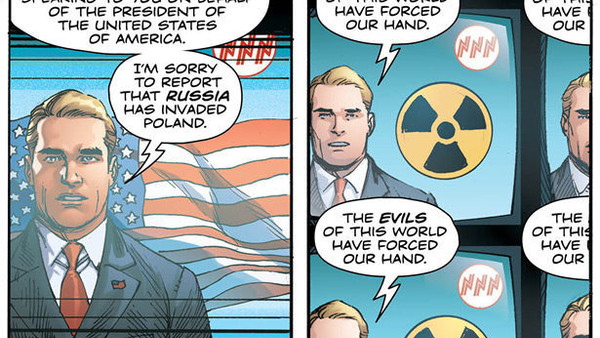
Although Doomsday Clock's title would've probably implied as much already, the world isn't exactly in the best of states when we find it in issue one. The peace Ozymandias masterminded at the end of Moore's novel has collapsed; the USSR and the United States are on the brink of nuclear catastrophe, the President is off messing around on a golf course (what an absurd concept, right?), and riots are kicking off all over the place.
It's not a fun place to be, clearly (especially not with William F. Buckley still on the airwaves), but it's part and parcel of the world Johns has conceptualised. It's 1992, a year that, in our time at least, was heralded as the beginning of a New World Order - one that had absented the Cold War dynamic and was on the cusp of embracing liberal democracy (as Francis Fukuyama would attest).
In Watchmen's 1992, Russia - taking on an ultranationalist persuasion - has invaded Eastern Europe, triggering an impending conflict between NATO and the Warsaw Pact nations. It's a world ending scenario by any other name, except this time there's no chance of it bringing the world together. The reveal of Ozymandias' deception has only made peace less of a possibility, and Johns is keen to remind us of that fact, perforating the background with literature heralding the now tarnished peace brought about by the squid's arrival six years earlier.
Where's Manhattan when you need him?
7. The Marrionette And The Mime
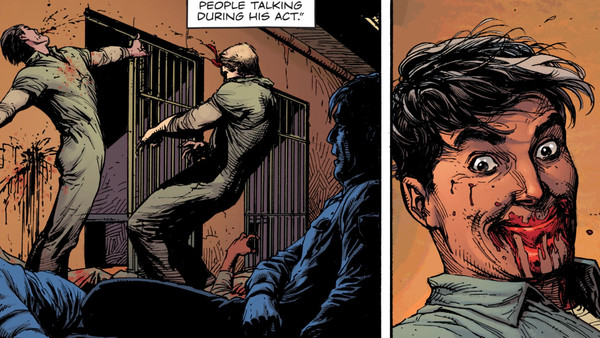
Doomsday Clock might get a rap for using Moore's creations (or superhero analogues), but Johns and Frank have created new additions to the lore too.
The Marionette and the Mime are the two most noteworthy additions to the canon this time around, with the latter in particular taking the cake for the issue's most shocking moment. He's just creepy, taking on violence as a performance (of which no one dare not interrupt). There's also the matter of his 'weapons', which are literally just finger-guns, which is as darkly comedic as things can get, really.
The two characters are of key importance to Rorschach though, hence why he took the time to bust them out of prison. We know not yet why they're so pivotal in his (and another character's) plans, but it's apparent that they fit the archetype of the disturbed Watchmen protagonist quite well.
Also, any character who can pull off finger guns is a definite villain, so make of that what you will.
6. Rorschach Is Dead, Long Live Rorschach

Leading up to Doomsday Clock's release, the question on everyone's lips concerned the identity of Rorschach. Seeing as how he died at the end of the original comic series, the fact that the vigilante featured so heavily in the book's marketing seemed to imply that a resurrection was on the cards.
Having read the book, it's clear that this isn't the case. The Rorschach of Doomsday Clock thinks he's Rorschach, and takes great offence when people say he isn't, but he's not Walter Kovacs. His real identity - at the moment at least - is unknown, but what we do know that he's taken it upon himself to try and save the world, with the most unlikely of all allies to help him out.
It's an interesting mystery to try and unravel, particularly so, considering how Rorschach as a literary icon has the tendency to be misunderstood. He was always meant to be this satire of the modern superhero as he then existed in '86, but as for the purpose of this new character, it remains to be seen what Johns has in mind.
News should abound by the time issue two rolls around, so keep you're eyes peeled for when it drops!
5. Ozymandias Is Alive... And Trying To Save The World
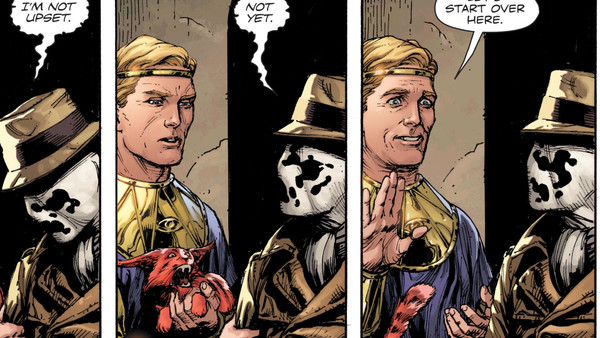
Oh Adrien, you and your harebrained schemes.
That's right folks, everyone's favourite anti-hero (anti-villain?) is back at it again in Doomsday Clock. A worldwide fugitive on account of his squid plans having been exposed in the press several years earlier, Ozymandias is doing his best to save the world again, with the plan this time revolving around tracking Doctor Manhattan's whereabouts.
Also returning is a baby Bubastis (Veidt's genetically altered cat from Moore's work), who doesn't take a liking to the new Rorschach at all, as well as other key pieces of Watchmen iconography. Veidt's still sporting his purple and gold garb from the original comic, and it transpires that they're actually holed up in Nite Owl's old lair too.
Time will only tell how Veidt, Rorschach and the two newly arriving characters find their way to Manhattan, but it's clear that their task is an important one, considering how the fate of the world depends on its success.
4. Nite Owl Has Retired (Again)
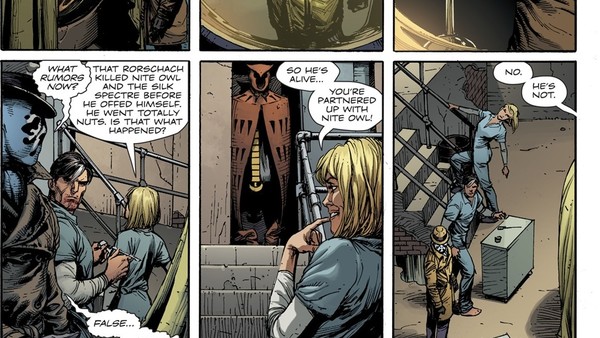
In the original Watchmen comic, Dan Dreiberg was the second Nite Owl and one who'd taken the decision to retire the mantle once the government set about outlawing vigilantism in the seventies. In 1992, it looks as though he's repeated the process all over again, with little chance of reemerging, so it would seem.
The whereabouts of Silk Spectre are also unknown in the book, but Ozymandias definitely vocalises his attempts to 'lure' Nite Owl back for his scheme, so it stands to reason that Laurie was involved in some way too, seeing as how they ended the story as a pair of sorts.
It's unclear as to whether or not Johns has brushed aside these characters for the remainder of Doomsday Clock's story, seeing as how we know that a great deal of it will take place on New Earth, but one would hope not. Dreiberg and Laurie were two of Watchmen's most interesting characters, and it's unlikely they'd be sitting on the sidelines with the entire world at stake.
For now at least, all of the Owl's gadgets are at Ozymandias' disposal. One panel certainly focuses on the Nite Owl II suit, so it could be the case that it factors into the story later on.
3. This Is The Definitive Follow Up To Moore's Novel

One thing that will inevitably grate a portion of DC's audience, however, is the fact that the events of Doomsday Clock are the definitive follow up to Watchmen's ending. This is how it all went down, Rorschach's journal and all.
While there's a chance that all of this could be undone through some Manhattan-esque space-time malarkey, there's nothing to suggest that what we see in this first issue isn't canon. Apart from the fact that Alan Moore is no fan of DC reusing the Watchmen license, whether it be for film, TV or otherwise, it's also true that Johns' continuation detracts from the ambiguity surrounding the original book's ending.
And this isn't just another prequel; 2011's Before Watchmen did - irrespective of the ethical issues surrounding DC's use of Moore's work - serve a purpose in fleshing out the history of the Watchmen mythos. With Doomsday Clock, the story's own sense of importance is somewhat mitigated by an overriding sense of cynicism on DC's behalf; they know that Watchmen sells, and they know that Moore isn't fond of a return to the license.
It's likely to be a sticking point for fans of the original comic, but if you can get past it, Doomsday Clock could just be the comic it's cracked up to be.
2. It's Implied That Manhattan Has Gone To New Earth

While Rorschach's identity was always going to be a hot topic of conversation before Doomsday Clock's release, the whereabouts of Doctor Manhattan was a lingering question Johns and Frank would have to address eventually.
The answer, so it would seem, is that Manhattan is on New Earth - DC's mainstream universe where Batman, Superman and all the other heroes reside in. More interesting, however, is that the book switches to Superman's perspective once Veidt ends his speech on tracing the blue demigod's whereabouts. Not only does this imply that Manhattan has made the switch to DC's most famous locale, it also infers that the two will collide in some sort of way, as is evidenced by Supes' newly acquired insomnia.
It's the only connection between the two worlds so far, but there's plenty to make of Manhattan's transition to the mainstream DCU.
It certainly seems as though Johns is alluding to the man in blue being responsible for the universe's recent (and indeed maligned) reboots, and if he has a bone to pick with the Man of Steel in particular, then Doomsday Clock's story could be hotting up more quickly than we all initially expected.
1. Superman Has His First Nightmare

Doomsday Clock's first issue was always going to end on an ambiguous note, but things don't get any more ominous than giving Superman a nightmare of his own to deal with.
I'm not brave enough to wade into the character's bibliography to actually discern whether or not he has had a nightmare, but that's a pretty big revelation if it's true. It certainly seems as though Superman has alerted to the presence of Manhattan, even if he himself doesn't know it yet, and that's dead interesting.
If the two are tied together in some way, and Manhattan is on New Earth, then we could be in for the match up of the century.
Or rather, a great exchange of dialogue. Johns has spoken at length at how he doesn't want this new book to be a fist-fight between Moore and DC's characters, and who greater to stoke the battle of ideas than Supes himself? There aren't many as powerful as he in the DCU, and with no one coming close to Manhattan in Watchmen's world, it's a match that should, in theory, be made in heaven.
Doomsday Clock #2 releases December 27. Are you excited for the next issue? Be sure to let us know in the comments below!