8 Biggest Things To Come Out Of Doomsday Clock #3
"What page are you on?"

Geoff Johns and Gary Frank's Doomsday Clock kicked things up a whole other gear this week, with questions surrounding last month's return dominating conversation in the immediate wake of the book's second issue.
While Johns doesn't provide all the answers fans have been hoping for (we are only three issues in, after all), Doomsday Clock #3 has given everyone a good idea of its own place in the DC mythos, further carving out an identity that, while certainly derivative of the original Moore text, is every bit as new and unique as Johns said it would be back when it was first announced.
Batman's finally entered the scene, 'The Supermen Theory' has been blown wide open, and Doctor Manhattan is waiting in the wings to finally make an entrance.
And, seeing as how these recaps are turning into a regular event - and how the third issue came packed with plenty of twists and turns - it make sense to chronicle all the biggest things from this week's issue. Y'know, for the sake of posterity and all that.
8. The Comedian's Back, And Doctor Manhattan Saved Him

The Comedian's back, and no, he isn't some imposter. This one, is the real deal.
While it's a move that's bound to rattle fans perturbed by DC's continued use of the Watchmen license, the fact that the character is back surely intimates Doomsday Clock's scale. Not only that, but the reveal also gave us our first look at Manhattan in the mainstream DCU, a full thirty-odd years before the events of Doomsday Clock take place.
It's a major alteration to the original Watchmen storyline, and while its implications are both wide and unnerving, it remains to be seen just why, exactly, Manhattan brought Edward Blake to the DC Universe, or even when he did in the first place.
No doubt we'll get the answer in the issues to come, but considering Blake made a target of Veidt and Luthor in the second issue, there could all be a wider plan at play here.
7. Batman Has A New Redesign
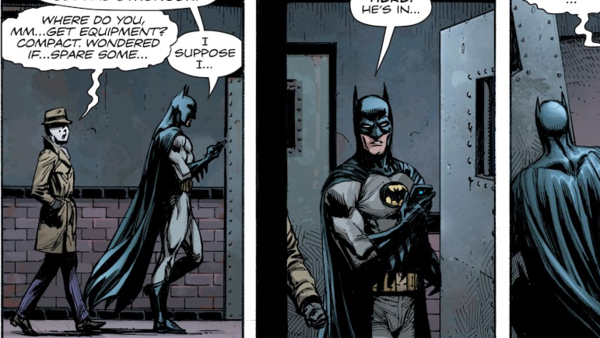
While Batman has his old threads on the cover to Doomsday Clock #3, he's sporting a new design in the actual comic itself. Throwing back to designs we've seen in both Earth One and Batman Inc. previously, the new look is a nice change over Rebirth's initial design, which was itself also stunning.
Gone is the purple underlay to the cape, and in its stead has come the grey and blue of the character's classic garbs. It's a nice throwback to the character's early days, and while the Rebirth suit was pretty great, it's nice to see DC spice up their designs periodically, especially when they look as good as this.
The design change might also lend itself well to Johns' narrative. The DCU, while increasingly temperamental in its current state, is far brighter in comparison to Moore and Gibbons' Watchmen world. The yellow symbol, then, takes on a whole new level of importance altogether, with the original design having derived from DC's silver age of comic books.
This isn't to say that Batman's any brighter in this reality, but compared to Watchmen, Bruce is a saint. How fitting he has the suit to match that reputation.
6. ...And He's Reading Kovacs' Journal

Although it's still up in the air regarding how, exactly, Bruce processed Kovacs' journal, the moment everyone had been waiting for finally came in this week's issue, with the Caped Crusader having finally read Rorschach's account of the Ozymandias Conspiracy.
It actually makes for quite a funny moment, where Rorschach stands behind Bats and nags him until he's finished. Although in fairness, it would appear as though Batman looked upon the journal's contents with a degree of scepticism, given how the issue pans out at the end.
The Dark Knight is a fan of deception however, and while there's a chance he - like most who'd stumble upon a rambling, incoherent and politically charged journal - would toss it in the bin, Batman's never been one to leave anything to chance, even if it has come from the most unlikely of sources.
5. 'The Supermen Theory' Gains Traction

Much like Watchmen was a product of the Cold War milieu, Johns' Doomsday Clock has rooted itself squarely in the zeitgeist of November 2016. Conspiracy theories abound, bigotry is resurgent, and the established heroes of the DCU are no longer granted the reception they once were.
These are testing times, clearly, and one way Johns chooses to both allude to this and further plant the seeds of Manhattan's machinations is to reference something called 'The Supermen Theory'. As the theory goes, DC's populace have finally alerted to the US-centric nature of superhero-dom, with most if not all of the DCU's heroes originating in the USA and not elsewhere.
On the surface, a stat like that would be cause for suspicion. In DC's case, the suspicion has manifested in opposition towards the government, with the Department for Metahuman affairs having created Metamorpho (a retconned origin for the former Outsider), and against the heroes themselves too, with Lex Luthor profiting from the world's metaphobia (?) by selling a series of bio-scanners that can detect superpowered individuals, stoking a superhuman arms race in the process.
This seems like more than just a case of contemporary political allegory though, and when you consider Veidt's past comments that Manhattan could have even been responsible for the creation of the superheroes already out there, the fact they're concentrated in one area could yet lend weight to that theory.
4. Rorschach's Face (And Origin)

Doomsday Clock #3 might not've come thick and fast with the reveals, but it did clue us in on the true identity of the new Rorschach.
In a flashback sequence that takes place in pale moonlight (a sure indication that Manhattan's presence is meant to be felt), it transpires that this new Rorschach, whose name is still a mystery, was right at the centre of the alien attack during the events of the original comic book. The squid is literally stuck to his car in fact, and while it's clear that this Rorschach, much like his predecessor, isn't all that there either, it remains to be seen if his present instability came as a result of the squid or from something else altogether.
What is clear is that this new Rorschach has lost his family and has a deep reverence for the original Rorschach. It's an identity that looks totally at odds with his past life however, and as he struggles to reconcile with his surroundings, it's becoming clearer and clearer that Manhattan, already potentially responsible for the origins of countless heroes the world over - including perhaps even Superman - may have birthed a vigilante too many.
3. Mime Is The Real Deal

Although Mime's talents were already shown off in the first issue of Doomsday Clock, the full extent of his abilities have until now been kept under wraps.
Doomsday Clock #3 wastes no time in remedying that however, shifting focus to the Mime and Marionette as they tumble into a familiar looking fairground. It bears the echoes of one of Alan Moore's other comics, namely The Killing Joke, and while it's likely Gotham isn't exactly light on creepy fairgrounds, it would make sense for this pair to begin their journey into another universe at that locale.
Things take a slight turn for the worse, however, when they head to a local bar. It's actually run by the Joker, and with both sporting a circus aesthetic, the goons inside don't take too kindly to their presence. A chaotic brawl ensues, and it turns out that the mime really does have a gun trained on people at all times - it's just concealed by a certain kind of fabric.
The pair make short work of the henchmen, and decide to try and find the Joker himself. A terrifying team-up, for a later issue.
2. Johnny Thunder And The JSA

Prior to Doomsday Clock's release, and going back to the inception of DC Rebirth, DC had hinted that an external force may have been responsible for all the retcons, reshuffles and reboots that had sent the DCU into disarray over the last seven-or-so years. The blue finger of Doctor Manhattan was spotted in initial promo material for the latest relaunch, and with The Button having added further fuel to the fire, it looks as though ol' Jon Osterman has in fact been messing with the multiverse.
Once thought erased from history by the time of the New 52, Thunder has been reintroduced in Rebirth as an elderly figure kept locked away at a retirement home. He appears in this issue of Doomsday Clock wearing the same suit he wore during his superhero days, upset that a guest he'd expected hasn't arrived to take him to dinner. It's tragic stuff, and while the identity of that guest is yet to be revealed, a faint glow can again be seen brushing against his face - a hint that the man of the hour is Manhattan?
Thunder is also the only person in the new DCU to remember the world's pre-Flashpoint self, and with references to the old JSA featured in this sequence, including one mentioning Ted Grant, it looks as though those older aspects of the DCU might just be creeping back into focus.
1. Batman Locks Rorschach In Arkham

The ending to Doomsday Clock #3 was pitch perfect, and while it might have come as something of an anticlimax for Bats to steer this new Rorschach wrong, it makes sense in the context of Moore's original text.
Rorschach was, at his core, a satire of the modern day superhero. He's this extreme representation of a vigilante and, were he to come into contact with someone from the mainstream DCU, they'd be liable to lock him away in Arkham any day of the week. Yes, this might not be the original Rorschach, and Batman himself has believed stranger people (and things) in the past, but it's a fitting end to a meeting that was destined to end in frustration anyway.
One wouldn't expect Rorschach to stay behind bars for long, and this could all be a tactic from Batman to draw Manhattan out, but it was still a fantastic twist to see play out in the issue's closing moments.
Doomsday Clock #4 releases February 28. Were there any other details you noticed? Be sure to let us know in the comments below!