8 Captain America Questions That Always Confused You
So... why exactly isn't he a soldier anymore?

Captain America is Marvel's Sentinel of Liberty, an icon of theirs and of the comics medium more generally. Such a status has invited constant debate however, to the point that, while Cap himself is nigh-on universally adored, there are a whole host of misconceptions surrounding the character.
Steve Rogers isn't unique in that sense, but make no mistake - he is unique. Few characters to have draped themselves in the flag of their own nation state have gone on to achieve such universal popularity, and it's fair to say it's because Cap transcends nationality. He represents the ideals behind America, not how it is, but as it should be - a message Marvel readers have been receptive to for decades.
Now, aided by the monolithic profile of the Marvel Cinematic Universe, Steve Rogers has become one of the most iconic fictional characters of all time. But while debate inspired by that status can obfuscate the character's personality and backstory, so too can the character's actual on-page history.
There are certain aspects surrounding the star-spangled man with a plan that are legitimately confusing, either because the answers aren't on the surface level, or because subsequent discourse has lent legitimacy to misinformation. The answers are there though, so let's get explaining.
8. What's The Deal With U.S. Agent?

Chances are that if you've encountered Captain America in a video game, you'll have seen an alternate costume that riffs on U.S. Agent, a separate character related to the Cap IP.
Originally appearing as 'Super-Patriot', John Walker was a peacetime soldier who became a government sponsored superhero. He finds the original Cap to be outdated, and after coming to blows with Steve as a result, benefits from a subsequent media storm surrounding his efforts to stop a terrorist attack on the Washington Monument.
Steve, fearing that the government are threatening to turn him into a puppet, abandons the Captain America identity for the second time. The US gov then recruits Walker as the new Cap, and things... well - they don't go smoothly.
Walker is blinded by a misplaced sense of patriotism, engaging in US imperialism in South America before realising that he's misrepresenting Steve's old identity. There isn't an immediate improvement in his attitude, but he at least makes a concerted effort to reappraise his reactionary tendencies.
After being rescued by Steve following a scheme from the Red Skull, Walker takes on a new identity as U.S. Agent. He eventually severs ties with the government, and while he's no Captain America, he's occasionally managed to live up to his predecessor's ideals on more than one occasion.
7. Why Did He Switch Shields?
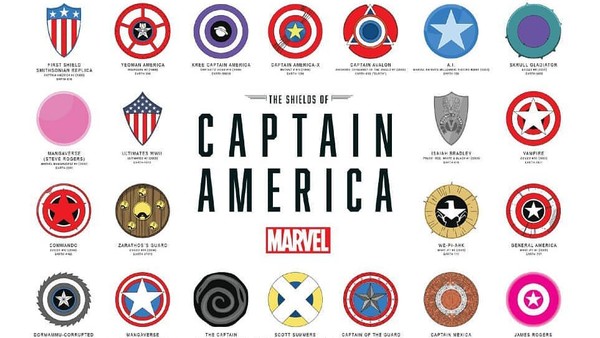
The first Captain America comic, written by Joe Simon and pencilled by Jack Kirby in March 1941, depicted Steve Rogers punching Adolf Hitler square in the jaw, with his trademark outfit in full view. It was a landmark moment, but while few artists have ever departed too heavily from Kirby's original design, few have ever returned to the more angular shield the character sported in his first appearance.
So, when did Cap start changing his shields? He's been through a lot of them, even donning an energy-based light-shield towards the end of the twentieth century, and while most - if not all - have been red, white and blue. Surprisingly, Cap only actually had the angular weapon on his first appearance; he switched to the circular one straight after in the next issue.
The reason why? Timely Comics received a complaint from rival publisher MLJ that it too closely resembled their own patriotic hero, known as the literal Shield.
In the comics themselves, Cap was actually presented his new shield by President Franklin Delano Roosevelt (as told in 1981's Captain America #255), from a design made by scientist Myron MacLain. Meanwhile, the term 'vibranium' wasn't actually coined until 1966 in Daredevil, of all comics. The more you know!
6. If Cap Was A Soldier, Why Wasn't He Drafted Into Other Wars?

This one's a bit of a doozy. Partially because of Marvel's sliding timeline, and also due to the fact retcons are frequent and also frequently confusing. Either way the question still stands: if Steve Rogers enlisted in the US Army during World War II, why didn't he serve in subsequent conflicts upon his return? The answer, unsurprisingly, is actually really interesting.
When Steve Rogers was thawed out of the Arctic ice in 1963, he came back to a country that had changed rapidly in the space of twenty years. The Cold War and Vietnam dominated the headlines, and the battle-lines were no longer clearly demarcated. Steve Rogers had signed up to confront the Nazi menace - a clear and present danger to the world - but everything had changed when he returned. The United States was no longer an isolationist nation spurred into action by the invasion of Europe and the Japanese attack on Pearl Harbor, but instead a true global superpower engaging in proxy conflict with a supposed enemy.
It wasn't a cause Rogers believed in.
On a purely technical level, when Rogers returned in 1963, he'd never actually been discharged by the US Army. This actually becomes a major point of contention when Cap designs to walk back on the identity in the eighties, as the gov threatens to treat him like a US operative and not as an independent superhero.
So, why didn't Rogers serve in Vietnam? The answer is simply that he didn't believe it was his battle to fight. In fact, Cap spent the next few decades exposing US corruption rather than serving overseas. That hasn't stopped What If? stories from asking what might've happened had Cap served, with Spider-Man: Life Story showcasing Steve fighting against US forces in Vietnam after witnessing war crimes firsthand.
5. Why Did Bucky And Falcon Stop Being Captain America?

Captain America is actually one of the Marvel universe's longest running legacy characters. Although he only gets that title via the assistance of some well placed retcons, Cap has actually maintained the most active legacy in recent years, with both Bucky Barnes and Sam Wilson stepping in to fill his boots when Steve has otherwise been indisposed.
Steve Rogers' death in the aftermath of 2007's Civil War was a huge event, and it came during a seminal moment in the character's bibliography. Ed Brubaker and Steve Epting were charting an exciting course for the hero, one that resurrected Bucky Barnes as a Soviet-era assassin known as the Winter Soldier.
When Steve was gunned down on his way to court, there was only one person who was going to replace him - although Barnes himself was reluctant to wield the shield. Comics dictate a return to the status quo however, and it only took a couple of years until Rogers returned - but not as Captain America.
For a while, Bucky actually retained the Cap identity while Steve took on the new role of America's Top Cop. It was only when Barnes himself was then killed off that Steve again took on the role, and Bucky attempted to detoxify the Winter Soldier identity.
Falcon, on the other hand, became Captain America after Steve's super soldier serum wore off and aged him. For a while, Wilson was the only Cap, until Steve returned and there were two. Secret Empire then concluded with Steve shaking the fascist funk brought on by the cosmic cube, which led Wilson to relinquish the mantle back to his friend.
4. So... How Did Steve Come Back To Life Again?
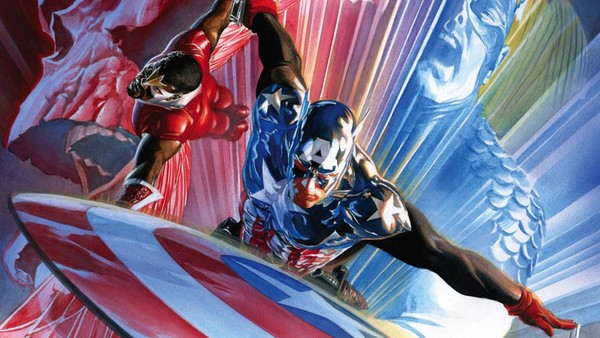
So, Rogers' death in 2007 was a big deal. Only, with this being comics it was never going to last, which presented a new challenge to Brubaker and Epting.
Steve Rogers was killed after being shot at point blank range by a mind-controlled Sharon Carter, but it was later revealed that his mind had been trapped through time. Rogers was forced to relive key moments in his life, and had to use different figures to relay the situation to the present day. Foiling a plot by the Red Skull in the process, Mister Fantastic and Cap's allies manage to bring Steve back... and it's still pretty confusing even if you read Captain America Reborn yourself.
The scheme just doesn't make too much sense. It's revealed that the gun Sharon shot Steve with was fashioned by Doctor Doom, and that the ultimate end goal for the Red Skull was to transplant his own consciousness into Rogers' body - an oddly recurring theme in Cap's comics.
Coincidentally, when all this was happening, DC were also in the midst of resurrecting Bruce Wayne - who was dealing with a similar time-travel quandary after having been killed by Darkseid in Final Crisis.
3. If Cap Went Missing In WW2, Why Did He Appear In The 1950s?
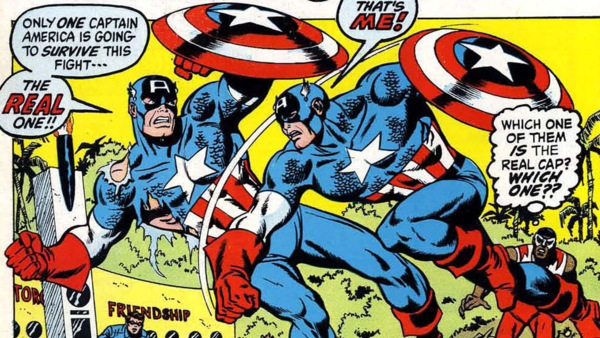
Everyone knows the story by now - Captain America and Bucky went missing at the end of World War II trying to disarm a Nazi super weapon, only to reemerge decades later as an Avenger and Cold War assassin respectively. However, when Stan Lee and Jack Kirby resurrected the Captain in 1963 with that story in mind they also encountered a problem - Marvel had been publishing Captain America comics after World War II for years.
The 1950s Captain America books are a fever-dream of contradictions and McCarthyist posturing, but that allowed Marvel to have fun years later. In the lauded Steve Englehart and Sam Buscema run on the comic, the creative duo introduced the character of William Burnside to explain how Cap existed in the 1950s.
Burnside, much like the fifties-era Cap comics, was an aberration. The story goes that the government wished to cover up the deaths of Steve and Bucky and so injected Burnside and another soldier with an ersatz version of Doctor Erskine's Super Soldier Serum. Burnside himself walked, talked and looked like a fascist, while the botched super soldier treatment left both him and his Bucky with psychotic tendencies.
Stored in suspended animation after the government realised that they'd perhaps made a huge mistake, Burnside later returned as the villain known as the Grand Director, battling Bucky-Cap until finally conceding defeat in 2012.
2. Who Does Cap Answer To?

One of the biggest misconceptions surrounding Captain America - at least before the MCU raised awareness of the character to the general public - was that he's a government stooge who toes the line. Obviously that isn't the case, but still, there is something to be asked about where Cap's allegiances lie; are they to S.H.I.E.L.D? The Avengers? Or is he just completely independent?
Steve Rogers is rarely ever static. While most other characters have seen themselves locked in a periodic reassumption of the status quo, the character has constantly progressed. He's often an Avenger, but he sometimes also answers to S.H.I.E.L.D. Over his seventy-plus year history Rogers has also held membership with the Invaders, the Illuminati and the Defenders, but does his synonymy with the star-spangled banner interfere with that in anyway?
The answer is no. Although Rogers has retained a correspondence with numerous presidents, he's repeatedly outmanoeuvred attempts to make himself a government operative. But that doesn't explain his time with S.H.I.E.L.D., necessarily; why would someone sceptical of the US intelligence apparatus align himself with that agency so often?
It's because of his war days. Rogers was friends with Nick Fury and undertook the occasional mission for S.H.I.E.L.D. when he felt it necessary. It was only in the early 2000s he became an official agent, and even then that didn't last for long.
1. How Does His Shield Always Return Back To Him?
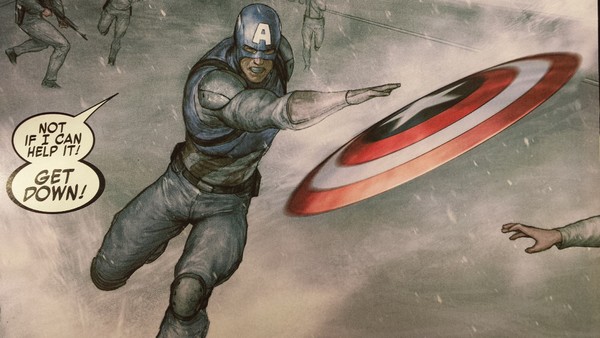
Physics-based questions are possibly the most tedious to ask when it comes to comics, but hey - the matter of how Cap's shield returns to him every time after has confused fans for decades, but the answer is actually fairly simple.
For a long time, those who've taken umbrage with Cap's shield-throwing ways have lamented how it makes no sense. "How does it magically return to him after he's thrown it?" cries one. "It makes no sense!" someone else presumably exclaims. However, it actually does - and it all stems from the super soldier serum.
When Steve Rogers was given Professor Erskine's formula, it not only heightened his physical attributes but also his mental skills too. Thus, whenever Steve 'yeets' his shield, he plans out the exact angle it needs to hit to return back to him. He's just that clever.
Watch Next
Marvel Vs DC Quiz: Captain America Or Superman - Who Said It?
