Is This The Most Important Comic Of All Time?
Fear and Loathing with Green Lantern/Green Arrow.

When an industry experiences as many seismic shifts as the comics one, it's only natural that commentators will point towards a multitude of different moments that fermented that change. Stan Lee and Jack Kirby's Fantastic Four, Frank Miller's The Dark Knight Returns, Alan Moore and Dave Gibbons' Watchmen - all have been optioned on the shortlist comprising the medium's most important - and influential - comic books.
And yes, while those books are all influential in their own way (Lee and Kirby's for reinventing the superhero genre, Miller and Moore's for ushering in the Modern Age of comics), there is another that revolutionised DC Comics. Published during the early 1970s, Dennis O'Neil and Neal Adams' Green Lantern/Green Arrow was politically salient, socially conscious and galvanised a once-complacent comic book publisher to look to the real world in their storytelling.
It was genre-defining for its time, and built upon the work the pair had done shortly before in Batman, where they - not Miller - first returned the character to his darker, Golden Age roots. There are few creative teams as revered as O'Neil and Adams', and in taking on Nixon's America with a pair of green-clad characters, the pair found their true calling.
Casting Green Lantern as a typical establishment figure (the embodiment of Nixon's 'Silent Majority', and the exemplification of the perfect 'Law and Order' candidate), and Green Arrow as a left-wing symbol of sixties counterculture, O'Neil and Adams took the pair on a Fear and Loathing-style road-trip across the United States in a quest to find the country's real self. It was bold, challenging and brutal in parts, and while its commentary might feel outdated in some respects, Green Lantern/Green Arrow will ultimately go down as a watershed moment, not just in the superhero genre, but for the medium as whole as well...
3. Hard Travelling Heroes
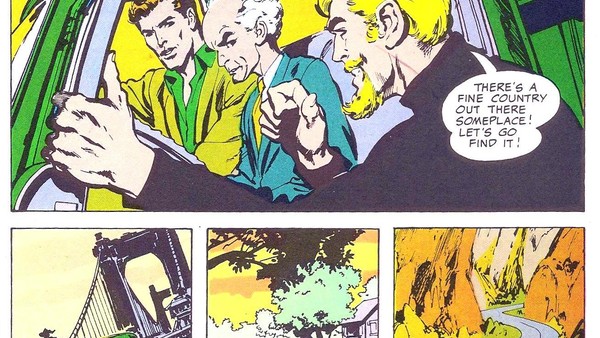
Green Lantern/Green Arrow is the quintessential seventies comic. What does that mean? Well, it subscribes to the Bronze Age of the medium - a period which saw a notable decline in Silver Age-style funny-books and a return to the darker, pre-Comics Code roots of the superhero genre. Secondly, the book roots itself squarely in the zeitgeist that engulfed the Nixon Presidency; an almost imperceptible malaise had gripped the US, and it manifested in film, TV and - through Green Lantern/Green Arrow - comic books too.
Earlier, I referred to the comic as a 'Fear and Loathing-style road-trip across the United States', and while the protagonists of O'Neil's comic are far more averse to drug use than that of Hunter S. Thompson's gonzo novel, the two works are similar. Thompson's revolves around a journey to Las Vegas where the book's two protagonists, Raoul Duke and Dr. Gonzo, embark on a drug-fuelled bender to find the American Dream. O'Neil's follows the exploits of two heroes who, embarking on a journey to find 'a fine country', end up touching on the malaise of '68 and with it the lingering throws of that decade's counterculture. Their destinations are far different, as are their journeys, but both books share the same motivation: to find an America that's been lost, ostensibly, to a cruel and uncaring milieu.
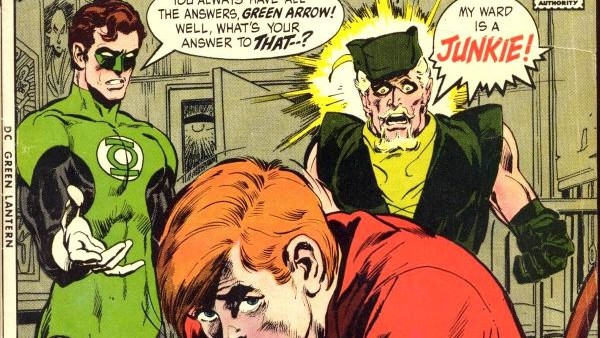
At times, Green Lantern/Green Arrow reads like a tour through an America in discontent, as the tour guide - Oliver Queen - takes the once oblivious Hal Jordan through all the political touchstones of that decade; drug use, liberation movements, authoritarian politics - all are broached by O'Neil in his attempts to confront what was once considered a silent tragedy, one that the equally silent majority of Nixon's electorate refused to consider.
Yes, there are moments where the book shows its age; in Snowbirds Don't Fly, Arrow's reaction to the revelation that Speedy, his sidekick, has been using drugs feels particularly outdated, but it was genuine. A few months earlier, Marvel had conducted their own 'anti-drug' comic in Spider-Man with a fairly outlandish story about Harry Osborn popping some pills and throwing himself off the nearest rooftop, but with Green Arrow, there was a harsh reality in seeing Roy Harper - the archetypal DC sidekick - succumbing to a heroin addiction. This was also a story both O'Neil and Adams wanted to tell, having witnessed firsthand the effects of drug addiction in their respective neighbourhoods, and you can tell as much reading the actual comic itself - hamfisted moments aside.
Important to note, however, is that while Lantern is the subject of Arrow's ire for much of the series, he too embarks on his own journey, one that would - like the Emerald Archer - change the character forever.
2. The Silent Majority
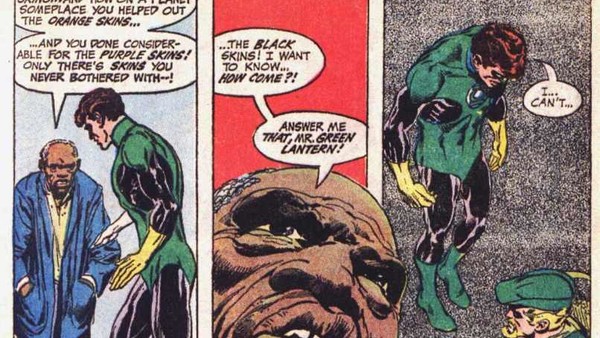
Despite this being Green Lantern's book, the character is scolded repeatedly by Green Arrow for what he considers to be his establishment background. Hal cedes authority to a group of intergalactic beings and seems vastly more concerned with the struggles of the galaxy than that of his own planet, a fact a passerby in O'Neil's series admonishes him for during an early appearance.
Hal came to represent everything old DC failed to address in their comics, but the journey isn't wasted on him. Over the course of O'Neil and Adams' comic, the Hal of old (a symbol of obedience, authority, and deference) morphed into a rebellious man of conviction who'd rebel against his leaders, the Guardians, more times than not.
Without Green Lantern/Green Arrow, that character doesn't exist. He is, for most of the O'Neil-Adams series, an analogue too and a criticism of the resurgent deference that brought in Nixon's presidency, one obsessed with 'law and order' and weary of the radical changes the sixties brought. By the end of the comic that's no longer the case, and in shaping perceptions of both Hal and Ollie in this series, but one aspect of the book's importance is made apparent.
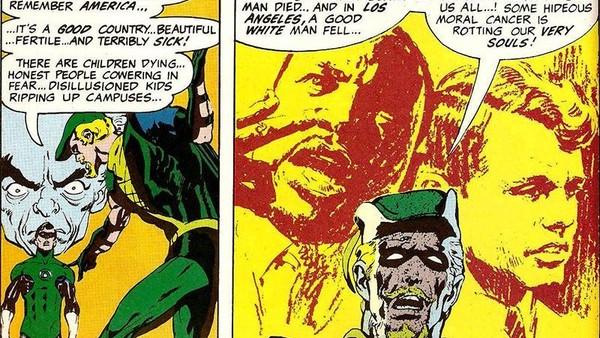
That isn't all though. To read Green Lantern/Green Arrow is to experience a comic uncompromising in its dedication to divest from a universe unconcerned by (to quote the Marvel tagline) "The World Outside Your Window". But where Marvel played things safe when it came to their allegories (the original incarnation of the X-Men, for instance, found inspiration in the Civil Rights Movement and yet featured not a single African American), O'Neil and Adams' comic confronted these moments head on (albeit in a sometimes dated fashion).
At times, GL/GA reads like an untamed response to a period of immense discontent. The above panel, for instance, references the deaths of Martin Luther King Jr. and Robert F. Kennedy, both of whom were assassinated in 1968 - a year many then came to see as the one that marked the 'death' of the sixties as they then existed. There's a clear emotional current to the comic, and while it can seem almost chaotic in its most exasperated moments, Green Lantern/Green Arrow conveys the anxieties of the period in a genuine way. That in itself lends the comic a unique historical importance, but in breaking genre boundaries too, the book's salience is nigh-impossible to overstate.
1. Before Watchmen
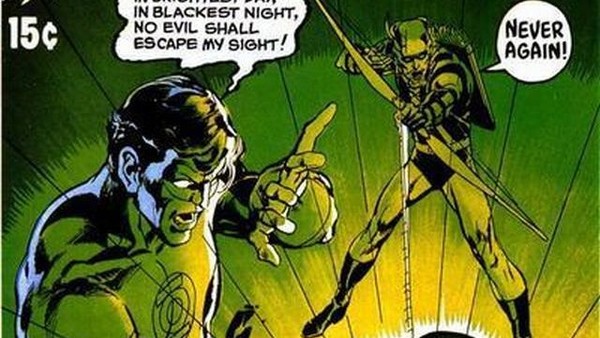
Green Lantern/Green Arrow is important for a whole host of reasons, and as far as legacies go, they don't much greater than its own.
There are plenty of events that marked the beginning of the Bronze Age of Comics - Gwen Stacy's death, for instance, is optioned as a key one - but the book that made it was O'Neil and Adams' seminal seventies hit. Green Lantern/Green Arrow was bold in its premise and even bolder in its delivery, rooting itself squarely in the malaise of the early seventies and questioning DC's own history in the process of doing so. It challenged the genre to be more, and while that isn't to say that it's a perfect book (it isn't), it did kickstart a whole wave of comics that felt brave enough to approach the real world; Marvel did so in Steve Englehart's scathing critique of Watergate in 1974's Secret Empire, and further forays into contemporary politics became the hallmark of the Bronze Age's closing moments, leading to the Modern Age of Comics with the ascendancy of Frank Miller, Alan Moore, and the British Invasion.
But perhaps Green Lantern/Green Arrow's most enduring contribution to the world of comics lies in how it redefined the DC Universe. Once considered unadventurous and sentimental, O'Neil and Adams dragged that world to be something bigger altogether, proving that it's not geographic analogues that reflect the world outside your window, but rather the issues that define it. Marvel's role in galvanising this change is of key importance, but in going one step further, both publishers deserve equal praise in challenging the medium to be more.
More innocuous, however, is the way in which GL/GA redefined two of DC's most prominent figures. They may lack the appeal of Batman and Superman, but the image of Hal as a rebellious do-gooder is now etched into the fabric of the character, as are Green Arrow's radical politics and goateed appearance.
In any case, Dennis O'Neil and Neal Adams' Green Lantern/Green Arrow is one of the most important comics of all time, and DC's definitive Bronze Age work.
What do you think is the most important comic book of all time? Be sure to let us know in the comments below!