The DC Comic That Saved Green Arrow
And how it made everyone love a hated superhero trope...

Green Arrow might not be as famous or as revered as DC's holy trinity (Batman, Superman and Wonder Woman), but make no mistake, he is a legendary character. The interesting thing about Arrow, though, is that his identity was never as clear cut as it is today - at least in the comics.
When Oliver Queen first graced the pages of More Fun Comics in 1941, he wasn't exactly what you'd call unique. Sure, Queen sported a green outfit and used a bow-and-arrow, but the Robin Hood motif never influenced the character beyond an aesthetic level. For much of those early years, Queen was pretty much just a Green Batman, replete with an Arrowcave, an Arrowcar, and an uppity young ward, called Speedy.
It wasn't until the 1970s, when Dennis O'Neil and Neal Adams transformed the character into a Hard-Travelling Hero, that Green Arrow truly found renewal. He had a Van Dyke beard, a firebrand attitude to social justice, and a personality that would persist throughout the following decades. That is, until he was killed in Green Arrow #101, diffusing a bomb planted by eco-terrorists, which seemingly heralded that the character's time was at a close.
Comics fans won't need reminding that death is something of a revolving door in the superhero genre (unless your name is Thomas or Martha), and Queen wasn't the exception. However, what threatened to be yet another example of comics diminishing the value of death was saved by two books, the first being Quiver - written by Kevin Smith - and the second (and most salient) being Brad Meltzer and Phil Hester's The Archer's Quest.
It is the latter comic that concerns this article, as even though Quiver was the book that brought Oli back, Meltzer's did something altogether different with the character, and turned a tiresome trope into something genuinely compelling.
5. Green Arrow In The Nineties - An Archer Without A Quest?

As was previously mentioned, prior to the 1970s, Green Arrow wasn't exactly one of DC's strongest characters. He'd featured in the Justice League and had managed to carve out a space of his own during the Silver Age of comics, but it wasn't until Dennis O'Neil and Neal Adams came along that Oliver Queen became a vital member of the publisher's library.
Green Lantern/Green Arrow was one of the most important comics DC ever published, and it defined Queen for an entire generation. He was outspoken, perhaps even reactionary, but his matter-of-fact approach to the political context of Seventies America was also massively refreshing, and even led to Green Arrow holding his fellow heroes' feet to the fire on numerous occasions.
Then came Mike Grell, and Oli underwent another reboot of sorts. He ditched the Robin Hood hat in favour of a hood, moved from Star City to Seattle, and ditched the trick arrows altogether. Reimagined as a 'Longbow Hunter', Grell depicted a slightly more cynical version of Queen that wasn't afraid to take a life, situated far away from the mainstream of the DC Universe.
After Grell left - and Queen was restored to more familiar surroundings - nothing particularly momentous occurred, save for the introduction of Connor Hawke, who was later revealed to be Queen's son. That said, the Green Arrow of the nineties didn't possess nearly the same transgressive qualities as that of the one from the seventies and eighties - he was lacking another compelling story.
Come 1995 - presumably in an effort to galvanise the Arrow family of characters - DC opted to kill off Queen and have him be replaced by Hawke. Batman scribe Chuck Dixon then took over the book with Oli's son at the helm until it was cancelled in 1998, leaving DC without an Emerald Archer, and with the door apparently closed to the original's return.
4. Quiver, Kevin Smith, And The Return Of Oliver Queen

It wasn't until 2001 that Oliver Queen made his return from the dead, and though fans have always been quick to bemoan the sudden resurrection of a deceased superhero, there was a different feel to the return of the original Green Arrow.
For starters, Kevin Smith had been tapped to write the series. Smith - who by this point had helmed Clerks, Mallrats, and Chasing Amy, and had written Daredevil: Guardian Devil for Marvel - turned out to be the perfect choice to bring Queen back, and that stemmed from his own love for the Arrow comics of the previous decades.
Dubbed Green Arrow: Quiver, Smith (also joined by Hester) orchestrated Queen's comeback tour by taking a holistic approach to the character's history. He broached all aspects of Queen's past (a theme that would persist into Meltzer's following comic), and in doing so managed to craft a genuinely affecting resurrection. It showcased Oliver struggling to reconcile the hard-travelling hero of the seventies with the darker, more world-weary version he became before his death, and in reappraising the character's two most definitive incarnations, Smith managed to attain the perfect balance.
Put simply, it pushed Green Arrow forward. The character had been lacking direction for years (though three of those years were spent in the afterlife), and Smith's work gave him the perfect foundations to find a new role in a rapidly changing DC continuity.
But there was something else that needed to be addressed. Though Smith had managed to bring Oliver back in a gratifying manner, there wasn't so much as a knowing wink towards the fact that Arrow was yet another DC superhero who was returning from the dead. It was just another thing to be accepted, and it wasn't until Smith departed the title that that particular aspect was appropriately deconstructed.
3. How Meltzer And Hester Addressed The Genre's Dullest Cliché
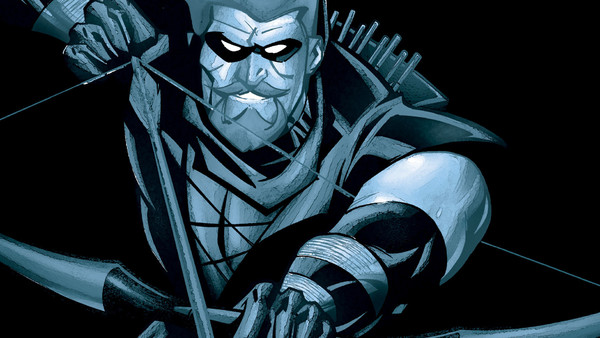
Kevin Smith's Green Arrow stories (collected in Quiver and Sounds of Violence respectively) are rightly lauded as some of the best the character's ever featured in. However, perhaps for that very reason, the following book hasn't been discussed nearly half as rigorously - that being Meltzer and Hester's Archer's Quest.
Today, Brad Meltzer is perhaps best known by comics fans for his work on Identity Crisis and the Justice League books that immediately followed its release, but back at the start of the millennium he was actually a novelist first and foremost (a line of work he's returned to in recent years). Him writing Green Arrow illustrated yet another occasion where the Big Two were branching out their horizons and recruiting from different mediums, with Smith a screenwriter first and foremost, and Meltzer (then) without a comic to his name.
If Quiver was about Oliver Queen reconciling with his development on the page, then the Archer's Quest was more about how developments off it have changed him too. There's still that same holistic approach to the character's legacy (which we'll get to later), but there's a very matter-of-fact way Meltzer addresses the character's return. In this case, the trope of resurrecting dead heroes isn't so much lampooned as much as it is addressed very literally; there's almost a level of black humour to the way the writer - and by extension Oliver too - broaches the concept of death, when the most definitive version of the character existed during a time when superheroes were immortal.
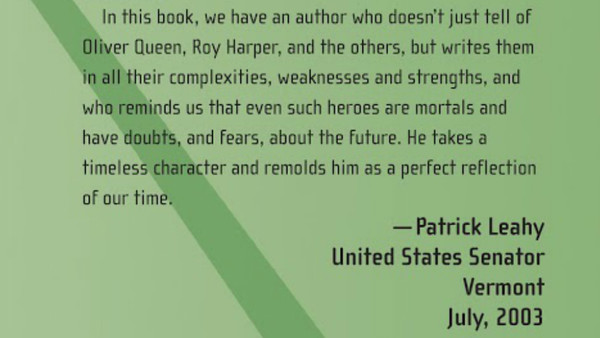
In this, according to United States Senator Patrick Leahy, Meltzer "goes way beyond our childhood days", and brings the character up to speed with the modern age of comics, but also the 21st century too.
Which brings us (nicely, I hope) to the story. Archer's Quest picks up a few weeks after the ending of Sounds of Violence, with Queen stood over his own grave next to Clark Kent. Why? He wants to know who attended his own funeral, and when he recognises a face that shouldn't be there - potentially jeopardising the safety of all those who attended - he sets out to solve what happened with Roy Harper, his former ward, at his side.
From then on in, Archer's Quest devotes the time to unpack how one would feel about returning from the dead, and what kind of reaction and emotions that would provoke. All of Arrow's friends had mourned his death for years - they'd moved on. But now that he's back, they have to pick up the pieces and start anew, unearthing a trauma few too little superhero books have considered when other figures have returned to the mortal coil. That alone imbues the Archer's Quest with a unique importance, and tacitly reiterates Green Arrow's own salience as well.
2. Reappraising A Legacy - Is GA DC's Most Important Hero?
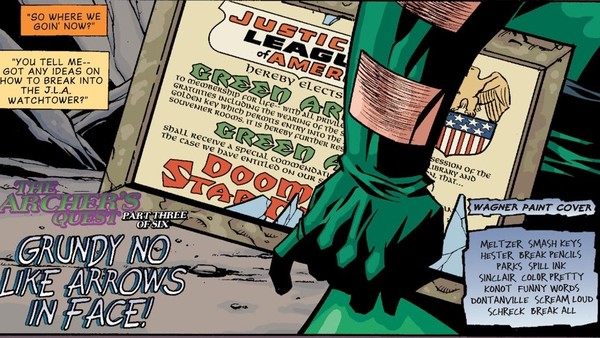
Much like Quiver, Archer's Quest finds a great deal of success in examining Green Arrow's literary history. In this case, the journey is spurred on from Queen revealing to Roy that he'd ordered the Shade - an immortal adversary of the Justice League - to round up all his old memorabilia and to have it destroyed so that it couldn't be used to target his friends and family. Through this, it is revealed that Shade had missed several key items from Queen's past, so it falls to him and Roy to go on a journey of self-reflection through memory-lane, find them, and ensure they can never be used again.
When Denny O'Neil and Neal Adams sent Hal Jordan and Oliver on a hard-travelling journey through Nixon's America, they did so in order to hold a mirror to America as it then existed. Just as that road-trip proved to be a transformative experience for DC's foremost green characters, the hard-travelling journey in the Archer's Quest is no different, except instead of confronting a contemporary zeitgeist, it takes an introspective approach to DC's history, as well as Queen's contributions along with it.
In Quiver, Kevin Smith made an important delineation between the Green Arrow of the 1970s and that of the one seen in Mike Grell's Longbow Hunters, and ultimately left the character with both interpretations informing their personality. It is this Arrow that leads Archer's Quest, as he heads across the country and accumulates a museum's worth of his history, from a ceremonial Power Ring gifted to him by Hal, to his official document decreeing his membership of the JLA.
There's an undercurrent of tragedy to the exercise, particularly when the final twist comes around, but it all serves a purpose in proving that Oliver is the most human hero of them all. Further to that, the Archer's Quest illustrates the importance of Green Arrow not just to the DC Universe, where he's been the conscious of the Justice League, an advocate for social justice and a competent crimefighter, but also to the superhero genre as a whole.
Save for the nineties, Oliver Queen has constantly been moving forward, and the added wrinkle in this book is that he's a baby-boomer learning and adapting to a whole new milieu. There's a generational element at play, and it only works to the book's benefit.
1. Why The Archer's Quest Is The Best GA Comic

When people ask DC fans what their favourite Green Arrow story is, they'll usually be treated to a varied response. There's still a lot of love for O'Neil and Adams' GL/GA duo, and even those who swear by Grell's mature, more weary interpretation of the Emerald Archer; others may even option Quiver, or Year One (Andy Diggle, Jock), which to many told the character's definitive origin story. It's an extremely narrow contest, and one that obviously doesn't have a right or wrong answer, but the Archer's Quest is something truly special.
For all the reasons previously mentioned, Meltzer, Hester and Ande Parks' book marked Queen's triumphant return to the medium, and made readers appreciate that very return in a way few other superhero comics have achieved. It turned a tired and cumbersome trope on its head and into something surprisingly emotional, and just like Quiver, provided a solid springboard for other creators to grow and define the Arrow character - albiet to mixed results.
"To me, the Archer’s Quest is a starting point. It’s not just self-contained."
- Brad Meltzer, speaking to Fanboy Planet.
Undoubtedly one of the best things about the book, though, is that it works both as a self-contained entry in the DC canon - something any fan can pick up, read, and appreciate - as well as something that informs latter interpretations of the character and his legacy. Perhaps not so much now that the publisher have undergone two reboots in the decade since Archer's Quest was published, but there remains something uniquely fascinating about Meltzer's Arrow, and that stems from the fact he occupies a moment in time.
The archer of DC's comics today isn't as hard-travelled as his predecessor, and even though he bears many of the characteristics of this Arrow - the one Smith and Meltzer moulded and to many the definitive incarnation - he hasn't been informed by the same experiences. The Archer's Quest, however, takes all of Queen's history into account, and ultimately leaves us with the most compelling version of the hero to date.
Watch Next
DC Quiz: How Well Do You REALLY Know Green Arrow?
