25 Greatest Film Deaths This Century
The movie kill count this century is in the millions, but only 25 of them can come out on top.

The past 25 years have served up an enormous number of onscreen deaths; so many that it can often be difficult to know where to start when looking at which were the best handled by their actors, directors and editors. Well, fear no more, because we are here to steer you in the right direction.
A great death scene doesn't have just one definition, as our favourite and most hated characters die for innumerable reasons, all of which serve different purposes for the films they feature in. As such, the greatest movie deaths span all genres, serving up moments that are pure badass, steeped in romance, mind-bogglingly epic, or downright righteous. These scenes shock, entertain, do the characters justice, fulfil or release things set up by their films, and even shine light on themes and ideas far larger than the scenes themselves.
You know what we're talking about: the deeply affecting deaths we find in indie-tinged flicks like Million Dollar Baby and Monster; the epic and noble sacrifices from big franchises like Star Wars and The Lord of the Rings; and the ghastly dissections the likes of Osgood Perkins and Damien Leone have delighted in showing us in recent years.
We're looking just at live-action movies this time around, and, of course, all fiction, because we're not interested in snuff. So wait no more: get stuck into one per year of the greatest film deaths this century.
25. Bridget von Hammersmark - Inglourious Basterds (2009)
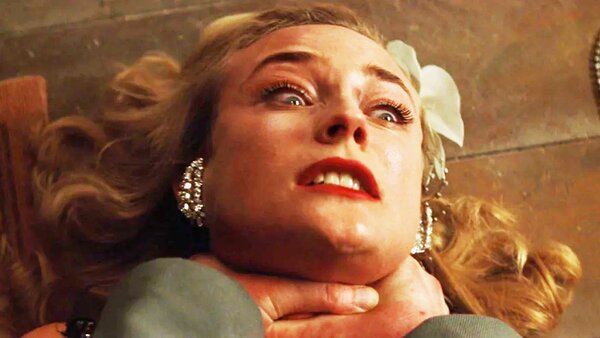
Revisionist WWII flick Inglourious Basterds is one of Quentin Tarantino’s best films, bringing together his iconic dialogue scenes and love of bloodshed in a narrative that anyone can get behind: a rag-tag group of soldiers and civilians concoct conflicting plans to terminate Nazi Germany's leaders in a Paris cinema.
Bridget von Hammersmark (Diane Kruger) is an undercover Allied agent who, after narrowly escaping from a bar shootout with some German soldiers, minus her shoe, comes up against SS Colonel Hans Landa (Christoph Waltz) and doesn’t live to tell the tale. Her final scene mirrors the tension of the film’s opening, when Landa is interrogating a rural family harbouring Jews under their floorboards. But this time, we know the game he’s playing from the start, and although Bridget thinks that if she holds her nerve she might escape, once Landa slips the missing shoe onto her foot, the game’s up and he strangles the life from her.
This is one of the most understated and overlooked kills of Inglourious Basterds, and it’s not hard to see why, given the unholy bloodshed in the film that surrounds it. But it’s unique and notable for Tarantino because it feels and looks so authentic - not overdone, no scenery chewing, just hard tension and a woman being choked to death.
Plus, when it came to getting the close-up, Tarantino himself donned the military jacket, his hands became the unscripted stunt-doubles for Waltz’s, and another legendary death scene was written in the Hollywood annals.
24. Jill Roberts - Scream 4 (2011)

Scream 4 was not only Wes Craven’s final run at his scary movies, but his final film of all. And what a way to go out. Managing its awkward place between the new and old Scream films with style, and bringing things up to date for a meme-friendly, heavily digitised age, the movie introduces a cast of new young things, including Sidney Prescott’s (Neve Campbell) cousin Jill Roberts (Emma Roberts), to face the return of Ghostface to Woodsboro.
After the usual slayings, fake-outs and cinephile chit-chat, Scream 4 outs its baddie - and this time it’s being kept in the family, with Jill masterminding the whole bloody enterprise.
Jill frames classmate Trevor (Nico Tortorella) and dispatches Sidney before putting herself in the hospital with a knife wound to become the new survivor and media darling. However, she doesn’t bank on the old gang’s durability.
Sidney survives, and when Jill comes to put her lights out proper, Sid is ready for a fight, with a little help from old pal Gale Weathers (Courteney Cox). After a bloody struggle that has Jill holding Gale at gunpoint, Sidney gets the drop on her and fries Jill’s head with a defibrillator, saying, "You forgot the first rule of remakes Jill: don’t f**k with the original."
Of course, Jill returns for one final scare and is put down permanently by a bullet to the chest. But whichever way you look at it, this is one of the most badass death scenes in all of Scream’s history.
23. Darcy Banker - Green Room (2015)

Jeremy Saulnier’s Green Room remains something of a sleeper hit, telling the story of punk band the Ain't Rights who get booked for a neo-Nazi clubhouse, witness a murder and find themselves being first held then hunted by a group of skinheads who want to clean up the scene and erase the evidence.
At the head of the skinhead gang is bar owner Darcy, played by none other than Patrick Stewart with a beard, glasses, and a cold heart of steel. Orchestrating the carnage, Darcy orders his boys to kill the Ain’t Rights, and they go after them with fists, knives, dogs, and guns, stopping at nothing and wreaking bloody havoc.
And, by gum, if Stewart isn’t terrifying. Gone are Picard and Professor X, replaced by a calculated animal of a man, a lifelike predator whose mere presence is chilling. So, when he’s finally brought down by the last Ain’t Rights standing, Pat and Amber (Anton Yelchin and Imogen Poots), it’s something to behold.
They finally reach the end of their tether, cornering Darcy and his last henchman, and robbing them of their power. Hot-footing it away, Darcy takes several shots to go down, and one in the head when he turns around to return fire, showing him as merely a man in the daylight and demystifying the whole skinhead neo-Nazi mystique. It’s quick, it’s painful, and it’s a double-whammy that it’s the usually safe and friendly Stewart in the crosshairs.
22. Bruce Robertson - Filth (2013)

Filth takes Irvine Welsh’s DS Bruce Robertson and brings him to life, via James McAvoy, in habitually manic fashion. Bruce is a hard-drinking, rapacious, and corrupt detective who stalks Edinburgh’s streets and puts the criminals to shame. Suffering from severe, untreated and long-standing mental health issues, he goes to any lengths to avoid sobriety, routinely tortures his unassuming pal Clifford “Bladesey” Blades (Eddie Marsan), and the only person he cares for in his life is Mary (Joanne Froggatt), a widow whom he barely knows.
Having torpedoed his career, we find Bruce in the film’s closing scene getting cleaned up and dressed in his old uniform. He sets his affairs in order, puts together a package and has a last drink. Bruce’s confession on the video tape that he sends Bladesey narrates his final moments, while he prepares to hang himself from his football scarf, standing on a chair in his front hall, a cover of Radiohead’s “Creep” building to crescendo.
It’s fraught and emotional, and then, as he’s teetering on the edge, Mary and her son ring the doorbell. Bruce manages to hold the chair steady on two legs, but when their shadows recede from behind the glass, he breaks the fourth wall to say his catchphrase, "Same rules apply," and laugh as the chair slides out from under him. This injection of dark humour offsets the moment and hits us with a sucker punch right as the credits roll.
21. Lindsey Farris - Mission: Impossible III (2006)
Before he ever got let loose on the two big Star franchises, sci-fi specialist J.J. Abrams was making his mark on a somewhat more down-to-earth film series, with Mission: Impossible III.
Abrams doesn’t exactly do things lowkey, and the opening mission, which sees retired IMF agent Ethan Hunt (Tom Cruise) step back into the field on a special mission to find and rescue his protégé Lindsey Farris (Keri Russell) from the clutches of malevolent arms dealer Owen Davian (Philip Seymour Hoffman), is proof of that. Hunt and his team race against the clock to extract Lindsey and escape a small army in their chopper, weaving through a wind farm while attempting to deactivate the explosive pellet implanted in her head.
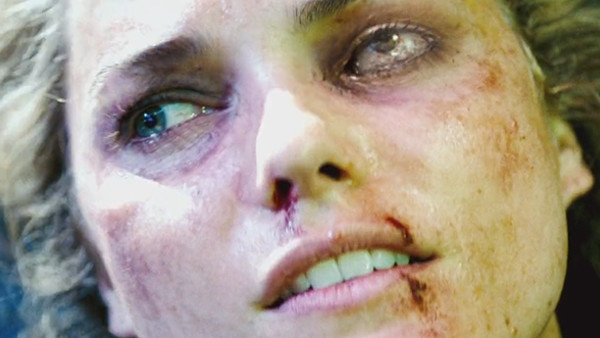
So, when Lindsey’s death arrives, it catches us all off guard. Ethan, our true-blue hero, does not save the day, and the death itself is the quietest thing in the loud and fast-paced scene. The quick, quiet thwip of the charge contrasts everything that has come before and gives a tragic, heart-rending finality to the scene, coming just seconds before Ethan’s defib is charged and ready to short the pellet.
As if that wasn’t enough, Lindsey’s battered face and jumbled eyes provide a haunting visual that sticks with you, and one of a type the Mission: Impossible films don’t normally trade in.
20. Maggie Fitzgerald - Million Dollar Baby (2004)

Despite being tastelessly parodied in other media (looking at you, Scary Movie), Million Dollar Baby, which sees a tragic boxing ring accident disable athlete Maggie Fitzgerald (Hilary Swank) at the top of her game, is a deeply affecting watch, and one of director Clint Eastwood's masterpieces. But while Gran Torino and Unforgiven have a sense of pace, excitement and fun that carry them along without letting their more miserable elements settle too heavily on us, Million Dollar Baby flips the script and makes us sit through every moment of its protagonist's pain, anguish, paralysis and attempts to die.
And all this leads to Maggie’s inevitable, hard-won death scene. Quadriplegic and bed-bound, suffering from bed sores and with her leg amputated, Maggie can’t get her country to kill her, and so she turns to her trainer Frankie Dunn (also Eastwood). After initially refusing, he comes to understand only death can liberate her.
Shot in lowkey lighting, this scene is the darkest night of the soul, as Frankie is forced to leave his own morality at the door, and set himself up for potential damnation in this life and the next. He unplugs Maggie’s support machines and injects a life-ending shot of adrenaline into one of her tubes. It’s made all the more painful by Maggie’s smile - her acknowledgement of what her mentor is doing - and a haunting voiceover from Morgan Freeman, who plays Eddie Dupris, Frankie’s gym assistant and the only other witness to Maggie’s death.
19. Detective Lurasetti - Dragged Across Concrete (2018)
Director S. Craig Zahler's Bone Tomahawk and Brawl in Cell Block 99 made him a legend in the indie movie scene, committed as he was to bringing the grimmest man-made horrors to screen, while also constructing deep, considered, and well-acted films around them. And Dragged Across Concrete is no different.
Brett Ridgeman (Mel Gibson) and Anthony Lurasetti (Vince Vaughn), two police detectives suspended for corruption, pursue sadistic armed robber Lorentz Vogelmann (Thomas Kretschmann) and his crew, with the intention of relieving them of their next haul. But this only leads to a deadly standoff that has disastrous consequences on all sides.
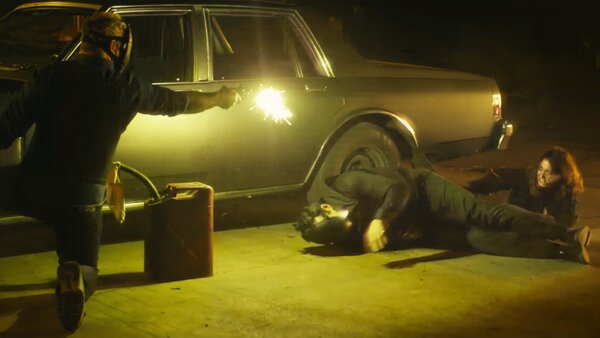
While for the most part Dragged Across Concrete plays out like a crime thriller, it is the violence - in all its ugly, repugnant glory – that elevates the film. The underlit standoff takes place in an empty lot, and forces the two detectives to take cover behind their car while Vogelmann and Co. hole up in their armoured van, with bank teller Cheryl (Justine Warrington) as hostage.
Cheryl escapes the van, crawling across the lot, but when she arrives to safety, she executes Lurasetti, having been blackmailed by Vogelmann beforehand. After such languorous pacing, the sudden and detailed violence hits twice as hard, the like of which would make even Quentin Tarantino think twice about screening this one again. Cheryl is then slain by Ridgeman, and the whole bloody affair just keeps on unwinding.
18. Earl Cole - Kong: Skull Island (2017)

To date, the deepest and most thematically-rich film in the MonsterVerse, Kong: Skull Island is a Vietnam War movie without either Vietnam or war. The mysterious island Kong inhabits in the Pacific draws the US government’s attention, and a rag-tag band of soldiers, contractors and the like are sent to investigate.
Once there, they come face to face with monsters of all kinds, and discover that giant ape Kong can be reasoned with - as well as being their only defence against the subterranean, reptilian "Skullcrawlers", which have brought Kong’s species to the brink of extinction.
Military Captain Earl Cole (Shea Whigham) is far from a main character, but he does have the best death scene. Faced with the onslaught of a big, bad Skullcrawler, Cole hangs back to sacrifice himself and save his team. He tells them to "go live their lives", gives a cheeky grin and then pulls a grenade, intending to get eaten by the beast and blow it to hell.
But this is immediately undercut as the creature sweeps him away with one flick of its tail, exploding him into the side of a hill. It’s a rare film that mashes heroism of this sort up against some balls-out gallows humour, and while we feel cheated of the promised moment, the comedy of it offers us an unexpected outlet. And, yes, you should feel guilty for laughing, but that's kind of the point. There ain't no heroes in 'Nam.
17. Big Daddy - Kick-Ass (2010)

Right when the MCU was just finding its feet, Matthew Vaughn provided a biting alternative to the coming storm of superhero gloss. Based on Mark Millar’s icky and edgy comic book series, Kick-Ass tells the story of ordinary kid Dave Lisewski (Aaron Taylor-Johnson), whose only superpower is being able to take a good kicking, but who nonetheless makes it his mission to tackle crime in his corner of NYC.
Along the way, Dave teams up with real ass-kicking heroes Big Daddy (Nicolas Cage) and his daughter Hit-Girl (Chloe Grace Moretz), and they come up against crime lord Frank D'Amico (Mark Strong). Now, things don’t exactly go smoothly at any point in the film, and an unfortunate double-crossing leaves Kick-Ass and Big Daddy in the hot seat (literally) in one of D’Amico’s warehouses, getting beaten and brutalised and, yes, set on fire.
Vaughn and his team allowed Cage to go all-out on this one, and as the Batman-adjacent hero burns, he screams and hollers like a maniac, guiding his daughter to defeat the well-armed men while dying horribly. What could have been a fairly rote (but no less saddening) death scene was brought to life by Cage’s intervention, and stands out as a strangely epic death that is quite unlike any other.
16. Neil - Tenet (2020)

Christopher Nolan’s Tenet is as confusing as it is loud, but it has all the elements of the filmmaker's best work, bringing together the puzzle-like construction of movies like Memento with the epic stunt and setpieces of the Dark Knight trilogy.
We join CIA operative the Protagonist (John David Washington) as he is recruited by Tenet, a secret organisation that uses inverted entropy to move backwards through time. The Protagonist’s contact is Neil (Robert Pattinson), a time-served operative of Tenet, who brings him on board to stop Russian oligarch Andrei Sator (Kenneth Branagh), who is communing with the future and planning to detonate a bomb to invert the entropy of the world and destroy its past.
In the epic final sequence, time is used in all directions to thwart the antagonists’ plans, but the Protagonist still comes face-to-face with death, and it's thanks to an inverted operative’s intervention that he survives. It is only after all is said and done that we learn the operative was Neil, sacrificing himself to save the Protagonist - and to see him alive after his death, but unable to be saved from his fate, is a new kind of emotional pain.
The one saving grace is that, although dead, Neil’s journey is far from over from the Protagonist’s perspective, who heads back in time to found Tenet and recruit his saviour. Poetic, and a significant death that goes overlooked when people recall the admittedly bombastic, setpiece-heavy film.