10 Things Everyone Hates About Modern Video Games
Welcome to the suck that is modern video games.
There's a strong argument to be made that we're living through the true Golden Age of Video Games right now. There's never been more quality content to choose from, nor a more diverse array of voices bringing their stories to the fore.
But it's also fair to say that modern video gaming is far from perfect, and isn't without many issues which hold it back from being an even more democratic and enjoyable art form.
Like any modern media, video games are reactive, constantly evolving to match the tastes and whims of players, but often publishers will also test the waters to see just how much nickle-and-diming they can actually get away with.
Video games are of course primarily a business above all else, yet the very best games manage a delicate balance between artistic intent and commercial "necessity."
But as the industry has proven time and time again, if it can get away with ripping players off, selling their childhoods back to them, and basically treating them like a wallet with legs, then it absolutely will.
From the most obnoxious current gaming trends to beloved aspects of the past that are slowly fading away, these are the 10 things gamers can't stand about video games these days...
10. Bloated Gameplay As "Value"

It truly does feel like video games are less respectful of the player's time than ever before.
Never have AAA games in particular felt more egregiously bloated out with repetitive copy-paste side-quests and substance-devoid collectible nonsense, intended solely to flood the map and present a massive time sink to completionist players who can't help themselves.
Ubisoft are far and away the most significant repeat offenders, their open-world AAA formula committed to turning a 20-hour game into a 100-hour slog.
That's without even getting to the many video games bogged down with unnecessary skill trees and needlessly convoluted progression systems that don't even fit the style of game - looking at you, God of War.
Ultimately this padding stems from an increasing desire for publishers to offer up "value" as time spent rather than delivering a quality, curated experience.
With services like Xbox Game Pass making the prospect of a day-one retail purchase less appealing than ever before, the desperation to justify that £60-70 price tag is bore out through hollow promises that a game will eat up at least a few weeks of your life.
Ultimately the industry needs to embrace the idea that games should be as long as they need to be, but also be priced to fit that length.
The death of the 8-10-hour single-player AAA game is a real shame, and with the industry pushing massive, empty worlds populated with boring, algorithm-created "content" so aggressively, they're likely never coming back in a major way.
9. Too Many Remakes & Remasters

Though players have more choice and value at their hands than ever before, you'd scarcely know it from the exhausting number of remakes and remasters released every year.
This is especially true in the AAA sphere, where it's seen as less risky to simply sell players' nostalgia-soaked childhood back to them rather than, you know, come up with something new.
That's not to say that all remakes and remasters are bad - Bluepoint's Shadow of the Colossus remake was a major technical improvement, for one - but that when the industry considers glossing-up games that came out barely five years ago, it feels like a lazy, cynical calculation.
More than anything it underlines a lack of creativity while taking time away from developers who could actually be coming up with something fresh.
Gamers are of course themselves largely to blame, as their nostalgia receptors can be so easily pressed to make them part with their cash. If this obsession with raking over the past wasn't profitable, publishers wouldn't do it.
Again, as exciting as the recently announced remake of Star Wars: Knights of the Old Republic is, the fact that there's a large portion of the industry devoted to industriously churning out half-baked remasters and dubiously necessary remakes feels like a major waste of resources and talent - artistically speaking, at least.
8. Always-Online Requirements & Performance-Affecting DRM
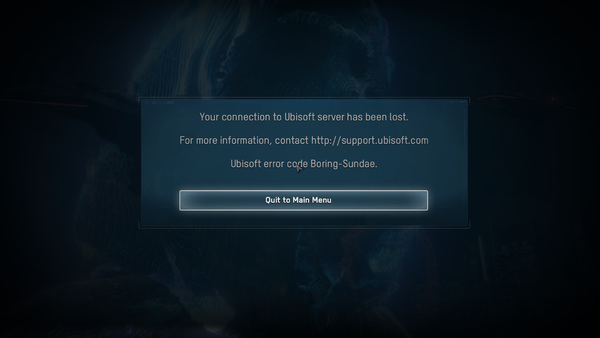
One of the most pervasively infuriating issues of the last decade-or-so of gaming has been the increasing requirement for games, even single-player ones, to be permanently connected to the Internet in the apparent quest to "combat piracy."
Beyond online multiplayer titles, there's no good reason for placing a barrier between players and their game, given that all it does is punish those who actually paid to play it in the first place. If your Internet connection isn't great or the servers go down, you're left with an unplayable piece of software.
On the PC side things are even more nefarious, what with the inclusion of intrusive DRM like Denuvo, which while intended to prevent new games from being cracked by pirates, often ends up adversely affecting performance for paying customers.
The irony in this case is that anyone who actually pirates an affected game with the DRM removed will have an objectively superior experience to those who did the morally right thing.
Publishers need to dial back their fetishistic fascination with stamping out piracy and instead focus on making games that people actually want to pay for.
Sure, some people will always pirate regardless, but they didn't ever represent a sale to begin with, so their piracy isn't the "lost sale" publishers believe it to be.
7. The Death Of Split-Screen

As much as the technological advancement of video games has brought us so many things, it's also taken something away - the irreplaceable fun of split-screen multiplayer.
While the appeal might be lost on the youngest gamers who only know playing multiplayer games online with their friends, split-screen was of course the only way to play with your pals back in the day, as you all crowded around a single TV screen to do battle.
Sadly with the increasing ubiquity of easy online multiplayer over the last 15-or-so years, developers have increasingly phased-out split-screen modes, such that even major franchises can't be relied upon to offer local split-screen gameplay.
For anyone with fond memories of playing games like GoldenEye 007, Halo, and Mario Kart split-screen, it's a shame that its inclusion is becoming scarcer with each passing year. As incredible as online play can be, there's no replicating the fun and drama of an in-person shared experience.
6. "Bullshots" & Misleading Marketing

Publishers have proven time and time again that they'll do whatever it takes to get your hard-earned cash, even flat-out lying about what a game really looks like.
Such is the cottage industry of "bullshots," whereby publishers will release gameplay images and video of an upcoming release that isn't in fact representative of what it'll look like in players' hands - perhaps most infamous, Aliens: Colonial Marines.
Sometimes this is a result of the developers realising that their original "target visuals" are too high-spec to perform consistently, resulting in them receiving a downgrade before release, as occurred with Watch Dogs years after its stunning original E3 trailer dropped.
Other times, publishers may simply pay a photo artist to retouch raw gameplay materials and make them look more polished, misleading players into expecting a more visually robust experience.
Despite publishers being dragged for this time and time again over the years, it's still extremely common in the AAA sphere.
Really the best thing you can do to combat it is not pre-order your games and wait for reviews to assure you you're not about to be swindled.
5. Grotesquely Large File Sizes

As video games become more complex, it's only natural that they'll grow larger, though it's also fair to say that major AAA games have a real problem with their ballooning file sizes.
Take last year's Call of Duty: Black Ops Cold War, which as of its Season 4 update weighs in at a stonking 219.8GB on PS5, accounting for almost one-third of the console's entire usable hard drive capacity.
Though Cold War is at least installed in a modular fashion, allowing players to uninstall the campaign and Zombies modes, it still speaks to a wider issue of exponentially increasing game sizes.
It wasn't that long ago that 50GB was a massive file size, but with the ever-increasing demand for ultra-high resolution, uncompressed 4K textures, it follows that games will get many times larger.
One can only imagine how big the average AAA game will be 5 or 10 years from now - with the possibility of the next generation embracing 8K gaming, could we end up seeing the first ever 1TB video game?
The real issues here are that these file sizes are growing out of step with the average consumer's available storage solutions, and for many without lightning-fast Internet connections, it simply becomes impossible to download a game within a reasonable timeframe.
4. Crunch Culture & Treatment Of Developers

While there are certainly many gamers who don't pay much attention to the inner-workings of the gaming industry, it's becoming increasingly difficult to ignore the flagrantly unjust working conditions inflicted upon many working in the business.
In recent years there's been increasing pressure upon AAA developers in particular to avoid subjecting their employees to brutalising crunch practises, whereby team members can be asked to work upwards of 100 hours per week in the lead-up to a game going gold.
The effects of crunch culture are far-reaching and extremely damaging to employees, ruining their mental wellbeing and potentially destroying relationships as they're unable to maintain a healthy work-life balance.
The decades-long expectation that developers slog themselves away into poor mental and physical health because making a video game is a "privileged" position is thankfully starting to die out, though the industry still has a long way to go to address crunch.
Ubisoft has claimed lately that they've been able to produce the recent Assassin's Creed games free of massive crunch, all while Rockstar and Naughty Dog have been thoroughly dragged for their brutal working conditions.
The real solution is the formation of a game developers' union, and while baby steps have already been made, it goes without saying that many publishers will actively do whatever it takes to prevent unionisation.
This is all without even getting into how horribly fans can treat developers, because of course, nobody hates video games more than gamers themselves.
Various employees working on Cyberpunk 2077, for instance, received death threats after the game was delayed last year, putting senior game designer Andrzej Zawadzki in the position of having to remind fans that such behaviour is unacceptable.
3. An Obsession With Metacritic Scores

In much the same way that film fans obsess over the minutiae of Rotten Tomatoes scores, so too do gamers hang on that single, aggregated number assigned to a video game on Metacritic.
This isn't to say that the number can't be a useful guide when people want to determine whether a game's worth their money or not, but the fanatical fascination with the specific number often lurches into genuinely unsettling territory.
So much does this one number mean to some people that they won't even consider playing a game with a score lower than, say, 80, and because of the apparent importance of Metacritic scores, publishers buy into it too.
Almost a decade ago, it was famously reported that Fallout: New Vegas developers Obsidian Entertainment had a performance bonus tied to the game's Metacritic score, and because it missed the target score by just one point, the team missed out on a hefty extra pay packet.
There are surely many other unreported instances of such practises, underlining the industry's generally excessive, gross obsession with critical reception.
2. Releasing Games Blatantly Unfinished

It's certainly a benefit to everyone that video games are no longer released as a one-and-done deal, whereby whatever ends up on the disc is as good as it will ever get.
Online functionality allows games to receive patches to fix bugs and generally whip them into shape, though this framework is far too often abused as a crutch for publishers to push unfinished games to market.
With publishers never wanting to disappoint shareholders, there's an enormous pressure on developers to deliver a functional game before a deadline, and if it's "good enough," publishers will lob it out the door even if there's still plenty of work to be done.
But good enough in a publisher's eyes isn't necessarily so for the player: take Cyberpunk 2077, which suffered a catastrophic backlash when it released long before it was clearly ready.
That didn't stop it selling 13 million copies in 2020 alone, though, suggesting ultimately minimal tangible consequences for CD Projekt RED, who are still fixing aspects of the game.
Once again, the only language that publishers understand is money, so the best thing you can do for yourself and the industry is to not pre-order games on good faith, and instead wait and see what the day-one reviews say.
1. Microtransactions

The true scourge of modern video games above all else must surely be microtransactions, the integration of additional minor purchases for players which, in games like Fortnite and Grand Theft Auto Online, can add up to billions of dollars of revenue.
Purely cosmetic MTX aren't inherently an awful thing, though there's certainly a lot to be said for the predatory practises often employed by publishers to exploit players with addictive personalities and, worst of all, children.
Then there's the fact that many MTX will actively grant players an advantage or allow them to skip through the grind, effectively becoming a form of pay-to-win gaming.
Marvel's Avengers recently added paid XP boosts despite Crystal Dynamics originally promising they never would, and a FIFA 21 player discovered he'd have to spend £80,000 or 22,000 hours in order to obtain his Ultimate Team dream team.
This all feels infinitely more gross given the recent pricing uplift applied to current-gen video games.
If publishers truly aren't making enough dough from simply selling games and DLC, there are clearly major structural issues within the industry that need to be addressed.
It's far more likely, however, to be nothing more than craven greed, and part of a wider desire to increase corporate profitability while lining shareholders' pockets.