10 Things You Need To Know About SpaceX

SpaceX could be the future of space travel, but who exactly are they?

Space Exploration Technologies Corporation, SpaceX for short, is a private aerospace technology company based in California. Basically, they build rockets. Good ones. It was founded in 2002 by a guy called Elon Musk (who, by all accounts, is some kind of peculiar savant, but more on that later), with the basic vision of creating simple, commercially viable and reusable spacecraft that could be sent into space multiple times, much like commercial airliners. SpaceX is currently in the process of changing the face of space travel, as the first ever private company to successfully launch into orbit and recover a spacecraft, the first private company to send a craft to the ISS and the first private company to launch a satellite into geosynchronous orbit. Whereas space travel has so far been the domain of governments, SpaceX are paving the way to a more commercial vision of space exploration. So, how exactly are they doing this? Here are the things you need to know about SpaceX.


10. It's A Pretty Cool Place To Work

So, despite the fact that this is literally rocket science, SpaceX is apparently a remarkably relaxed place to work. There are no swish private offices, everyone just has their cubicle, including Elon Musk himself, and there are no parts of the factory floor that are sealed off to any employees. According to Josh Boehm, Former SpaceX employee, you can wander around looking at the rockets during your breaks or even get them live streamed to you at your desk. Until the company reached over 1,000 employees after eight years in business, Musk interviewed every single one of them himself, including the cleaners, and still has an intricate knowledge of every single person who works for him. In order to cut costs and improve efficiency, there's no culture of "middle management" and the chain of command is relatively short. Candidates aren't hired on experience but enthusiasm and raw talent, but there is a strict "No A**holes" policy as Musk has this groundbreaking theory that if you hate your colleagues and your boss then you won't do your best work. This relaxed atmosphere, coupled with hiring on enthusiasm, far from descending into anarchy means that everyone puts an incredible amount of effort and passion into their work voluntarily. When put like this, it's a wonder that we do things any other way.

9. €‹Elon Musk Inspired RDJ's Iron Man

South African born Elon Musk is the brains and the cash behind the SpaceX operation. He wasn't always a rocket scientist. His career began with a little start-up called PayPal which he then sold to eBay for $180 million. Not satisfied with becoming a multi-millionaire once, he then went on to set up SpaceX, Tesla Motors and Solar City (the largest provider of solar power in the US), making him simultaneously a green and space pioneer. This is a man with both hands grasped firmly onto the modern world and his eyes fixed resolutely on the horizon. It is, therefore, unsurprising that, when Robert Downey Jr. was getting ready to play Iron Man, he sought Musk out to try and get inside the mind of a billionaire modern-day Renaissance man. RDJ says that he based a lot of his portrayal of Iron Man on Elon Musk, but added the flamboyance of Oracle CEO Larry Ellison to his quiet and measured personality.

€‹8. And He's Retiring To Mars

The effect of Elon Musk's quiet and reserved personality is that when he says things like "I would like to retire to Mars", you're inclined to take him seriously. This is not as insane as it sounds. SpaceX currently has its sights pretty firmly fixed on Mars at the moment and by the time the 44-year-old Elon Musk is ready to retire, the chances of him having found a way to get himself to Mars and settle down are actually pretty good. This is largely because, unlike most other aspiring space geeks, Elon already has a spaceship. Whether, by the time he retires, Musk will be able to take the rest of humanity out to the stars with him, or whether he just plans to one day climb into his rocket and leave us all behind remains to be seen. Hopefully it's the former, but the latter would also be a pretty spectacular exit strategy.

7. It's A Private Company That Has Achieved More Than Whole Countries
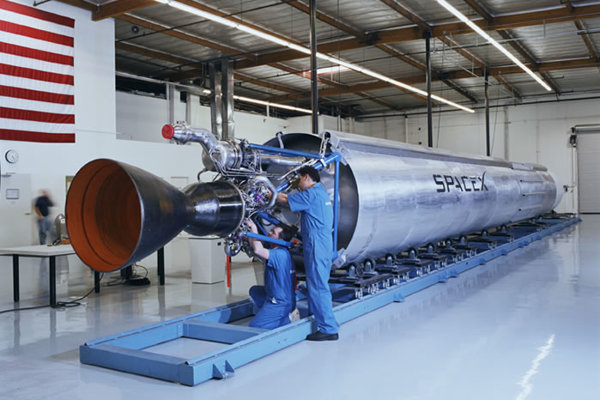
SpaceX, compared to the world's major space programmes, is just a baby at not even 10 years old yet. Despite this, it has already achieved more than many others have not. Brazil and South Korea, two countries with national space programmes, has so far been unable to put anything into orbit, whereas SpaceX, as of May 2015 has flown six missions to the ISS. In the private sphere there are many other companies jumping on the space tourism bandwagon. Richard Branson's Virgin Galactic project might grab the headlines, but SpaceX is already much more advanced and has already won millions of dollars worth of business contracts. This is all despite being, by most definitions, the underdog. The company isn't supported by any of the major players in aviation and aerospace, it's basically a start-up with big dreams.

6. Putting People On Mars

So, SpaceX is a super whizzy, futuristic spaceship company, but what's the goal of all this? Why, to put a million people on Mars, that's what. This seems pretty ambitious considering that, at the moment, the grand total number of humans on Mars is zero (now that we've managed to get Matt Damon back), but the reasoning behind the million figure is pretty solid. Musk reckons that a million people is the minimum number required to create a self-sustaining population. A Martian colony would be at the mercy of the year-long commute time from Earth to the Red Planet should they need anything. If the colonists are going to support themselves then there will need to be enough people to deal with everything that goes with building a society. Mining, farming, building, governing, engineering and basically everything else that keeps us ticking over here on Earth will need to be represented on Mars, and a carefully selected population of a million should just about cover it. So, how does Elon Musk and SpaceX plan on getting those people up there?

5. The Gadgets

SpaceX build spacecraft and, what's more, they're pretty damn good at it. They have an ever expanding range of rockets to suit your every need. The main players include: Falcon 1: SpaceX began modestly (well, as modestly as one can when building rockets) with the Falcon 1 - named after the Millennium Falcon. This was by no means the biggest or most advanced rocket ever, at 21 metres tall, but most of its innovations were cost-based. Elon Musk sees the future of space travel hanging in the balancing of the books. Here was a rocket designed to get payloads into space more cheaply than ever before. It was powered by one of SpaceX's own inventions: The Merlin. The Merlin: The Merlin engine was designed to go hand in hand with the Falcon family of spacecraft and is one of the most advanced in the world. With a thrust-to-weight ratio (i.e. how much it can lift compared to its weight) of 165:1 it outstrips the competition by a country mile. It also powers the Falcon 9 Falcon 9: Following the success of the Falcon 1, which took SpaceX into orbit, in 2008 the Falcon 9 ushered them into the pro arena. At 68 metres tall, the Falcon 9 is over three times the size of its predecessor. It is capable of carrying 13 tons of gear into orbit. This was a serious step up and showed the world that SpaceX were a force to be reckoned with. Falcon Heavy: The Falcon Heavy, due to launch in 2016, is as though someone gave the Falcon 9 steroids and a Red Bull. This beast has three "first stages" (the bit with the engines) and a grand total of 27 Merlin engines. When it eventually launches, it should be able to take up to 2,000 tons into orbit, more than twice the amount of any other rocket, and will do it at about a third of the price that the ULA (the United Launch Alliance) currently offers for half the payload. Dragon: The Dragon is about the size of a Land Rover and is designed to transport cargo into space. It is launched by the Falcon rockets and is partially reusable. It is currently contracted by NASA to ferry cargo to the ISS and its two holds (pressurised and unpressurised) can carry about 6 tons of gear.

4. €‹Quadrupling The Number Of Satellites In Orbit

With all of this technology, Musk has announced that SpaceX will begin manufacturing and launching satellites, hopefully putting 4,000 new satellites in Low Earth Orbit by the year 2030. Why? Because most of the satellites up there today are dinosaurs in technology terms. Due to the high cost of launching a satellite, companies are unwilling to risk their investment on new, unproven technology. The upshot of this is that most of the satellites that provide us with services such as GPS are using technology that was already old in the 80s. By launching a veritable swarm of cutting edge, low cost satellites into orbit, Musk wants to achieve a number of things, chief of which is providing global high-speed satellite internet coverage. Not only would this mean that you would be able to check Facebook in the remotest corner of the planet, but it would also force the hands of the massive corporations who currently hold the monopoly on internet provision. This would mean that they would have to begin offering a cheaper, higher quality service (i.e. stop strangling speeds at peak times and imposing data limits) or risk losing all their customers. The move from cables to satellites also opens up a whole world of opportunities in terms of setting up new systems in places such as, say, Mars much more quickly and efficiently. Cables are in the past, satellites are where it's at according to SpaceX.

3. Manned Space Travel

As well as cargo missions and hordes of satellites, SpaceX are throwing themselves into the realm of manned space flight. As the Space Shuttle programme ended in 2011 and its successor, the Space Launch System, has been repeatedly been pushed back and delayed with a current estimated finish date of some-time-in-the-next-decade (2021 was the last solid number), the United States don't actually have any means by which they can put astronauts into space at the moment. With the US space programme now barely limping into orbit using borrowed Russian spacecraft, the entire enterprise hangs in the balance of maintaining good political relationships with the countries that own all the rockets. This is not a particularly secure strategy, demonstrated in a tweet by the Russian Deputy Prime Minister after the US brought sanctions against them, suggesting that the Americans deliver their astronauts to the ISS using a trampoline in future. To try and avoid this eventuality, NASA have had to go private, splitting a budget of $6.8 billion between Boeing and SpaceX for crewed launches. Seeing as the big, government run hitters are currently somewhat out of the game, this leaves the market is wide open for some next-generation manned spacecraft.

2. Dragon 2

At the beginning of 2014, SpaceX announced its latest innovation in the world of manned space travel: The Dragon 2. The Dragon 2 is the next-gen edition of the original Dragon, but so much cooler. First of all, its specially designed SuperDraco engines are the first to ever be completely manufactured by 3D printer and could each lift the equivalent of 4 cars. Secondly, the inside has had a complete makeover, all racing style seats and touch screens. This, compared to the 60s era buttons and dials that most spacecraft still use, is beginning to look distinctly like the sci-fi spaceships of the future. The third, and most important, feature of the Dragon 2 is the abort function. the biggest danger in space travel is the launch, with even the best rockets sometimes going up in flames. If we're going to bring the risk, cost and novelty of spaceflight down, then eliminating the risk of getting blown up before you reach orbit is a biggie. The abort function ensures that, in the event that something does go wrong, the part of the craft with the people in it gets flung well clear of the explosion. This reduces the risk of damaging any precious cargo aboard, whether that be humans or technology, and again brings the cost of a space mission down (as well as, you know, making sure no one gets killed).

1. The Future?

So, say we get to Mars. We get our million people on Mars and become an official galactic colonial species, what next? When interviewed for Aeon, Musk had this to say about how he envisions the future of space travel: €œIf we can establish a Mars colony, we can almost certainly colonise the whole Solar System, because we€™ll have created a strong economic forcing function for the improvement of space travel. We€™ll go to the moons of Jupiter, at least some of the outer ones for sure, and probably Titan on Saturn, and the asteroids. Once we have that forcing function, and an Earth-to-Mars economy, we€™ll cover the whole Solar System.€ Of course, as well as the rockets, we'll need to kick it up a notch in terms of our terraforming technology to make the other worlds in our solar system habitable. If we can get the technology and finances sorted then taking our little Earthling show on the road has a lot of massive benefits. Aside from expanding our knowledge of the solar system in a tangible, boot-on-ground way, it also allows us to offload our booming population onto other worlds and could well be the key to our survival as a species. Plus, with the colonisation of Mars, we officially become a multi-planet species. The transition will take generations, but it would ultimately be worth it, taking us out into the solar system and beyond. Love all things science? Like us on Facebook and follow us on Twitter for loads more science bits up in your brain parts.

 
First Posted On: 
Contributor
Contributor

Writer. Raconteur. Gardeners' World Enthusiast.