7 Puzzles And Paradoxes To Twist Your Brain
Can you solve some of the unsolvable riddles?
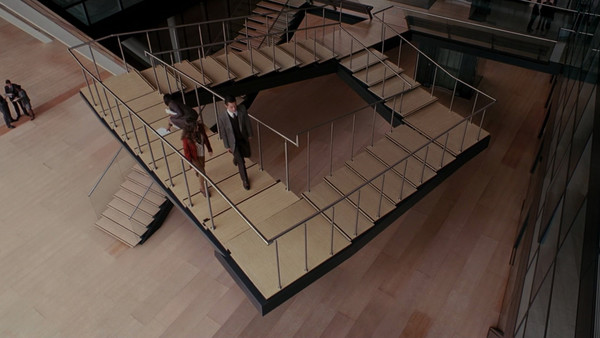
Reckon you're pretty smart? Well there's no better way to put your powers of deduction and reasoning to the test, than a good, old fashioned brain teaser.
There are lots of different flavours of puzzle and paradox, each designed to challenge a different part of your critical thinking abilities. Some of them are purely abstract, testing your ability to think your way out of the dark. Others have their roots in reality, and are actually baffling contradictions that have cropped up in science experiments, proving that, just when we think that we're getting to grips with the universe, it'll throw us a curve ball, just to keep things interesting.
As simple as many of these riddles and paradoxes seem on the surface, many of them actually remain unresolved to this day. Whilst this is pretty frustrating, it's a good way to stir up some healthy debate in the pub that may or may not result in the breakdown of a number of friendships.
On the plus side, some of them do have a resolution so you can use them in the future to baffle your friends, confound your enemies and impress pretty girls with your immense brainpower (that's what it's all about, after all).
7. Unexpected Hanging
The Unexpected Hanging Paradox is so tricky that it has never officially been resolved, and philosophers and logicians are still arguing about it (although that's pretty much all philosophers and logicians do anyway).
The riddle goes like this:
A prisoner is told that he will be executed on some day between Monday and Friday, but that he will not know on which day the hanging will occur before it happens, so that it will be a surprise. The prisoner concludes that he will be pardoned and heads to his cell with a cheery wave.
The prisoner's logic was thus:
He couldn't be executed on Friday, because if he had made it through to Thursday without getting it in the neck, he'll know for sure that it will be Friday and it would not, therefore, be unexpected. Using this same logic, the prisoner eliminates Thursday, Wednesday and the rest of the week.
The executioner, however, turns up on Wednesday and the prisoner is still surprised. How?
What's the solution?
Believe it or not, this paradox is actually still unresolved.
Some argue that the problem with it is linguistic, and that the meaning of "surprise" is too ambiguous. Others argue that it's a demonstration of how deductive reasoning fails to eliminate surprise (basically, you can't "logic" your way out of everything). There are literally books and academic papers written on this subject, so good luck figuring it out. Let us know if you have a brainwave in the comments.
6. Sorites Paradox

What is it?
When is a heap not a heap?
In the sorites paradox, we are presented with a heap of sand. When a single grain is removed, can it still be considered a heap? The answer is invariably yes, but imagine that you continue to remove grains until just one remains, is that a heap? The answer is invariably no, but then you have to question at what point the transition was made.
The same principle can be applied for a range of different vague measurements such as "tall", "heavy", "old", "bald" and even "blue".
So, what's the solution?
You can come up with all kinds of arbitrary "rules" to solve this paradox, perhaps by deciding that 20 grains is a heap "just because", but remember that that good logical solutions are supposed to be unassailable.
Another potential solution is to apply the principle of Hysteresis, in which the properties of an object are dependent on how that got that way. For example, a large heap of sand retains its "heap status" for longer as the grains are removed, because it began as an indisputable heap.
You can use this principle to answer the question of whether a glass is half full or half empty. It is the former if it got that way by being filled and it is the latter if it got that way by being emptied.
5. The Grelling–Nelson Paradox
What is it?
Here we have a linguistic paradox that is more frustrating than being stuck in a traffic jam with a child and a kazoo.
First things first:
An adjective is autological if and only if it describes itself. For example, the English word "English" is autological, as are "unhyphenated" and "pentasyllabic".
An adjective is heterological if it does not describe itself. Hence "long" is a heterological word (because it is not a long word and is shorter than "short"), as are "hyphenated" and "monosyllabic".
Got that? Because it's important.
Anyway, the puzzle is whether the word "heterological" is, in itself, heterological. The problem is that, whichever way you answer it, you automatically contradict yourself.
If you answer yes, then you are saying "heterological" does not describe itself ... therefore "heterological" is not heterological after all.
If you answer no then you are saying that "heterological" describes itself ... therefore "heterological" is heterological, in which case it should contradict itself.
Yeah, but what's the solution?
There isn't one that we know of. Have fun.
4. Olbers’ Paradox
What is it?
If you think that this is all just philosophical mucking around, then think again, because Olber's Paradox helped us to understand one of the most fundamental principles in modern cosmology (as well as giving us a name for possibly one of the worst sitcoms on TV): The Big Bang Theory.
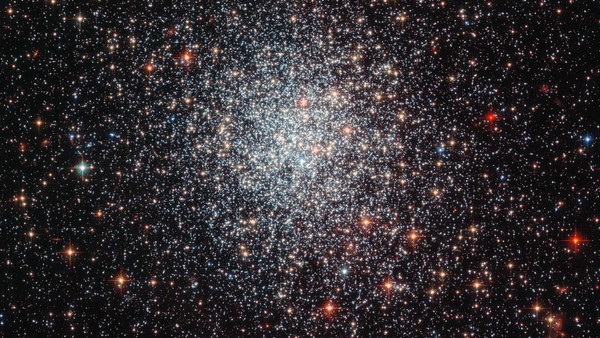
Olber's paradox, or the "Dark Night Sky" paradox, was the observation that the fact that the sky was dark at night must mean the the universe must have had a beginning (and presumably and end) and that it must be finite. In an infinite and eternal universe, the night's sky should not be black, but can you figure out why?
What's the solution?
In an infinite static universe, as it was thought to be for a great deal of history, the light from the infinite number of stars would have had an infinite amount of time to reach us, meaning that the sky should have been ablaze with the blinding light of an infinite number of fiercely burning suns.
As you're probably aware, it isn't, which must mean that the universe has a finite age and/or a finite number of stars. So, the simple observation that the night is dark led us to one of the most profound discoveries in astronomy - that the universe must have had a beginning.
3. The Monty Hall Problem
What is it?
Here's a logic puzzle to put to your friends if you ever want to take them down a peg or two.
The Monty Hall problem is a counter-intuitive statistics puzzle, based on the popular game show, Let’s Make A Deal. It first became famous back in 1990, when a reader of Parade magazine sent it into Marilyn vos Savant's "Ask Marilyn" column for her to solve, which she did. This prompted a storm of letters from over 10,000 readers, many of whom had PhDs, angrily disagreeing with her solution, but she was right and they were wrong.
It goes like this:
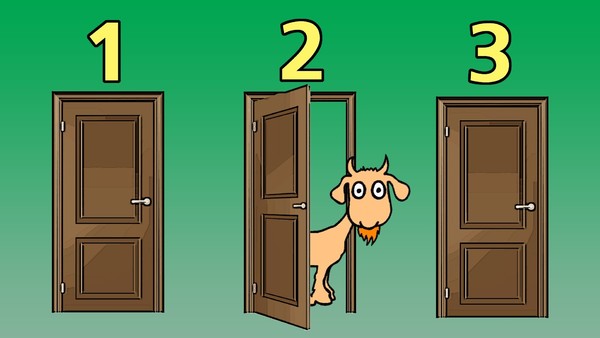
There are 3 doors, behind which are two goats and a car.
You pick a door, door A for the sake of argument. You’re hoping for the car (although goats are cool.)
The game show host, Monty Hall, can see behind the other doors (B & C) and will choose one to open, he always opens one of them with a goat behind it (if both doors have goats, he’ll randomly pick one to open)
You are then given the option to either stick with your original door, or switch to the other remaining closed door
Which do you do? Do you stick with door A (your original guess) or switch to the other unopened door? Does it matter?
Fine. What's the solution?
Surprisingly, the odds aren’t 50/50 and you are much better off switching your door. If you switch, you’ll actually win two thirds of the time! It’s counter-intuitive as most people assume that two choices means a 50/50 chance. This is the mistake that Vos Savant’s enraged readers made, but look at it this way:
When you pick your door, you have a 1 in 3 chance of winning.
That must mean that the other doors have a 2 in 3 chance of having the car behind them.
Monty opens one of them to reveal a goat, which means that the 2 in 3 chance for the car is transferred to the one other remaining door. If you stick with your door, you only ever have a 1/3 chance of winning, which is still a chance. But if you switch, you are switching to a door that is more likely to hide a car.
2. The French Paradox

What is it?
So you would expect disciplines such as philosophy, logic and even physics to throw up the occasional paradox, but surely not biology? This isn't so much a logical puzzle to figure out, as a medical mystery.
The main thrust of the paradox is how exactly the French are so apparently healthy, with a low incidence of coronary heart disease, low obesity rates and a relatively high life expectancy, when they spend all of their time drinking, smoking, eating cheese and being generally French?
Medical researchers have been scratching their heads over this one for years and have got about as far as, "Well, it's because they're so bloody French aren't they?", but there must be something other than a wilful disdain for health advice that's keeping them going.
Sounds mad. What's the solution?
No one can agree. Some links have been made with moderate alcohol consumption and lower risk of heart attack (which is as good an excuse as any for that glass of wine), the link with resveratrol (found in red wine) and longevity, or a diet that, whilst high in fat, is mostly comprising of unprocessed foods.
Some think that it could be to do with a low-stress lifestyle, as the French take longer breaks, longer summer holidays, have a 35 hour working week, walk and bicycle regularly and spend more time with their families.
On second thoughts, who cares about the solution? Let's all move to France.
1. The Hat Riddle
What is it?
Finally, we have a riddle that is (a) solvable (b) easy when you know how and (c) tricky enough to impress your friends.
The basic premise is that you and nine others have been captured (probably by aliens) and they are going to eat you unless you can prove that you have the logical skills of a higher-functioning being.
To find this out, they will line you up in height order so that each person can see the people in front of them, but not behind them, and randomly assign each of you a hat that is either black or white. All you have to do is correctly guess the colour of your hat and, if 9 out of the 10 of you get it right, you are all free to go.
You are not allowed to step out of line, look behind you or say anything other than the words "black" or "white".
You are briefly allowed to figure out your strategy with the others whilst the aliens fetch the hats, what do you do?
So what's the solution, wise guy?
The only way you can be sure, is to encode information in the words "black" and "white", in this case, the encoded information should be "odd" or "even".
The person at the back, we'll call them number 1, can see everybody's hats but his own, so rather than guess his hat accurately, he should say "black" for odd and "white" for even. He will communicate to the rest of the group whether he can see an odd or even number of black hats using this system.
For the person in front of him, we'll call them number 2, if they know that the person at the back can see an odd number of black hats, but they can see an even number, then they will know that their hat must be black. If they can also see and odd number of black hats, then they know their must be one of the white ones.
So number 3 will deduce from this (a) the number of black hats and (b) how many of them are behind them and will be able to use this information, along with what they can see in from of them to deduce the colour of their hat.
Make sense? Let us know your thoughts in the comments.
Does science make you tingle in your special place? Like us on Facebook or follow us on Twitter for plenty more.
Want to write for WhatCulture Science? Click here to find out how you could get paid to write about what you love.