10 Biggest Controversies In Doctor Who History
Chris Chibnall's off to an interesting start...

The Doctor has been journeying across our TV screens since the early '60s, and as a result, the show has a fanbase that spans from grown adults who remember the Jon Pertwee, Patrick Troughton, and William Hartnell days, to young children who've grown up watching Matt Smith, Peter Capaldi, and Jodie Whittaker.
This massive age range means that opinions about the show are about as varied as it's possible to get, and sure enough, there are few properties out there with a fanbase as passionate as Doctor Who's - and these fans have certainly had a lot to talk about.
With 57 years of TV to digest, Whovians have had many different issues to discuss, debate, and yes, complain about. From off-camera friction to major canon shake-ups, Doctor Who's history is riddled with controversial moments, and with the show unlikely to be ending any time soon, there are definitely more to come too.
But for now, let's focus on the past. Doctor Who is pure escapist entertainment, but that doesn't mean it's immune to the controversial sting of some serious real-world issues and drama, as these ten incidents proved.
10. Steven Moffat Fires His Executive Producer

Series 7B was a weird time for Doctor Who. While still entertaining, there's something that feels a little bit off about this particular run of episodes, especially when compared to showrunner Steven Moffat's first two seasons in charge.
There are no standout, show-stopper episodes like The Pandorica Opens or A Good Man Goes To War, and aside from the finale, everything feels merely serviceable. Again, it's still entertaining - it just lacks that extra pop, that "wow" factor.
Around this time, it's said that Moffat was extremely overworked and tired, pouring all of his creative energy into the show's 50th anniversary celebrations, while also focusing on the third series of Sherlock. This, along with a few other factors - such as Doctor Who being moved to a brand-new studio during the production of the series, and a script for Nightmare in Silver being left in a taxi by an actress - added to his stress levels, and is likely why 7B feels like it lacks that extra bit of Moff magic.
But perhaps the biggest issue facing the show around this time was the falling out that Moffat had with Caroline Skinner, who was Doctor Who's executive producer.
The pair reportedly had a massive bust-up at a party hosted by the BBC, with Moffat yelling "you are erased from Doctor Who". This is supposedly what led to Skinner's surprisingly early departure from the show after just one series, giving Moffat another huge problem on top of his already insane workload.
It's not known exactly why Moffat and Skinner were at odds, but the fact that its two driving creative minds didn't get along does explain why 7B feels a little bit unloved.
9. The Violence Of The Colin Baker Era

Colin Baker's Sixth Doctor isn't exactly at the top of the pile when it comes to fan adoration, and his short tenure on the show - which was interrupted by an 18-month hiatus - is arguably the weakest in the programme's history.
But more specifically, an issue that's often brought up in relation to his era is its violence.
In Baker's debut serial - The Twin Dilemma - he strangles his companion Peri Brown. In Attack of the Cybermen, Lytton's hands are crushed into a bloody mess by the titular villains, and in Vengeance on Varos, the Doctor appears totally fine after causing two guards to fall into an acid bath and die horribly. Then, in The Two Doctors, he suffocates Shockeye after ambushing him in the woods. Brutal.
While there's always been violence and death in Doctor Who, it stood out during Baker's era because his Doctor had an almost nonchalant attitude towards it. For example, after the guards fall into the acid bath, the Doctor drops a cheesy one-liner rather than displaying remorse. A lot of fans hate this element of the Baker era because it feels unlike the Doctor to behave in this manner, and while there are those who defend it, there's no escaping the fact that it's controversial.
The darker tone of the Baker years is also one of the reasons why Michael Grade - a BBC boss in the 1980s - didn't like Doctor Who. In a 2004 interview, he stated that the show was "very violent and it had lost its magic", and as a result, he put it on hiatus, fired Colin Baker, and ultimately, it was cancelled altogether in 1989.
But more on that later.
8. Peter Davison's Jodie Whittaker Comments

Jodie Whittaker was announced as the Thirteenth Doctor in July 2017, and officially replaced Peter Capaldi at the end of that same year.
As is always the case when a new Doctor is announced, the reaction was all over the place: there were those who hated her immediately, those who were willing to give her a chance, and those who didn't care either way. But the comments that drew the most heat were the ones made by the Fifth Doctor, Peter Davison.
Shortly after Whittaker's casting was announced, Davison stated that changing the Doctor to a woman was a "loss of a role model for boys", and that he felt "a bit sad about that". He also said that he liked the idea of the Doctor as a male.
As you might expect, the former Time Lord was met with a swift and vocal backlash once his comments started doing the rounds, with many people calling him sexist. Even Colin Baker spoke out against Davison, telling him he was "talking rubbish".
This public firestorm eventually resulted in Davison being bullied off Twitter, and to this day, he hasn't sent out a single tweet since July 2017.
The frustrating thing about this debacle is that people often seem to overlook some of the comments that Davison made in support of Whittaker.
He called her a "terrific actress" who he thought would do a "wonderful job", but because those quotes wouldn't make for a juicy headline, most outlets just ran with the negative bit and ignored the rest. That's the mainstream media for you.
7. Graham Norton Ruins Doctor Who - Twice
The 2005 revival of Doctor Who was a huge moment for British TV in so many ways.
Kids who'd grown up during the classic era were now adults, eager to introduce their children to the show. It was the return of not just one cultural icon - the Doctor - but many, including the TARDIS, the Daleks, and that iconic opening theme music. Not everyone was confident that it would work, but there was still plenty of excitement.
So, imagine the confusion and horror on the faces of the British public - not to mention the hard-working cast and crew who'd toiled away to make the show great - when the very first episode was rudely interrupted by Graham bloody Norton.
A few minutes into Rose, there's a scene where Billie Piper's title character is being stalked by the Autons in a department store. During the initial 2005 broadcast of the episode, sound from a Norton-hosted BBC Three programme was accidentally played over this moment, spoiling the tense atmosphere and annoying viewers who were just starting to get sucked into this all-new version of Doctor Who.
Understandably, there were a lot of complaints, but bizarrely, this wouldn't be the last time that Norton barged into a pivotal moment of the show.
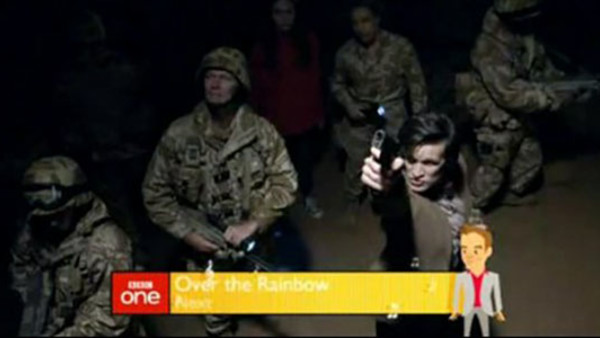
Just five years later, an animated banner for the talent show Over the Rainbow - which was hosted by Norton - was placed right over Matt Smith's face during the cliffhanger of The Time of Angels. Smith's Doctor was right in the middle of delivering a badass speech, only for Norton's bright yellow advert to dominate the screen. Nice.
The BBC received almost 6,000 complaints after this incident, one of the biggest TV backlashes around that time.
6. The Talons Of Weng-Chiang's Representation Of Asian Characters

The Talons of Weng-Chiang is widely regarded as one of Tom Baker's best stories, with Robert Holmes' sharp script among his finest Doctor Who contributions. Former showrunner Russell T Davies has even called it "the best dialogue ever written".
And yet, despite this goodwill, the serial is also heavily criticised for being fundamentally and blatantly racist.
The plot follows the Doctor and his companion, Leela, as they journey to Victorian London so that Leela can learn about her ancestors. Here, they encounter time traveller and criminal Magnus Greel, who is masquerading as the Chinese god Weng-Chiang, while being aided by his accomplice, Li H'sen Chang.
While the serial gets a lot of things right, it isn't exactly sensitive or tactful in its handling of Asian characters. At one point, Chinese people are referred to as “inscrutable chinks”, and elsewhere, the Doctor himself describes Chang with the phrase "epicanthic eyebrows".
But the biggest problem that people bring up when discussing Talons' racism is its use of "yellowface" - the character of Chang is actually played by white actor John Bennett, whose face has been fitted with prosthetics to make him look Chinese.
Understandably, the serial has proven to be quite a controversial one as the years have rolled by, and recently, streaming service BritBox was forced to slap it with a content warning amid complaints from viewers.
5. Christopher Eccleston's Complicated Departure

While we've grown accustomed to Doctor Who's stars exiting the show under amicable circumstances, it's not always a smooth transition from one Time Lord to the next.
Christopher Eccleston played the character for a sole series, the first year of the 2005 revival. Doctor Who fans owe the actor many thanks for helping to bring the show back so successfully, and while his episodes are a joy to watch, things apparently weren't so peachy once the cameras had stopped rolling. In fact, Eccleston had such a poor experience making Doctor Who that he chose to leave rather than continue on.
Over the years, the actor hasn't been coy in sharing details about how nightmarish his time on the show actually was. He's said that he didn't enjoy working with showrunner Russell T Davies, and that he "lost faith" in his superiors. He's also said that he "didn't like the culture" that was built around the series, and has even accused the BBC of putting him on a blacklist, which almost "destroyed" his career.
In addition, there are whispers that the production of his series was borderline disastrous, with Eccleston rumoured to be considering leaving before filming had finished. In particular, the actor failed to click with director Keith Boak, who helmed three episodes. Eccleston, rather pointedly, has described Boak's work as a "disaster".
Was Eccleston mistreated in some way? Is this all just a simple case of creative conflict? We'll probably never know for sure, but there's an unusual amount of heat emanating from this situation, and it's clear that there were some major problems behind-the-scenes on Series 1.
4. Doctor Who Series 11 Is "Too Political"

While it performed from a ratings perspective, the eleventh series of Doctor Who (the first to star Jodie Whittaker) is arguably the weakest in the modern era of the show.
The quality of the writing left a lot to be desired, companions Ryan and Yaz weren't given much to do (and were uninteresting to boot), and the finale was so underwhelming that some people didn't even know it was the finale. And the less said about the Tsuranga Conundrum... the better.
But quality aside, a vocal portion of the fanbase criticised the series for its preachy political messaging. Episodes where the Doctor encounters civil rights activist Rosa Parks, and another revolving around the partition of India, were singled out as major examples of this issue, while smaller details - like the fact that the Doctor's t-shirt had a pride flag emblazoned across it - were also pointed out too.
While there's no denying that some of the hate towards Series 11 was just out-and-out trolling, it's also true that some fans did genuinely feel like the show's political messaging - which, for the first ten series, was mostly found in one-line gags or minor story beats - had been brought to the forefront a bit too much, and was detracting from the sci-fi escapism that people generally want from Doctor Who.
It's hard to remember a time when Doctor Who fans have been more outspoken against the show, and even though Series 12 was an improvement quality-wise, the negative response to Series 11 will forever loom large over the Whittaker era.
3. The John Nathan-Turner Sex Scandal

John Nathan-Turner ran Doctor Who throughout the entirety of the 1980s, overseeing the show from the end of Tom Baker's tenure, to its cancellation in 1989.
Some would say that he ran Doctor Who into the ground, and the fact that he was in charge for some of the worst periods of the classic era doesn't exactly beef up his credentials. But Nathan-Turner - who passed away in 2002 - was at the centre of another big controversy in 2013, when a former Doctor Who Magazine writer accused him of having made sexual advances towards underage fans.
In an interview with Starburst, Richard Marson said that Nathan-Turner tried to get "a bit frisky" with him, at a time when Marson was just seventeen years old - four years below the homosexual age of consent in the 1980s.
In addition, Marson said that the producer was "promiscuous", and liked "getting off with young guys", hinting that his inappropriate sexual behaviour towards young Doctor Who fans was less of a one-off incident, and more of a habit.
While Marson was also careful to specify that he didn't believe Nathan-Turner was "predatory", this story emerged at a time when the world was still reeling from the Jimmy Savile sex scandal, and as a result, it was taken extremely seriously by the BBC, who launched a full-scale investigation into the matter.
2. Chris Chibnall Rewrites The Doctor's Backstory

Because we're still so close to the blast radius, this one might feel like a bigger controversy than it actually is. That being said, there's no denying that the events of Series 12's The Timeless Children sent shockwaves through Who fandom.
The recent Chris Chibnall-penned finale revealed that the Doctor isn't just an ordinary Time Lord who stole a magic box and ran away: she's actually the Timeless Child, a being with the ability to regenerate infinitely.
As a result, Whittaker isn't technically the Thirteenth Doctor, and William Hartnell isn't technically the First Doctor - the character has had countless other faces across her lifetime. In addition, Chibnall revealed that the Timeless Child's DNA is what gave the Time Lords their regeneration powers, meaning that the Doctor is basically a god, responsible for the creation of the Time Lords as we know them.
The decision to completely rewrite Doctor Who history was certainly a bold one, but the majority of fans weren't exactly supportive of the change. Completely overhauling who the Doctor is - almost sixty years into the show's run - felt like a slap in the face to hardcore Whovians. Imagine if DC suddenly decided to change Batman's origin story.
Proving how controversial the twist was, it was even criticised by two former Doctor Who creatives. Classic era script editor Andrew Cartmel said that it "depletes the mystery" of the show, while Russell T Davies tweeted a subtle jab during a rewatch of Journey's End, right at the moment where the Doctor and his allies save the day.
We'll have to wait and see how Chibnall plans to deal with the aftermath of The Timeless Children in Series 13 (and the upcoming special), but for now, this huge canon alteration has a big chunk of the Doctor Who fandom up in arms.
1. The Hiatus & 1989 Cancellation

While Doctor Who isn't exactly firing on all cylinders as of late, at least it's still on the air. As we've already discussed, the Colin Baker era of the show is quite a divisive one, and even though this period does have its fans, it set the show on a downturn that resulted in an 18-month hiatus, and eventually, a full-on cancellation.
The hiatus was put into effect by the aforementioned Michael Grade, who absolutely hated classic Who. He thought that it looked cheap when compared to cinematic sci-fi like E.T. and Star Wars, and recently called it "garbage" in a 2019 interview.
Naturally, fans weren't too chuffed about Grade's decision (and dislike for the man has continued to persist throughout the years - see the time he was booed during an appearance on Room 101), but the hiatus wasn't the end of his Doctor Who meddling.
After Baker's second full series had concluded, Grade fired him from the role, and in response, the actor refused to return to film his regeneration scene. Baker lost a lot of fan respect for this decision, and has since labelled his actions as "selfish".
But the biggest, most controversial dump that the BBC took on Doctor Who came in 1989, when they cancelled it outright. This was easily the most turbulent time in the show's history - after all, cancellation is the worst thing that can happen to a TV programme - and it led to a barren and bleak period for Doctor Who in the 1990s.
On the plus side, the cancellation led to 2005's stellar revival, but considering that the Sylvester McCoy years were an improvement over Baker's - and Doctor Who was still massively popular - there's never been a more upsetting time to be a fan of the show.
-
Got any other examples of controversial events within the Doctor Who world? Let us know in the comments section!