Doctor Who: 10 Things The Doctor Miraculously Survived (When He Should've Regenerated)
 The Doctor is an impossible being capable of many impossible things. He is the last of the Time Lords, an advanced alien race from the planet Gallifrey. He travels through time and space in a ship that masquerades as a 1950s British police call box. He saves worlds, hates guns, speaks every language (including baby), and is over 1,100 years old. And instead of dying, he can change regenerate into a new, healthy body, completely different from his last. The transformation is so complete, that even some of his personality traits differ after the process. Regeneration occurs when a Time Lord is about to die, but the energy that drives it can occasionally be accessed at will. Time Lords can regenerate up to 12 times, therefore having the potential to have 13 total incarnations. If a Time Lord so chooses, they can also stop the process from happening and allow themselves to truly die. Almost anything that can kill a normal human can kill a Time Lord. William Hartnell's First Doctor regenerated when his aged body gave out, David Tennant's Tenth Doctor died from radiation exposure, and John Simm's incarnation of the latest Master died from a bullet wound. As we approach the end of Matt Smith's tenure as the Time Lord and welcome Peter Capaldi as the next regeneration, let's take a look back at times when our beloved Doctor managed to survive some fairly impossible things - even for him.
10. Aliens Of London/World War Three
 In episodes four and five of series one, companion Rose Tyler (Bille Piper) and the Doctor (Christopher Eccleston) go back to London so that Rose can visit her mother and boyfriend, only to discover that Rose has been gone for 12 months, and not 12 hours as the Doctor has promised. An alien ship crashes, and draws national panic while an alien family known as the Slitheen who have been infiltrating the British government for years begin preparations for a takeover that will enable them to start a nuclear war. The war will leave the planet barren, and the Slitheen can then sell it to the highest bidder in need of a radiation source. At the end of Aliens in London, the Doctor is part of a panel of alien experts lead by two Slitheen in human guise. The Slitheen use the specially modified ID badges to electrocute the panel's experts. When He Should Have Regenerated: At the beginning of World War Three, the Doctor takes the ID badge he is being electrocuted with and puts it onto a Slitheen, which in turn electrocutes them all, including the one terrorizing Rose's mother Jackie in her flat. All of the humans being electrocuted died, but the Doctor survives, saying only that it is "deadly to humans, maybe." The Doctor has previously shown a resistance to electricity in the original series, but never has he stated that Time Lords are immune to it. In addition, it is shown with Matt Smith's Eleventh Doctor that he is indeed susceptible to electricity, when a massive shock stops one of his two hearts. This sustained exposure to electricity would have definitely damaged, if not stopped, both of his hearts if both instances are regarded as canon. Also, the badge mysteriously stops electrocuting him once it is ripped off his neck, despite being held in his hand and visually produing electricity. While it may not have been shocking him with as much oomph given it's new location, it still would have been dealing damage until he let it go completely.
9. The Satan Pit
 In this episode, the second in a two-parter featuring the Tenth Doctor (David Tennant) and companion Rose Tyler, the Doctor and Rose find themselves on a planet at the edge of a black hole with some sort of beast buried deep in the planet's core. When He Should Have Regenerated: The Doctor and scientist Ida Scott are trapped 10 miles beneath the planet's surface. They use a snapped lift cable to lower the Doctor a giant pit they find, where "the Beast" is presumably hiding. When they run out of cable, the Doctor makes the choice to unharness himself and fall to the bottom, in case he survives. The Doctor makes a point to say that he could survive a 30 foot fall, but the viewer witness him falling so far into the black pit that he becomes a speck, indicating a much further (and unsurvivable) drop. When we see him next, he is at the bottom of the pit, with his space suit visor shattered but otherwise unharmed. The air is breathable down in the pit, despite not being so at the surface or in the cavern, and the Doctor surmises that the air cushioned his fall. However, seeing as the Doctor and Ida seemed to be experiencing similar, if not identical, gravity to Earth when they were in together in the cavern before the Doctor's descent, there really isn't any way whatsoever that the Doctor shouldn't have regenerated upon impact.
8. Smith And Jones
 In the first Martha Jones episode, the hospital Martha (Freema Agyeman) works at is transported to the moon, where the Judoon invade in search of a fugitive alien known as a Plasmavore. The Plasmavore is vampire-like, and can disguise itself as the species whose blood it drinks. The Judoon can only find the Plasmavore by scanning for and finding alien DNA, which causes a few entertaining moments with the Doctor, since he is an alien as well and doesn't wish to be detected. When He Should Have Regenerated: At one point, the Plasmavore drains the Doctor's blood to the point of him passing out. Later, Martha is able to restart the Doctor's two hearts by giving him CPR. If there has been enough blood loss that the Doctor's hearts can't keep him alive, then CPR certainly wouldn't have revived him. Martha, as a medical student, should have known better. There is a very plausible chance that the Plasmavore didn't drink enough of the Doctor's blood to kill him. However, if this was the case and he had only fallen unconscious, Martha wouldn't have had to give him CPR as she did. Again, a medical student would know better.
7. The Shakespeare Code
 In the second episode of series 3 with Martha, The Doctor and Martha visit the Globe Theater in 1599 to attend a performance of William Shakespeare's Love's Labors Lost. In the episode, the duo and Shakespeare encounter three witches that are trying to restore their imprisoned population through the power of Shakespeare's words. The witches, actually members of an alien race called Carrionites that use and thrive on the power of words, attempt to use Shakespeare to finish his lost play Love's Labors Won, and have it performed the next day to complete their task. When He Should Have Regenerated: The witches use voodoo dolls and strands of human hair to kill some of their victims. The Doctor calls the doll and hair combination a DNA replication module as opposed to magic, and when one of the Carrionites takes his hair and combines it with the doll, she stabs him in the heart. While the Doctor has two hearts and one was left intact, he is unable to function with only one, which we witness in the seventh series in The Power of Three. Earlier in the episode, a character died when the Carrionites drowned and stabbed his voodoo doll, and exhibited outward symptoms of the drowning, having water come spouting out of his mouth uncontrollably as a visual queue. This means that his heart was likely penetrated as well, though no outward signs could be seen of this. So, when one of the Doctor's hearts was stabbed, it should have resulted in his eventual death by internal bleeding and lack of required circulatory function. However, with a little guidance, Martha was able to save him by hitting him in various places over the heart to jolt it into functioning. What this proves is that not only is there a lack of continuity to the way the voodoo dolls function in this episode, but that Martha is a terrible medical student who shouldn't have assumed the Doctor's idea for restarting his heart would work.
6. Evolution Of The Daleks
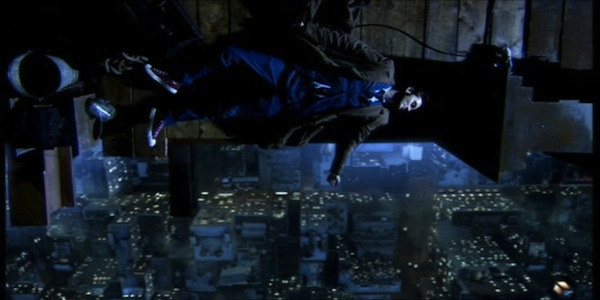 In this defining episode of Dalek mythos that is never explored again, Dalek Sec of the Cult of Skaro is fused with a human to make a Dalek-human hybrid in hopes of obtaining humanity's ambition and talent for war. Evolution of the Daleks is the second episode in a two-parter set in New York City in 1930, and the Daleks are using the nearly-completed Empire State Building as a collection tool for obtaining gamma radiation from a solar flare to power a machine to create more hybrids. The Doctor and Martha attempt to sabotage the machine before it's too late. When He Should Have Regenerated: The top of the unfinished Empire State Building has been outfitted with three strips of Dalekanium (presumably the metal used to make the Daleks' iconic shells), and the Doctor needs to remove them before the gamma storm strikes the building with lightning. He only succeeds in getting one off before he climbs the mast and allows himself to be electrocuted so that his DNA melds with the Dalek DNA being used to create the hybrids. This later allows them to find a semblance of humanity, and ultimately save the day. However, the lightning strike is powerful enough to power the extremely advanced and utterly enormous machine and kill all of the Daleks' pig slaves, but somehow, the Doctor survives. Similar to the incident in World War Three, the electrocution is sustained over a relatively lengthy period of time, and courses through his entire body for the entire duration. The shock is much more powerful than in World War Three, so if he somehow should have survived that incident, this one should have been a sure thing in the death and regeneration books. However, the Doctor wakes up with a headache after a short period of unconsciousness.
5. The Big Bang
Skipping ahead to the finale of series six, The Big Bang is the episode in which Amelia Pond (Karen Gillian) is released, alive, from the Pandorica after 2,000 years trapped inside, Rory (Arthur Darvill) is given the label of the Last Centurion, and the Doctor (Matt Smith) enters a cracks in time in order to close them all and save the universe. In the restored present day, Amy remembers the Doctor on hers and Rory's wedding day with a gentle nudge from River Song (Alex Kingston), and pulls him back into reality. When He Should Have Regenerated: At one point in the episode, The Doctor is shot by a Dalek, and uses a time manipulator to go back in time to warn his previous self to create a distraction. While the younger self goes to the roof and gets shot (the distraction), the slightly older, dying Doctor makes his way to the Pandorica where, after a few tearful good-byes, he flies into the heart of the exploding TARDIS and becomes the explosion that saves the universe Big Bang Two. The problem here is that being shot by a Dalek is always immediately fatal it has been depicted this way ever since the first Dalek serial in 1963, which took place on their home planet of Skaro before they could even exist in other environments or levitate. In series one when the Ninth Doctor meets a trapped Dalek, he immediately assumes that being shot by it will kill him, until he realizes that it is truly trapped, and drained of energy. The Dalek in this episode had its energy restored by the power of the Pandorica and, while sluggish at first, gave every indication (via the iconic skeleton CG that shows up on impact) that it was up to full power by the time the Doctor is shot by it. Therefore, he should have regenerated before he could ever transport himself back in time to warn himself to create a distraction. This, admittedly, might have created problems for the other characters and saving the day, but if this is how Steven Moffat wanted to portray it, a gunshot wound would have been more believable.
4. Let's Kill Hitler
 In the first episode of the second half of series six, Amy and Rory's friend Mels essentially TARDIS-naps the dynamic trio and takes them back in time to 1940s Germany, where they crash into Hitler's office, accidentally saving him from a premature assassination. Hitler shoots Mels, killing her, and she regenerates into River Song (whom the trio learned one episode previous is Rory and Amy's daughter). River immediately succumbs to the brainwashing of Madame Kovarian and the Silence, and begins trying to kill to Doctor. Ultimately, she poisons him with a kiss; the poison will not only kill him, but prevent regeneration as well. When He Should Have Regenerated: River, after realizing what a good man the Doctor is, and who River Song is (due to her and the Doctor always meeting in the wrong order, she is unaware that River Song becomes her alias at the beginning of the episode), she gives him all of her remaining regenerations to stop the poison and keep him alive. Because the Doctor is so close to death, and he was protesting what River was doing, he likely was unable to control the energy himself. That much regeneration energy flowing through him should have sparked a regeneration. River, likewise, showed no ability to control regeneration energy earlier in the episode (other than jokingly saying that she was concentrating on a dress size), so it can be assumed that she too didn't have the ability to control what the energy did once it was inside him. With the addition of John Hurt as a previous incarnation of the Doctor, and Peter Capaldi about to take over as the next incarnation, the Doctor will, as of Capaldi, be in his thirteenth and final incarnation. Moffat has previously stated that the BBC would come up with "something" when the time came to make way for more regenerations, and a recent interview at the Chetlanham Literature Festival, said, "I think you should go back to your DVDs and count correctly this time. There's something you've all missed." Some people hypothesise that River's gift of her own regenerations are what he's referring to, and if that turns out to be true, perhaps that explains why they didn't want to force him to regenerate in this episode.
3. The Doctor, The Widow, And The Wardrobe
In the 2011 Christmas special, the Doctor manages to help a separated family find joy at Christmastime, and help a mother who believes she is a widow bring her husband home to their family on Christmas. It's a heartwarming episode, and a gentle homage to the Chronicles of Narnia series, but most of it should have had a different Doctor. When He Should Have Regenerated: Before the opening credits, the Doctor escapes an exploding alien ship in Earth's orbit but, separated from the TARDIS, he still falls through Earth's atmosphere, and to the ground in 1938 London. After the opening credits, he is seen walking around with the helmet on backwards, looking for a parked-nearby TARDIS. No reason for his survival is given and with a fall like that, with gravity the way it is, the Doctor surely should have died on impact and regenerated - if there was anything left of him to regenerate after he made it through the atmosphere. Come on BBC, at least try to make something up to explain that. A space suit, no matter how advanced, wouldn't have saved the Doctor from that one.2. The Rings of Akhaten
 In this episode of series 7, the Doctor takes his newest traveling companion Clara Oswald (Jenna Louise Coleman) to the Rings of Akhaten to observe a unique cultural and religious ceremony. It is believed that the songs contain the memories and stories of the past and that as long as the song never ends, the god known as Grandfather will not awaken and devour the universe. While briefly separated from the Doctor, Clara meets a little girl named Merry Gejelh, the Queen of Years, who is afraid of singing her part of the song for fear that she will make a mistake and awaken Grandfather. Clara convinces her that she will do just fine, and both she and the Doctor go to observe this part of the ceremony. Needless to say, despite Merry not messing up, Grandfather awakens. When He Should Have Regenerated: The Doctor discovers that Grandfather is a giant parasite who feeds off of memories and emotions, and attempts to save the day by telling Grandfather a story of himself. He puts his entire history into the speech, hoping it will overload Grandfather due to how extensive it is, but he fails to do so. When Clara comes back with a token (a leaf that led to her parents meeting) that symbolizes all of her mother's lost potential by dying young, the leaf disintegrates and is absorbed, and the infinite potential history overloads Grandfather and he dies. What this, and the mythology of Grandfather, shows is that when the memories are absorbed, so is the person, or object, that contains them. When the Doctor failed to overload Grandfather, he should have either been absorbed, or he should have died and regenerated. Either way, he shouldn't have just slumped over weakly before Clara happened to save the day. It goes against the established mythos the episode presents.
1. The Name Of The Doctor
 In the final episode of series 7, the Doctor and Clara must rescue his friends Madame Vastra, Jenny Flint and Commander Strax from the planet Trenzalore, the site of his eventual grave. A post-Silence In The Library River Song makes an appearance as a ghost-like being, visible only when others are in a dream-like realm, the Doctor, or someone she has bonded to (Clara). The Great Intelligence and his minions the Whisper Men have taken them hostage on Trenzalore to lure the Doctor there so that he can open his tomb by revealing his greatest secret his name. Once there, the Great Intelligence infects the Doctor's time stream all that remains of Time Lords after they pass to destroy the Doctor at every point in his time line simultaneously. When He Should Have Regenerated: Actually, the Doctor shouldn't have regenerated, he should have simply died. Traveling into his own time stream is something he knows should kill both Clara and himself, but it doesn't, for no apparent reason. The Doctor alludes to the dangers of crossing his own time stream in several adventures, and when Rose alters her family's time stream back in series one to save her father, we see Reapers trying to sanitize the time wound by devouring those within it. Since viewers have an entire episode as visual reference to the dangers of paradoxes and crossed timelines, it is expected that the process will cause damage. In this case, the damage should happen to the one doing to crossing the Eleventh Doctor. Theoretically, the Doctor could have regenerated or simply died, at any point that the Great Intelligence was in his timeline. With "all of his victories" being turned to defeats by the Great Intelligence, his death and regeneration could (and in many cases, should) have been happening at many of those points in time. It would have been nice to see this visualized by the appearance of regeneration energy on the suffering present-day Doctor before Clara jumped into his time stream. With a five-second explanation from Madame Vastra or River's "ghost," this would have been a more believable and emotional motivation for Clara to take the risky plunge for this man she still barely knows. So that's what I think. What do you think? Feel free to comment!