Doctor Who: 11 Best Matt Smith Stories

In the wake of his imminent departure, here our picks for the Tenth Doctor's all-time best stories...

"And now it's time for one last bow, like all your other selves. Eleven's hour is over now. The clock is striking twelve's." Following the departure of Russell T. Davies and star David Tennant, newly-appointed showrunner Steven Moffat took the bold decision to cast the youngest Time Lord yet in the shape of relative unknown Matt Smith. The widely beloved Tennant left big shoes to fill, not to mention the broken hearts of innumerable lusty fangirls, but from the moment Smith took the stage, relieved to discover he still had legs, it was clear Moffat had struck gold. Joyful but reflective, whimsical but unknowable, Smith adopted Ten's mercurial nature while adding an alienness all his own. Despite his youthful face, few actors have sold the Doctor's centuries-old age quite as movingly. Just as Smith made the almighty challenge of taking over from Tennant seem effortless, Capaldi too now has to prove himself worthy of succeeding one of the all time great Doctors. Despite Smith receiving nothing but acclaim for his interpretation of the fifty year old character, it hasn't always been smooth sailing during his time in the TARDIS. Moffat struggled to maintain the excellence of his first season into the later years, and disrupted scheduling meant seasons six and seven were split in half, with the latter uncomfortably straddling autumn 2012 and spring 2013. Even with that inconsistency, Smith's performances were never anything less than outstanding, and with silence set to fall on the Eleventh Doctor in just a week's time, let's take one last trip into the past to remember his 11 finest episodes. Geronimo!

11. Cold War (S7, E9)

Mark Gatiss' first episode of New Who's seventh season marked the return of the Ice Warriors, one of the most fondly remembered creatures from the series' classic era. Taking on the traditional Who format of a base under siege, Gatiss offers the inspired twist of making the base in question a Cold War Soviet nuclear submarine. The Doctor and new companion Clara are not only forced to fight off the most fearsome figure in Ice Warrior military history, but do so in the claustrophobic confines of a badly damaged underwater vessel containing humanity's most devastating weapons and Eastern Bloc soldiers with their fingers on the trigger. The uncertain allegiances of everyone aboard give the characters a moral ambiguity rarely seen on Who. Despite being a high ranking Soviet official, Captain Zhukov (Davos Seaworth, aka Liam Cunningham) is an authoritative but rational man able to confront an unknown threat without resorting to violence with the unwise reflexivity of his second in command, executive officer Stepashin (Tobias Menzies, another Game Of Thrones vet). Ice Warrior Skaldak is presented with a degree of sympathy appropriate to a race which has been both friend and foe to the Time Lord in the past. As the Doctor immediately realises, it has Skaldak who has every reason to be angry: awoken after being frozen for five thousand years, his friends and family are dead and he has been forced to abandon his armour - a great dishonour - after being locked in chains. The folly of the mutually assured destruction philosophy is a theme throughout, and while the episode features one of Gattis' often frustrating 'power of love' endings, it is an appropriate resolution to an episode which posits that any conflict can be resolved as long as both sides are willing to empathise with the other's position.

10. Dinosaurs On A Spaceship (S7, E2)

If Cold War derived its strength from mining historical tension, big themes and conflicted characters, Dinosaurs On A Spaceship is Who at its nuttiest and most unashamedly enjoyable. You'd be hard pressed to find any meaning to it, but it's difficult to complain when presented with so many barmy ideas crammed into a brisk 45 minutes. The most memorable of these is the introduction of Brian, Rory's dad, played with the same avuncular daffiness star Mark Williams brought to the role of Arthur Weasley in the Harry Potter movies. Fully formed from the start, he serves not only as the episode's comic relief (delivering one of Who's riskier laughs - "Only my balls" - with a straight face matched only by Smith's bewildered reaction) but its heart as well, sweetly showing where Rory inherited his deep reserves of empathy. Let's also not forget his trowel, or sweetly humble request upon discovering the TARDIS' ability to travel through space. Beyond Brian, the Doctor also brings along two one-shot companions in Queen Nefertiti and John Riddell, a big game hunter from colonial Africa. Though it's questionable whether the Doctor would happily ally himself with someone who kills animals for sport, the two characters are vivid enough to justify their presence and bring new dynamics to the established TARDIS team. Amy's respect for Nefartiti's queenly righteousness, and vice-versa, gives her a fellow female to spar with for a change, while Riddell's gung-ho attitude brings a confrontational spirit which adds a spikier edge to the series' usual pacifist leanings. The dinosaurs themselves play a relatively small part in proceedings, though considering that part includes being ridden by a delighted Matt Smith as two frustrated robots give chase, it's difficult to argue that their prominence in the title isn't deserved. Writer Chris Chibnall also uses the series' history well, with the Silurian origins of the eponymous spaceship giving the fans a nice little nod. In an episode rich with bold visuals and ideas, there was always likely to be one or two elements which didn't quite work, and villain Solomon - played by David Bradley, who would go on to portray William Hartnell in 50th Anniversary docudrama An Adventure In Space and Time - is a little too cruel for an episode this lighthearted. His robot assistants, voiced by Peep Show stars David Mitchell and Robert Webb, also aren't as funny as they should be, but on a ride this gleefully entertaining, such hitches feel relatively minor when there's so much else to enjoy.

9. The Time of Angels/Flesh and Stone (S5, E4/5)

Bringing together two of Steven Moffat's most popular additions to Who's mythology, the first two-parter of Season Five saw the Doctor team up with his future missus, River Song, to recapture an escaped Weeping Angel from the catacombs beneath a crashed spaceship. While never coming close to matching the scariness of 'Blink' or intrigue of 'Silence In The Library', Moffat spins a suspenseful, action-packed yarn which is about as close as Who will ever get to riffing on James Cameron's Aliens. This is Moffat when he could still tie together a large number of interweaving plot strands and character arcs without becoming over-complicated, and despite the volume of detail underpinning the episode's basic narrative, it's all surprisingly easy to keep up with. True, replacing the Angels' 'killing with kindness' threat with a more standard neck break reduces their distinctiveness by several orders of magnitude, but it's a small sacrifice to make when the story wouldn't work as well with any other monster and one of the additions to their arsenal (their ability to physically manifest themselves through captured images, including the mind's eye) is inventive enough to compensate. The army of clerics is a bit of a bust, with no narrative reason given for their religious bent, but River is a welcome return and both the character and Alex Kingston's performance are less grating than they would become in later years. Of the new elements, Karen Gillan continues to put her endless charisma to good use, playing Amy with greater depth than Moffat writes her and sneaking suggestions of self-doubt and uncertainty behind her sarcasm. Where Moffat does deserve credit is his handling of the season long arc, feeding viewers just enough information about the cracks in time to raise even more questions while turning what seemed like a continuity error at the time into a brilliantly played reveal in the season finale. He also has Matt Smith imitate the TARDIS noise, which is just about the best thing ever.

8. Journey To The Centre Of The TARDIS (S7, E11)

Journey To The Centre Of The TARDIS didn't receive particularly positive reviews when it aired. Perhaps expectations were set too high, with fans having waited a long time for the chance to see more of the TARDIS than just the control room and a brief glimpse at the wardrobe in The Christmas Invasion. The 'big friendly button' ending was seen as mocking viewers' disapproval of the series' frequent use of narrative resets, while also seemingly reversing Clara's discovery of several pieces of information which crucial to the season's arc. The reason none of this particularly matters is because the central conceit laid out in the title, an episode set in the unseen bowels of the Doctor's ship, allows for such a splendid confection of alien imagery and nods to the series' history. Journey is a visual delight, from the gorgeous TARDIS library with its liquid form encyclopediae and that deliciously teasing History Of The Time War tome, to the long-awaited reveal of the Eye Of Harmony. We get a glimpse of the swimming pool and the Yggdrasil-like machine allowing the TARDIS to reconfigure and rebuild its internal architecture. When Clara pops into a storage room, she discovers the Doctor's cot (previously seen in A Good Man Goes To War), one of Amy's papier maché TARDISs, and possibly the Seventh Doctor's umbrella. Yes, there are some fairly glaring faults and the performances of the three Van Baalen brothers are at times staggeringly bad, but this is an episode with treats around every corner for long-term fans and Clara at her most gorgeous in that disgracefully adorable red dress.

7. Night Terrors (S6, E9)

Night Terrors was originally scheduled to air as the second episode of season six, but moved to a later date as the stories surrounding it were considered too similar. This partly explains why there's no mention of the events of the previous episode, Let's Kill Hitler (still a hell of a title), where Amy and Rory discovered that their kidnapped daughter had grown up to be River Song and was on a mission to kill the Doctor. Considering the plot of Night Terrors revolves around parenthood and troubled children, it makes a particularly uncomfortable oversight and overshadows the episode's many other accomplishments. Like Cold War, Night Terrors is a Mark Gatiss episode strongly driven by theme. George, the little boy whose fears manifest themselves behind the doors of a particularly ominous cupboard (incidentally, worst parenting advice ever? "What do we do when something scares us? Put it in the cupboard."), embodies the idea that there's nothing scarier than the idea of being abandoned by those you care about. Gatiss skillfully expands on that to evoke how poverty can be a key driver in creating that isolation: the council block where much of the episode is set is lit in a grimy yellow, emphasizing the row after row of identical doors and windows, stripping each flat's inhabitants of their identity to the outside world. Behind one door, a disabled old lady lives in fear of local vandals and has no-one to help her carry out her rubbish. Behind another, a nasty landlord watches the same movie night after night, his only connection to people being to threaten them for money. Both are literally sucked into their surroundings, consumed by the very place where society has abandoned them. It's no coincidence that George's fears are also brought to life within the confines of a house, albeit the doll's house locked in his cupboard. Just as the inhabitants of the council block are reduced by their surroundings to a single identity - the poor - so too are the monsters in the dollhouse blank-faced and near-identical. Does Night Terrors work better as a metaphor than a story in its own right? Maybe, but like the best episodes of Who, it uses creepiness and foreboding to ultimately tell a tale of empathy and kindness. And yes, it's Gatiss episode so there's inevitably a power of love ending, but guest star Daniel Mays commits so thoroughly that it warms the heart rather than rolls the eyes.

6. The Pandorica Opens/The Big Bang (S5, E12/13)

Far and away the best of Steven Moffat's season finales, the Pandorica Opens two-parter plays fast and loose with timey-wimey nonsense while satisfactorily drawing to a close the key plot strands laid throughout the preceding season. The aforementioned reveal that an apparent continuity error in Flesh And Stone was in fact the Doctor travelling back in time to talk to Amy is in itself a trick worthy of standing ovation, but only one of many Moffat pulls in a conclusion which hits every key moment out of the park. If the continuity reversal takes the top prize, Amy's 'something old, something new, something borrowed, something blue' reveal is a very close second. Matt Smith's 'drunk giraffe' dance routine takes the bronze. Also impressive is how the two episodes feel distinct from one another despite clearly being part of the same story. Many Who two-parters drag due to a single story being over-extended to two episodes, but The Pandorica Opens uses the questions laid throughout the season to set the board for the final conflict, which The Big Bang then spends its hour resolving. It's a neat structure using one set of questions to ask a whole new one for the finale, which Moffat has unfortunately proven unable to replicate since. More than anything, these episodes are enormous fun and a great showcase for Matt Smith, who gets one of his many great speeches in Pandorica ('I am talking!') and a second chance to play off Caitlin Blackwood, the young Amelia Pond, in Big Bang. Smith's Doctor is at his best when playing the universe's favourite big brother, and his interactions with young Amelia are as sweet and funny as ever. It's a triumphant end to a fantastic first season for Smith.

5. Vincent And The Doctor (S5, E10)

Moffat's stewardship of Who is often criticised for focusing too much on being clever, using its characters as empty ciphers in a grand scheme rather than developing them as individuals. That's fair criticism for the most part, and compared to the bold colour melodrama Russell T. Davies painted on the screen, the more recent seasons have certainly pulled back to observe from a distance. There are a couple of exceptions to that rule, and Vincent And The Doctor is the biggest and most accomplished. As unashamedly sentimental as Who has ever been, it doubles up as a surprisingly nuanced look at depression - it doesn't take much analysis to grock the subtextual significance of an invisible monster only one misunderstood man can see - and the relationship between mental illness and creativity. As written by Richard Curtis, of Blackadder and Four Weddings & A Funeral fame, it's also very funny at times, particularly Amy's fangirlish attempts to inspire some of Van Gogh's greatest masterpieces. And yes, everyone knows that her passion for post-Impressionist art comes out of nowhere and goes back there just as quickly, but personally I'm more than happy to overlook such contrivances if it produces more episodes as beautiful as this. Tony Curran is exemplary as Van Gogh, capturing the depth of the character's torment and the immensity of his joy when he looks up at the sky and sees the universe shaping itself into the greatest canvas ever painted. Smith and Gillan are both given broader emotional ranges to play than usual and succeed with aplomb - Smith and Curran mirror each other beautifully with moments of boyish delight contrasted against soulful sadness - and Bill Nighy's cameo is perfection itself, right down to the bow tie. Vincent & The Doctor sets a new high standard for Who historicals.

4. A Christmas Carol (2010 Christmas Special)
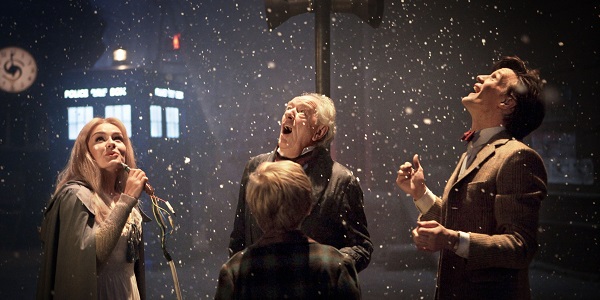
A Christmas Carol is completely and utterly loopy in the way only Doctor Who can be. It has fish swimming in a planet's atmosphere, clouds controlled by song, a grumpy old man having his history rewritten on the fly, an opera singer with ten days to live in cryogenic sleep who falls in love with the man who awakens her once a year, a shark-driven sleigh and at least one fez. It's also utterly joyous, bursting at the seems with seasonal spirit and funny, sad and heartwarming in almost perfectly balanced measure. In other words, it's Moffat at the peak of his powers and having an absolute ball. One of the many reasons it works so well as a Christmas special is because it has sympathy for absolutely everyone. There's no monster here, just an old man who needs to be reminded why there's value in kindness after all. The episode's repurposing of the plot of the Dickens classic is turned into a wonderful joke, where Smith's Doctor delightedly realises the similarity between his situation and that of the novel. As Kazran Sardick, the story's real main character, Michael Gambon gives an extraordinarily deep performance which subtly shifts as his history changes. He doesn't hold back at all on Sardick's nasty side, making his eventual redemption all the more affecting. Smith, too, embraces every facet of the material, and though his scenes with Gambon are acting masterclasses, it's (once again) his chemistry with the young Sardick where he shines brightest. "Come on, we're boys! And you know what boys say in the face of danger? Mummy!" Amy and Rory are largely sidelined, trapped on a crashing starliner, but Katherine Jenkins and Danny Horn fill the companion positions with sweetness to spare. Moffat's timey wimey manipulations provide the brains, but it's their love story which gives this Christmas its heart.

3. The Lodger (S5, E10)

The Lodger feels like the first episode of a particularly daft sitcom, where a wacky outsider moves in with a relatively normal flatmate and shenanigans ensue. Who fans weren't especially enamoured with the idea when it first came to light, especially when it was revealed that the flatmate in question would be played by James Corden, the overexposed star of Gavin & Stacy whose profile seemed to be rising far beyond his talent. As it turns out, everything that could have gone wrong about The Lodger went absolutely right: Corden's straight man routine works perfectly as an anchor for the utterly unhinged Smith, clearly relishing the opportunity to flex his comedic muscles to the full. In the space of forty-five excellent minutes, Smith lets Eleven's freak fly in a tour de force of physical comedy. Whether air-kissing everyone, regurgitating wine, handing over large sums of 'rent' in a small paper bag or breaking out the twinkle toes on a football field - a real-life talent of Smith's, who captained the Leicester City youth team before a back injury forced him to give up his dreams of playing professionally - it's impossible to take your eyes off him as Corden's Craig finds his life being taken over by the mercurial man next door. There's also a nice nod to Eleven's introduction as we see him take a shower, the first Doctor to do so since Pertwee (no sign of any snake tattoos this time though), who also stole his costume from a hospital dressing room. And for the fangirls, he accidentally drops his towel en route to save Craig from being killed by the alien upstairs. What works particularly well about The Lodger is that its comedic trappings work in aid of a bigger idea. The Doctor's lunacy may steal the show, but his arrival also serves to highlight the rut that Craig has allowed his life to settle into. Craig and Daisy's plutonic relationship is the believable product of two people just comfortable enough in their boring lives to make them completely risk averse, whether it be pursuing their dream careers abroad or telling their best friend how they really feel. The scene where the Doctor coaxes a spark of long-lost passion out of Daisy is a beautiful encapsulation of the spirit of a character who centuries ago abandoned the staid culture of the Time Lords to go gallivanting around the universe with his granddaughter. The more traditional aspects of The Lodger are its least interesting - the alien threat upstairs is hastily sketched and the power of love ending is all kinds of corny despite making thematic sense - but apart from that unnecessarily conservative final act, The Lodger is an exceptionally charming and silly outlier in Who canon and all the better for it.

2. The Eleventh Hour (S5, E1)

With the Eleventh Doctor's run now just a single episode from its end, watching The Eleventh Hour today proves something of a shame. The monumental brilliance of this introduction to the Moffat/Smith era, setting out a brave new tone and direction for the character and the series, now only serves to highlight how much of its potential ultimately went unfulfilled beyond its first season. From the moment his head pops out of the upturned TARDIS, Smith's Doctor is every bit the live-wire eccentric he is today - bow-ties remain cool - but would only intermittently go on to find material worthy of his talent. Amy, the girl who waited, cuts a fascinatingly broken figure whose attitude towards the Doctor is a cocktail of adoration, distrust and self-doubt. While Gillan's performances allowed the character some steady growth into a confident young woman ready to choose the man she really loved over the one she waited for, the writers never seemed quite so sure what to do with her beyond the standard 'sparky female companion' mould. The sci-fi fairytale tone which clearly delineated Moffat's first season from the preceding Davies era was abandoned soon afterwards as the show steadily started to become too clever for its own good. For all that might seem disappointing about what followed, the episode itself remains a high point of New Who and Moffat's most complete script since his Empty Child/Doctor Dances two-parter in 2005. While the pre-credits sequence is an eminently disposable and nonsensical bit of fluff - the TARDIS must be crashing particularly slowly if it flies all the way from London to the countryside village of Leadworth - the iconic moments start piling up once the story begins in earnest. From young Amelia rushing outside in her red wellies to investigate the blue box in her garden, the conversation over fish fingers and custard, grown up Amy's strippergram introduction (oh, those flowing red locks), Smith stepping through the projection of his predecessors to claim his title, The Eleventh Hour has a clarity of purpose and confidence which sets it apart as the most accomplished introductory episode for a new Doctor or companion in the series' fifty year history. Even the plot, so often left by the wayside when a new character needs to be to brought into the fold, is deftly handled, with Prisoner Zero giving an immediate sense of peril to the 'cracks in the universe' season arc and allowing Eleven the opportunity to showcase his intelligence by saving the world without resorting to the sonic screwdriver's Get Out Of Jail Free card.

1. The Doctor's Wife (S6, E4)

I'll lay it on the line and say that, to my mind, The Doctor's Wife is not only the best episode in Matt Smith's run by a comfortable distance, but a contender for the best story Doctor Who has ever told. It's a concise, perfectly formed love letter to the most enduring unspoken romance in television history, between the youngest old man in the universe and the magical blue box which takes him everywhere he needs to go. Newcomers may find it utterly perplexing, but never mind them. This is one for the fans honest and true, unashamed to deliver a succession of escalating geek out moments culminating in the most long awaited and devastating deployments of the word 'Hello' ever uttered. It's scary and funny and sweet and silly, a supreme representation of the qualities which have kept Doctor Who in the hearts and minds of at least three generations of television viewers while still feeling new and exciting. With the TARDIS finally given voice through the immaculate Suranne Jones, whose crazy hair and scruffy Victorian dress capture the essence of the blue box without overtly seeking to aesthetically recreate it, a number of longstanding questions are finally given an answer. The TARDIS takes the Doctor where he needs to go, rather than where he wants to go. She - and I think we can now definitively say 'she' instead of 'it' - allowed him to steal her away to see the universe just as much as he wanted to go. There's a giddy little joke about the Doctor opening the doors the wrong way for decades. It's all too wonderful for words and a welcome tribute to the single most iconic element of the show outside the Daleks. While such pandering can often come across as hollow retrospection no matter how sincerely it is meant, Gaiman gives the episode substance by building on Who's mythology rather than replaying it. Where last month's 50 Anniversary special, The Day Of The Doctor, crunched together sights and sounds from the show's past without ever tying them together in a cohesive or coherent whole, Gaiman keeps his tributes firmly in service of the plot. His lifelong passion for the series beams through every word of the script, but never overshadows it as a self-contained story. House is a wonderfully sinister villain, the kind of devious non-corporeal entity we don't see nearly enough of these days and voiced by an unrecognisable Michael Sheen, and his torture of Amy and Rory as they navigate the labyrinthine corridors of the possessed TARDIS' guts is fiendishly rooted in their own insecurities about being abandoned. The Doctor's interactions with Idris may revolve around such crowd-pleasing moments as the construction of a makeshift TARDIS, but Gaiman sets out a clear set of stakes and ensures there are plenty of new ideas (the telepathic password is another showstopper) to complement the fanservice. That it just so happens to bring in the previous two Doctors' archived control room and an evil Ood is just icing on an already magnificent cake. Now that you've read my choices of the best Eleventh Doctor episodes, give your favourites due credit in the comments below. Do you have unwavering faith in The God Complex? Can you not bear to see The Girl Who Waited left behind? Do you sense a tragic lack of appreciation for Hide?

Contributor
Contributor

28-year old English writer with a borderline obsessive passion for films, videogames, Chelsea FC, incomprehensible words and indefensible puns. Follow me on Twitter if you like infrequent outbursts of absolute drivel.