Doctor Who: 4 Reasons Why Russell T Davies Was Better Than Steven Moffat
 After a 16 year hiatus, Doctor Who was brought back onto our screens with producer Russell T Davies at the helm. This brought in a lot of new, younger fans and gave the show a new lease of life. Then, 5 years later, at the height of the shows success, Davies stepped down as producer and head writer, and Steven Moffat took his place. As it was always going to, changing the producer meant slightly changing the show; Moffat made it his own, just as Davies had done. Change isnt necessarily a bad thing: the show needed certain elements to change to keep it fresh, interesting and up to date. However, in the space of three short years, Moffat seems to have changed it more than Davies did in his five. Im not talking about the new lick of paint that the TARDIS has received or the new green colour of the sonic screwdriver, but there are a couple of things that Moffat has done that I personally think were done better in the Russell T Davies era. Just to clarify, I don't dislike Moffat, he has done some great things with the show and he is a brilliant episode writer. I just preferred how Russell T Davies ran the show...
4. People Used To Die
 This is probably the most obvious point and the one that most people will agree with: since Moffat started running the show, no one seems to die - or at least, not for very long. This happened a little bit with Russell T Davies: Rose brought Captain Jack back to life, River Song was uploaded to the library database to live forever inside the machine and theres that God-awful paving slab moment in Love and Monsters, if you can call that bringing someone back to life. But these few were the exception and not the rule: countless times wed seen the good guys die in battle and stay dead, but apparently this is no more. It was nice at first: Rory had fallen through a crack in the universe and had wound up never having existed. He'd been gone for a few episodes and, when we least expected it, he and Amy were reunited. But then things started getting stupid. He died again; drowning, when he fell off of the side of a pirate ship. And then, he died again, as an old man, locked in a small room by the weeping angels, desperate to see Amy for the final time. Then, he died again in preventing this, by jumping off of a building. And then finally, he died again of old age. It's not that the episodes were disappointing; they were actually well-written, tense and exciting. But it was a little overkill. Its not just Rory, either. Everyone seems to be popping back from the dead for a second chance at living. In some cases it can be quite sweet: in The Doctor, The Widow and The Wardrobe, the Doctor visits two children in World War Two. Their father, who had previously helped the Doctor, had recently died but their mother had not yet broken the news to them. During the episode they get spoilt rotten, they get into lots of Doctor Who style trouble and they find out about their fathers death. However, at the end of the episode, it is the power of their mothers love for their father that allows him to come back to life and spend Christmas with them. Yes, its sweet and you could argue that because its a Christmas story on a family show that they have to have a happy ending, but didnt anyone think of the implications? That many children watching at home are now devastated because their family member didnt come back to life too. Theres still more on the list of who Moffat has killed off and brought back. Most famously; Clara Oswin Oswald. In fairness, the plot was very compelling, ensuring we would all come back after the confusing Christmas episode to find out just how one girl could die twice. It was interesting to then follow her story throughout series seven, finding that she had lived and died thousands upon thousands of times saving the Doctors life. And then, once shes done, the Doctor brings her back to life and the real world once again as he steps into his own time stream to save her. Its nice because weve all grown to like Clara over the last series but it just goes to show that even when he could have quite easily killed her off at the very end of the series, in the final tense battle, Moffat chose to bring yet another person back to life. And even if Clara is too important a character to the show, he still had another opportunity for a tragic death in the final episode of the series, but he didnt take it. Jenny Flint of the Paternoster Gang was murdered while in a strange minds-only conference call. But she doesnt stay dead for more than a few minutes: Strax is able to fix her up, good as new, before wife Vastra, and indeed anyone watching, has time to grieve for her at all. Its not like Im asking for everyone on the show to die and its not like I want the main characters out of the picture. I just want to see people dying and remaining dead, just like in real life, just for once.
3. The Doctor Was Still Mysterious
 Its inevitable that even the most mysterious characters will have their entire backstories revealed if a show runs for long enough, and Doctor Who has been running for 50 years; so we should know the Doctor inside out by now. But we dont: a lot of his character still remains unknown, with only a few secrets seeping out every now and then. However, now it seems like untold mysteries of the Doctors backstory are flooding the show. In the Russell T Davies era, which ran for five years, very few revelations about the Doctors character came about and only a couple more about other important characters and events, such as the Time War. However, over the last few years with Moffat in charge, it feels as if there are a lot of things about the Doctor coming out in one go. First, theres River Song. Although she was introduced in series 4, which was a Russell T Davies series, the episodes which included her were written by Moffat. It was as if he was setting up the relationship to work with in the future and when he got the chance to run the show, he immediately went back to it. In the space of two series she had gone from only being in two episodes to being an occasional assistant, the child of the current companions and the Doctors wife. Some of this, of course, was hinted at previously in series 4, but it looked as if it was going to be years until their relationship grew to this level. But no, by series 6 she was fully integrated into his life. Another mystery that Moffat has almost leaked, but not quite yet, is the name of the Doctor. Hes even created what appears to be a brand new incarnation of the Doctor to tell this story. Although it will probably make a very good plot for the 50th anniversary special, it does feel as if a lot is being revealed at once. Not that this is necessarily a bad thing; if the stories are good then the episodes will be a joy to watch. However, it does feel like too much is being revealed too quickly.
2. Better Story Arcs
 I have two issues with the story arcs that Moffat has introduced. Firstly, they are far too obvious! The cracks in the universe, it has to be said, were criminal! They were in nearly every single episode and were not subtle at all. I understand, of course, that they were cracks in the universe and were just there, rather than hidden messages laid out for the Doctor and the audience to slowly pick up on. At least, I hope they werent supposed to be subtle, because by episode three the audience had already picked up on the fact that they were a recurring thing. Russell T Davies did subtly well with the Bad Wolf message that was spread across time and space. Maybe it was because the audience werent looking out for anything, not knowing that they had to, but the messages remained a mystery for the majority of the series, even though they were in a lot of the episodes. The other issue I have with the story arcs is that they are over far too quickly or there are too many at once, this means that they have less time to build up and therefore more have to be thought of to replace them much faster, which isnt really necessary. In series six, they had two story arcs: Amy being pregnant and the Doctors death. Almost all of the episodes were dedicated to extending one of these stories in some way and they just felt rushed. Moffat could have quite easily put a few filler episodes in between, that didnt mention the story arcs in any great detail, thus making the stories feel as if they went on for longer. The same goes for series seven; the overriding storyline is the confusion about how Clara died twice before and is somehow still alive and oblivious to this. They really could have strung this one out until series eight, or if its got something to do with the 50th anniversary, switched it for a previous storyline wed never have known! They could have possibly shown her dying a third time and dropped a few more hints (but spaced out further) that linked her to her previous incarnations. It could have really spread out the drama and tension, making for much more interesting watching.
1. The Daleks Were Threatening
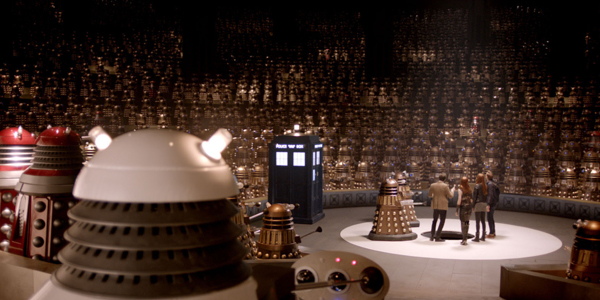 When Russell T Davies brought the Daleks back onto our screens in 2005, the older fans were excited to see them again and the younger ones, without experience of Doctor Who, were instantly in awe of these fearsome monsters. They were brought back in an interesting episode that explored the Doctors character more than their own and then at the end of series one, they were a terrifying fleet of impending doom. Throughout the Russell T Davies era, the Daleks kept returning and almost winning, only for the Doctor to thwart their plans and remove them from existence, until they somehow returned with another mad plan the next time. Credit where its due, Moffat broke this cycle by presenting the Doctor with an ultimatum: defeating the Daleks once and for all or saving the Earth. As he always would, he chose the Earth. The Daleks escaped the Doctors clutches and flew away, to rebuild their empire and hopefully pose a massive threat to the Doctor later. Even if they were far too colourful and cuddly-looking to be at all threatening. Except, when Moffat brought them back in Asylum Of The Daleks, he ruined them forever. They were never going to be a threat again. The episode itself was fantastic; it was just the ending that got to me. Oswin, or rather Clara as we know her now, removed the Doctor from the Daleks collective knowledge, meaning that anything that had previously happened between the Doctor and the Daleks had now never happened as far as the Daleks were concerned. Yes, okay, she did save his life with that move, so I guess the rest of the universe is thankful. But removing the Doctor from their memories? Thats basically taking all of the threat away from them now the Doctor and the Daleks could easily patch up their differences and make up, or at least stay out of each others way. And before you argue that the Daleks are death machines and that not knowing the Doctor doesnt make them any less of a threat - it does. When the Doctor had finished on the asylum and returned to their spaceship, did they try and exterminate this unknown intruder the second that he appeared on board? No. They simply asked who he was. Yes, Moffat, a basic interview question is as frightening as a war cry. Completely agree? Or are you more of a Moffat fan? Leave your opinion in the comment section below.