Doctor Who: Why You Should Watch The Peter Cushing 'Dr. Who' Movies
A rundown of why you should check out the Dr. Who movies starring Peter Cushing.

Here's a little backstory into my personal relationship with these films. Back when I was a kid, my parents quickly got me into the world of Doctor Who. But not in the conventional way. Instead they placed me in front of the Peter Cushing 'Dr. Who' outings first.
It's a strange way to get established with this infamous, and much beloved franchise, but that's where my journey began. And, honestly, I wouldn't have had it any other way. I personally love these movies. They are a fantastic delve into the mysterious unknown, particularly when you look at it from the perspective of what could've happened had Doctor Who been made with a film production during the 1960s. That, and of course, the 'what if' scenarios of having The Doctor be a completely different character in their own unique universe.
Fundamentally, I fell in love with these features and watched them over and over again as a child. Quickly I grew to idolise the Daleks, to the point where I became that sad little infant playing by their lonesome in the corner at school, re-enacting iconic scenes from the movies. Yeah, I was a pathetic lonely boy, but one with a huge appreciation for these amazing pieces of art. So much so that I was blown away when my parents introduced me to the product that allowed Peter Cushing's Dr. Who to grace the big screen.
I was soon thrown into a whole new universe of possibilities. Graced with the very show that the movies were based upon, I got to fall in love with Doctor Who all over again, and was blessed with so many Dalek outings. And, of course, history is history. Now I'm a massive Whovian who loves Doctor Who with all their heart. So, naturally, I thought it'd be a fun experience travelling down memory lane to see where it all started, and showcase the many reasons why you should check out the Peter Cushing films if you haven't already.
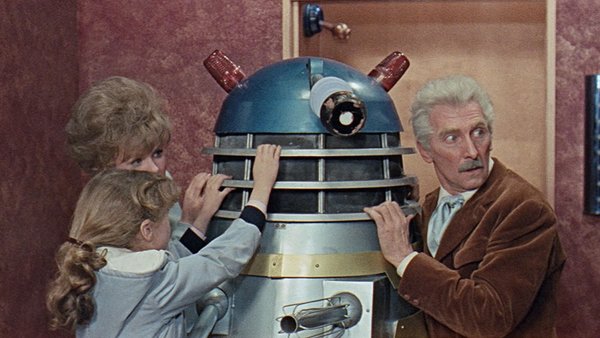
For those of you who don't know what the Peter Cushing features are, they are essentially adaptations of the original two Dalek serials. The Daleks, and The Dalek Invasion of Earth respectively. Terry Nation's scripts, and creations, were elevated to the big screen and given a Hollywood make-over. Basically the irritating restrictions that shrouded over the original productions were swept aside. Everything was made much grander within these reimaginings. Plus, Doctor Who was finally presented in colour many years before the main show would be graced with this technological advancement in storytelling and presentation.
Immediately when diving into these movies you will quickly notice significant changes to the lore of Doctor Who, and the characters within it. This is not the same universe as the televised series. The Doctor is first and foremost known in these narratives as Dr. Who. He's kind of an eccentric scientist who manages to build their very own TARDIS. Also, they're not a Time Lord from Gallifrey, but rather just an ordinary human.
Essentially Peter Cushing's portrayal is loosely based upon the First Doctor played by William Hartnell, but beyond that he's his own unique variation of the iconic character. This is where the 'what if' comes into play, as we're looking into a parallel world were everything is the same but a little bit different. The narrative itself is practically beat-by-beat the television serials, while the main characters themselves are retroactively altered to fit in within this brand-new movie scaled version of the Doctor Who mythos.
The only element that remains from the original series is that Dr. Who is an intelligent, heroic character who has a granddaughter named Susan. Barbara becomes a secondary granddaughter, whilst Ian is rendered Barbara's bumbling boyfriend. But, for the purposes of this adaptation it works perfectly well, and adds to its own charm, characterisation, and world-building.
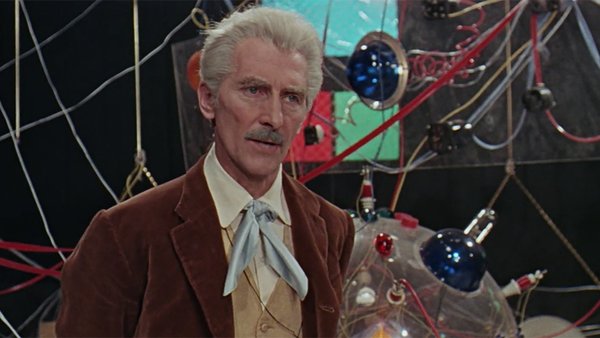
With all this talk about change I would honestly say that's my first recommended reasoning for checking out these films. The alterations are rather fascinating, especially if you're used to the original renditions of the characters. It's great fun to watch through the adaptations and comparing the subtle, and not so subtle changes. Mostly it concerns the main characters.
Dr. Who isn't as abrasive, cold, and self-obsessed as the First Doctor was in The Daleks. So that is a key variation from the original source material. Sure, Dr. Who does still meddle with the TARDIS (i.e. the fluid link) to force his travelling companions back towards the Dalek city so that he can peak his scientific curiosity. But it's done in a less selfish way, particularly since Susan initially wishes to join her grandfather in searching the alien establishment.
He's also incredibly apologetic when it comes to the realisation that he's placed his family in mortal danger. From this we quickly gather that he is a caring, responsible, and outright respectable gentlemen who holds a lot of heart. Dr. Who doesn't hold the traits of the First Doctor's aggressive self-importance, who has little tolerance for his human companions. This rendition is an easily beloved protagonist, and Peter Cushing sells his gentle soul perfectly.
I particularly enjoy his chemistry with the Thals. Unlike in The Daleks, Peter Cushing's Dr. Who is instantly willing to help them in their battle against the Daleks, wishing to save them from the Nazis-like creature's trap, as well as give them advice on how they can save themselves from any future tyranny long before he realises he'll need their assistance in retrieving the fluid link. He's not callous, or calculating within his persuasion, he simply wants everyone to be safe, and wants the Daleks to be prevented from causing any further harm.
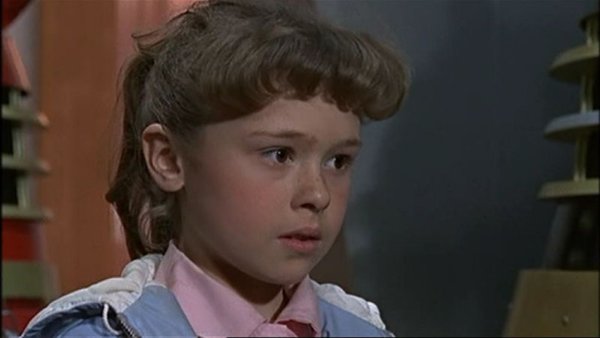
Another clear advantage within the characterisation of the Dr. Who movies is that of Susan. Now, I do actually like Susan's character within the main series, but even I can't deny that her portrayal can be extremely painful to watch. That's not to say that Carol Ann Ford didn't try her best, but tragically the writing didn't do her any favours, and usually didn't know what to do with her.
Here, however, the writing treats Susan with a lot of respect, and does everything within its power to correct the mistakes of the televised rendition. What's even more ironic is that this variation of Susan is much younger, and yet so much wiser. In these films she's a child, but she comes across as a bright, inquisitive, strong minded individual who doesn't crumble under the face of danger. And she's incredibly supportive of her grandfather.
At every needed moment Susan rises to the occasion without any real hesitation, which is admirable due to how young she is. Plus, it's nice to see a child character given so much respect. There's no pandering here. The filmmakers could've easily made her a frightened little girl who screamed at every moment of terror, but instead Susan is shown to be very mature for her age, and incredibly intelligent, thus easily keeping up with the scientific jargon that her grandfather continuously spouts, whilst always willingly facing the harsh challenges in front of her with wit and confidence.
One major complaint I hear when it comes to the original Dalek serials (especially The Daleks) is their length. The Daleks' first outing is three hours long. That's the same runtime as Avengers: Endgame! The major difference is The Daleks feels incredibly padded, and needlessly long. When it comes to Dr. Who and the Daleks the duration is mercifully cut down to a mere hour and nineteen minutes.
I actually made a note when re-watching it to see how the pacing compared between the two variations. By the twenty minute mark the Daleks were introduced, which had already shed off a good fifteen minutes from the original running time (and that's including the fact that this film had to establish the new character renditions). Fast forward to the fifty minute mark and the movie had completed the narrative of the first four episodes of The Daleks, leaving the remaining half an hour to tell the story of the final three episodes.
It completely skips out any filler material and just gets to the point. Sure, it does feel like at times that the movie is racing through the original script, but it never entirely comes across as clumsy, or rushed. The information given allows you to understand the story perfectly, all the while maintaining a good pacing that keeps the narrative going. It's a none-stop adventure which keeps you engaged from start to finish, which is always a positive in my books. If anything, it demonstrates how easily it was to lighten the load of the original source material in order to condense it down into a more disgustable, and easy going experience.
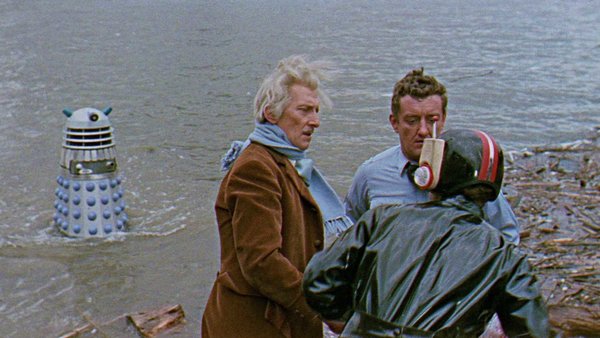
Personally, the meat of my argument into why you should watch the Peter Cushing features comes down to Daleks' Invasion Earth 2150 A.D. This movie is such a delight. Out of the two movies this was the one I came back to the most. And for good reasoning. Apart from the fact that it has a much better narrative to tell, it just looks more impressive, allowing for more range in characterisation, development in storytelling, alongside a clear bigger scope in direction, and filmmaking in general.
Between The Daleks, and The Daleks Invasion of Earth, the latter has always been my favourite. Sure, the original story is iconic, and set the bar for where Doctor Who would go due to the Daleks' popularity, but their second appearance was were the boundaries were really pushed. The whole idea of Terry Nation having these deadly creatures of hate invading our world was truly terrifying, and it allowed their second outing to be far more bleak, and surreal in its establishment of the Daleks' mentality, and power.
Naturally, having this story placed on the big screen was always going to push that fear to new heights, as these awful monsters rampaged across London and exterminated human kind without mercy. Also, the advantage of the bigger budget allowed for The Dalek Invasion of Earth to feel much bigger in its scope and imagination, particularly when the Daleks callously murder an escaping prisoner after desperately trying to evade capture. The horrific imagery of them surrounding him, all the while screaming "exterminate", must have been utterly terrifying for young children.
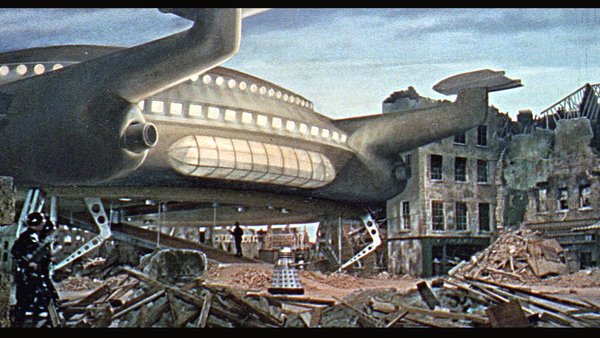
Everything about Daleks' Invasion Earth 2150 A.D. screams excitement, and thrills. On top of that, it's actually far more creative in how it establishes itself as its own unique product. Whereas Dr. Who and the Daleks pretty much followed The Daleks beat-by-beat, with very few minor changes to the characters and events, its sequel went about to really push itself to be radically different. This, to me at least, is one of the major reasons I love this adaptation, in that it clearly respects the source material, but acknowledges that it has to stand out enough to be its own event within the Doctor Who franchise.
The clear notable changes from the start are the fact that Ian and Barbara are completely absent. Instead, we have the introduction of police officer Tom Campbell, and Dr. Who's niece Louise. Though it seems rather odd that they ejected these two vital characters from the televised serial, I find it works to the feature's advantage, and really goes about to craft its own stand-out universe, while establishing characters that reflect the world the filmmakers were trying to create.
Plus, you have Bernard Cribbins playing Tom, which I feel really helps to elevate this film. Bernard Cribbins does well at bouncing off Peter Cushing, and is quick to adapt to the strange world he finds himself in. Bear in mind he'd just been attacked by a burglar, which inevitably allowed them to escape with the goods, and he merely stumbled upon Dr. Who after entering the TARDIS (thinking it was just a police box) to call for help.
Now he's travelling to the future were it's been invaded by Daleks! But he's ultimately brave, acts calmly throughout the whole situation, despite the frightening odds placed against him. Although I enjoy Roy Castle's more clumsy, slapstick interpretation of Ian, I can't deny that I much prefer Bernard Cribbins' more serious Tom character, who fits into the narrative much more coherently, whilst still allowing for some well timed comedic moments that didn't instil as much cringe.
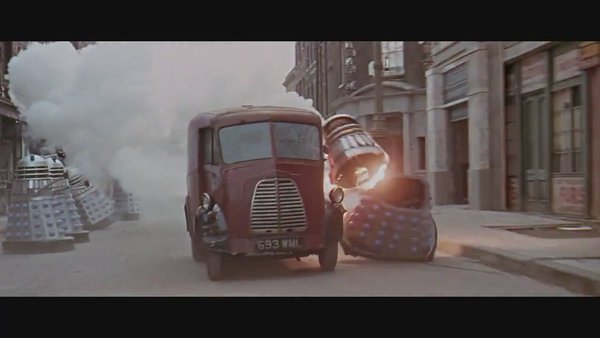
Other alterations come with how the characters are split up in act two of the plot. Dr. Who still remains with David on his journey to Bedfordshire. Similar to Ian, Tom gets trapped aboard the saucer as it journeys back to the mine. Louise surprisingly doesn't take over Barbara's adventure and is simply paired up with Tom. This, in turn, cuts the middle section down by a huge margin, with Susan accompanying new character Wyler, as they undertake Barbara's venture - stealing a truck (which ploughs through a unit of Daleks) before eventually being dubbed in by the creepy women in the cabin.
Personally, this segment of the narrative flows so much better. It certainly doesn't drag as it does in the original serial, and with fewer groups splitting off on their journey towards the final act, the narrative moves at a brisk pace, with no room for dawdling. No random trips into the sewers were Susan is nearly eaten by a crocodile, nor is there an unorthodox appearance from the Slyther. And, of course, there's no romantic subplot for Susan to undergo. In fact, I kind of prefer her teaming up with Wyler, as he comes across as this stern, stonewall survivor who slowly warms up to Susan as a secondary grandfather figure, protecting her through the harsh world surrounding them.
What makes Daleks' Invasion Earth 2150 A.D. all the more satisfying is its tweaks to the storyline's conclusion. The Dalek Invasion of Earth doesn't have the pay-off that it deserved, and the Daleks don't feel utterly defeated. Here, however, a plan is put into place to prevent not only the Daleks' masterplan, but also any further conquest of Earth. This entailed diverting the bomb down a secondary shaft that would cause the release of Earth's magnetic poles, which inevitably drags the Daleks into the core in an explosive conclusive sequence.
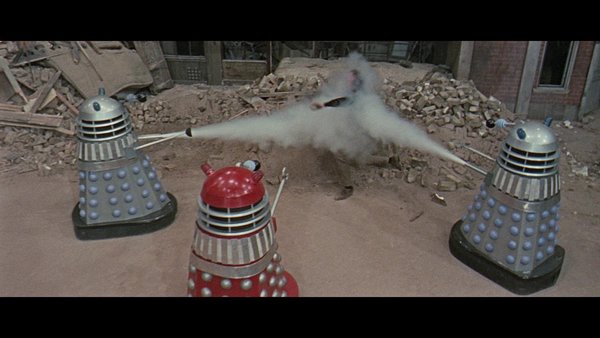
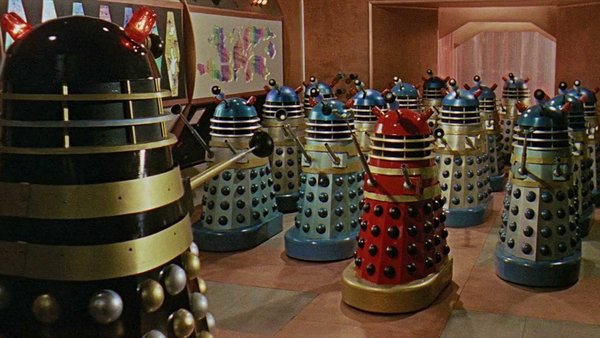
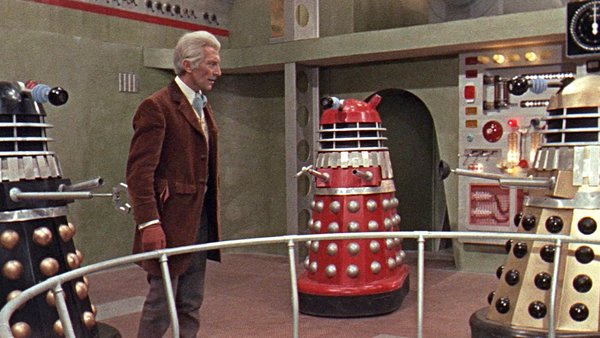
Finally, the biggest reason you should check out the Pushing Cushing movies is for the Daleks themselves. In many ways they've never looked better than on the big screen. Sure, they may have had their brief second coming in 2013 for The Day of the Doctor, but they weren't the vocal point of the narrative. In these two features they are the centre piece. Come one, come all, and witness the Daleks not only in colour for the very first time, but watch in horror as they exterminate the innocence in cinemas across the country.
Say what you will about the poorly executed Paradigm Daleks, but these colourful Daleks look impressive, and actually stand out as a bold design which makes them feel more intimidating. And the added effect of the spray guns (as opposed to the death ray) was a neat little touch that made these variations stand out.
Plus, the higher budget meant that there was a lot more of them. Instead of cardboard cut-outs alluding to the fact that there were loads of Daleks onscreen. You could actually see them all roaming around, which made their invasion of Earth all the more scary due to their sheer numbers. Particularly during the rebels failed attempt to strike the saucer, with them ultimately being completely overwhelmed, as the Daleks exterminate everyone in sight. There's even a grim scene afterwards showing the Robomen checking the lifeless bodies, as their Dalek masters patrol in the background.
Another clear factor in establishing their terror was the music. This was more so in Daleks' Invasion Earth 2150 A.D. were more emphasis was put into making the Daleks imposing, and quite frankly terrifying, playing over sequences were the Daleks act menacing. There's even some tense musical scores that genuinely elevate scenes where the heroes are trying to escape, or hide, from the Daleks, filling you with dread as to whether these monstrous invaders will catch them. That, and it certainly sets the scene from the very moment Dr. Who steps out the TARDIS to see a desolate London, setting the tone for the horrors ahead.
I could go on and on about the Peter Cushing films. They hold so much charm, wit, and passion. Yes, they aren't a direct carbon copy of the original serials, and beyond the initial plotline don't have anything to do with Doctor Who. But that doesn't matter.
They stand as their own unique entity, allowing for so much possibilities in traversing Doctor Who into other mediums of entertainment, broadening the scope of what the show can be. One also can't deny the huge draw by Peter Cushing's lovable portrayal of Dr. Who, and it's a massive shame really that we never saw more of his beloved character.
There were plans to adapt The Chase into a movie, but disappointingly this never came to be. Imagine had they continued the trend of adapting popular Doctor Who tales with Peter Cushing at the helm. Maybe he could've battled against the Cybermen. What if Christopher Lee became his rival as The Master! So much lost potential. It's actually criminal that it never went ahead. But, who's to say that this idea couldn't be reinstalled for a modern audience, with another popular British actor leading the show.
Before I go, it would be shameful of me to leave without acknowledging that daft little sequence featuring the Robomen grabbing their dinner. Of course when you say it like that it sounds utterly ridiculous, and it is. But it goes a long way to show the campy charm of these wonderful movies. There is a clear undermine of the seriousness of these zombie-like minions, but it's also a lot of fun seeing Bernard Cribbin's desperately impersonate one of them, as he tries to keep in sequence to their robotic rhythm of getting up and grabbing some food. It's a life and death situation with a comedic spin.
Anyway, enough of me waffling, go and watch these films! You owe it to yourself as a Doctor Who fan to at least check them out once. And who knows, you might find some enjoyment out of these ventures into another dimension and add the both of them to your Doctor Who collection.