Sherlock: 10 Stories We'd Love To See Adapted
Sherlock is back!
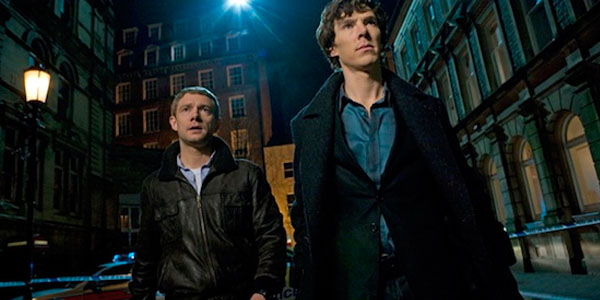
The hugely anticipated third series of the BBC's Sherlock starts this week. Fans everywhere have spent the best part of two years speculating wildly over how the eponymous genius consulting detective survived his fall at the end of Series 2 to return this New Year's Day for the start of Series 3. With their questions surrounding their hero's survival about to be answered, the Sherlock fandom is likely to turn its interest to the new narratives on offer and new cases for the detective to solve.
Readers of the stories of Sir Arthur Conan Doyle will, of course, have some advantage when it comes to thinking about how the plots of future series will develop. For those fans it is always interesting to see how the BBC series and writer-creators Mark Gatiss and Steven Moffat re-interpret Doyle's source material. In some cases - the source for The Hounds of Baskerville is obvious - it is a case of re-imagining a whole story, in others - such as the use of the Bruce-Partington Plans in Series 1's The Great Game - it is a smaller reference point in a larger story.
Doyle wrote sixty stories and novels involving Holmes and Watson so the six episodes we have seen so far and the three in Series 3 have only just scratched the surface of possible material. In this list we look at 10 classic Doyle-Holmes stories that we'd like to see adapted both in the coming series of Sherlock and any future parts.
10. The Empty House
9. The Sign of Four

8. His Last Bow

7. The Man With The Twisted Lip
 Drug addiction and begging are the order of the day in this fun little story in which no particular crime is actually committed; opium dens being entirely legal, if disreputable, at the time. While probably not sufficient to form the basis of the main narrative, it would be interesting to see this story updated to play around with the shift in attitudes and legal positions since it was written in 1891. The Man With the Twisted Lip sees Holmes undercover in an opium den, posing as an old man, looking for a missing businessman who was spotted by his wife in the window of the drug house in a rough part of town. However, on entering the room there is nobody but a disfigured beggar. After Holmes discovers the businessman's possessions amongst the beggar's, there is an immediate suggestion of murder until Holmes, the master of disguise, reveals the disfigured beggar is the respectable businessman, also in disguise. The theme of Holmes' incredible ability with disguises is one that the BBC series has not yet really touched upon, so it would be nice to see it referenced somewhere with another character being just as successful. The outwardly respectable businessman with a heavy drug habit will always remain a topical subject, but the story's reliance on being able to make enough by begging to own a large country estate seems a bit Daily Mail for the usual politics of both Doyle's stories and the BBC show. That would, though, just allow Watson to express his incredulity and Holmes to, undoubtedly, cite the few cases where beggars have made large profits.
6. The Musgrave Ritual
In this, one of Holmes' earliest cases, a quaint family heirloom, a riddle passed down from generation to generation, turns out to be the secret to finding the lost crown of King Charles I, a secret that results in the disappearance of the family butler and maid. It is partly interesting as an example of Holmes' riddle solving abilities and partly because it is one of the few stories that Holmes himself tells rather than being narrated by Watson. Watson gives a brief narration as a frame device, but the case itself pre-dates him and involves Holmes helping out an old university acquaintance: Reginald Musgrave. Within the BBC series it would be nice to have Holmes recount the details of some earlier adventure or mystery that prove pertinent or similar to their current case. It would help establish more of a sense that Holmes had an existence prior to Watson joining up with him, a world in which he had friends of a sort and began to establish himself as a reliable solver of mysteries (something touched on in the episode The Great Game). Watson would be quite ready to be somewhat disbelieving of the image of Holmes with any friends other than himself, which could be a good source of gentle tension between the two. The ritual itself is something that could be open to some quite loose adaptation while still referencing the original story, the Basil Rathbone film turned it into moves on a giant chessboard. Perhaps, given Holmes and Musgrave's student history together it could become some archaic Oxbridge student tradition that nobody questions the meaning of.5. Silver Blaze

4. The Blue Carbuncle

3. The Speckled Band
 Arguably the most popular of Doyle's short stories, The Speckled Band has already been referenced in Sherlock, during the first episode of last series: A Scandal in Belgravia. As Holmes fame grows through Watson's blogging, we see some of the successful cases that they have worked on together and that Watson has blogged about, including that of "The Speckled Blonde", in which a blonde woman's corpse is found riddled with puncture wounds. While the allusion to the title is nice (and comes along with many others, like The Geek Interpreter for The Greek Interpreter), it would be a shame if one of the best Holmes stories only received this much reference. Doyle's story is not a mystery in the sense of a whodunnit, it's pretty obvious right from the start who the culprit is, but is a classic "howdunnit" in the form of a locked room mystery. The aggressive and manipulative Dr. Roylott has plenty of motive to murder his stepdaughter Julia Stoner, but how he does it while she is locked in her bedroom and leaves no trace is a greater mystery. Moffat and Gatiss could easily take the set up of the slightly unhinged doctor and his house full of exotic animals (a cheetah and a baboon roam the grounds of this country house like Michael Jackson's Bubbles the Chimp or Siegfried and Roy getting mauled by their tigers) and take it in a different direction from the story's deadly poisonous snake. Way back in A Study in Pink, Moffat took the image of the victim scratching out the word "Rache", which in the novel A Study in Scarlet Holmes reveals as German for revenge, dismissing the theory that it is the unfinished name Rachel. In Moffat's version the revenge angle is waved away as far less likely than the female name. In this way perhaps The Speckled Band could refer, as Holmes initially suspects in the story, to a band meaning a group or gang of people with some kind of speckled insignia.
2. The Valley Of Fear
1. The Red Headed League
 Arguably the most enjoyable, entertaining and creative of all Doyle's Sherlock Holmes stories, The Red Headed League is ripe for adaptation to the smart and knowing BBC series. In this story, ginger haired pawnbroker Jabez Wilson is picked from hundreds of applicants after a newspaper advertises to join "The Red Headed League" and receive an impressive salary for very little work (copying out the Encyclopaedia Britannica) thanks to the legacy of a generous ginger of years gone by. It turns out that this is an elaborate scheme by a famous bankrobber, John Clay, and his redheaded accomplice to get Wilson away from the shop so that they can tunnel to the bank behind. The image of huge groups of redheaded applicants is an impressively visual and comedic one that would work very well on TV and would be fun to play with in a modern context: X-Factor style auditions, perhaps, or a gingers-only Facebook group or, best of all, a red headed flashmob. After setting up the Red Headed League as its initial mystery and the famous thief Clay as the villain, the plot could take any number of twists and turns. While a completely straight adaptation of The Red Headed League may not quite be enough to sustain an hour and a half run-time, it would definitely be the kick off point for a great whole episode with a few embellishments as we saw in Study in Pink, which started the same and then took its own course.