Star Trek: 10 CORE Seven Of Nine Moments
Seven Of Nine remains one of the most enduring characters in Star Trek, but what made her this way?

When Seven of Nine, Tertiary Adjunct to Unimatrix Zero One, stepped out of that alcove in Scorpion, Part 2, Star Trek: Voyager was changed forever. While the initial character biography was thin, Ryan managed to flesh out this drone to become one of, if not the, stand-out characters in this Trek spin-off.
Voyager began with an interesting premise that was quickly abandoned. While much of its first three seasons saw it struggle to find an identity beyond the shows that had come before, its focus on character building helped to lift it out of rehash territory. When Jennifer Lien's Kes sadly struggled to grow beyond 'the Mayfly' inspiration, Brannon Braga and Rick Berman decided to pivot.
The idea for the 'Borg Babe' could have fallen flat had the writers failed to do anything with the concept. Ryan, who was then primarily known for modelling, was cast in the thankless role of bringing this sex bomb to the screen. This was a character who, technically, betrayed the very things that helped Kate Mulgrew sign on to star as Captain Kathryn Janeway. Star Trek: Voyager wasn't going to be about scantily clad women serving as damsels in distress. Was Seven not a U-turn on this idea?
The answer to that is complicated. Certainly, casting Jeri Ryan was a success beyond measure, with her skill at giving Seven nuance helping to lift the character beyond the conceit. However, the writers clearly found a new direction for the show through the lens of Seven's arc. Her arrival ruffled feathers, but her journey helped Star Trek: Voyager go on to become the success that it was.
Here, we focus on those core moments that truly built this character into the iconic captain of the Enterprise-G.
10. Having The Worst Parents In The Galaxy
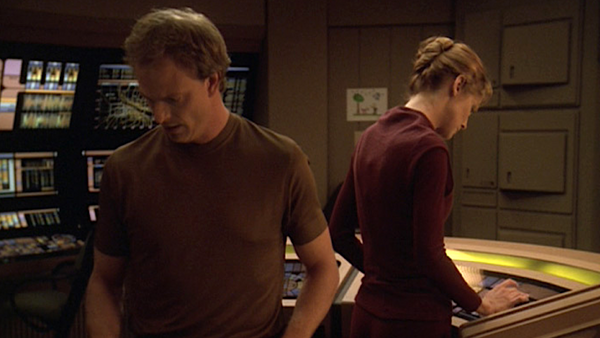
On the surface, Magnus and Erin Hansen appeared to be kind and loving parents. They ensured that young Annika was shown all the affection she deserved and did their best to take care of her, especially after she woke from nightmares. However, they are also directly responsible for introducing her to the greatest and longest nightmare of the child's life.
The Hansens' obsession with the Borg led them to veer off course from their chartered mission, as well as ignore several directives from Starfleet to turn back. They followed a Borg Cube into a transwarp corridor, flinging them across the galaxy, depositing them in the Delta Quadrant. Had they simply risked their own safety, that could have been understood, if not condoned, in the name of scientific exploration.
However, they did all of this with their six-year-old daughter on board the SS Raven with them. As helpful as their research ended up becoming, there is simply no excusing the fact that they put their child in danger, betting on their luck holding out to keep them all safe.
They developed a technology that allowed them to remain undetected aboard a Cube for over an hour. While this was a successful method of reconnaissance for a time, a simple malfunction led to the Borg discovering them. Their ship was quickly overwhelmed, they were taken away, and Annika herself was assimilated into the Collective. At that moment, Annika Hansen ceased to exist, at least in that form.
It truly was Seven of Nine who stepped forward to meet Janeway and Tuvok in Scorpion Part 2. While she would eventually find liberation from the Collective, the Hansens were lost.
9. Creating Her Own Collective
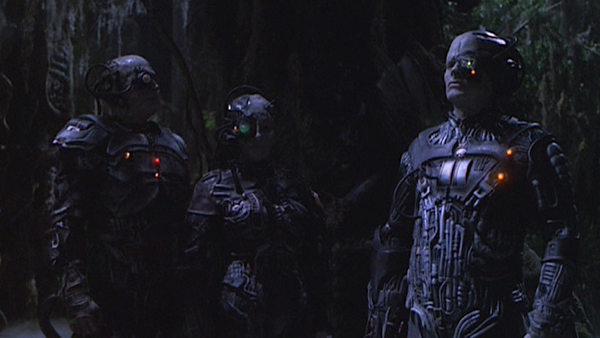
Though Seven would only learn of her culpability in this event several years after the fact, she was responsible for re-assimilating three drones incorrectly. When their scout ship crashed on an alien world, the four survivors, including Seven, attempted to signal the Collective to save them. As time passed, all four began to rediscover their individuality.
Seven's early days aboard the USS Voyager were marked with a strong resistance to her own individuality, having spent so much time as part of the whole. While Janeway worked to help her rediscover herself, she was unaware that it wasn't her first foray into being one. This time, however, she had people there to support her.
Her fear of being alone drove her to forcibly inject nanoprobes into these drones, effectively assimilating them for a second time. However, her attempts also blended them into a kind of mini-collective, shared a neural link, eventually driving them to leave the Borg for good. Their surgeries to remove their implants did more harm than good, with the Doctor predicting a complete removal would leave them each with a month to live.
This deeply affects Seven when she encounters them again in Survival Instinct. She now understands the damage that she did to them, having grown to accept her life as a person. After they plead with her to decide their fate for them, she elects to have their surgeries completed.
She now understands that living a lifetime as a drone couldn't compare to living a single month as an individual.
8. The Trauma Of Species 8472

Much of Seven's early life aboard Voyager was shaped by her experiences within the Collective. As a drone, she was part of the temporary alliance against Species 8472, working with the Starfleet crew to overpower the deadly foe. The Borg failed to mention that they were the ones who initiated hostilities.
Despite being freed from the Collective, Seven harboured a deep fear and resentment toward these organic beings. When a single survivor was discovered in the year after she joined Voyager's crew, hunted by the Hirogen, she was not inclined to help.
For months, Seven had been encouraged by Janeway to express her individuality. In this instance, she demonstrated her lack of understanding. While she was no longer part of a Collective, she was part of a crew, and there were rules to follow. She disregarded those rules when she chose to beam the alien to a Hirogen vessel, essentially sentencing it to death.
Janeway was not simply furious with her, but she was disappointed. Seven argued that as an individual, she chose to act, thus saving the ship from a conflict with the giant hunters and their prey. Janeway rebuked her sharply as the lesson she had hoped Seven would learn would be one of cooperation.
In dressing Seven down and confining her to the cargo bay, Janeway reminded her that, at that point at least, Seven still had a long way to go in understanding her place aboard the ship.
7. Voyager Is My Collective
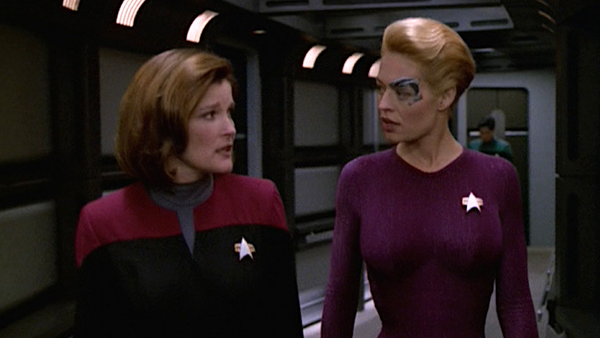
Though her separation from the Collective was traumatising, Seven's life aboard Voyager became a source of both riches and strife. While she was largely accepted by the Starfleet crew from the jump, she was slower to accept them. An early encounter with a Borg homing beacon, emanating from the SS Raven itself, was a reminder that Seven had the capacity to turn into a flight risk.
Though she weathered this encounter and several more reminders of her former drone status, Seven took a long time to accept that she was truly a part of the crew. In Dark Frontier, when planning a heist on a Sphere, Seven finally admits to both Captain Janeway and herself that:
Voyager is my Collective now.
This is evidenced when, during the mission to steal a transwarp coil, Seven decides to sacrifice herself to ensure the ship's escape. While Janeway debates the actual need for that sacrifice, Seven is resolute. This was the only course of action that she could live with, in that moment.
Though that could have been the end of Seven's journey with individuality, she is rescued once again by her newfound Collective. Janeway takes an away team into the heart of Borg territory and, armed with a phaser rifle, faces down the Queen herself - all to make sure that Seven comes home again. Voyager truly was her Collective at that point, and she was a part of the crew.
6. You Are Hurting Me
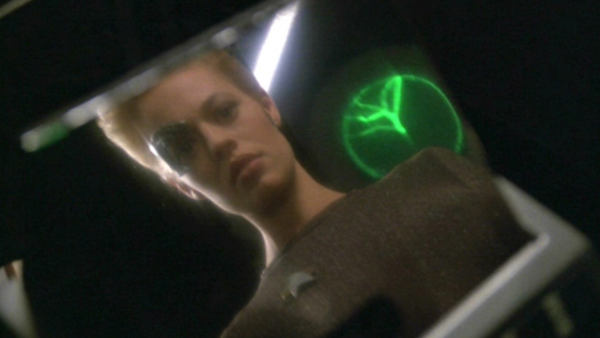
In the fifth season episode Drone, Seven becomes a mother, of sorts, for the first time. After an accident that sees some of her nanoprobes fuse with the Doctor's mobile holoemitter (and some of Ensign Mulcahy's DNA, lest we forget the Daddy!), a new Borg Drone is created in Voyager's science lab. Ageing at an accelerated rate, the Drone matures in a matter of days, and it is up to Seven to guide him.
This episode sees some of the finest examples of Jeri Ryan's earlier emotional work on the show. She is initially hesitant to take responsibility for the Drone, though it quickly imprints on her as its mentor. She softens as they spend time together, teaching him the history of the Collective, as well as the importance of remaining an individual.
His technology, based on that from five hundred years in the future, is too tempting for the Borg to ignore. Once they receive an inadvertently shared message from him, they send a Sphere to nab him.
The Drone's defence of Voyager, and his subsequent self-sacrifice are devastating for Seven. Though he survives the destruction of the Borg ship, he refuses to allow the Doctor to provide medical aid, understanding that as long as he survives, the Borg will hunt him and Voyager.
She pleads with him, even going so far as to tell him how much he is hurting her. He assures her that she will adapt and then quietly passes away.
The final shot of Seven looking into the same mirror she had practised smiling in earlier is brutal.
5. Returning To (And Leaving) Unimatrix Zero

While Seven was still part of the Borg Collective, she often visited a place dubbed Unimatrix Zero. It was beyond the reach of the Borg Queen because it was all in Seven's head. Hers, and many other Drones besides. Unimatrix Zero was effectively a computer glitch, created accidentally, serving as a haven for the individual parts of the Drones who shared its existence.
It was something beyond dreaming; a place that both existed and did not. While others could enter, there was no physical realm that hosted it. This was, in some ways, good for all concerned, though it still left it vulnerable to invasion, as the Queen demonstrated once she learned of it.
When she was separated from the Collective by Janeway, Seven didn't visit Unimatrix Zero for over a year. Then, quite suddenly, one of her regeneration cycles took her back inside. Confused at first, she quickly adapted, remembering friends (and more) from the time spent there before. She shed the Borg implants of her waking life, becoming Annika Hansen once again.
She even rekindles a romance with another Drone, Axum. However, once the Queen discovers this realm, the only answer is to destroy it. This act will allow those Drones within to keep their individuality once they awaken, though it will mean that Seven and Axum will likely never see each other again.
It is one of Seven's first brushes with romance since leaving the Collective, something she at first resists, but comes to appreciate. While it would not be the last time she would feel it, you know what they say about your first love...
4. Motherhood (Again)
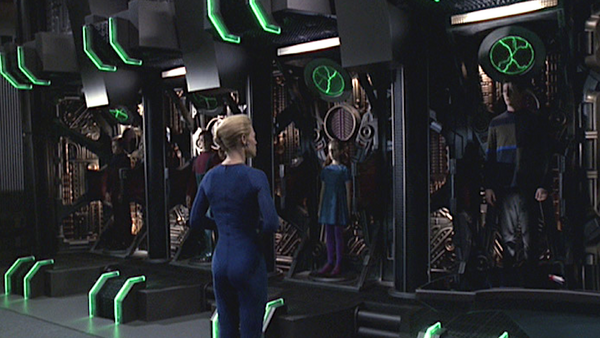
In Collective, Seven's life is changed forever - again. Really, her time aboard the USS Voyager seems to be an ongoing attempt to change the goalposts for this recovering individual, one trauma at a time. Here, having already wrestled with the challenges of motherhood to One, she inherits four ex-Borg children, and a fifth that we apparently do not speak of.
The Cube on which these adolescent Borg were travelling sustains critical damage. Though six survive, one is killed aboard the ship, leaving the survivors to adapt to life aboard Voyager. This is perhaps one of the fundamental moments in Seven's life and journey. Though there is no one better suited to the task, becoming a parent to several children overnight is certainly a challenge.
They remain with the ship for much of the following year, though only Icheb travels with the crew back to the Alpha Quadrant. Mezoti, Azan, and Rebi are all welcomed to the twins' people, the Wysanti. Though she is sad to see them leave, Seven is happy for them, understanding that they now have the chance to grow up as they should have done.
While Icheb's fate is a little darker (more on that in a moment), Seven is both mother and mentor to him, guiding him through his growth, but also his studies to attend Starfleet Academy. He sacrifices his own cortical node to save her life, resulting in Seven's tears beginning to flow freely.
Though a difficult journey, Seven adapted to parenthood magnificently. Now, does anyone know where that baby went?
3. Starfleet Says No
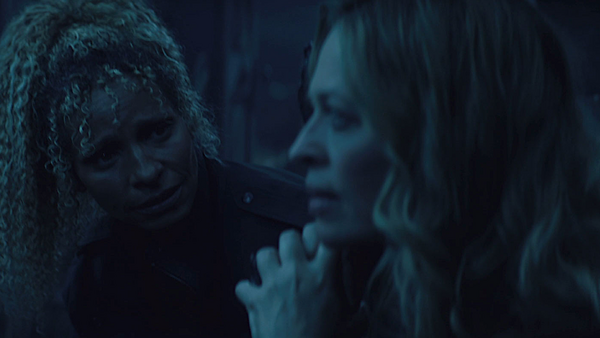
Imagine that, after four years of learning to be human again and becoming part of the Starfleet family that liberated you from the Collective, you arrive back in the Alpha Quadrant only to find that that same crew are the outliers, and the institution they serve feels very different.
That was the case for Seven of Nine when Voyager returned to the Alpha Quadrant in Endgame. Rather than welcoming her with open arms, Starfleet treated her with mistrust and barely concealed hostility. Though she petitioned to join the organisation properly, she was denied that request. Her former Borg status was considered too high a risk, and Starfleet is famously sketchy about that sort of thing.
Despite Janeway putting her career on the line for Seven, and even threatening to resign her commission should Seven not be granted one, it was no use. Seven opted to walk away rather than put her family's careers at risk.
From that point, she moved away from Starfleet and joined the Fenris Rangers. This organisation aimed at helping those colonies and people along the periphery of Federation territory, often left without aid, and even more often forgotten. For over a decade, she rose through their ranks to become one of the most infamous Rangers among them. It took, ironically, the arrival of another sect of the Borg, a galactic event, and a field commission from Admiral Jean-Luc Picard for her to finally become an officer.
2. The Murder Of Bjayzl
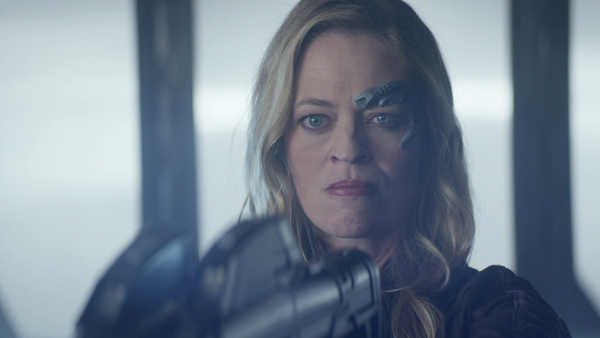
One of Seven's darkest moments comes in the first season of Star Trek: Picard. The episode Stardust City Rag reveals that, after Voyager returned home, Icheb achieved a commission in Starfleet. Rather than set him on the path for a long and happy career, it puts him in the crosshairs of ex-Borg hunter Bjayzl. He was captured, his Borg implants were harvested for profit, and by the time Seven discovers him, she has no option but to mercy kill him to put him out of his misery.
This shocking revelation was a hard twist from the assumptions of many fans of the show. As Icheb's eye was pulled from its socket, there were more than a few lunches pulled from stomachs. For Seven, this was a foundational moment in the next decade of her life.
Her hunt for Bjayzl took her to Freecloud, a planet where lawlessness was standard practice, though also a planet where bounty hunters widely recognised someone like Seven (implants and all). The crew of La Sirena gave Seven a lift, and while they attempted to save Bruce Maddox from Bjayzl, she had another plan. Having successfully saved the cyberneticist, Seven beams back down to the planet, two phaser rifles in hand.
She murders Bjayzl in cold blood, vaporising the criminal before shooting her way out of the bar. It was a darker representation of the former Drone than audiences had yet seen, leaving a shocked set of viewers in its wake. In the heat of the moment, her reaction may have been understandable, even if it was still unexpected by those who were used to the calm, collected Starfleet approach.
1. Captain Seven Of Nine
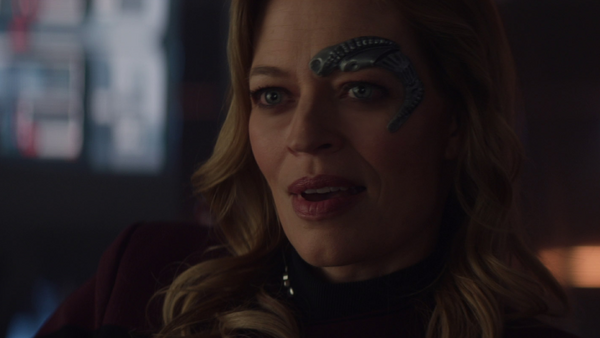
Star Trek: Picard's third and final season concludes with The Last Generation. This story sees the Enterprise-D save Starfleet from a Borg incursion while Commander Seven of Nine, Raffi, and a host of the Titan-A's crew attempt to defend the ship against assimilated officers. When the phasers stop firing, the ship is saved, and Seven has a meeting with Captain Tuvok.
Much of the season saw Seven referred to as Annika Hansen by Captain Liam Shaw. His refusal to use her Borg designation, despite her preference, was a symptom of his own trauma. Shaw survived the Battle of Wolf 359, never truly overcoming his demons. Though Shaw is killed during the events of Frontier Day, he left a recorded message for Starfleet wherein he recommended Seven of Nine (as opposed to Annika Hansen) for promotion to captain.
Though Shaw's trauma could not excuse his continued use of Seven's deadname, she is clearly moved when Tuvok shows her this message. She had been on the verge of resigning from Starfleet, only for her Vulcan friend to refuse. Instead, he promotes her to captain, giving her command of the re-christened USS Enterprise NCC-1701-G.
We may never see the adventures of this ship on screen at this point, but Seven's legacy is such that she deserves not only her own command, but her journey from assimilated child, to recovering Borg Drone, to saviour of Starfleet is one of, if not the, truly outstanding arcs in Star Trek's long history.
Now, all that remains is to hear her utter her going to warp phrase.