Star Trek: 10 Things You Didn't Know About The Kobayashi Maru
In Star Trek, death may not be certain, but if you're at the Academy - the Kobayashi Maru definitely is

In terms of the ethics of our dilemmas, we're a long way off reality for Starfleet Academy (the institution). Another one of those first steps towards it would be to realise that nothing in life, not even the Kobayashi Maru, is ever quite so simple as win-win/lose-lose. Plus, to think in such binary terms is to miss half the point: you can't win the simulation, but you can leave the simulator!
Created, as we know, for The Wrath of Khan, the Kobayashi Maru was, at face value, the latest name for a perennial problem, called 'Cornelian dilemma,' 'Pyrrhic victory,' or just 'rock and a hard place'. On closer inspection, however, it is precisely Star Trek's twist on the no-win scenario that has stuck like a catch-22. That is in large part the genius of that film. Anyone can 'face their own Kobayashi Maru,' without having to face the Klingons.
Ask yourself what you would do, then and there, in the room. If you don't like to lose, you might want to redefine your definition of winning, before loss catches up with you. For Kirk and for Spock, Kobayashi was an omen. The rest was Dickens.
Ever since, the no-win has featured in various iterations of the franchise. With the way things are, it's tempting to agree with Dal R'El's assessment of the test from Star Trek: Prodigy: "The only way out is chaos."
10. Scripting The Simulation

Star Trek II: The Wrath of Khan went through several treatments, several drafts, several names, and several writers before becoming the movie we know today. As detailed in Star Trek: The Magazine, volume 3, issue 05, what started as an outline by executive producer Harve Bennett in November 1980, called "Star Trek II: The War of the Generations," was then handed over to writer Jack B. Sowards to develop into a script.
Sowards' first draft of 20 February 1981, entitled "STAR TREK: The Omega System," featured a good deal of the now familiar — Khan, Captain Terrell, the Reliant, the death of Spock. It did not, however, include a simulator or the Kobayashi Maru. In fact, that first version of the script began with a deliberate beam down to Ceti Alpha V on the part of Terrell and first officer Chekov.
As also noted in Star Trek: The Magazine, it was Sowards' second draft, dated 10 April 1981, which included "the simulator sequence" and the Kobayashi Maru for the first time. In it, Kirk also "suggested that the Kobayashi Maru might be a 'no-win scenario'". Sowards' script just didn't quite work, however, so it was passed to Samuel A. Peeples, writer of Where No Man Has Gone Before. His version didn't work either.
Facing their own Kobayashi Maru, Bennett and fellow producer Robert Sallin met Meyer at his home in late 1981. There, notepad at the ready, Meyer suggested making a list of their favourite elements from each of the scripts and treatments. "I'll write a new screenplay that incorporates all the things on it," Meyer then offered. And he did, though he never got the credit.
9. What Will The Neighbours Say?
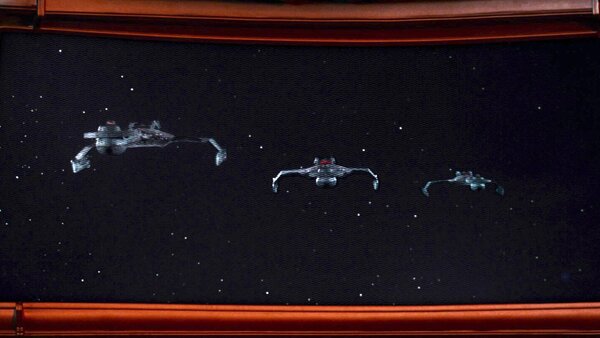
The Kobayashi Maru is all about the neighbours, doubly so. First, it wouldn't be much of a test, nor half as much fun, if it weren't for those pesky Klingons next door (even in the Star Trek: Prodigy version). Second, according to an article in Starlog Magazine #67, Jack Sowards, the man who invented the Kobayashi Maru, named it, named the ship, after his former neighbours in Hancock Park, Los Angeles. We're not sure if the Kobayashi family was pleased about that fact or not!
'Kobayashi' is, in fact, one of the most common surnames in Japan. Though this is no doubt incidental to its use in Star Trek, 'Kobayashi' can also be translated as 'small forest/woods'. 'Maru' has several meanings, such as 'circle,' 'round,' or the notion of 'correctness'. The word is also sometimes used as a suffix in Japanese ship names — sort of like adding 'USS'. "Maru' does not mean 'ship/boat,' however, and 'Kobayashi Maru' should not be translated, even roughly, as 'little wooden ship'.
In the neighbourhood or not, during the simulation, the Kobayashi Maru gives its position as "nineteen periods out of Altair VI". Altair VI was the planet Kirk was ordered to in Amok Time. Another no-win scenario of sorts, in that episode, Kirk disobeyed orders and diverted to Vulcan to save Spock's life. No pon farr in Star Trek II, but Altair VI was perhaps a little extra foreshadowing of the engine room demise.
8. Catch-2245
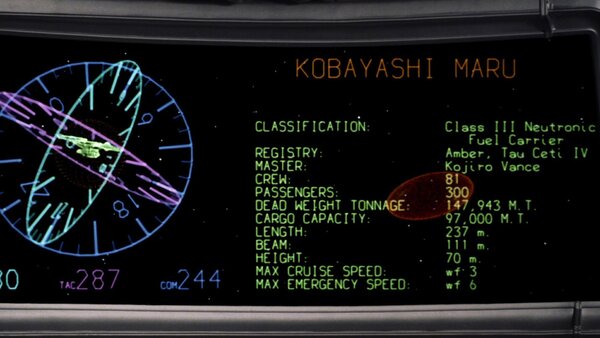
In canon, it is not known if the Kobayashi Maru — that is to say, the Class III neutronic fuel carrier that bears the name — ever existed outside of the simulation. In fact, the Kobayashi Maru is never actually seen in The Wrath of Khan. Its counterpart is all but virtually absent from Star Trek (2009), save for a couple of screenshots. That version did get its own Eaglemoss model — the ECS-1022. The Kobayashi Maru from Star Trek: Prodigy's Kobayashi had a different design still, with an NCC registry.
The reference work Star Trek: Star Charts gives the real "S.S. Kobayashi Maru" as "Lost (2245)" just outside of Klingon space. The catch there, aside from blurry non-officialdom, is that the date is (now) awfully close to Kirk's start at the Academy —2252 by all accounts. It seems a bit inconsiderate to base a test for teenagers on the loss of a very real ship in the first place. Leaving only about seven year's distance to the actual event is practically dancing on graves.
If hindsight helps, the Star Trek: Enterprise novel Kobayashi Maru dates the loss of the titular vessel that inspired the simulation as much earlier, in 2155. The situation is largely similar to the parameters of the test — gravitic mine in the Gamma Hydra system — but in this case, the Romulans are involved.
7. He's Already Dead Already

In Harve Bennett's very first treatment for Star Trek II, Spock didn't die. Spock, in fact, wasn't even in it. Little point, as Leonard Nimoy didn't want to don the ears in a movie again. According to Star Trek: The Magazine, volume 3, issue 05, it was writer Jack Sowards — "a self-confessed Star Trek fan" — who thought that a good death might become the actor as much as it did the character. As Harve Bennett joked on the Wrath of Khan special feature, Inception, "Nimoy's own ears went up" when they told him the plan.
There was one problem with killing off Spock. Two words — Gene Roddenberry. In a twist that no-one saw coming, like 2D Khan in the Mutara Nebula, Star Trek's creator leaked one of the scripts. Fans learnt about Spock's death as a result. Letters were written!
Director Nicholas Meyer came up with a solution to throw off the fans for a bit, in the form of the Kobayashi Maru. As writer, Trek historian, and co-host of Inglorious Treksperts, Mark A. Altman noted during a Paramount livestream in 2020 (via CinemaBlend):
The thing that's so brilliant, that Nick did, he said, 'Let's kill Spock in the simulator scene and everyone's going to think 'Oh, it's all a publicity gimmick. Of course he doesn't really die. Spock is going to be fine.'
As Meyer himself stated in Star Trek: The Magazine, he was, in fact, sitting with Harve Bennett when he suggested opening the film with the Kobayashi Maru and killing Spock in it. "I sort of thought I was being funny," Meyer added, but Bennett loved the idea.
6. Mode Of Cheating
Having taken over writing of the screenplay (uncredited), it was also Nicholas Meyer who first suggested that cadet Kirk might have cheated on the Kobayashi Maru. Harve Bennett, a dyed in the wool Trek fan, was "initially resistant to the idea that Kirk could do anything 'bad'". Meyer managed to persuade Bennett, however, that Kirk should have his failings, too. As Meyer went on to note in Star Trek: The Magazine, volume 3, issue 05:
If you look at the heroes of antiquity and myth, they all have flaws. It's something that they have to overcome; their flaws are something that they have to act in spite of. The challenge is not to defy your fate, but to endure it. That is heroic.
For Meyer, Kirk, as the Greek hero, had to go from "think[ing] he knows the answer" to finding out, via the death of Spock, that he knows nothing at all. "When you've had the sh*t kicked out of you, you're ready to start over, and with a little humility," Meyer concluded. No doubt the real point of the Kobayashi Maru is to have the grace to accept which way to lose.
Or, Kirk could have just played Star Trek: Armada and/or Star Trek: Armada II, in which cheat code 'kobayashimaru' instantly wins the current mission and moves the player onto the next.
5. How Do You Like Them Apples!
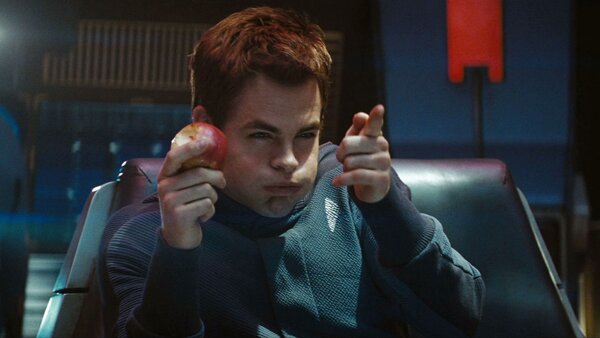
In canon, for Prime Kirk, we know little more than the fact of the act of reprogramming, i.e., "He cheated!" For his other half over in the 'Narada Incursion,' we got to see the trickery unfold. One man's "commendation for original thinking" is another, almost identical, man's academic suspension for "violat[ing] the ethical code of conduct pursuant to Regulation 17.43 of the Starfleet code". One apple in the Genesis cave — "I don't believe in a no-win scenario" — is another in the simulation room.
In the script for Star Trek (2009), dated November 2007, Kelvin Kirk was to get around the infamously impossible test in the "USS Trainer" by sleeping around. Gaila, the Orion who made it into the final version, we find out, was, in fact, a technician for the Kobayashi Maru. Still in the dorm room the day before, Kirk tells Gaila he has sent her a message, but that she can "only open it tomorrow at three o'clock on the dot ––".
Gaila obliges, opening the message at the right time in the "TESTING CONTROL BOOTH". It simply reads "I'M SORRY," and, the script continues, "UPLOADS [something] and EXECUTES and ALL THE SCREENS IN HERE AND ON THE BRIDGE DIE –– THE SYSTEM CRASHES". That is certainly one way of doing it! There was also a scene a little later in which Kirk apologised to the wrong Orion! Of course, that had to be cut too.
4. Beta Tests
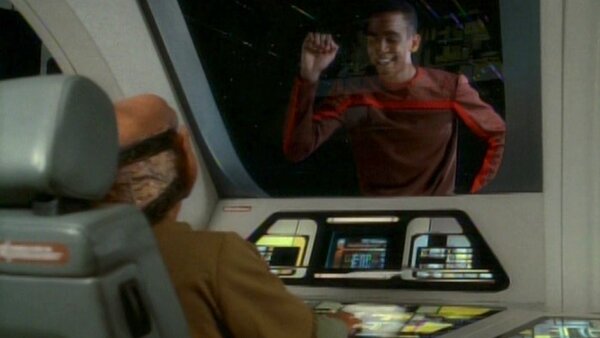
Numerous beta canon works have depicted the no-win scenario. Julia Ecklar's 1989 novel The Kobayashi Maru in particular goes into great detail as to just how one famous set of youngsters fared on the test. Pre-empting the now clichéd of 1999, the novel also revealed that cadets weren't meant to talk about Kobayashi Maru, so that the next victim… candidate couldn't plan ahead.
Captains and senior officers could talk about it all they liked. Stranded in a shuttle in Ecklar's novel, with rescue looking unlikely, Chekov, Scotty, Sulu, and Kirk start to tell their stories of the simulator room to pass the time. Kirk cheated, but only on his third attempt. Cadet Scott tried to engineer his way around with the deflector shields. Sulu refused to enter the Neutral Zone. Chekov went all in and self-destructed his ship. McCoy and Spock never took it.
In addition to the cheat code previously mentioned, the Kobayashi Maru also featured in the 1997 video game Star Trek: Starfleet Academy and got a nod in 2001's Star Trek: Away Team. The 2007 Star Trek Strange New Worlds VI short story Best Tools Available then told us of one of the few cadets to have beaten the scenario without cheating — Nog. In the most gloriously Ferengi manner possible, he simply asked the attacking Romulan commander — times had changed — to 'name her price' in gold-pressed latinum.
3. No-Win, The Janeway
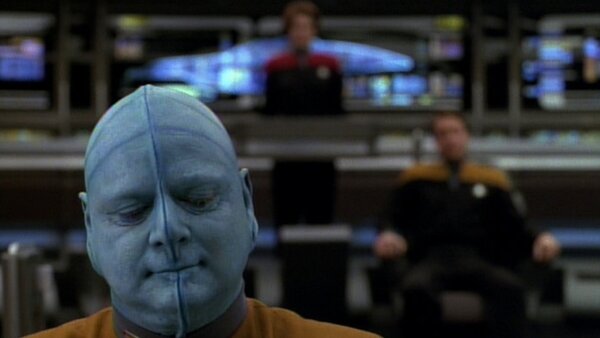
"If you can't solve a puzzle, cheat," said Captain Janeway, channelling Seven of Nine, herself probably channelling the Collective's knowledge of Kirk's creative solution to the Kobayashi Maru. Well, "cheating is often more efficient". The 'Think Tank' of Think Tank was Voyager's own no-win scenario until Janeway decided to stop playing by the rules of someone else's game.
In essence, the initial premise of Star Trek: Voyager was equally a Kobayashi Maru. Use the Caretaker's array to get home, endangering the Ocampa, or destroy it, stranding your crew halfway across the galaxy? Neither was an enviable choice. Neither was a win, per se. Only one would get you high marks when you got home. A little later, Tuvok would put the wayward Maquis through their paces in his holographic version of Kobayashi Maru in Learning Curve. In Latent Image, the Doctor would face a no-win medical dilemma.
The Autobiography of Kathryn Janeway, edited by Una McCormack, also revealed certain details about the Captain/Admiral's "turn on the Kobayashi Maru" as a cadet in her final year. Janeway apparently received praise from mentor Admiral Parvati Pandey for her "grace under fire" during the test. "I'd like to think I made her proud," Janeway concludes in the autobiography. '70,000 lightyears' says she did.
2. Kobayashis Colloquial
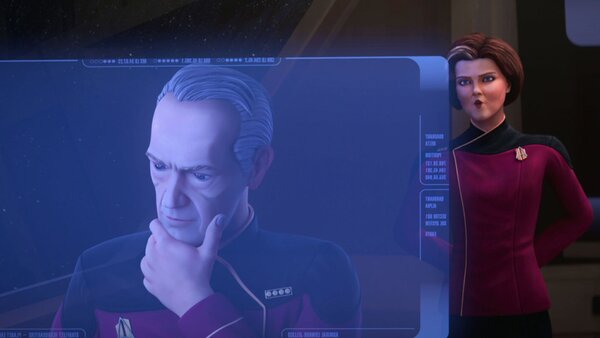
Since its inception in The Wrath of Khan, 'Kobayashi Maru' has come to be used as a byword in Star Trek for, quite naturally, any kind of apparently unwinnable situation. On the supposedly inescapable hellhole of Rura Penthe in Star Trek VI: The Undiscovered Country, McCoy told Kirk, "One day, one night, Kobayashi Maru". Stuck outside the Romulan Neutral Zone in Star Trek: Prodigy's Masquerade, Admiral Janeway noted to Admiral Jellico, "We're facing our own Kobayashi Maru".
More than just terminology, several episodes have, by now, used the notorious test in the title. Prodigy had Kobayashi, Star Trek: Discovery had Kobayashi Maru, and Star Trek: Picard had No Win Scenario. Cadets must have had their own choice set of words about the exercise, all the way up to at least the end of the 32nd century (with a gap), it seems. By 2401, Admiral Jean-Luc Picard, Chancellor of Starfleet Academy, was also considering an unspecified update of the Kobayashi Maru.
For better and for much, much worse, 'Kobayashi Maru' as phrase has also crossed the boundaries of reality to enter common journalistic, political, and even academic parlance. 'Kobayashi Maru moments' and 'problems' abound. Or there's always the title of a 2011 article in IEEE Security & Privacy: "Embracing the Kobayashi Maru: Why You Should Teach Your Students to Cheat".
1. Paradox Of Youth
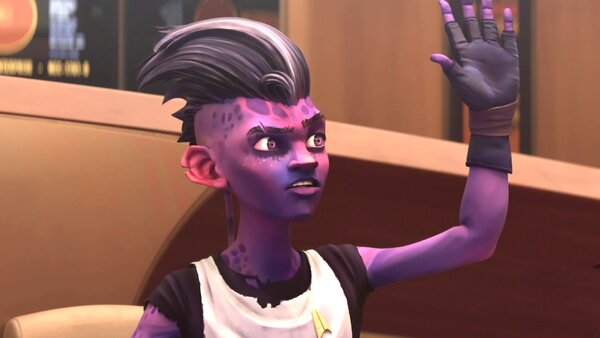
Kobayashi, the season one episode of Star Trek: Prodigy, began with a basic premise, as writer/executive producer Aaron Waltke told Polygon in 2022:
[We needed to] get Dal to realise that as much as he fantasises about being in the Captain's seat and ready for leadership, that maybe he still has to learn a thing or two.
This led to the question: "Well, what is the greatest leadership test in all of Star Trek?" The answer saw Waltke scouring through episodes and archives to find the precise recordings needed for Dal's holographic "dream team". At one stage, Worf was due to appear in the simulation but had to be cut for the sake of "streamlining". Gates McFadden notably returned as Doctor Crusher, however, assisted by her Star Trek colleagues in a fine tribute.
Were it not for putting his feet up, Dal R'El — not yet a cadet — might well have beaten the unbeatable without resorting to reprogramming. Perhaps we shouldn't be surprised. Often the youngest stars, like that one at the core of the ship, shine brightly in the most unexpected places. It's not all thinking outside the actual box. It's the 99% persistence of perspiration. Dal still lost, even with all the help. In the end, the no-win scenario was always about finding the value of failure.