Star Trek: Discovery 5 Ups & 3 Downs From 'Context Is For Kings'
Can a horror-themed Star Trek really keep going?

We may be a little late with this one, but it'd be criminal not to talk about Sunday night's episode of Star Trek: Discovery, 'Context is for Kings'.
The episode, set some time after Burnham's court martial at the end of the second episode, really upped the stakes, providing an accurate representation of what we can expect from the series going forward and, more importantly, a brilliant hour of television in itself.
It was a marked improvement over Discovery's pilot, and while the show does (admittedly) have a long way to go before it can lay claim to being among the very best Trek shows out there, the signs we've seen so far have been encouraging. It very much feels as though the series is carving out its own identity within the wider Trek canon, crafting a story that feels both salient and even necessary in regards not just to Roddenberry's world itself, but within the milieu of 2017 too.
A few niggling issues aside, Discovery's latest episode feels like a breath of fresh air. Occupying something of a tonal middle ground between the Abrams reboot of 2009 and the original, non-Kelvin timeline, the series has taken to the franchise not in an attempt to rekindle nostalgia (although it does come into play), but to reappraise its founding tenets in a period that feels distinctly un-Trek like.
It's inevitable that it won't please everyone but - as far as Trek goes - Discovery is right up there with the very best.
Ups...
5. Burnham

Although Sonequa Martin-Green's Michael Burnham didn't endear herself to everyone in those first two episodes, the character came into her own in Context is for Kings.
Martin-Green did a tremendous job of conveying the character's guilt for what happened in the Battle of the Binary Stars this time around, with the episode taking the time to flesh out and explore the character's feelings in the aftermath of the event.
Her interaction with Saru was particularly brilliant, and it's clear that the death of Captain Georgiou will weigh heavily on the first officer throughout the series, especially now she's faced with the task of serving under the less than perfect Captain Lorca.
Burnham has a long way to go before she can rival Ryker and Spock for a spot on the series' best and brightest first officers, but what we've seen so far has made for encouraging viewing. She's certainly living up to the reputation of being the smartest officer in Starfleet, and while it's unlikely we'll get to see a typical Bridge dynamic on the Discovery, Burnham has proven that she's a protagonist worth getting behind.
4. Cadet Sylvia Tilly

Mary Wiseman's Sylvia Tilly was something of a surprise for Discovery's third episode, being introduced as Burnham's roommate before accompanying the mutineer and the Discovery's chief of security on a mission to board the out of commission USS Glenn.
She also turned out to be one of its biggest highlights, with Wiseman conveying a convincing arc as Tilly confided in Burnham about her long-term aspirations to be a Starfleet captain. Her role on the Glenn was equally noteworthy, as the character took the lead in confronting an isolated Klingon before ensuring a speedy exit from the ship itself.
The character was all about overcoming expectations, so it'll be interesting to see how her relationship with Burnham evolves in the weeks ahead. If there's a chance she could snatch the captaincy from Lorca by the series' end, then we'll be very pleased indeed.
3. Captain Lorca

Jason Isaacs might just be the most terrifying Starfleet Captain we've ever, ever seen (and that goes for Ed Harris' character from Into Darkness too).
In Discovery's case that might, however, be a good thing. Ambiguity is the name of the game after all, and Captain Lorca fits the bill and then some. An ex-military man with a distinct affinity for fortune cookies, this is a Captain unlike any other, determined as he is deceitful.
It's unclear as to whether he fits more into the anti-hero or anti-villain bracket at this current moment, but - in any case - he's a compelling character to watch onscreen, lending the captaincy of the Discovery with an edge no other Trek show has really had before.
That's fascinating in and of itself, and as the purpose of the Discovery's mission begins to come into focus, one can only hope that Lorca - as messed up as he is - continues to take centre stage.
2. The Atmosphere

Although Discovery's tone isn't going to be to everyone's liking, what with all those horror elements taking centre stage in its third episode, it feels like a necessary shift for Trek media to undertake. This isn't the Original Series, after all, and a journey must be taken before we get to the Enterprise's five year mission.
The pilot alluded to the themes that would permeate Discovery going forward, but CIFK reiterated them with lethal force, depicting the aftermath of an experiment gone wrong with frightening detail. Corpses are mangled and distorted, blood paints the wall and, to top things off, we also had to deal with a slug-like cat... thing; something that would - ostensibly - feel more at home in a John Carpenter film than the latest Trek TV show.
Then there's the atmosphere that pervades the Discovery itself. It feels like a stark contrast to the name of the vessel, with Lorca's machinations providing a palpable sense of dread across the ship and engendering the series with a tension that would, on the surface at least, seemingly contradict the sense of wonder and yes, discovery that permeated the Enterprise's halls all those years ago.
It feels less like we're being pulled along in an adventure in many respects, and more that we're trapped with Burnham in a distorted version of Kirk's vessel. It's a house of horrors waiting to be unleashed, and that - more than anything else - is the hook the series needed most.
1. A Mystery Established
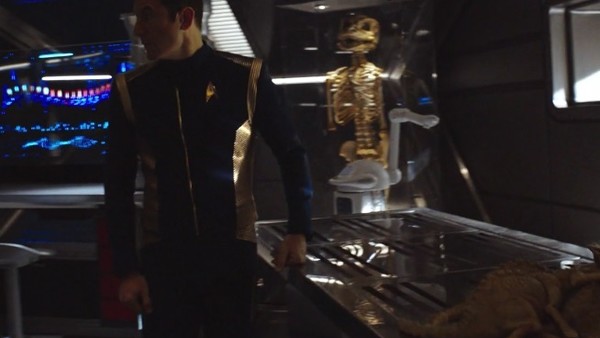
On top of the episode's ability to firmly define the series as being a unique entity in the wider Trek canon, it also did a fine job of establishing a mystery for viewers to unravel.
Lorca's speech to Burnham regarding the potential for the Discovery's weapons research to affect a positive change in the years to come was an interesting one, certainly in regards to the fact that most technological leaps in history have occurred during a period of great crisis.
However, it's clear that there's a malicious edge to the Discovery's research, with the ending scene showing Lorca in the possession of one of the crazy critters that attacked Burnham et al. onboard the Glenn earlier in the episode.
On top of that, the room featured at the end of the episode also showed off some nasty looking skeletons (could that one in the cabinet be a Gorn?), illustrating that - although the Federation might like to claim it comes in peace - war may have just illustrated that its tenets are more malleable than previously suggested.
Downs...
3. The Air Vent Sequence
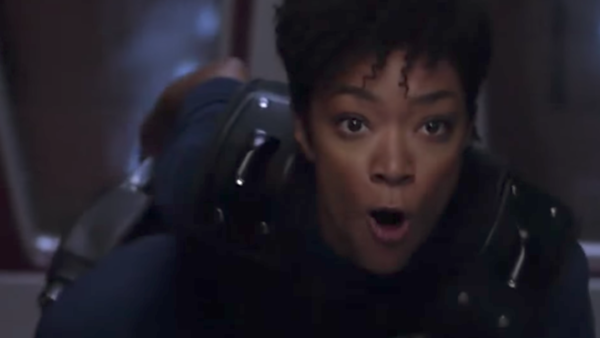
Despite the fact that Burnham came into her own during Context is for Kings, the scene that was meant to illustrate her combat prowess didn't feel as tense as the build up had implied.
Certainly, the moment the Discovery's crew boarded the Glenn oozed atmosphere, with Tilly, Burnham and the rest all taking the time to witness the horror of an experiment gone awry, but the actual moment the beastie started chasing our heroes didn't seem to convey the same threat.
This wasn't a matter of special effects here either; the creature certainly looked convincing, but the way Burnham and her cohorts interacted with it didn't seem to suggest the same threat. That vent sequence felt extremely derivative from other sci-fi horror classics and, while it was an appropriate way of showing Burnham's tactical nous, it almost seemed to negate the build up we just saw.
Not that it detracts heavily from the episode itself, but it would've been nice if the payoff felt as threatening as the build up did beforehand.
2. Lack Of Exploration Between Certain Characters
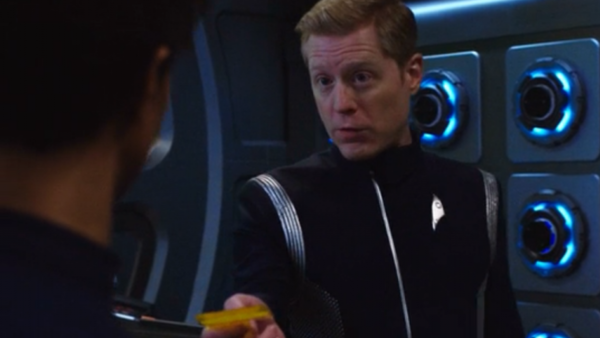
Stamets (played by Anthony Rapp) is the Discovery's chief Science Officer, and the little that we saw of him worked out as being some of the episode's best parts.
He's snarky, stressed, and not entirely onboard with the idea of his peacetime research being appropriated by a military outfit (Lorca in particular is singled out during this exchange). He also has a relationship of sorts with his counterpart on the Glenn, with the pair having conducted their research together before Starfleet shipped them off to two separate vessels.
When we find out that the Glenn's crew are dead, it's certainly a sad moment. We can see that it's troubled Stamets but, however well Rapp conveys that grief, the relation he had with his colleague on the Glenn felt almost brushed over.
Granted, there's only so much you can do within the space of an hour, but that final act would've felt far more dramatic if the episode had taken the time to explore the pair beforehand.
1. The Tonal Flux Will Upset Certain Viewers

While this isn't Discovery's fault per se, it is true that it represents something of a departure for the franchise as a whole.
While those opening two episodes certainly felt like Trek, the series' third episode really turned up the horror elements and while yes, Star Trek has never been alien to the concept of sci-fi horror, it's placed front and centre in Discovery, twisting the archetypal 'bridge dynamic' that has, for the most part, typified each and every entry in the franchise.
Lorca isn't a Kirk, or a Picard, or even a Sisko. He's a schemer, a military man first and that, while undoubtedly a fascinating and important aspect of the series, isn't going to sit well with everyone.
Discovery certainly sounds as though it's going to be one of the most polarising Trek things since the reboot (and that's saying something). In that respect (and others), it's boldly going where no other series has gone before. Whether the Trek faithful stick around is another question entirely, but - for this Trekkie at least - it's amazing to see play out.
It's Trek, but not as you know it. Roll on next Sunday.
What do you think of Discovery? Are you sticking around for the next episode? Let us know in the comments below!